The Ant and the Grasshopper: Work, Play, and the Seasons of Life
The Ant and the Grasshopper: Work, Play, and the Seasons of Life: The garden existed in a state of abundant chaos. It was a wild place, neither fully Life
This is one of the oldest and best-loved fables in the world. It comes to us from the Greek storyteller Aesop in the sixth century before Christ, was set down in Greek prose in the Augustana recension of the Aesopica around the second century after Christ, and was given a graceful Greek choliambic verse-form by Babrius as Fable 140. From there it travelled into the medieval West through the Romulus prose-collections (where it was titled De Cicada et Formica), the verse-Aesop of Walter of England, and the Ysopet of Marie de France, into the first printed English Aesop by William Caxton in 1484, and into Jean de La Fontaine’s celebrated French Fables in 1668 — where, as La Cigale et la Fourmi, it became the very first poem of his entire collection, the door through which the whole Aesopic tradition stepped into the modern French literary imagination.
One small note before we begin. In the original Greek, the singing insect is not a grasshopper at all — it is a cicada, the loud-singing summer insect of the Mediterranean (τέττιξ — tettix). The shift from cicada to grasshopper happened in the medieval north of Europe, where cicadas are rare and the more familiar grasshopper took the singer’s place in the schoolroom translation. The Latin tradition kept the cicada (cicada); the English tradition adopted the grasshopper. Both insects are doing the same thing in the same fable, and the lesson is exactly the same.
This is its story.
The Summer Garden
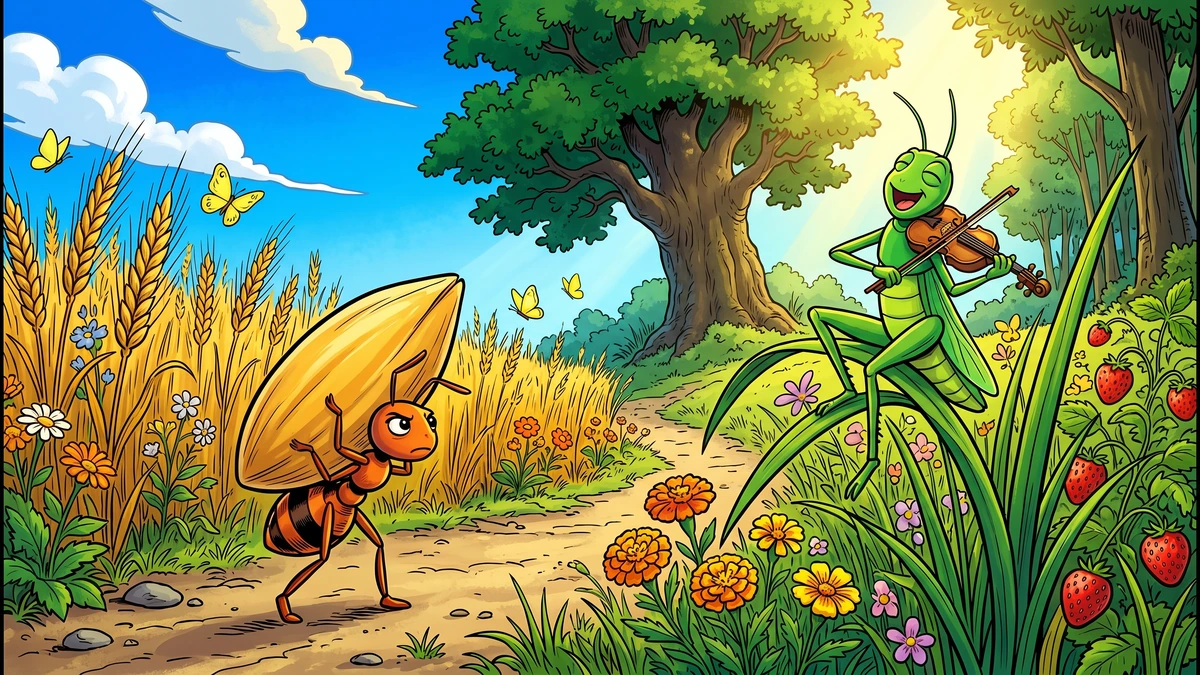
It was high summer in a wide green garden at the edge of a forest, and the sun was warm and the air was sweet. Tall stalks of wheat swayed in the soft wind. Marigolds bloomed in great orange-and-yellow clusters. Strawberries hung red and ripe under their broad green leaves. The hum of bees rose from the lavender, and butterflies — yellow, white, and blue — drifted from flower to flower in the golden afternoon.
It was the kind of summer that seems, while it lasts, as if it will never end.
And in this garden lived two creatures — small ones, both — who held between them the whole great difference between two ways of being alive in the world.
The Ant
The first was an ant. She was small, as ants are small, the size of a grain of rice, with a sleek polished black body and a determined dark face and six tireless legs. She lived in a vast underground colony beneath the roots of an old oak tree at the heart of the garden, and she had a name, in our story, although ants do not really have names — let us call her simply the Ant.
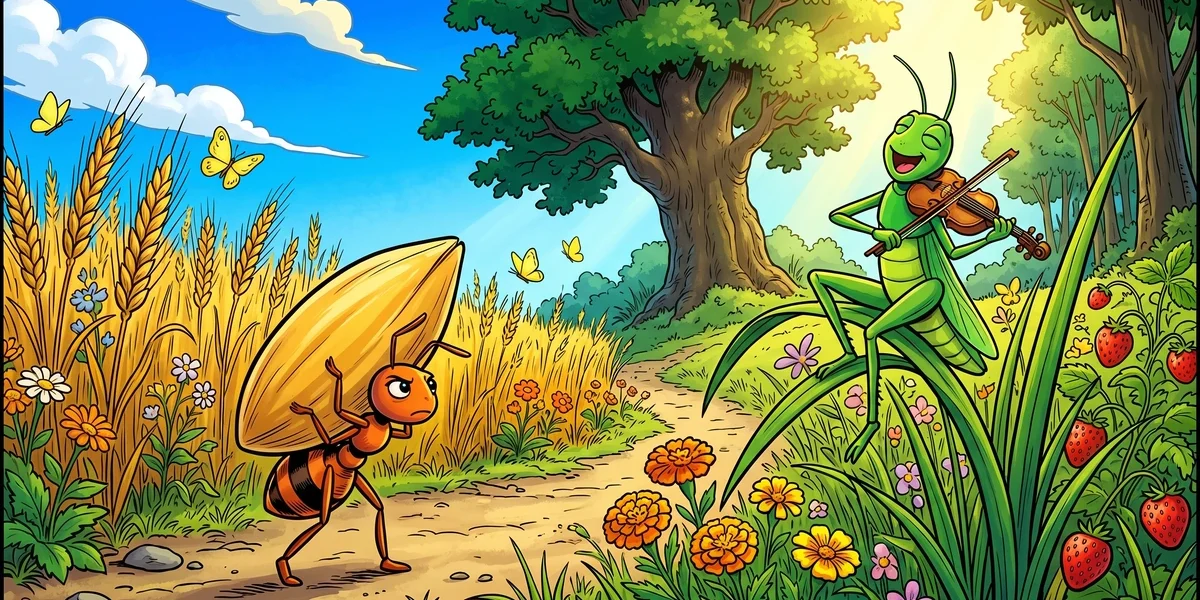
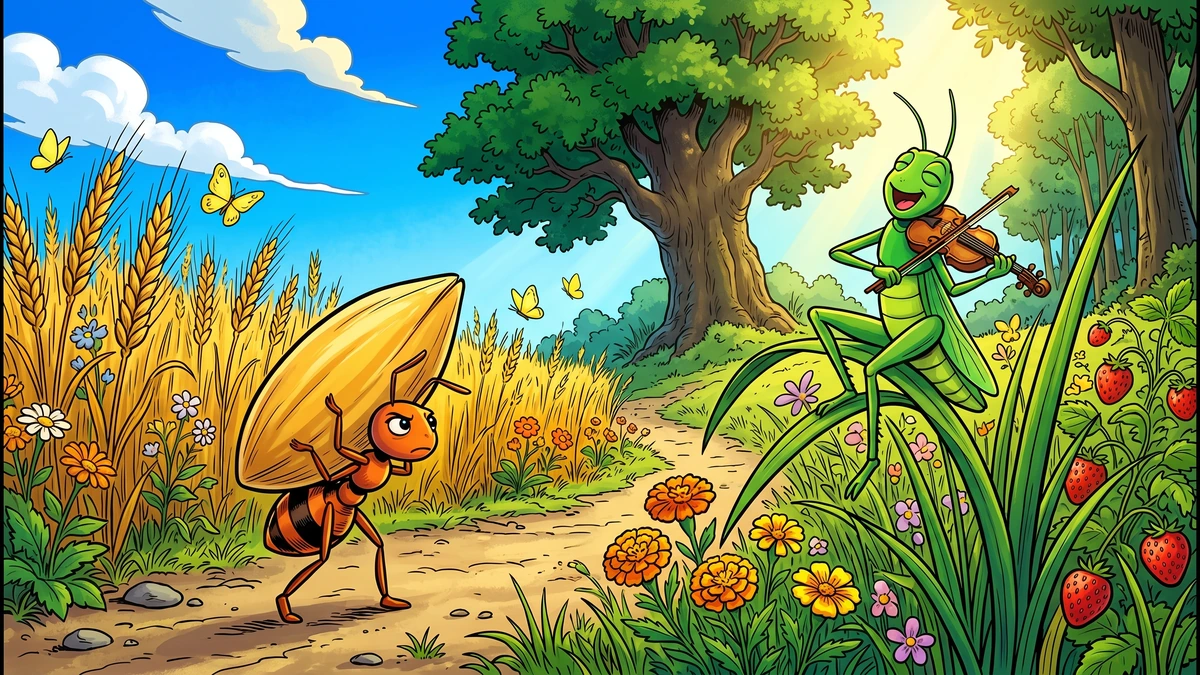
The Ant worked. From the first pale light of dawn she climbed out of her tunnel and began to gather, and she did not stop gathering until the last red of the sun had drained out of the western sky. She climbed tall stalks of wheat to reach a single golden grain, and then she carried that grain — a thing many times her own size and many times her own weight — back along the long path to the colony, and she set it carefully down in the storehouse, and she went back for another.
From dawn until dusk. Day after day after day.
The other creatures of the garden, those who saw her trudging back and forth in the heat, sometimes laughed at her. “What is the hurry, little ant?” they asked. “It is summer. There is food everywhere. Why do you carry so much, so fast, so far?” And the ant, without stopping her small black legs, would answer in her small clear voice: “Because winter is coming.”
“Winter?” they would say. “But it is summer.”
“Yes,” said the ant, and walked on.
The Grasshopper
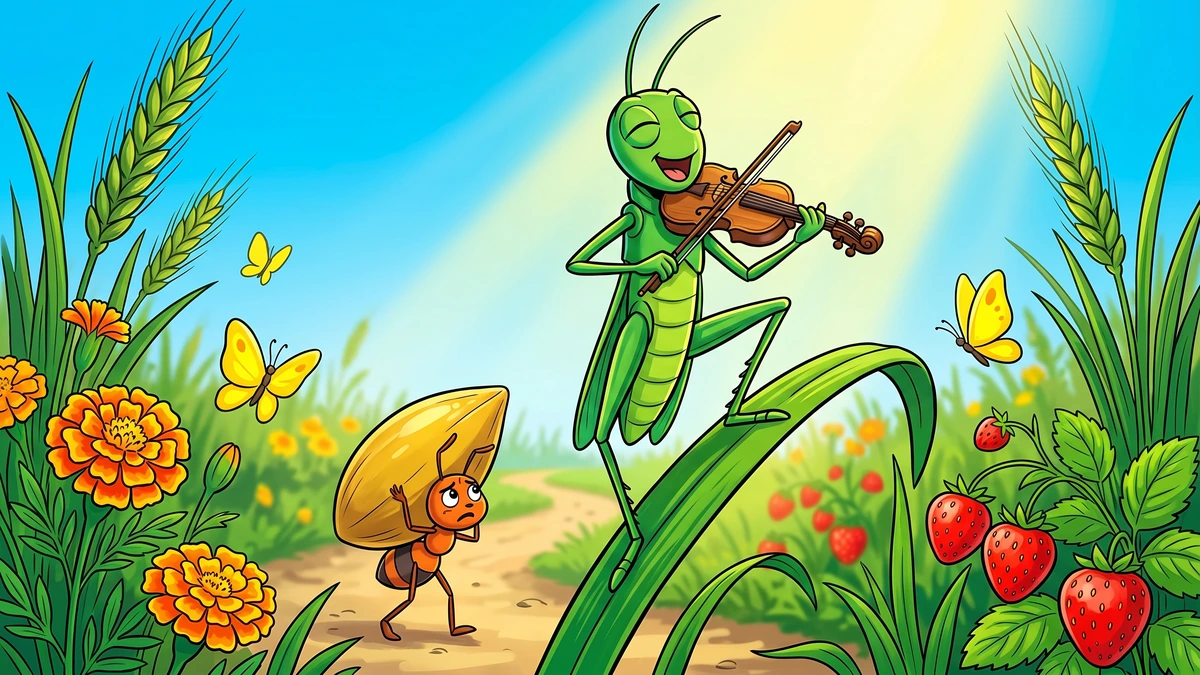
The second creature was a grasshopper. He was bright emerald-green, slender and elegant, with long springy legs that could carry him in a single leap from one end of a flower-bed to the other. He had bright black eyes and a pair of fine wings folded along his back, and on his front legs — a small wonder, this — he held a tiny fiddle, and he played it.
For the grasshopper, the summer garden was a great open-air concert hall. From morning to evening he sat on the tall green blades of grass and on the broad warm leaves and on the heads of the marigolds, and he played, and he sang. His song was bright and gay and lifted on the warm air, and the bees and the butterflies and even some of the smaller birds would pause to listen.
The grasshopper had no storehouse. He had no nest. He had no winter coat. He had only his fiddle and his song and the green blades of summer grass beneath him, and to him, that was enough.
One bright afternoon — one of the brightest, hottest, most golden afternoons of all that summer — the grasshopper looked up from his fiddle and saw the small black shape of the ant trudging past below him along the dusty path, bowed nearly double under the weight of a seed three times her size.
“Ant!” he called down. “Ant! Where are you going so fast on such a beautiful day?”
The ant looked up at him through her small dark eyes, set down her seed for one breath, and said: “I am gathering food for the winter.”
The grasshopper laughed — a clear bright laugh that rang across the garden. “Winter?” he said. “But it is summer! Look at the marigolds. Look at the strawberries. There is more food in this garden than ten thousand ants could eat in ten thousand summers. Sit with me on this leaf. Listen. Sing with me. Why do you work when you could play?”
The ant looked at the grasshopper for a long moment. She was not unkind. She knew the song was beautiful. She liked the grasshopper. But she shook her small black head.
“You should be gathering too,” she said softly. “Winter will come. It always comes.”
And the grasshopper laughed again, and waved a green leg at her, and lifted his fiddle, and played her on her way down the dusty path.
The ant picked up her seed and walked on.
The Long Bright Days
The summer wore on, and on, and on.
Each day the ant climbed and gathered and carried and stored, and the great underground storehouse beneath the roots of the oak tree grew fuller and fuller — golden wheat-grains, dried red berries, little husks of barley, bright yellow seeds, dark brown nuts, even, in one corner, a careful pyramid of poppy-seeds the size of dust.
And each day the grasshopper sat on his green stalk in the sunlight and played and sang and laughed, and his song grew finer and his wings shone brighter, and he was, in his way, the most beautiful creature in all the garden.
Sometimes, in the cool of the evening, the ant would pass by the grasshopper on her way home and the grasshopper would call out to her: “Sing with me, little ant! It is the most golden evening of the whole world!”
And the ant would only smile her small ant-smile, and walk on, and disappear down her tunnel.
The First Cold Wind
And then, very quietly, summer ended.
It did not end with a great storm or a thunderclap. It ended one morning with a small cold wind. The grasshopper woke on his green leaf and felt the wind, and he shivered, and he looked around — and the green leaf was no longer green. It had turned a soft yellow at the edges. The marigolds had bowed their heads. The strawberries were gone. The wheat-stalks were dry and brown, and the bees were not buzzing in the lavender.
The grasshopper played a few small uncertain notes on his fiddle. The notes drifted out into a thin grey air that was not the air of summer.
And then, one day, the snow began to fall.
The Hungry Grasshopper
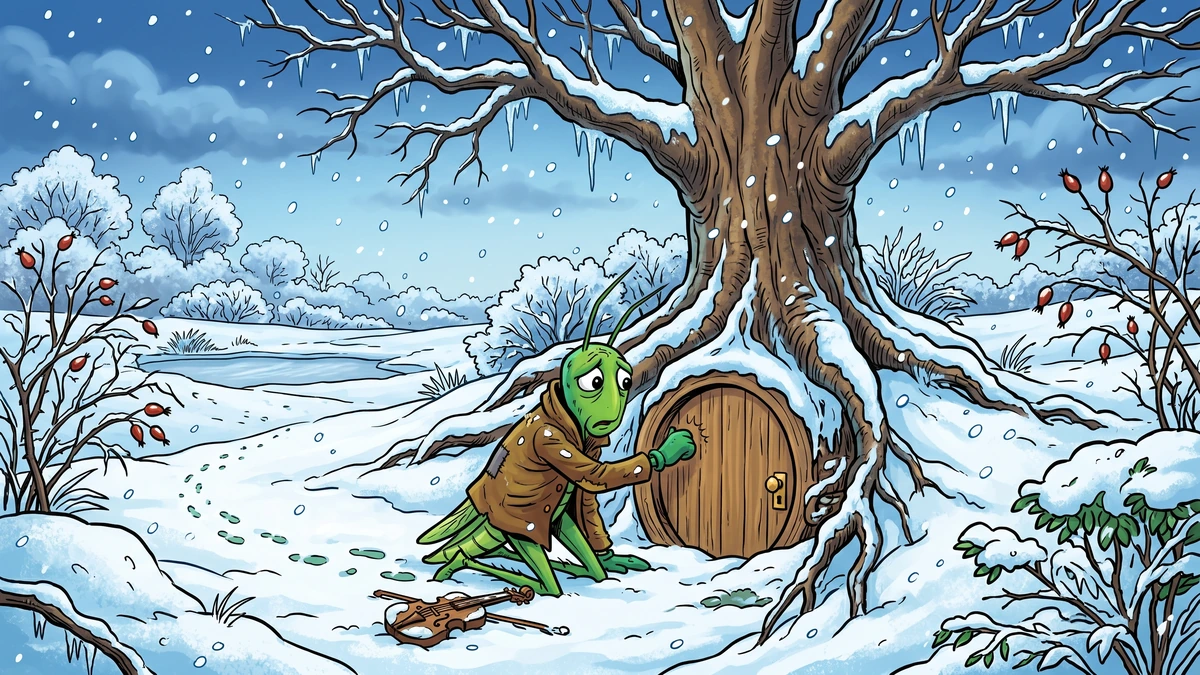
The snow came down in soft white flakes that piled and piled until the great oak tree stood bare and frost-laden over a white silent garden. The marigolds were gone. The wheat was gone. The strawberries were a memory of summer that even the grasshopper could only half-remember.
And the grasshopper, who had never in his bright green life felt cold before, was very cold indeed.
His fiddle had cracked in the frost. His wings were stiff. His green coat was thin and worn. He had not eaten in three days, and his thin green legs trembled under him as he hopped slowly, slowly, painfully, across the frozen white garden, looking — and not finding — anything at all to eat.
And then, at the foot of the great bare oak tree, he saw a small wooden door — the door of the ant’s storehouse — and through the small chink at the bottom of the door, he saw a thin warm line of golden lamplight.
And he saw, suddenly, what he should have seen all summer: the ant had been right.
The Knock at the Door
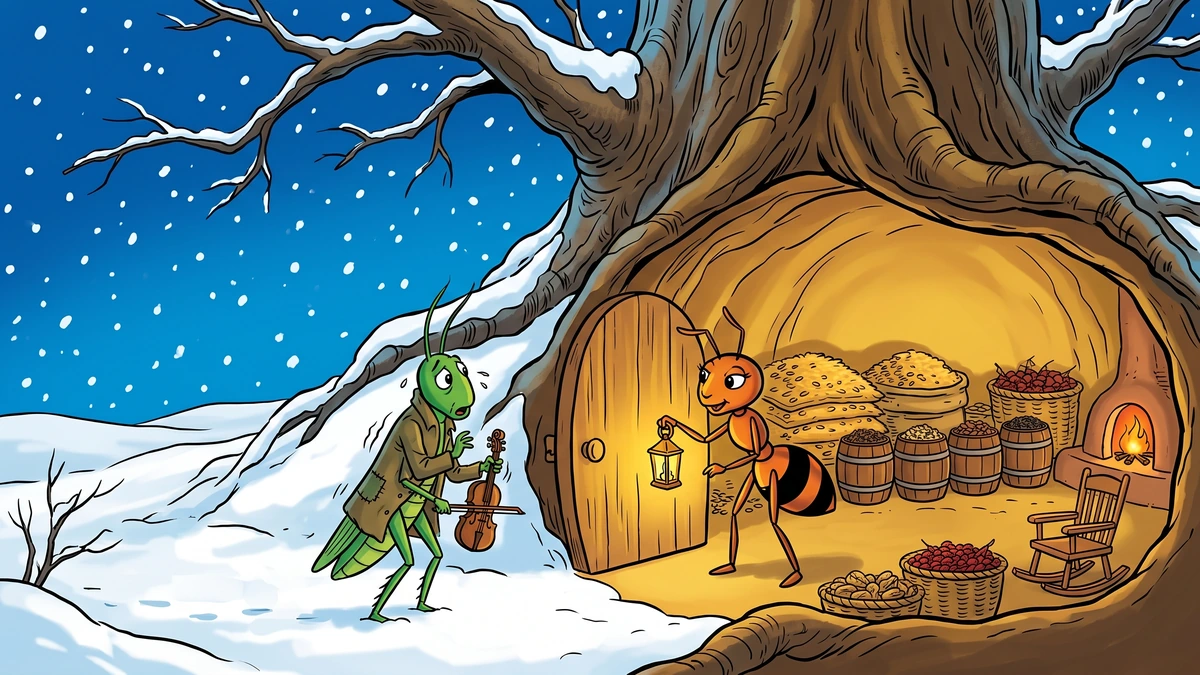
The grasshopper crept up to the small wooden door and knocked on it with a thin, trembling green hand. He waited. He heard, from inside, the soft sound of footsteps — small, ant-sized footsteps — and then the door cracked open, and the warm golden lamplight spilled out into the cold blue snow, and the ant was standing in the doorway, and behind her, glowing in the lamplight, were piles and piles of golden grain and dried red berries and small barrels of seeds.
The ant looked at the grasshopper. The grasshopper looked at the ant.
“Please,” said the grasshopper. “Please. I have not eaten in three days. I am cold. I am hungry. May I come in?”
The ant looked at him for a long moment, not unkindly, but firmly. Her small dark face was thoughtful.
“What were you doing,” she asked, “all through the summer, while I was working?”
The grasshopper looked down at his thin green legs and then up at the ant.
“I was singing,” he said.
And the ant looked at him, and the ant said the words that two and a half thousand years later are still the most quoted words of any fable in the French language — the words that close La Fontaine’s La Cigale et la Fourmi:
Vous chantiez? j’en suis fort aise:
Eh bien! dansez maintenant.
“You were singing? Charmed, I am sure: very well now, dance!”
What Happens Next
Here, the fable in its strictest classical form ends. The Greek prose Aesopica leaves the grasshopper at the door. Babrius leaves him at the door. La Fontaine, the great unsentimental French moralist, leaves him at the door. The lesson is the lesson: summer does not last forever, and the time to gather is the time you do not yet need to gather.
But many gentler English schoolroom Aesops — Croxall, Jacobs, the kindly Victorian children’s editions — soften the ending. In their versions, the ant looks at the trembling grasshopper for one more moment, and then she opens the door wider, and she lets him in, and she gives him grain, and she gives him a place by her warm hearth, and she tells him: “Stay until the spring. But next summer, when the sun is warm and the marigolds bloom, you must remember to gather as well as to sing.”
And in those gentler tellings, the grasshopper bows his thin green head, and learns his lesson, and lives — and the next summer, in the long bright days, you can find him in the garden with a tiny fiddle in one hand and a single grain of wheat in the other, doing both at last.
Both endings are old, and both endings are true, and which ending you prefer says rather a lot about which kind of person you are.
The Moral
The Greek prose Aesopica preserves the moral as: ὁ μῦθος δηλοῖ ὅτι οὐ δεῖ τινα ἀμελεῖν ἐν παντὶ πράγματι, ἵνα μὴ λυπηθῇ καὶ κινδυνεύσῃ — ho mythos deloi hoti ou dei tina amelein en panti pragmati, hina me lypethe kai kindyneuse — “the fable shows that one must not be careless in any matter, lest one suffer and be in danger.”
La Fontaine, two thousand years later, ended his French verse with the line that is now perhaps the most famous closing line in all of French children’s poetry:
Vous chantiez? j’en suis fort aise:
Eh bien! dansez maintenant.
“You were singing? Charmed, I am sure: very well now, dance!”
The pithy modern English schoolroom form, descending through Croxall and Jacobs, runs:
It is best to prepare for the days of necessity.
Or, in its simplest children’s form: There is a time for work and a time for play.
Why This Story Has Lasted
It has lasted for two and a half thousand years because it tells, in the body of two small garden insects, the simplest and oldest truth there is about a human life: summer does not last forever. The bright days of strength and ease and laughter are not the whole of a year, and they are not the whole of a life, and a person who lives only in those days — who plays the fiddle in the sun and never thinks of the cold months ahead — will, sooner or later, find a closed door and a long winter.
The story is not unkind to the grasshopper. The fable does not call him bad. He is not wicked. He is merely young in a way that some people stay young their whole lives — full of song and full of summer, and unable to imagine the snow. The ant is not boastful. She does not gloat. She only points, very quietly, at what was true all along: the song was beautiful, the summer was beautiful, but the song does not feed you when the leaves come down.
This is one of the few fables that gives almost every culture a phrase. The French still say la cigale et la fourmi for any pair of an improvident dreamer and a prudent saver. The English schoolroom phrase “the ant and the grasshopper” carries the same meaning. In Hindi and other Indian languages, parallel idioms drawn from the local Pancatantra tradition convey the same lesson — the foresight of the ant and the carelessness of the singer.
And every September, in every part of the world where the leaves turn, when the air goes thin and cold and the first warning wind comes — there is, somewhere in the back of the human mind, a tiny green grasshopper standing at a small wooden door in the snow, knocking. We have all been him, a little. We have all, also, been the ant. And the fable, gently and without scolding, asks us each: which one are you being, this summer?
Two and a half thousand years after Aesop first told it on a Greek hillside, that question is as alive as it ever was — and the warm garden, and the singing grasshopper, and the patient little ant with her seed three times her size, are still walking, somewhere, through every long bright summer day we are given.
Frequently Asked Questions
What is the moral of The Ant and the Grasshopper?
What is different about a reflective retelling of The Ant and the Grasshopper?
Who wrote the original Ant and the Grasshopper?
What is the story of The Ant and the Grasshopper?
What deeper lesson can adults take from The Ant and the Grasshopper?
You May Also Like
 Aesop's Fables
Ages 6-8
Aesop's Fables
Ages 6-8
Mr Wont Give And Mr Wont Leave
Mr Wont Give And Mr Wont Leave: In a certain town there lived a clever old Brâhmaṇ, named Won’t-Give(Vidâmundan). He used to go out daily and to beg in all the
 Aesop's Fables
Ages 3-5
Aesop's Fables
Ages 3-5
The Gardeners Cunning Wife
The Gardeners Cunning Wife: In a certain village there lived with his wife a poor gardener who cultivated greens in a small patch in the backyard of his house.
 Aesop's Fables
Ages 3-5
Aesop's Fables
Ages 3-5
The Boy Who Cried Wolf: Loneliness and the Price of Deception
The Boy Who Cried Wolf: Loneliness and the Price of Deception: The village of Ashford clung to the edges of the Westwood Forest like a child reluctant to let