The Cat’s Judgement
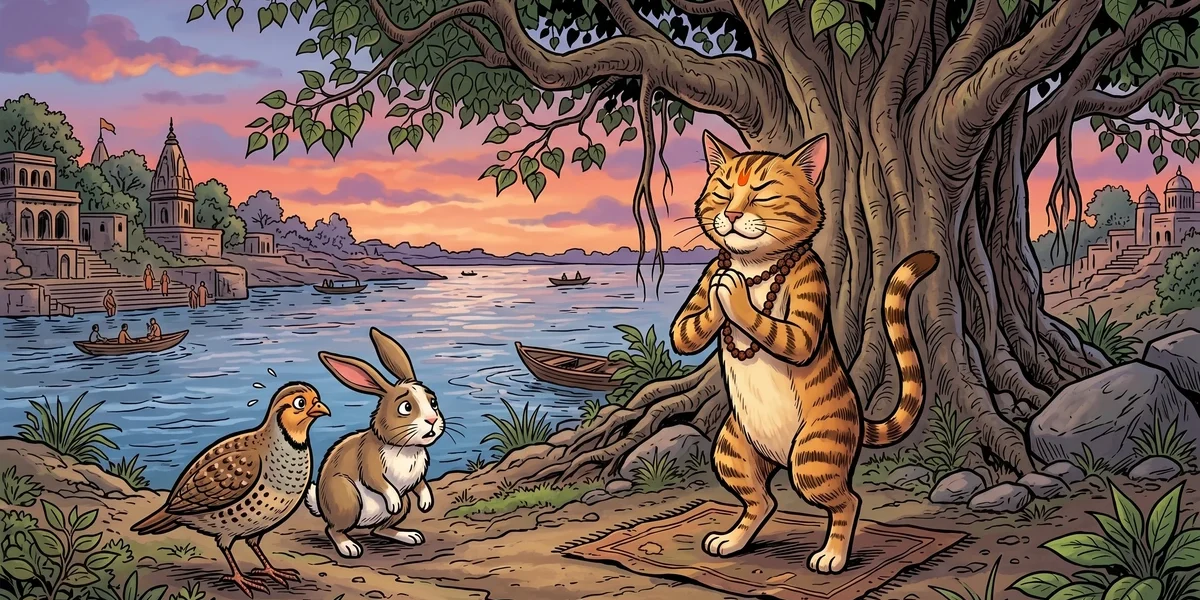
Two gullible rats trust a flattering cat's promises and pay the ultimate price for their foolish faith.
Origin & Canonical Placement
“The Cat’s Judgement” is a classic Panchatantra tale about the catastrophic consequences of seeking arbitration from a party whose interests are served by the dispute continuing rather than being resolved. The story belongs to Vishnu Sharma’s Pancatantra (c. 300 BCE–300 CE) and appears in the Hitopadesha and numerous regional Sanskrit and vernacular collections. It belongs to Book I: Mitra-bheda (“The Separation of Friends”), which explores how alliances dissolve and how third parties may exploit disputes between principals whose conflict distracts them from recognising the common threat a self-interested mediator represents.
“Vivadamanayoh shodhayati yo madhyastha sva-prayojanam, sa naiva nyayah.”
“He who extracts his own benefit from the dispute of two parties is no just arbitrator.”
— Sanskrit maxim, Panchatantra tradition
Beat I — Two Animals and a Disputed Cake
Two cats — in some versions a cat and a monkey, or two monkeys — found a large piece of bread or cake and immediately began quarrelling about how to divide it. Each claimed the larger share; neither trusted the other to measure fairly. The quarrel was genuine and the grievance on both sides equally sincere: both cats felt certain that if they allowed the other to divide the food, the division would favour the divider.
A monkey sitting nearby observed their quarrel with the patient alertness of a creature who has just identified an opportunity. He approached them with an air of calm authority and offered his services as an impartial weigher and divider. He had, he said, a pair of scales; he was known throughout the forest for his scrupulous fairness; and the solution to their problem was simple — they need only place their trust in him and he would ensure that each received exactly his due portion. The cats, too absorbed in their mutual suspicion to examine the monkey’s credentials carefully, agreed.
Beat II — The Arbitration and Its Outcome
The monkey placed the two pieces on his scales. One side was heavier. “This side is too heavy,” he said, with great seriousness, and broke off a piece from the heavier side, which he ate. He placed the pieces on the scales again. Now the other side was heavier. “This side is now too heavy,” he said, and broke off a piece from that side, which he ate. The pieces returned to the scales. The first side was now slightly heavier again. He broke off another piece and ate it.
The process continued through several iterations. Each correction required a bite; each bite was slightly larger than the imbalance it was correcting, so that the piece requiring correction was now smaller than the piece that had previously been corrected. The cats watched with mounting alarm as their food diminished with each arbitration round. By the time the two pieces were genuinely equal — equal in the sense that what remained of each was identical — what remained was too small to be worth dividing. The monkey declared the arbitration complete and ate both remaining pieces as his fee. The cats went home with nothing.
Beat III — The Analysis: The Self-Interested Arbitrator
The Panchatantra’s analysis of this tale identifies the structural feature that makes the monkey’s arbitration a trap from the first moment: the arbitrator’s reward is the discrepancy, not the resolution. In a genuine arbitration, the arbitrator is compensated for the resolution — his interests are served when the dispute ends. In the monkey’s arrangement, he is compensated by the correction — his interests are served by each round of imbalance, which gives him another opportunity to eat. This means the monkey has a powerful structural incentive to ensure that each correction produces a new imbalance requiring a further correction, indefinitely.
The cats’ error was not in distrusting each other — their mutual suspicion was rational, given what each knew about the other’s self-interest. Their error was in failing to apply the same scrutiny to the monkey that they were applying to each other. They examined each other’s interests carefully and concluded, correctly, that neither could be trusted to divide. They failed to examine the monkey’s interests and concluded, incorrectly, that he could be trusted. The monkey’s air of calm authority and his claim of a reputation for fairness substituted for actual verification of his interests.
Kautilya’s Arthashastra discusses the selection of arbitrators in commercial and interstate disputes at some length, identifying several criteria for disqualifying a candidate: financial interest in the outcome, existing relationship with one party, or personal gain derivable from the continuation of the dispute. These disqualifying criteria exist precisely to identify the monkey — the arbitrator whose reward structure incentivises prolonging rather than resolving the dispute.
Beat IV — Moral Dimension & Enduring Relevance
The tale’s moral operates at two levels. For parties in a dispute who are seeking a mediator: examine the mediator’s interests as carefully as you examine your adversary’s. An arbitrator whose compensation is tied to the dispute’s continuation is not a solution to the dispute but an additional party with a stake in it. The genuine arbitrator’s interests are served by resolution; the predatory arbitrator’s interests are served by continuation and the discrepancies that continuation produces.
For the parties specifically: the cats’ mutual distrust, while rational in isolation, was the direct cause of their vulnerability to the monkey’s scheme. If they had simply agreed — by any imperfect method — to divide the cake themselves, each might have received slightly less than half. Instead they received nothing. The Panchatantra’s implicit counsel here is that an imperfect agreement between genuine parties is preferable to a perfect-seeming process managed by a predator. The search for a perfectly neutral arbitrator, when no genuinely neutral arbitrator exists, may produce outcomes worse than either party could produce through direct negotiation, however imperfect.
In contemporary terms, the story speaks to any dispute resolution process in which intermediaries are compensated per transaction or per round of negotiation rather than per resolution. Legal systems that bill by the hour, consulting arrangements that are renewed rather than concluded, advisory relationships whose value to the advisor disappears when the client resolves their problem — all create versions of the monkey’s incentive structure. The cats’ wisdom lies in recognising, in retrospect, that the question “who profits from our dispute continuing?” should have been asked before the first piece of cake was placed on the scales.
Moral: Before accepting an arbitrator, ask whose interests are served by the dispute continuing; the mediator whose reward is the discrepancy will always find one.
Why This Story Has Lasted 2,000 Years
The monkey and his scales have remained one of the Panchatantra’s most frequently cited images because they describe, with great economy and humour, one of the most enduring features of social and commercial life: the self-interested mediator who profits from the dispute he claims to be resolving. The story crossed from Sanskrit into Arabic (Kalila wa Dimna), Persian, and European literary traditions, where versions of it appear across multiple national literatures — each culture recognising in the monkey a figure it has encountered in its own judicial, commercial, and political life. The image of the scales tipping back and forth while the arbitrator eats the discrepancy is among the most compact and memorable pictures of structural conflict of interest in world narrative literature.
About the Panchatantra
The Panchatantra (“Five Treatises”) was composed in Sanskrit by the scholar Vishnu Sharma around 300 BCE–300 CE as a niti-shastra — a guide to wise conduct and statecraft — framed as animal fables for the instruction of young princes. Its five books cover the dissolution of allies, the winning of allies, war and peace, the dangers of naivety, and the hazards of rashness. The text spread westward through Pahlavi and Arabic translations to become the most widely translated secular book of the ancient world after the Bible.
Frequently Asked Questions
**Q: Why is this story important?**
You May Also Like
 Panchatantra Stories
Ages 3-5
Panchatantra Stories
Ages 3-5
Tale of The Three Fish
Three fish brothers face a fisherman’s net: the wisest escapes by foresight, but the dullest perishes by delay.
 Panchatantra Stories
Ages 6-8
Panchatantra Stories
Ages 6-8
The Elephants and the Hares
The Elephants and the Hares: The weak must make use of all tactics to survive.” Deep in the jungle, there lived a big group of elephants. The elephants lived
 Panchatantra Stories
Ages 9-12
Panchatantra Stories
Ages 9-12
Foolish Lion Clever Rabbit
The Panchatantra's most famous Book I fable. A lazy, tyrannical lion named Bhasuraka devours the forest until a small clever hare named Lambakarna walks him to an old stone well — and lets the lion meet the one opponent pride cannot defeat: his own reflection. Full origin, Sanskrit names, age-agnostic retelling, and lessons for today.