Foolish Lion Clever Rabbit
The Panchatantra's most famous Book I fable. A lazy, tyrannical lion named Bhasuraka devours the forest until a small clever hare named Lambakarna walks him to an old stone well — and lets the lion meet the one opponent pride cannot defeat: his own reflection. Full origin, Sanskrit names, age-agnostic retelling, and lessons for today.

A rabbit no bigger than a man’s foot. A lion who could fell a buffalo with one swipe of his paw. Between them — a forest full of frightened animals, a long, slow walk in the noonday heat, and an old stone well with a secret at the bottom of it. This is one of the world’s oldest “story about a story” — a tale told inside another tale, used by a wise jackal in the Panchatantra to explain how a smaller, weaker party can sometimes neutralize a stronger one without ever raising a paw.
It is the kind of story that sounds simple when you first hear it, and then keeps unfolding for the rest of your life. Children remember the moment the lion looks down the well and roars at his own reflection. Adults remember something else — that the lion was not really defeated by the rabbit at all. He was defeated by the version of himself he could not see clearly.
Where this story comes from
“The Foolish Lion and the Clever Rabbit” belongs to Book I of the Panchatantra — Mitra-Bheda, often translated as “The Loss of Friends” or “The Separation of Allies.” The Panchatantra is a collection of interlinked beast fables traditionally attributed to the sage Vishnu Sharma, who composed them around 200 BCE to teach three young princes the practical wisdom of statecraft, friendship, and survival.
In the original Sanskrit, the lion is named Bhasuraka — “the radiant one” — and the hare is Lambakarna, which simply means “long-ears.” The story sits inside the long opening tale of Book I, in which the jackal Damanaka uses it as an exemplary fable to explain how clever counsel can overcome brute force. Modern retellings, including this one, often call the lion King Sharpfang and the hare Speedy, but the bones of the story are unchanged from the version a Sanskrit-speaking grandmother might have told her grandchildren two thousand years ago.
It is one of the very first Panchatantra stories taught to children, because its moral is so clean: thinking can defeat strength, if the strong one is proud enough to stop thinking.
The story
Act I — The reign of King Sharpfang
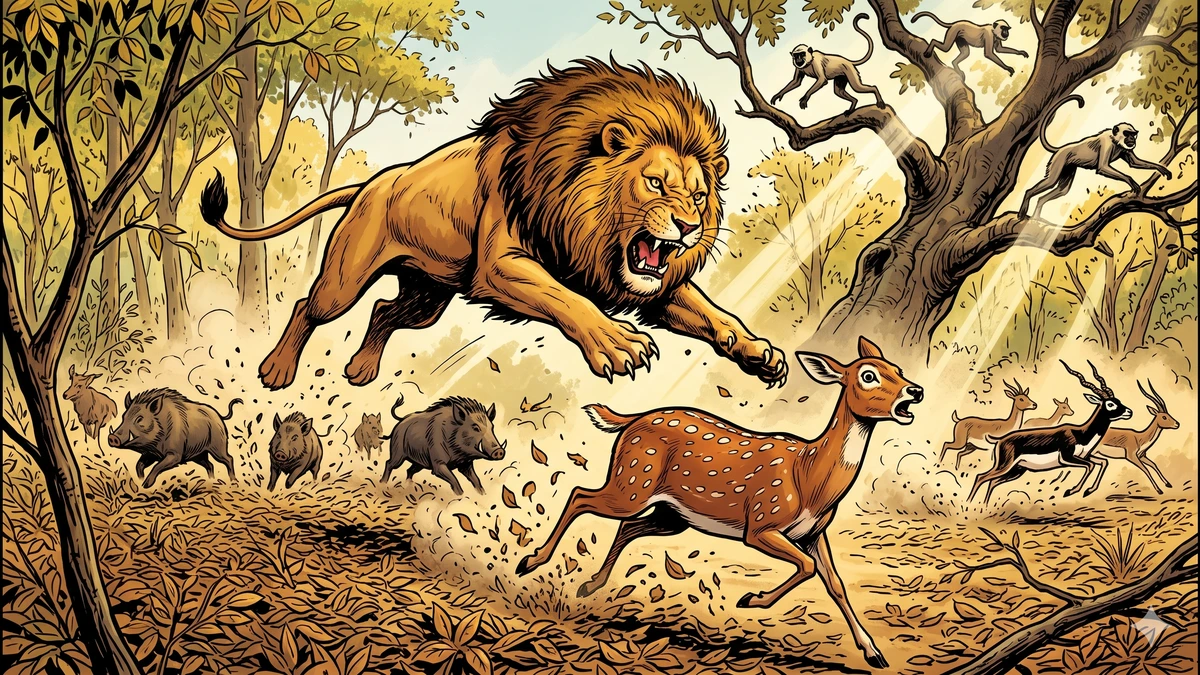
Long ago, in a great green forest at the foot of the hills, there lived a lion named Sharpfang. He was enormous. His mane was the color of dry summer grass, his paws were the size of dinner plates, and when he roared, leaves fell from trees half a mile away. Every animal in the forest, from the proudest buffalo to the smallest squirrel, knew his footfall and feared it.
But there was a problem with King Sharpfang, and the problem was this: he killed too much.
A hungry lion kills only what he needs. King Sharpfang killed for sport. He killed when he was hungry, and he killed when he was bored. He killed in the morning, and again at noon, and sometimes once more before the moon came up. Some days he ate only a single bite of what he had hunted and left the rest to rot in the sun.
Soon the deer were vanishing. The boars went deeper into the thickets where the lion would not follow. The antelopes stopped coming down to the river. Mothers kept their fawns hidden in long grass and would not let them out to graze. The forest, which had once rung with the calls of a thousand creatures, grew quiet. Birds still sang in the upper branches, but on the forest floor, fear had moved in like a fog.
Act II — The council of the animals
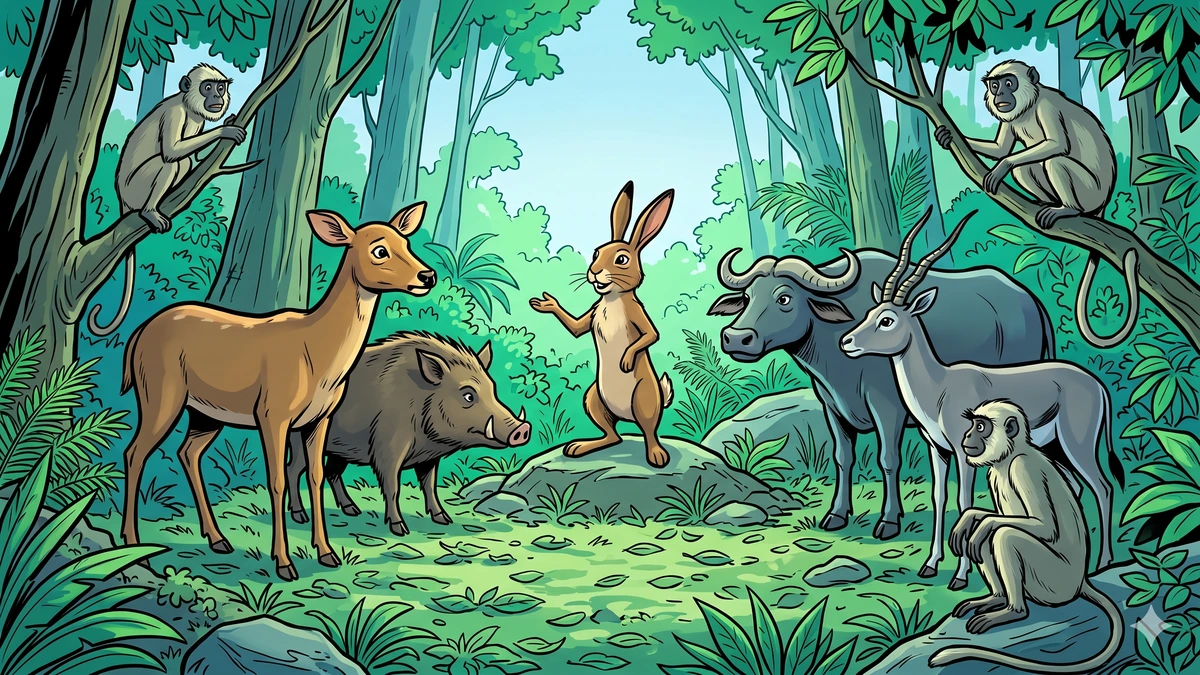
One evening, when the lion had gone to drink at his favorite stream, the older animals of the forest gathered in a hidden glade. A grey-muzzled deer spoke first. A boar followed. Then a buffalo who had lost two calves that month. They were all saying the same thing: at this rate, the forest would soon be empty. There would be no one left for the lion to hunt — and no one left to live, either.
“Friends,” said the old deer, “we cannot fight him. He is stronger than ten of us together. But perhaps we can speak to him. Perhaps we can offer him a bargain.”
The animals murmured. A bargain with a lion seemed like a strange and dangerous thing. But they had no other plan.
So they chose a delegation — the eldest deer, a wise old boar, and a small brown hare named Speedy who, despite his size, had a reputation for being the calmest head in the forest. Together, the three of them walked the next morning to the mouth of the lion’s cave.
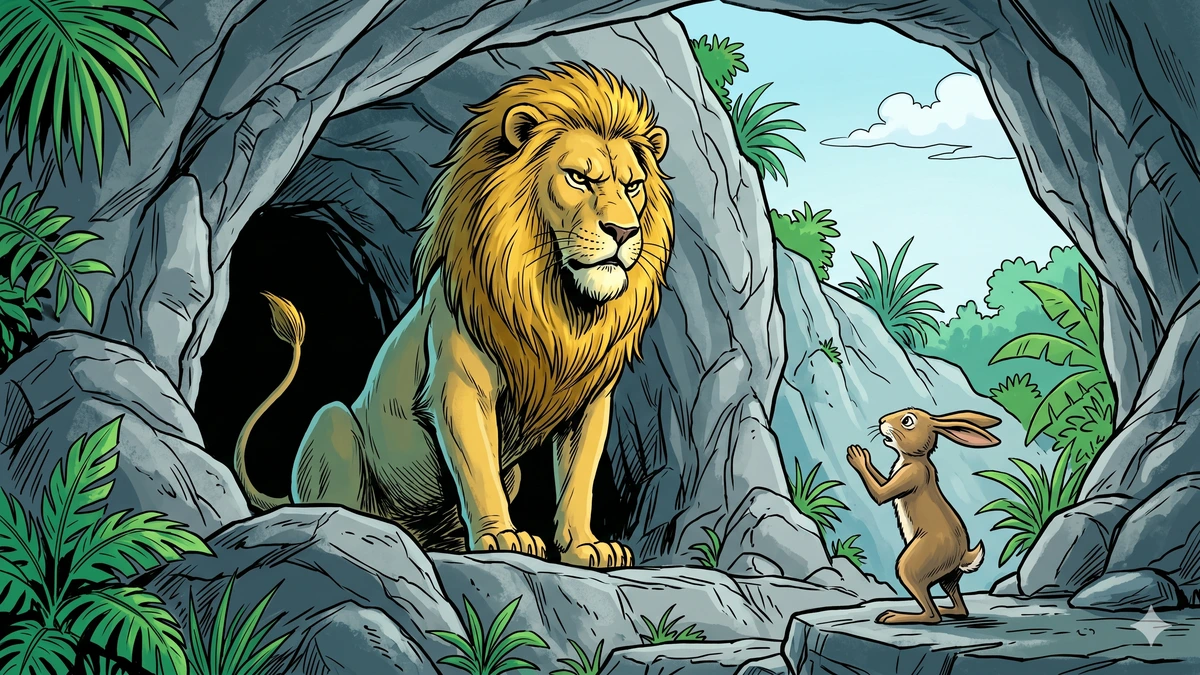
King Sharpfang was just waking from his midday nap. He stretched, yawned, and looked at them with mild curiosity, the way a grown man looks at three children who have come to ask him a question.
“Great king,” said the old deer, lowering his head, “we have come to offer you a gift, and to ask a kindness in return. Each day, on our own, we will send one animal of the forest to your cave to be your meal. You will not have to hunt. You will not have to chase. You may rest in the shade of your cave, and your food will come to you. In return, we ask only that you stop the great hunts. Take only what we send. Let the rest of the forest live.”
King Sharpfang considered this. He was, above all, a lazy lion at heart. The idea of food walking up to him every day, instead of him chasing it through the heat, was extremely appealing. He yawned again, and waved his enormous paw.
“Agreed,” he rumbled. “But I warn you — if any day no animal arrives, I will come out and eat as many of you as I can find. Do not test me.”
The delegation bowed and left.
Act III — The pact and the days of plenty
For many weeks, the pact held. Each morning, the animals drew lots, and one of them — a deer, a boar, an old buffalo, sometimes a monkey too tired to go on — walked the long path to the mouth of the lion’s cave. The lion ate without rising from his shade. The rest of the forest, freed from constant terror, began to breathe again. Mothers let their young out to graze. Old animals dared to walk by the river. The birds sang lower in the branches. The forest came back, slowly, to a kind of life.
But every animal knew, in the back of their mind, that their turn would come. Every morning, when the lots were drawn, someone walked away from the council with the cold weight of the day’s journey settling onto their shoulders. The pact was working. It was also, slowly, eating the heart of the forest.
Now Speedy, the small brown hare, watched all this with growing unease. He was clever, and he was patient, and one morning he understood something the others had not understood. The pact, he saw, was not really a peace. It was just a slower kind of dying. So long as the lion sat fat and idle in his cave, the forest would shrink and shrink until there was nothing left at all.
Then one morning, the lots were drawn — and Speedy’s name came up.
The other animals lowered their eyes. A few of the younger rabbits began to cry. Speedy looked at them and smiled, the way a grown-up smiles at a child who is more frightened than he needs to be.
“Don’t worry,” he said. “I have a plan. If it works, none of us will need to walk that path again.”
And he set out — but slowly. Very slowly indeed.
Act IV — The slow walk, the false rival, and the well
The path to the lion’s cave was long enough at a brisk hare’s pace. At Speedy’s pace that morning, it was a journey. He stopped to nibble grass. He stopped to listen to a brook. He sat under a banyan tree and watched a beetle climb a stick. The sun rose. The shadows shortened. The shadows lengthened again. By the time Speedy arrived at the mouth of the lion’s cave, the afternoon was nearly gone.
King Sharpfang was furious. He had been waiting since dawn. His belly rumbled. His tail lashed. When the small hare came up the path, the lion sprang to his feet with a roar that shook the trees.
“You miserable creature!” he thundered. “You are late, and you are small! Do those wretched animals think one mouthful of rabbit is enough for the king of the forest? I will eat you, and then I will go and eat ten more of you, and tomorrow I will eat ten more!”
Speedy, who had been practicing his face on the long walk, looked up with an expression of polite, sorrowful regret.
“Great king,” he said softly, “you are right to be angry. The forest sent five hares for your meal today, not one. But on the way, we were stopped by another lion — a lion as great as you, perhaps greater. He said this forest belonged to him. He took the other four hares for himself. I escaped only because I am small and quick, and I came running to bring you the news.”
King Sharpfang’s roar froze in his throat. Another lion? In his forest?
“Where,” he said, very quietly, “is this lion?”
“Not far, sire,” said Speedy. “He lives in a great stone fort he has built for himself. If your majesty would follow me, I can take you to him at once.”
The lion’s eyes were narrow now, his mane bristling. He had forgotten his hunger entirely. “Lead on,” he growled.
And Speedy led him — at the same patient, ambling pace he had used to come — across the dry leaves and through the long grass and around the back of a small hill, to a place where, in a forgotten clearing, stood an old, deep, abandoned well, lined with smooth stones and dark with cold, still water.
“There, your majesty,” said Speedy, pointing one small paw, “lives the rival king. He is in his fortress now. If you wish, you may go and look upon him.”
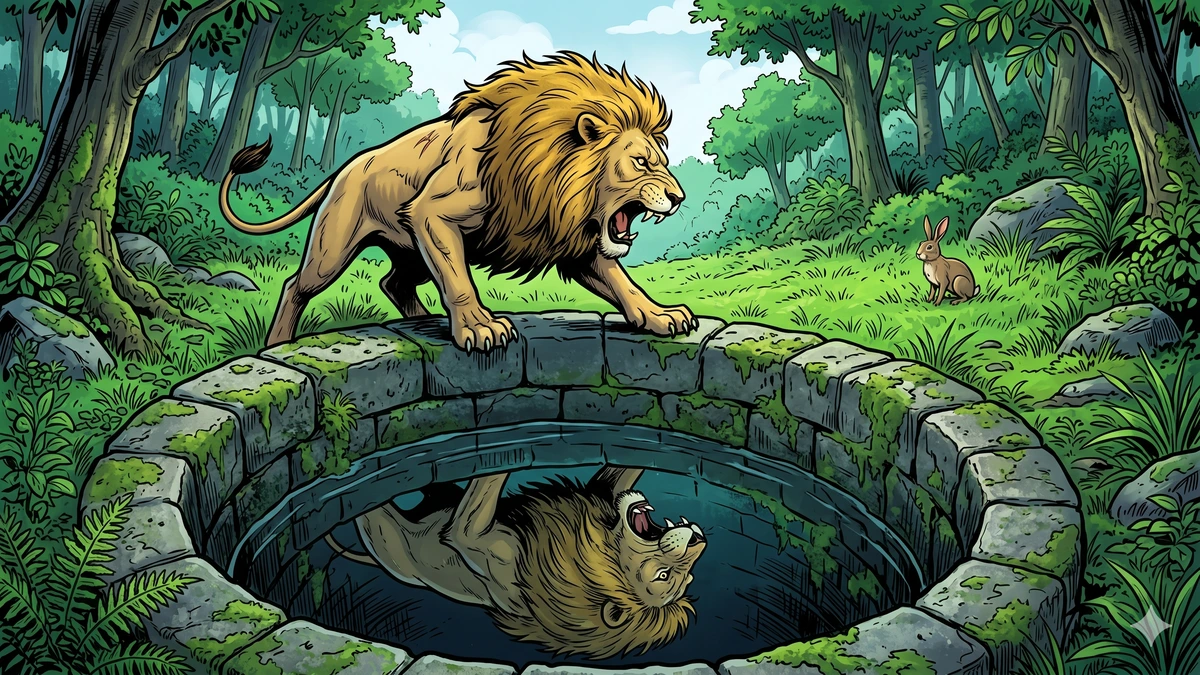
King Sharpfang strode to the lip of the well and looked down.
And from the dark water, far below, another lion looked back at him.
An enormous lion. A lion with a mane the color of dry summer grass. A lion with paws the size of dinner plates. A lion whose eyes were narrowed to slits, whose teeth were bared, whose mouth was open in a great, soundless roar.
King Sharpfang threw back his head and roared.
The lion in the well roared back at exactly the same moment.
“You dare!” thundered Sharpfang. “You dare challenge me, in my own forest!”
The lion in the well, of course, said nothing. He only opened his great jaws and stared.
And King Sharpfang, who had never in his life backed down from a challenge, who could not bear the thought of another beast claiming his kingdom, gathered his enormous body, bunched his huge muscles, and leapt down into the well to fight his rival.
There was a great splash. Then silence. Then the small brown hare named Speedy turned, and walked back to the forest at his own slow, thoughtful pace, to tell the council that they would not need to draw lots tomorrow.
Who’s who in the story
King Sharpfang (Bhasuraka) — A lion of enormous size, strength, and pride. Powerful enough to be feared by every creature in the forest, and lazy enough to accept a pact that brings food to his door. His undoing is not his strength but his temper and his vanity.
Speedy (Lambakarna) — A small brown hare. Patient, observant, calm under pressure, and willing to walk slowly when speed would give him away. He understands the lion better than the lion understands himself.
The forest council — The deer, boars, buffalo, antelope, and monkeys who choose, reluctantly, to bargain rather than fight. They represent the wisdom — and the cost — of choosing the long peace over open war.
The well — A silent character. Deep, dark, and old. The well does nothing. It only reflects what is brought to it.
The lesson
Brute force is loud. Thinking is quiet. The lion’s downfall in this story is not really the rabbit. The rabbit only points him toward the well. The lion’s downfall is his own reflection, mistaken for an enemy. We are most often defeated, the Panchatantra is telling us, by the version of ourselves we cannot see clearly — our pride, our temper, our certainty that the universe is arranged around our hunger.
The clever do not destroy the strong. They simply set conditions in which the strong destroy themselves. Speedy never raises a paw against King Sharpfang. He does not have to.
Why this story still matters today
Almost every interesting conflict in the world is asymmetric. A small startup faces a dominant incumbent. A junior employee faces a bullying manager. A small country faces a much larger neighbor. A child on the playground faces a much bigger child. In each case, the smaller party is told — sometimes by themselves, more often by everyone around them — that the only options are to fight (and lose), to flee, or to submit.
The Panchatantra has been quietly suggesting a fourth option for two thousand years: let the strong party’s own weight do the work. A bully is rarely brought down by counter-force. A bully is brought down by the consequences of his own bullying — by his impatience, his vanity, his inability to imagine that anyone smaller than him could be smarter than him. Speedy’s plan works because he understands King Sharpfang completely. The lion’s pride is the real well, and the reflection is the real bait.
This is a story about negotiation, leverage, and self-knowledge. It is also a story about restraint. Speedy’s most impressive act, the one most often missed by children who hear the story, is that he walks slowly on purpose. He spends the whole morning not arriving. He understands that to handle a furious lion, he must first let the lion become furious. The slow walk is the plan.
Frequently asked questions
What is the moral of “The Foolish Lion and the Clever Rabbit”?
The moral is that intelligence and patience can defeat raw strength, especially when the stronger party is proud or impulsive. A lion who never thinks is more dangerous to himself than to anyone else. The story also teaches that we are most often defeated by versions of ourselves we cannot see clearly.
Which book of the Panchatantra is this story from?
It is one of the embedded fables in Book I — Mitra-Bheda (“The Loss of Friends”) of the Panchatantra, traditionally attributed to Vishnu Sharma around 200 BCE. The jackal Damanaka tells it inside the long frame story of the lion Pingalaka and the bull Sanjivaka, as an example of how cunning can prevail over force.
How did the rabbit defeat the lion?
The hare did not defeat the lion directly. He told the lion that another, equally great lion lived nearby and was claiming his forest. He then led the lion to an old stone well. When the lion looked down and saw his own reflection in the dark water, he mistook it for the rival lion and leapt down to fight it. The lion drowned. The rabbit walked home.
Why did the lion jump into the well?
The lion jumped into the well because he believed his own reflection was a rival lion challenging his rule. His pride and temper would not let him walk away. The story uses this as a pointed image of how an unchecked ego can lead even the most powerful creature to destroy itself.
What can children learn from this story today?
Children can learn that being small or quiet does not mean being powerless. Thinking carefully before acting, observing the people around you, and using patience as a tool can solve problems that direct conflict cannot. The story also gently teaches that anger and pride are dangerous to whoever holds them, no matter how strong they are otherwise.
Related folk tales
If you enjoyed this story, you may also like these other tales from the Panchatantra and beyond, all on this site:
- The Elephant and the Sparrows — another Book I Mitra-Bheda fable in which small allies bring down a giant.
- Elephants and Hares — a Book III tale in which a hare uses the moon’s reflection to outwit an elephant king.
- The Monkey and the Crocodile — a Book IV tale of cleverness on a riverbank.
- The Talkative Tortoise — a cousin tale on the dangers of pride.
- The Three Fish — a Book I fable about foresight, courage, and procrastination.
Did you know?
The Panchatantra is one of the most travelled books in human history. It was translated from Sanskrit into Pahlavi (Middle Persian) in the 6th century, then into Arabic as Kalila wa Dimna, and from there into Hebrew, Latin, Greek, Spanish, and almost every major European language. Versions of “The Foolish Lion and the Clever Rabbit” appear in medieval Persian fable collections, in La Fontaine’s seventeenth-century French fables (as a tale of a fox tricking a wolf), and in countless oral traditions across Asia and the Middle East. When you tell this story to a child today, you are passing along a piece of moral instruction that has been crossing borders, languages, and centuries for two thousand years — and is still, somehow, exactly the right size for an evening before bed.
Frequently Asked Questions
What is the moral of Foolish Lion Clever Rabbit?
Which Panchatantra book contains the Foolish Lion and Clever Rabbit story?
How did the clever rabbit trick the foolish lion?
Who is the lion in Foolish Lion Clever Rabbit?
Is Foolish Lion Clever Rabbit a good story for children?
You May Also Like
 Panchatantra Stories
Ages 3-5
Panchatantra Stories
Ages 3-5
A Baker’s Dozen – An American Folktale
Why do American bakers give thirteen instead of twelve? A Dutch baker, a strange old woman, and Saint Nicholas made it so.
 Panchatantra Stories
Ages 3-5
Panchatantra Stories
Ages 3-5
The Monkey and the Wedge
The Monkey and the Wedge: One, who interferes in other’s work, surely comes to grief.” There was once a merchant who employed many carpenters and masons to
 Panchatantra Stories
Ages 9-12
Panchatantra Stories
Ages 9-12
A Three-in-One Story
Some Panchatantra tales are simple. A Three-in-One Story is not. It is a tale that hides three little stories inside one bigger story — and each of the three teaches the same surprising lesson: even the wisest grown-ups become foolish when love asks them to be. King Nanda neighs like a horse for his queen, his prime minister Vararuchi shaves his head for his wife, and a third nested tale shows how this folly travels far beyond the palace walls.