Elephants and Hares — A Panchatantra Story of Wit Over Might
When a drought drives a herd of elephants to a faraway lake, hundreds of hares lose their burrows under the elephants' feet. A small, calm hare named Vijaya proposes a trick involving the moon's reflection — and convinces the elephant king to bow and march his herd away. A Panchatantra Book III tale on cunning over brute strength.


An entire herd of elephants, kings of the forest by sheer weight alone, stand at the edge of a moonlit lake. Their leader, a tusker so large that no other animal in the country dares speak his name, lowers his head and bows. He is bowing — and this is the strange part — to a hare. A small, brown, perfectly ordinary hare, sitting on a rock as if it had been doing this its whole life.
How did a creature smaller than the elephant’s foot bring the king of elephants to his knees? Without a weapon. Without an army. Without raising his voice. The answer, as the old Panchatantra tellers have it, is the same answer that good negotiators, clever diplomats and quietly brilliant children have given for two thousand years. You do not always have to be the larger animal in the room. Sometimes you just have to know which story to tell.
Where this story comes from
“Elephants and Hares” lives in Panchatantra Book III — Kakolukiyam, “Of Crows and Owls.” The Panchatantra (“five treatises”) is a collection of interlinked animal fables traditionally attributed to the sage Vishnu Sharma, who composed them around the 3rd century BCE to teach three reckless princes the practical art of governance — what the Sanskrit texts call niti-shastra, the science of right conduct.
Book III, where our story sits, is framed by an old war between crows and owls. The crows are smaller, fewer, and outmatched in straight combat. So they win not by fighting harder but by thinking better — by infiltrating, deceiving, and managing their enemy’s perception until their enemy moves of his own accord into a position the crows have chosen for him. This story of the elephants and the hares is a smaller version of that same lesson, told inside the larger frame. It is what wise crows tell each other around the fire when they are studying how to outlast something bigger than themselves.
The story
Act I — The drought and the great migration
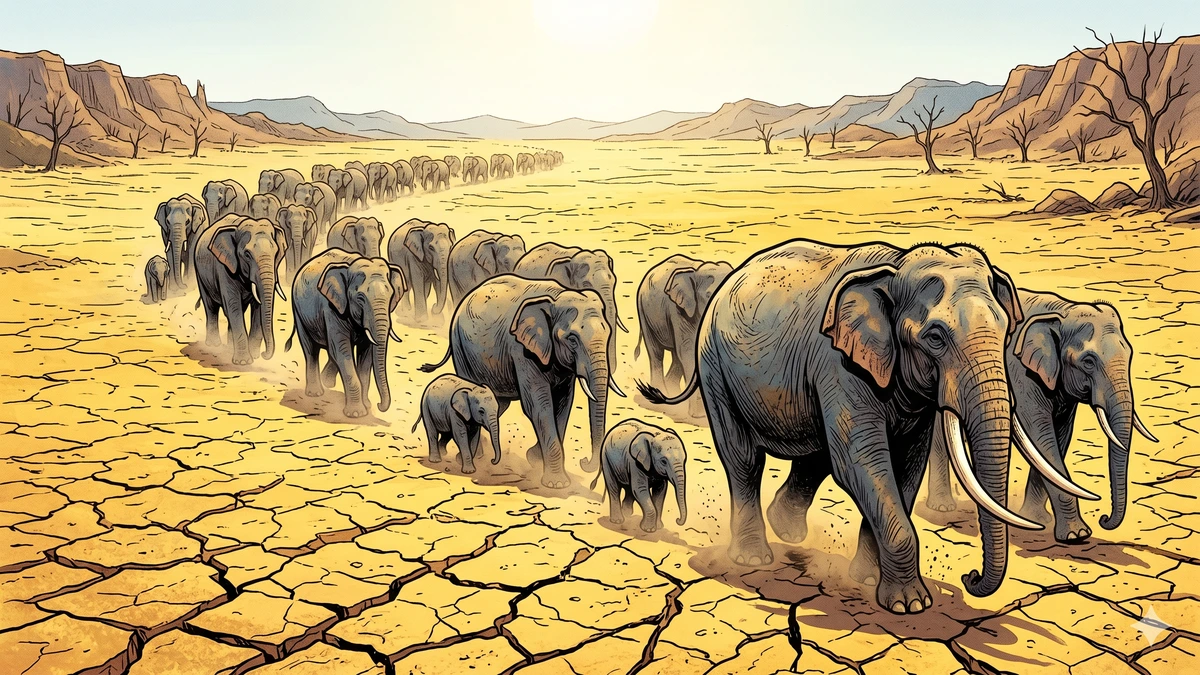
For year after year, no rain fell on the forest where the elephants lived. The streams ran thin. The watering ponds that had welcomed generations of elephants began to crack and finally went dry, baking under a relentless sun until the cracked earth looked like the skin of an old, abandoned drum. The elephants stood beside the empty hollows for a long time, hoping the water would somehow come back. It did not.
The herd’s matriarch and king — the great tusker the others called Chaturdanta — gathered the elephants and told them, in the patient low rumble of his kind, that he remembered a place. A place far away across the dry country, where a great lake lay surrounded by soft earth and tall grass and shade trees. He had been there once as a young bull. The water there, he said, did not run out.
So the herd set out — old elephants, young elephants, calves who had never seen a real river — walking nose-to-tail across the cracked plain. They walked for five days. They walked five nights. The dust rose around them. The sun burned them. By the time the cool blue glint of the great lake appeared on the horizon, half of them were stumbling. They reached the water at twilight on the fifth day and they all but fell into it, splashing and rolling and trumpeting in a relief that none of them had felt in years.
Act II — The trampling

What the elephants did not know, and what they had no way of knowing, was that the soft, pleasant earth around the great lake was honeycombed with the burrows of an entire colony of hares. Hundreds of small brown hares had made their homes in those banks for generations. The same earth that the elephants found so cool and soothing under their tired feet was, for the hares, a roof. The same shade trees were nurseries for their young.
The elephants did not see the hares. Of course they did not. To an elephant’s enormous foot, a hare’s burrow is barely a depression in the ground. The herd splashed and rolled and danced in the water that first evening, and in the morning the next, and the morning after that. And every time they did, the earth above the hare burrows collapsed inward. Babies were crushed in their nests. Old hares could not get out fast enough. Many were maimed. Many simply did not come home.
By the third day the surviving hares of the colony had gathered, terrified and grieving, in a clearing some distance from the lake. They knew the elephants were not malicious. They could see that. The elephants were just enormous. But that was the problem. They did not need to mean any harm to be killing the hare colony entirely.
Act III — The council of hares

The hares knew they could not fight. A hare cannot fight an elephant any more than a leaf can fight the wind. They could not flee either — the lake was the only water for miles. So they did the wisest thing creatures in their situation can do: they held a council, and they listened to the smartest among them.
The smartest among them was a hare named Vijaya, an older buck with quick eyes and a slow, careful way of speaking. Vijaya listened to the others without interrupting. The elder hares wept. The young hares argued. Some shouted that they should run. Some said they should appeal to the elephants directly. Some said all was lost. Vijaya let them speak themselves out, and only when the clearing was quiet did he stand up on his hind legs and say, very simply, “I have a plan. I will go alone. I will speak as the messenger of the moon. Let me try.”
The other hares blinked at him. The plan made no sense to most of them. But they had no other plan. So they let him go.
Act IV — The moon-trick

That night Vijaya walked slowly to the great lake. He waited until he saw Chaturdanta, the elephant king, standing apart from the herd. Vijaya climbed onto a tall flat rock at the lake’s edge, drew himself up to his full small height, and called out. Chaturdanta turned, surprised. The elephant king had to lower his head and squint to even see who was speaking.
Vijaya bowed. Then he said, in the most respectful voice he could manage: “Great king of the elephants. I come to you tonight as the messenger of the Moon God himself. I would not have come, but I was sent. The Moon God has watched what your herd has done these last few days. The lake at which you have been bathing — this lake here, before you — is his sacred water. The hares who live around it are under his particular protection. He is, sir, very angry.”
Chaturdanta was quiet. He had not expected this. He had certainly not expected a hare to speak to him at all. But the hare’s voice was steady, and elephants — for all their pride — are old enough to know when something larger than themselves is in the room.
Vijaya pointed across the lake. “If you do not believe me, look. The Moon himself is here, in his own water, tonight. He is meditating. You may see him for yourself.”
The elephant king looked. There, in the still surface of the lake, was the perfect silver disc of the full moon — luminous, calm, vast. To Chaturdanta, who had never been told that water could hold a reflection, the moon appeared to be inside the lake, below the surface, watching him.
Vijaya continued, very softly. “Bow to him. Do not speak. Do not disturb his meditation. Apologise in your heart. And lead your herd away from this lake at first light, and never return. He will let you live. He has asked me to say that much.”
The elephant king lowered his huge head and bowed. The lake rippled. The moon in the water shivered, as if accepting his apology. Vijaya stood very still, did not move, did not breathe, did not give the trick away by even a twitch.
At first light the elephants were gone. The herd, quiet and chastened, walked back the way they had come, into the dry country. They never returned to the great lake. The hares rebuilt their burrows. And Vijaya, who never raised his voice and never raised a paw, became the most famous hare in any forest for a thousand miles.
Who’s who in this story
The cast is small but each character is doing important work — even the ones who never speak:
- Chaturdanta, the elephant king — proud, immense, but not stupid. He listens when something seems older than himself. His tragedy is not cruelty; it is unawareness.
- Vijaya the hare — the brain of the colony. He does not panic. He waits, listens, and finds the one belief in the elephant’s mind that he can press on. Calm under enormous pressure.
- The hare council — ordinary hares, frightened and grieving, who do the right thing: they listen to their cleverest member and trust his plan.
- The Moon — never speaks, never appears, but the entire story turns on his presence. The moon, in this tale, is the idea of something even bigger than the elephant king. Belief is the lever.
- The lake — the prize, the stage, and the mirror. Without the still water, the trick would not have worked.
The lesson
The headline moral of “Elephants and Hares” is the one most readers carry away: wit can defeat strength when strength has nowhere to look but down. But there is a quieter, deeper moral underneath that one, and it is the part that has kept the story alive for two thousand years.
Vijaya does not fight the elephant. He does not lie, exactly — he does not say the moon is anything other than what it is. He simply tells a story that fits inside a worldview the elephant king already has. The elephant believes that gods are larger than him. The elephant believes that the moon is special. The elephant believes that creatures who claim to speak for the gods deserve a hearing. Vijaya finds those existing beliefs and rests his plan on them.
That is the harder lesson the Panchatantra is teaching: the strong are not invincible — they are only as strong as their assumptions. If you can find the assumption a powerful person rests on and gently press it, you can move them in a direction they would never have gone if you had tried to push them with your shoulder. This is not a story about lying. It is a story about reading the room.
buddhir balavatāṃ nityam, na balaṃ buddhimatāṃ bhavet /
buddhyā vijīyate balaṃ, na balaṃ buddhim eva ca //“Intelligence belongs always to the strong; brute strength does not belong to the intelligent. Strength is conquered by intelligence; never is intelligence conquered by strength.”
— Pañcatantra Book III, the Sanskrit verse spoken by Vijaya the hare after Caturdanta the elephant-king leads his herd away.
Why this story still matters today
Modern children, modern adults, modern companies and modern countries all encounter elephants. The bullying older sibling is an elephant. The classmate who shouts down quieter voices is an elephant. The giant company moving into a town that would have crushed a smaller business by sheer momentum is an elephant. Sometimes the elephant in the room is not malicious. It is just enormous, and it has stopped looking down.
The story does two things at once. First, it reassures children — and every reader who has ever felt small — that being little is not the same as being lost. There are tools available to small creatures that are not available to big ones. The elephant cannot lie down on the lake’s edge and study the moon’s reflection; he is too big. The hare can. The very thing that makes Vijaya physically vulnerable also makes him able to see what the elephant cannot.
Second, the story warns about ever becoming the elephant. Power, the tale says, is the thing that makes you stop noticing other lives. The elephants in this story are not punished for being large. They are reminded, quietly and firmly, that the world is larger than they remembered.
The grown-up takeaway is practical: when you are the smaller party in a negotiation — at school, at work, at the supermarket return counter, at a city hall meeting — do not try to overpower. Find the belief the other party already holds, and tell a true story that fits inside it. They will move themselves where you wanted them to go.
Frequently Asked Questions
What is the moral of Elephants and Hares?
The moral is that wit and a well-told story can prevail where strength would lose. Vijaya the hare cannot fight the elephant king, so he speaks to the elephant king’s existing beliefs about the moon and gives the king a graceful way to leave. Cleverness, applied through belief, beats brute force.
Which book of the Panchatantra is this story from?
“Elephants and Hares” belongs to Book III of the Panchatantra, titled Kakolukiyam (“Of Crows and Owls”). Book III is framed by a long war between crows and owls, in which the smaller, outmatched crows defeat the owls through cunning rather than direct combat. The hare-and-elephant tale is one of the embedded stories that illustrates that larger lesson.
How did the hare trick the elephant king?
Vijaya the hare presented himself as the messenger of the Moon God and pointed the elephant king to the moon’s reflection in the still lake. The elephant, who had no concept of water reflecting an object above it, believed the moon was actually present in the lake. When the moon’s reflection rippled at his bow, he believed the Moon God was acknowledging his apology. He led his herd away that morning and never returned.
Why did the elephants come to the hare lake in the first place?
A long drought had dried the elephants’ usual watering ponds. Their king, Chaturdanta, remembered a great lake from his youth far across the dry country, and led the herd on a five-day, five-night migration. The lake was real and full — but the soft earth around it housed a colony of hares whose homes the elephants unknowingly destroyed.
What can children learn from this story today?
Three things. First, that being small is not the same as being weak. Second, that careful listening — to the room, to the other person, to what they already believe — is more powerful than careful shouting. Third, that the strongest creature is not always the most aware creature, and that this is exactly the gap a thoughtful smaller creature can use.
Related Folk Tales
If you enjoyed this Panchatantra tale, you may also like these stories from indianfolktales.com:
- The Elephant and the Sparrows — another tale of small creatures defeating a proud elephant by working in sequence.
- The Foolish Lion and the Clever Rabbit — a tiny rabbit topples a tyrant lion using only a well full of reflections.
- The Tale of the Three Fish — preparation, hesitation and disaster in a quiet pond.
- The Talkative Tortoise — a tortoise who flies, and what he discovers about silence.
- The Clever Monkey and the Crocodile — a friendship across two worlds, and how cunning saves a life.
Did You Know?
- The Panchatantra was composed in roughly the 3rd century BCE by Vishnu Sharma, originally in Sanskrit.
- The “moon’s reflection” trick is one of the oldest deception motifs in world folk tradition. Variants of it appear in Aesop, in medieval European bestiaries, in Persian and Arabic story collections, and in Native American trickster tales — but the Panchatantra’s version is among the oldest surviving written forms.
- The hare’s name, Vijaya, means “victory” in Sanskrit. Old storytellers loved hiding the moral of a story in the names of their characters; Vijaya is a hare whose name announces what is going to happen by the end of the tale.
- Asian elephants in the wild can travel 25 to 30 kilometres a day in search of water during a drought. The five-day, five-night migration in the story is therefore biologically plausible — about 150 km of dry country, roughly the distance from Delhi to Agra.
- By the 6th century CE the Panchatantra had been translated into Pahlavi (Middle Persian), then Arabic, then onward into Greek, Hebrew, Latin, and nearly every major European language. It is one of the most translated books in human history.
You May Also Like
 Panchatantra Stories
Ages 3-5
Panchatantra Stories
Ages 3-5
Tale of The Three Fish
Three fish brothers face a fisherman’s net: the wisest escapes by foresight, but the dullest perishes by delay.
 Panchatantra Stories
Ages 9-12
Panchatantra Stories
Ages 9-12
The Lion and the Clever Jackal
The Lion and the Clever Jackal: In a great forest of India, where the sal trees grew tall and ancient and the undergrowth was dense with life, there dwelt a
 Panchatantra Stories
Ages 3-5
Panchatantra Stories
Ages 3-5
The Brahmin’s Dream
Read 'The Brahmin’s Dream' — a classic Panchatantra story about wisdom. The Brahmin’s Dream is a beloved Panchatantra tale featuring a ant and a brahmin...