The Story of the Singing Donkey
The Story of the Singing Donkey: In a certain town, there lived a donkey, by the name of Uddhata. He belonged to a washerman. Duringthe daytime, he carried the
Origin & Canonical Placement
“The Story of the Singing Donkey” is a classic Panchatantra fable of misplaced aspiration, inappropriate timing, and the catastrophic consequences of expressing oneself in a context where silence is the only safe option. The tale appears in Vishnu Sharma’s Pancatantra (c. 300 BCE–300 CE) and is also preserved in the Hitopadesha. It belongs to Book V: Aparikshitakaraka (“Ill-considered Action”), and represents a distinct but related variant of the donkey-and-washerman story: here the emphasis falls not on misguided ambition but on the inability to read a situation — specifically, to understand that what is natural, enjoyable, and even admirable in one context can be ruinous in another.
“Desha-kaala-virodhena na kuryat karma panditah.”
“The wise person does not act in defiance of place and time.”
— Panchatantra maxim, Book V
Beat I — The Donkey and the Fox: Partners in Night-Raiding
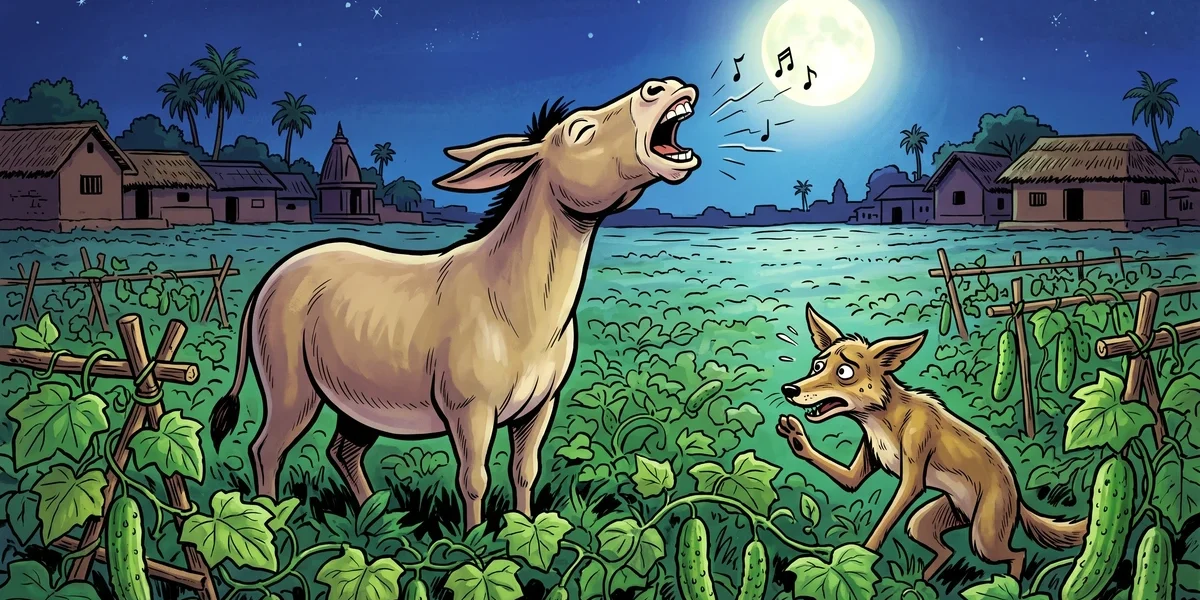
A washerman’s donkey and a fox had formed an unlikely partnership for nightly raids on a cucumber field at the edge of their village. Their arrangement was efficient and complementary: the fox, smaller and cleverer, would scout ahead and locate the gaps in the fence; the donkey would push through first, widening the gap for them both; and they would spend the night eating their fill before slipping out before dawn. The farmer who owned the field had noticed the damage but had not yet identified the culprits, setting a watchman who had so far been ineffective.
For several nights the partnership worked perfectly. The donkey ate well, grew satisfied and content, and began to feel — as creatures well-fed in the still hours of the night tend to feel — a powerful aesthetic impulse. The night was beautiful. The cucumbers were sweet. The moon was full. He felt, as he told the fox, an overwhelming desire to express his happiness through song. The fox was alert and practical: “This is the worst possible moment for singing. We are in someone else’s field at night. The watchman is nearby. A donkey’s bray will wake the entire village. Please do not sing.”
Beat II — The Irreducible Desire and Its Consequences
The donkey heard this counsel and appreciated it in an abstract way. But the desire to sing was not abstract — it was immediate, physical, and deeply felt. He also had a theory: the night was quiet, the watchman seemed to be sleeping, and surely one brief song would go unnoticed. He tried to explain to the fox that singing was natural to him, that suppressing it felt wrong, and that the fox was perhaps being overcautious. The fox, who had heard this kind of reasoning before and knew exactly where it led, said simply: “If you are going to sing, I am going to leave the field now.” And the fox did.
The donkey brayed with the full emotional commitment of a creature expressing its deepest feelings about cucumbers, moonlight, and the general goodness of existence. The watchman woke. The farmer woke. Several neighbours woke. By the time the donkey had completed what felt to him like a thoroughly satisfying vocal performance, he was surrounded by people with sticks. He was beaten severely, a bell was tied around his neck to make future raids impossible to conduct quietly, and he returned to his stall with considerably more information about the social context of nighttime field-raiding than he had possessed when he left.
Beat III — The Analysis: Reading Context Before Acting
The Panchatantra’s analysis of this tale focuses on a cognitive and ethical failure distinct from simple rashness: the failure of contextual intelligence, the inability to read a situation and calibrate one’s behaviour to what the situation actually requires rather than what one’s impulses suggest. The donkey’s desire to sing was not in itself wrong. In an appropriate context — his stall, a field he was legitimately using, any situation where his presence was already known — braying would have had no consequences. The wrongness was entirely situational: he was in a place where silence was essential, and he was constitutionally unable to maintain that silence when a competing impulse arose.
The fox’s counsel encodes a classical niti-shastra principle: desha-kaala-viveka, the discrimination of place and time. This is the capacity to recognise not only what one wants to do but whether the present place and time make that action appropriate. It is a fundamental component of practical wisdom in the Panchatantra tradition, and its absence is treated as one of the most reliable causes of self-inflicted disaster. An individual who can only behave appropriately when their natural impulses happen to coincide with situational requirements is not actually managing themselves; they are merely lucky when the two align.
Kautilya’s Arthashastra addresses desha-kaala-viveka extensively in its treatment of diplomatic protocol and military timing: the envoy who makes a declaration at the wrong moment, the general who attacks at the wrong hour, the king who reveals his plans before execution — all commit variations of the donkey’s error, with proportionally larger consequences. The discipline of kshanajnana — knowledge of the right moment — is identified as one of the most essential skills in both statecraft and personal conduct.
Beat IV — Moral Dimension & Enduring Relevance
The tale’s moral is not a general argument against self-expression or against following one’s natural impulses. It is an argument for contextual intelligence — the capacity to assess whether the present situation is one in which natural impulse and situational requirement are aligned, and to choose accordingly. The donkey’s singing would have been entirely appropriate in many other moments of his day. It was catastrophic in this specific moment because he failed to distinguish between “I want to sing” and “this is a situation where singing serves me.”
This distinction is among the most practically consequential in daily professional and social life. Authenticity — the expression of one’s genuine feelings, opinions, and impulses — is a virtue the Panchatantra generally endorses; but authentic expression must be tempered by situational awareness. The person who says exactly what they think at exactly the wrong moment — in the meeting where silence protects, in the negotiation where disclosure weakens, in the relationship where the timing of honesty determines whether it is received as care or attack — is committing the donkey’s error with human-scale consequences.
The fox, who leaves the field before the disaster, models the alternative: when you cannot prevent someone from ignoring sound counsel, at least preserve your own position. The wise practitioner does not sacrifice themselves on the altar of another’s poor timing.
Moral: Know the place and time before you act; what is natural and even admirable in one context becomes ruinous in another, and the wise person learns to read the difference.
Why This Story Has Lasted 2,000 Years
The singing donkey has endured across two millennia because his error — the inability to suppress a genuine impulse in a situation that requires precisely that suppression — is among the most recognisable and most consequential failures in human social life. The story’s comedy is in the donkey’s complete conviction that his desire to sing is relevant information that the fox has simply failed to weigh adequately. The tragedy is that the fox has weighed it perfectly: the desire is real, and it is also irrelevant to the situation’s requirements. The story crossed from Sanskrit into Arabic, Persian, and European traditions, where it was absorbed into the broad body of tales about the importance of timing, and its central image — a creature braying in perfect contentment in the worst possible place at the worst possible time — remains one of the Panchatantra’s most vivid and durable lessons.
About the Panchatantra
The Panchatantra (“Five Treatises”) was composed in Sanskrit by the scholar Vishnu Sharma around 300 BCE–300 CE as a niti-shastra — a guide to wise conduct and statecraft — framed as animal fables for the instruction of young princes. Its five books cover the dissolution of allies, the winning of allies, war and peace, the dangers of naivety, and the hazards of rashness. The text spread westward through Pahlavi and Arabic translations to become the most widely translated secular book of the ancient world after the Bible.
You May Also Like
 Panchatantra Stories
Ages 9-12
Panchatantra Stories
Ages 9-12
The Elephant And The Sparrows: Panchatantra Book I (Mitra-Bheda) — Stories From India Retold
How can creatures the size of your palm bring down a creature the size of a hill? The classic Panchatantra Book I tale of two sparrows, a wise owl, a mosquito, a woodpecker and a frog who teach a proud elephant the cost of forgetting how to listen.
 Panchatantra Stories
Ages 3-5
Panchatantra Stories
Ages 3-5
The Story Of Cat A Mouse A Lizard And An Owl
The Story Of Cat A Mouse A Lizard And An Owl: This is the story of four creatures, none of whom loved each other, who lived in the same banyan tree in a forest
 Panchatantra Stories
Ages 3-5
Panchatantra Stories
Ages 3-5
Union Is Strength
Union Is Strength: Long ago, there lived a flock of pigeons in a dense forest. In the flock, there was an old pigeon who was very wise. All the pigeons