The Story of the Brahmin’s Wife and the Mongoose
The Story of the Brahmin’s Wife and the Mongoose: In a certain town, there lived a Brahmin, by the nameof Dev Sharma. One day, his wife gave birth to a son.
Origin & Canonical Placement
“The Story of the Brahmin’s Wife and the Mongoose” is one of the Panchatantra’s most enduring and emotionally powerful tales — a story of faithful service, precipitate judgment, and irreversible loss that has been retold across two millennia and in virtually every major literary tradition of the world. It belongs to Vishnu Sharma’s Pancatantra (c. 300 BCE–300 CE) and is also preserved in the Hitopadesha, the Kathasaritsagara, and the Sanskrit veterinary text Salihotra. Thematically it belongs to Book V: Aparikshitakaraka (“Ill-considered Action”) — specifically the subset of tales about the catastrophic cost of acting without investigation on a first impression, however vivid and alarming that impression may be.
“Aparikshitam na kuryan naro karma kadachana; parityajya kritam karma pashchad duhkham prapnuyat.”
“A person should never perform an act without reflection; one who abandons reflection and acts will suffer for it afterwards.”
— Panchatantra, Book V opening verse
Beat I — The Household: A Brahmin, His Wife, Their Son, and the Mongoose
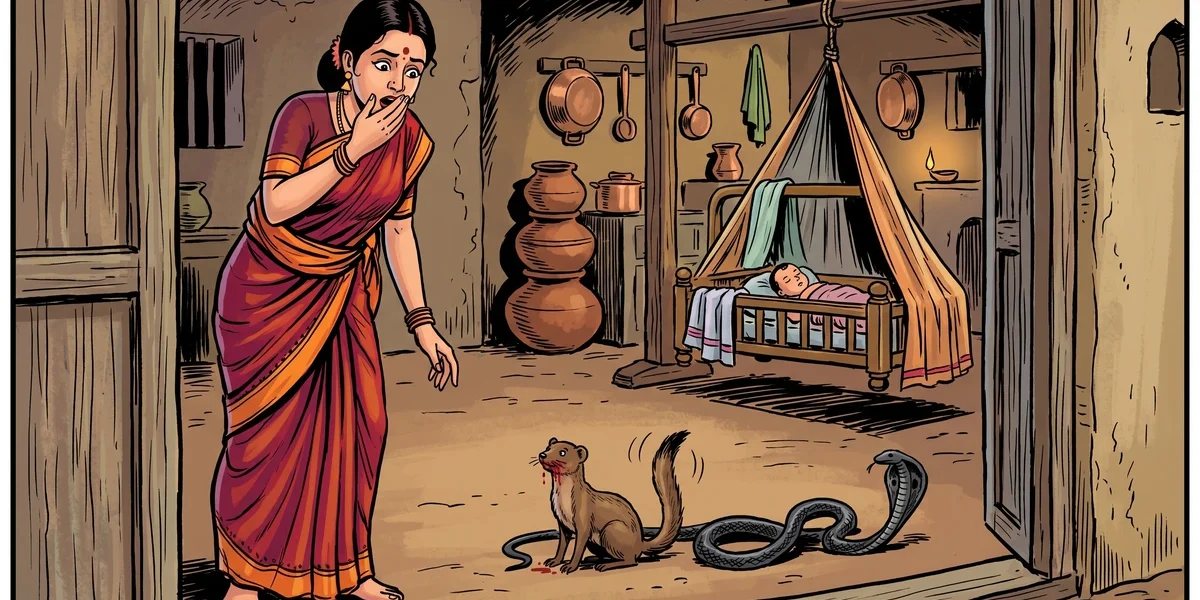
A Brahmin and his wife kept a pet mongoose who had been raised from an infant in their household and was treated as a member of the family — played with, fed from the family’s meals, and given the run of the house. The mongoose returned this affection with complete loyalty and a terrier’s vigilant attention to the household’s wellbeing. The Brahmin’s wife had recently given birth, and the infant son lay sleeping in his cradle in the inner room while she managed the household’s daily work.
One afternoon the wife needed to go to the well for water. She asked her husband to watch the baby while she was gone; he agreed but shortly afterwards left on an errand of his own, leaving the mongoose alone in the house with the sleeping infant. The mongoose remained alert, as always, in the room with the baby.
A snake entered the house through a gap in the wall — drawn, perhaps, by the warmth — and began moving toward the cradle where the infant slept. The mongoose saw it, recognised the danger immediately, and attacked. The fight was fierce — the snake was large and the mongoose had to work hard — but the mongoose killed it, defending the baby with its life if necessary. It stood among the fragments of the dead snake, bloodied from the struggle, at the moment the Brahmin’s wife returned from the well.
Beat II — The Misreading and the Irreversible Act
The wife came through the door carrying her water-pot and saw the mongoose sitting at the threshold, its face and paws covered in blood, looking up at her with the particular expression of a creature that has done something significant and expects acknowledgment. She did not see the snake. She did not look into the room. She saw blood on the animal that she had left alone with her infant, and her mind completed the story instantly and completely: the mongoose had attacked her baby.
She dropped the water-pot on the mongoose, killing it instantly, and ran into the inner room — to find her baby sleeping peacefully in its cradle and the dead snake lying in pieces on the floor. She stood for a long moment looking at what she had done and what had actually happened, and the two pictures did not fit together in any way that could be repaired. The mongoose was dead. It had died saving her child. She had killed it in a single unconsidered act performed on a false inference from incomplete evidence.
When the Brahmin returned and she told him what had happened, he was silent for a long time. Then he said: “I told you I would watch the baby. I did not. You told me you would watch the baby. You did not. And the one member of this household who did watch the baby is dead because of it.” The wife had no answer.
Beat III — The Analysis: The Anatomy of a Fatal Inference
Vishnu Sharma’s analysis of this tragedy focuses on the exact structure of the wife’s inference, because it is a model of how intelligent people arrive at catastrophically wrong conclusions from incomplete evidence. She had two pieces of data: blood on the mongoose, and the mongoose’s proximity to where her baby had been sleeping. From these two pieces of data she drew the most vivid, emotionally salient hypothesis available — the mongoose had attacked the baby — and she acted on it immediately without seeking the additional information that was available within seconds and would have completely reversed her conclusion.
The additional information — the state of the baby, the state of the room — was physically accessible. She was standing at the threshold of the room. A single step and a glance would have told her everything she needed to know before she acted. The Panchatantra’s term for this failure — aparikshita-kara, acting without examination — is precise: the information for correct judgment was present in the environment; what was absent was the practice of seeking it before acting.
The story is also a meditation on the relationship between emotional intensity and epistemic error. The wife’s love for her baby was real, her fear for its safety was real, and her grief after the fact was real. None of these genuine emotional states compensated for the cognitive error they produced: the substitution of the most emotionally compelling hypothesis for the most evidentially supported one. The Panchatantra consistently presents this substitution — acting on what feels most likely rather than what is actually most supported — as one of the most dangerous failures available to human minds.
Beat IV — Moral Dimension & Enduring Relevance
The tale’s moral has two dimensions. The first, explicit, is the warning against acting without investigation: look before you strike, check before you commit to an irreversible course. The second, implicit, concerns the specific conditions that make this error most likely — precisely the conditions in which it most matters to avoid it. The wife acts without investigation at the moment of highest emotional intensity, when her anxiety for her baby is at its peak. This is the moment when the temptation to act on the most alarming available hypothesis is strongest, and the moment when doing so is most likely to be fatal.
Kautilya’s Arthashastra addresses this problem in the context of military intelligence: the commander who receives alarming reports of enemy activity must not immediately mobilise on the first report, no matter how alarming, but must seek corroborating evidence before committing irreversible resources. The emotional intensity of a military crisis creates exactly the same pressure toward hasty action that the wife experiences — and the cost of acting on a false alarm in a military context, as in a domestic one, can be irreversible.
For individual decision-making, the story encodes a practice: before any irreversible act, take the one additional step that converts a hypothesis into a confirmed fact. The wife’s step was literally one step — into the room, to look at the baby and the floor. In most situations the equivalent is similarly small: one phone call, one document read, one question asked. The Panchatantra does not ask for extensive deliberation; it asks for the minimum investigation that distinguishes hypothesis from confirmation before an irreversible act is taken.
Moral: Before every irreversible act, take the one additional step that converts suspicion into confirmed knowledge; the cost of that step is always smaller than the cost of acting on a false impression.
Why This Story Has Lasted 2,000 Years
“The Brahmin’s Wife and the Mongoose” has been one of the world’s most widely retold stories across two millennia — appearing as the Welsh legend of Llywelyn and his hound Gelert, as the story of the faithful dog in dozens of European traditions, as tales of loyal cats, falcons, and other animals across the Islamic world and Asia. The pattern is invariant: a faithful guardian kills a threatening animal to protect a child, the returning caretaker misreads the evidence, the guardian is killed, the truth is discovered too late. The universality of the retelling reflects the universality of the cognitive error: every culture in every era has known what it is to act on a vivid but false impression and discover the truth only when the irreversible act has already been committed. The Panchatantra’s version is among the earliest and most precise formulations of both the error and its lesson.
About the Panchatantra
The Panchatantra (“Five Treatises”) was composed in Sanskrit by the scholar Vishnu Sharma around 300 BCE–300 CE as a niti-shastra — a guide to wise conduct and statecraft — framed as animal fables for the instruction of young princes. Its five books cover the dissolution of allies, the winning of allies, war and peace, the dangers of naivety, and the hazards of rashness. The text spread westward through Pahlavi and Arabic translations to become the most widely translated secular book of the ancient world after the Bible.
You May Also Like
 Panchatantra Stories
Ages 9-12
Panchatantra Stories
Ages 9-12
The Fall and Rise of a Merchant
The Fall and Rise of a Merchant: One should treat one and all, even the lowest, with respect.” In a city called Vardhamana, lived a very efficient and
 Panchatantra Stories
Ages 3-5
Panchatantra Stories
Ages 3-5
The Young Greedy Bird – A Panchatantra Tale from India
The Young Greedy Bird – A Panchatantra Tale from India: Long ago, a flock of birds stayed on the trees near a lake. The flock was ruled by an old queen bird.
 Panchatantra Stories
Ages 6-8
Panchatantra Stories
Ages 6-8
The Crow-Rat Discourse
The Crow-Rat Discourse: After he saw how Hiranyaka had helped Chitragriva, Lagupatanaka came down from his tree perch and called out the rat in a voice