The Story of the Jackal and the Drum
The Story of the Jackal and the Drum: There was once a jackal called ‘Gomaya. One day, he was very hungry arid he wandered about in searchof food. At last he

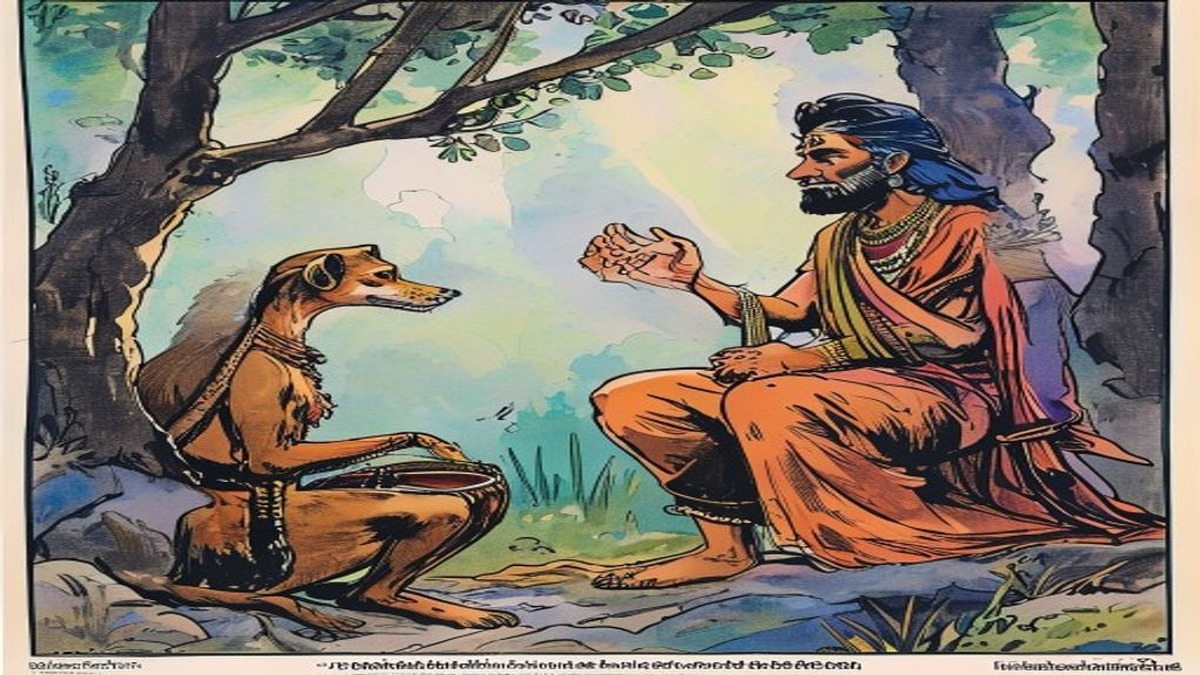
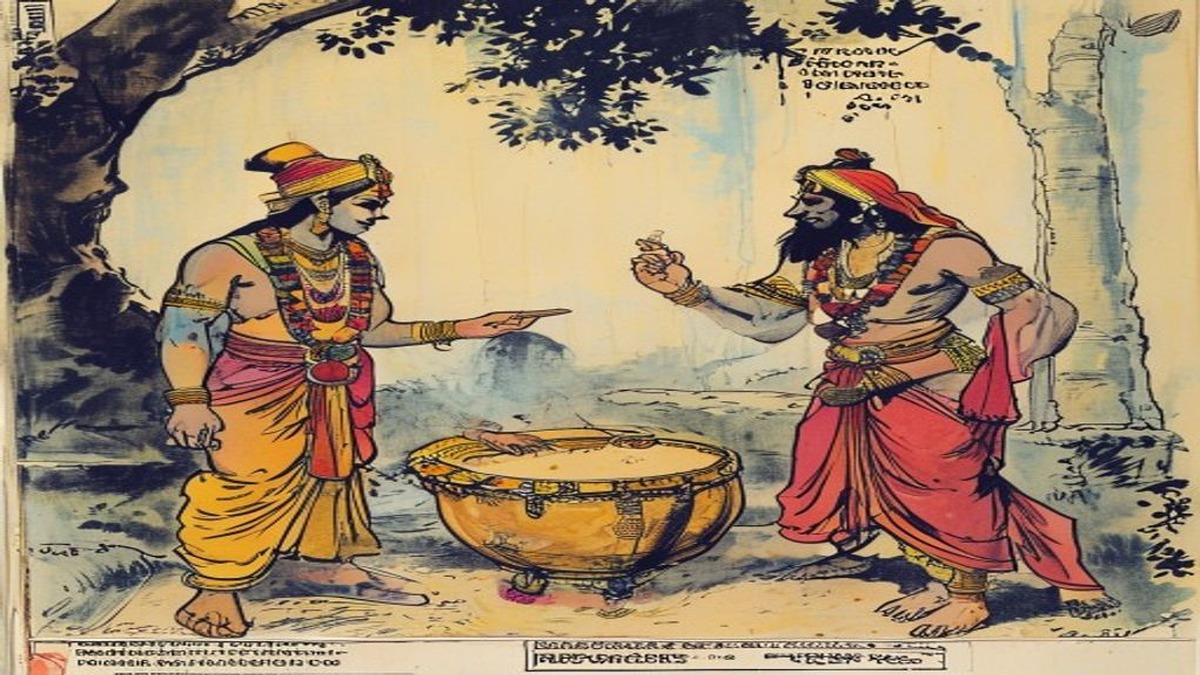
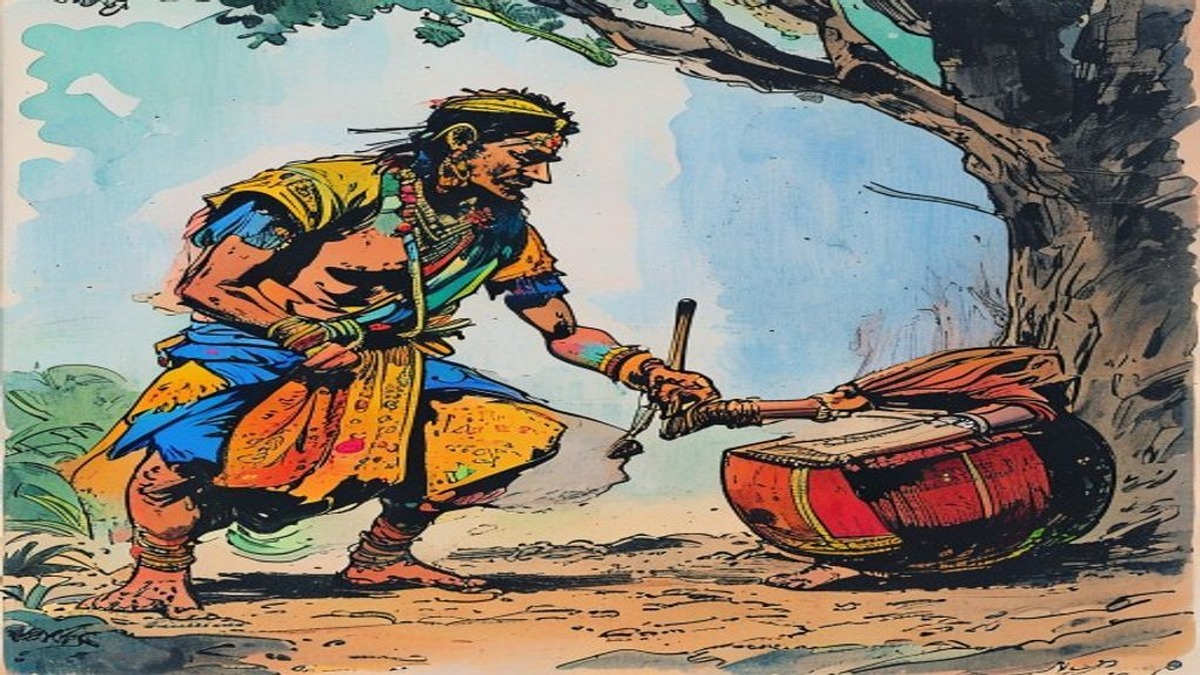
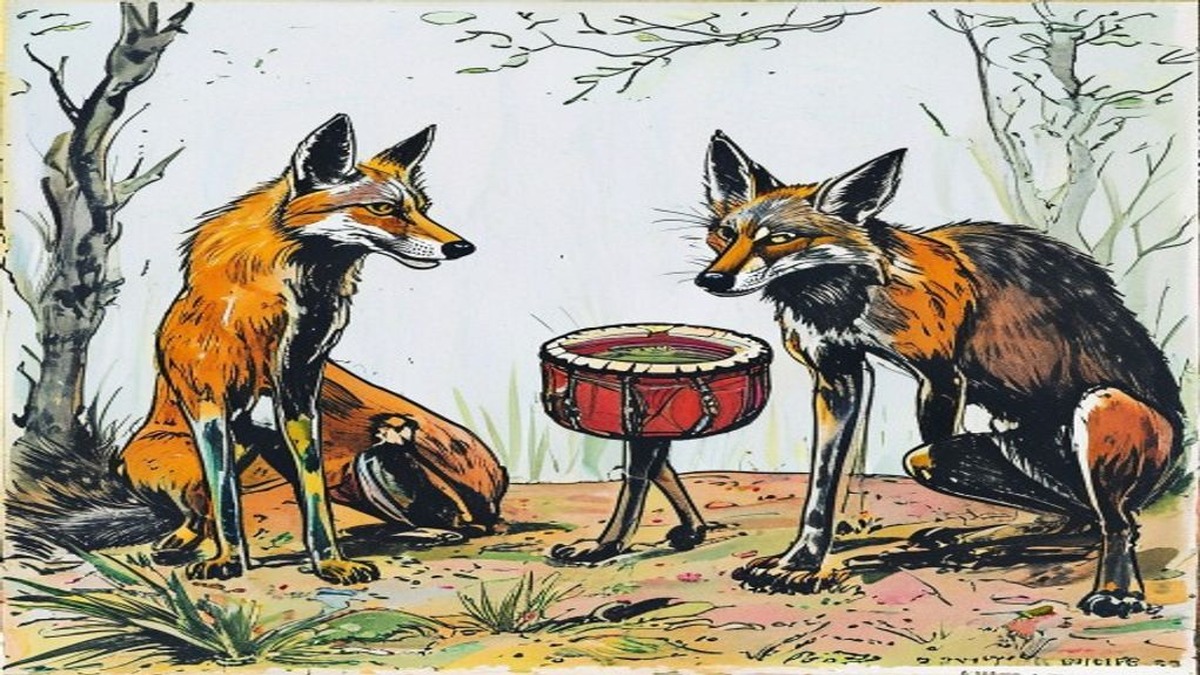
“There was once a jackal called ‘Gomaya. One day, he was very hungry arid he wandered about in searchof food. At last he came to a battlefield. The fightingarmies had left behind a drum, lying near some creepers. B ecause of a strong wind, the creepers were rubbingagainst the drum and making a noise. When the ‘jackalheard this, he got frightened and thought to himself, ‘Unless I can make myself scarce before whoever ismaking this noise sees me, I am done for. But then, itis unwise to desert one’s house suddenly, so instead Imust try to find out who is making this noise. ‘ ” S o h e took all his courage i n his hands and a s hecrept forward he realised that it was only a drum. Hecontinued his search and nearby he found sufficientfool’l to last him a long time. -“-”And, so you see,” Damanaka went on, “you-shiluldn’tbe afraid of a mere noise.” -“How can I be brave,” said Pingalaka, “when my wholecourt is trembling with fright and wants to get awayfrom here?” -“Master,” said Damanaka, “servants should not be heldresponsible for they only follow their master’s example. They say: ‘ ‘Horses, eapons, books, conversation, The harp and a wife, They all become worthy or worthless According to the man they belong to. ‘ -“And so,” continued Damanaka, “be brave and wait here patiently until I return. I am gding to find outabout the noise. And then we shall do whatever is for the best.” -“Are· you brave enough to go?.’ ‘ asked Pingalaka. -“Certainly,” said Damanaka, “besides, why should aservant ask questions whe ther a thing is to be done ornot, if it is his ma.ste.r’s pleasure.”
” My, dear friend I” said Pingalaka. “Well, if that’s thecase, then by all means, go. May God protect you. ” Damanaka bowed before the king and set out, followingthe noise made by Sanjivaka., After the jackal had taken his leave, Pinga’.laka gotfrightened. He sank into a deep reverie and began tothink to himself, ” I have made a mistake in confidingmy intentions to him. As I deprived him of his position, he may join hands with my enemy and thus revenge himself on me. And so I shall hide somewhere so asto ·find out wht he is u, p to and to make sure that. hedoes.rot lead my enemy straight here to: ll me,. for they say: ‘A strong man · who puts his faith in others, May pay with his life, But a weakling who is always wary, Escapes death, Even at the hands of the stro: p.gest of men.’ ” And so having come to tliis decision; Pingalaka tookoff and waited anxiously foi Damanaka’s return. in the meantime, Damanaka.came near to where Sanjivaka was, and realised that it was only a bullock, making the noise. He was overjoyed, thinking to himself, “This is a lucky omen: now I shall have Pingalaka undermy thumb because I have the power to make him andthis bullock friends or enemies, whichever choose, for: ‘As a man in good health requires n6′ doctor I So a king free from troubles pays no att.ention tohis minister.’ ” With these thoughts, Damanaka returned and searchedou t Pingalaka. Bowing before him, he took his place. -“So did you se, e him?” asked Pingalaka. -“With your good favour I have seen him, ” replied Damanaka. -“Honestly?” asked Pingalaka. “Are you telling thetruth?” -“Do you think anyone would dare lie to you?” said Damanaka. ·
·
-“So, it’s true?” said Pingalaka, “You have seen him. The great do not assert themselves against weaklings, that’s why he did not kill you, for: ‘The storm spares the low-bowing and weak grass But uproots the tall trees. The strong fight the strong But not the weak.’ ” -“Well. however great he may be, and however helplesswe seem by comparison,” said Damanaka, ‘just say theword a.n, d I will make him your servant! ” Pingalaka breathed a sigh of relief and said, “What! Could you really do that?” -“Wh; it is impossible for a man of intel Hgence?” replied Damanaka. ‘-“Well,” said Pingalaka, “if that is the case, I appointyou my minister from this very day.”, Damanaka took his leave and went straight to Sanjivaka. He began to scold him, “Despicable ox! Aren’t you afraidof our master Pingalaka that you bellow at such oddhours? Come with me. My master Pingalaka has. summoned you.” When Saajivaka heard this he said, “My dear fellow, who is this Pingalaka?” -“What! ” exclaimed Damanaka. “You haven’t heard of Pingalaka? Just you wait, you’ll get to know him alrightsoon! He is over there, sitting under the banyan tree, surrounded by his retinue.” When Sanjivaka heard this, he thought that his endhad come and his heart sank. He said to Damanaka, “My friend, you seem sympathetic and an expert in thearts of conversation. If you want to take me to the lion, get me a guarantee that my life will be safe.” -“You are right to ask for security,” -said Damanaka, for: ‘A man, can reach the ends of the earth Or the depths of the sea Or the tops of the mountains, But none can fathom the deep thoughts of a king.’
-“So wait here. I shall take you to him when the timeis ripe.” Then Damanaka returned to Pingalaka and said, “Master, that is no ordinary animal. He is an ox whois a special mount of Shiva. When I asked him heexplained to me, ‘My Lord Shiva was very. pleased withme and gave me leave to enjoy tpe tendr grass of theriver Yamuna. And Lord Shiva said that the wholejungle should be my playground.’ ” -“Now I know the truth! ” exclaimed P!ngalaka__terrified. “How else could a grass-eating animal wander fea Flesslyin a jungle full of dangerous beasts, except he had theblessings of Shiva. But what did you say to him whenyou heard that?” -“Master,” said Damanaka, “I told him, ‘This junglehas already been presented to our master by the goddess Durga, whose mount he is. But, all the same, you arewelcome. Come and stay with king Pingalaka as if youwere his own brother, spend your time making merrywith food and drink and gams.’ Well, he agreed buthas requested that you should’ guarantee that his lifewill be safe. So, the rest is up to you.” When Pingalaka heard this, he said, “Well done, myefficient minister. You have acted exactly according tomy wishes. I do assure him that his life shall be safebut get me a similar assurance from him too and bringhim to me quickly.” Damanaka bow d before Pingalaka and, on his way to Sanjivaka, he thought.gleefully, “My master is verygracious towards me and js behaving exactly as I hoped. I think I must be the luckiest being alive. ” W hen h e reached Sanjivaka, h e said to him respectfully, “Friend, I made a request to my master that your lifeshould be spared. He has promised that it shall be so. And so, accompany me with confidence. But when wearrive at the king’s place, you.should respect me asmuch as you respect yourself. Don’t get too big for yourboots and start bossing me about. On my part, I shall
consult you in the exercise· of my duties as a minister.. In this way, we can both enjoy Lakshmi, for: ‘A man who; OU of pride, Does not properly handle the high, the middle and the low, Shall be· ruined, as Dantila was ruined, Even though l; ie was the favourite of the king.’ ” -“How was that?” asked Sanjivaka. And D amanaka told:
CONFLIC’f AMONGST FRI ENDS
T. HE STORY OF THE MERCHANT DANTILA “Somewhere in the wodd, is a city called Vardhamana. A very prosperous merchant, by the name Dantila, lived there. He exercised authority over the whole city. Duringhis administration, he kept both the common peopleand the king very happy. What more can be said’? Aman as wise as that has hardly been heard of or seen, for: ‘The man who seeks the good of the king, Is hated by the common people. And the man who seeks the welfare of the people, Is hated by the king.’ “In such conflicting circumstances, it 1s almostimpossible to find such a man, loved by the king a·swell as the people. ” In the course of time, the marriage of Dantila’sdaughter took place. Dantila invited the entire publicand the king’s officers. He entertained them sumptuous ly, g: ive them presents of clothing and in this way, hehonoured them. After the wedding, the king himselfwith queen and the entire court were invited along to Dantila’s house and he showed them great respect. “A servant by the name of Gorambharwho u.sed tosweep the floors of the king’s palace, came there too, but uninvited. He sat down on a seat meant for some oneelse. Dantila caught him by the neck and threw himout. “The servant felt insulted and could not sleep all nightfor thinking’, ‘How can I get Dantila into disfavour with the king and so, get even with him. But then, whatchance have I, an ordinary fellow, of harming such apowerful person as he is.’ “Several days later, early in the morning, when the king was not yet wide awake, Gorambha was sweepingthe floor near his bed and said, ‘Good heavens! Dantilahas become so brazen nowadays that he actually dares
to embrace the queen!’ “When.the king heard this, he jumped up and shouted, ‘Gorambhal Is that true? Has Dantila really embracedthe queen?’
- ‘Master,’ replied Gorambha, ‘I was gambling all night
and didn’t sleep at all. This morning I feel drowsy. Ire ally don’t know what I’ve been saying.’ “Jealous, the king thoug4t to himself, ‘Yes! The serva.nt Gorambha is allwed to go about freely in the palaceand so is Dantila. It is quite possible that Gorambhahas seen Dantila embracing my queen, for: “What a man ponders over, sees or per forms During the day, He will mutter in his dreams.” ‘And there is no doubt about it when a woman isinvolved. She smiles at one man, with half-opened lips, throws a little remark at another; at the. same timeflirting with the third, her eyes half-closed, whilst inher heart she dreams of yet another man, the one sheloves. Who can depend on the love of such a woman, with eyebrows like the bowsof an archer? The manwho thinks that a woman loves him, is a fool. He fallsinto her trap she’ll treat him like a toy.’ “The king)o.s thoughts were so troubled that, from thatday onward, he withdrew his favours from Dantila and, what is more, he forbade him e,.ven to enter the palace. Dantila was astounded to see ·this sudden change in the king’s attitude and said to himself, ‘It’s true what theysay: “Has anyone heard of A crow that is clean, A gambler who is honest, A snake that forgives, A passionate woman who is calm, An impotent man who is brave, A drunkard with discrimination, Or the friendship of a king.”
- ‘Even in my dreams, I have done no harm to anyone,
.
·
·
not t o the king himself, nor to anyone in his family. Why then is the king so hostile towards me?’ “Some time passed.. “One day, when Dantila wanted to pass through thegateway to the palace, he was stopped by the guards. Gorambha, who was sweeping the floor, saw this andhe said with a smirk, ‘Ho! Guards! That fellow is the king’s favourite. He can arrest or release people, justas he pleases. He threw me out1• Be careful, you maysuffer the same fate.’ “When Dantila heard this, he thought to himself, ‘ Itis surely Gorambha who has caused the trouble. Now I u nderstand why they say: “The king’s servant, Though he be of low caste, foolish or mean, Is respected wherever he goes.” ‘ “Dantila felt upset and returned home in a verydejected mood. He thought it over and that evening, he invited Gorambha to his house, gave him a pair ofgarments and said kindly, ‘My dear friend; it was notbecause I was angry that I threw you out that day butbecause it was an impropriety for you to take the seatyou took it was reserved for a Brahmin. The B rahminfelt insulted, that’s why I had to throw you out. Forgiveme.’ “When Gorambha: saw the clothes, he was very pleased. Full of joy, he said to Dantila, ‘Sir, now I forgive you. You have expressed your regrets and also honouredme. Once again you shall see the favour of the kingand in this way I shall prove to you my cleverness.’ With these words Gorambha went home happily. “Next morning, he went to the palace a.nd startedsweeping the floor. When he had made sure that the king was lying halfawake, he said, ‘The king is reallyindiscreet, he eats cucumber in the lavatory! ‘ “The king was taken aback to hear this and h e shouted, ‘You! Gorambha! What’s that nonsense you’re talking! I t’s only because you’re my servant that I don’t kill you. ·
.
·
Have you ever seen me doing such a thing?’
- ‘Mastet/ said Gorambha, ‘I was gambling last night
and didn’t sleep at all. This morning I feel drowsy. Ire ally don’t know what I’ve been sayfog. But if I’ve saidanything o: ut of place, please forgive me.’ “When the king heard this, he thought to himself, ‘Never in my life have I eaten cucumber in the lavatory. If this fool has said something ridiculous about me? surely what he said about Dantila was ridiculous too. it was wron of me to. have insulted Dantila. Besides, without him, the whole administrative system, at thepalace and in the city, has become slack.’ “When he had considered this carefully the kinginvited Dantila to the palace, presented him with jewelsand clothing and reappointed him to his former position.. -“And so,” continued Damanaka, “that’s why I said: ‘A man who, out of pride, Does not properly handle the high, the middle and the low,. Shall be ruined, as Dantila was ruined, Even though he was the favourite of the king.’ ” -“Brother,” said Sanjivaka, “you’re right, I’ll do exactlyas you say.” Then Damanaka brought Sanjivaka to Pingalaka andsaid, “Master, I have brought Sanjivaka to you. Now Ileave everything in your hands.” Sanjivaka ‘bowed before Pingalaka and. stood beforehim respectfully. Pingalaka greeted him with similarrespect and asked, “My friend, how is the world withyou? How do you come to be in this wild jungle?” And Sanjivaka told him all that had happened to him. When Pingalaka had finished listening to Sanjivaka’sstory, he said kindly, “My dear Sanjivaka, don’t be afraid. Move about as freely as you, please in this jungle, whichmy claws and arms protect. However, you must always ‘stay near me, for this jungle is inhabitd by wild beasts, dangerous even ‘to very powerful animals, to say nothingof grass-eaters.”
With this, Pingalaka went to the bank of the river Yamuna to drink water to his heart’s content. And thenhe returned to the jungle. He entrusted the administra tion of the kingdom to Karataka and Damanaka andbegan to listen to Sanjiaka’s moral tales this is howhe spent his time. Sanjivaka had made a thorough study of the shastras, and, in a few days, he considerably enlightened the dull Pingalaka and made him forget his wild mannerisms, Every day they had discussions together in secret. Allthe other animals stayed at a distance, even Pamanakaand Karataka were forbidden to approach them. As the lion would no longer go hunting, all the animalsincluding Damanaka and Karataka began to starve. Theysay: “As birds forsake an old and wit hered tree, No longer bearing fruit and fly elsewhere, So servants forsake a king, From whom they no longer benefit.” When Karataka and Damanaka had given up all hopeof a change in the king’s attitude, they held a discussiontogether. -“B rother Karo, taka,” said Damanaka, “again we’re ina spot. Ever since Pingalaka has been taken up by thistalk of Sanjivaka’s, he has neglected all his responsibilities. His entire court has deserted him. Now what are wegoing to do?” -“Even if the master does not listen to you,” said Karataka, “it is still your duty to set his faults right. It’sa m inister’s duty to advise a king, whe ther the kingaccepts his advice or not. If a proud king o, r an agitatedelephant follows the wrong path, it’s the fault of theminister and the mahout. You brought the grass-eating Sanjivaka to the master. You yourself have raked theburning coals.” -“That’s very true,” said Damanaka. “It is my fault, not the master’s. They say: ‘The jackal between the fighting rams ·
And the Sanyas who trusted Ashadhbhuti, Were themselves to blame.’ ” -“How was that?” asked Karataka. And Damanaka told:
What is the moral of THE STORY OF THE JACKAL AND THE DRUM?
The moral is: To value wisdom and make thoughtful decisions. This story teaches us that every action has consequences, and we must think carefully about the impact of our choices on ourselves and others.
What collection does THE STORY OF THE JACKAL AND THE DRUM belong to?
THE STORY OF THE JACKAL AND THE DRUM is from the Hitopadesha Collection, an ancient Sanskrit text. The Hitopadesha is a timeless collection of stories that teaches important life lessons through didactic stories about friendship and wisdom.
What age group is THE STORY OF THE JACKAL AND THE DRUM suitable for?
THE STORY OF THE JACKAL AND THE DRUM is best suited for Ages 8-12. Younger children will enjoy hearing it read aloud for its engaging narrative, while older children can read it independently and explore the deeper meanings and moral lessons embedded in the story.

Moral
The protagonist learns an important lesson about virtue and character. This story exemplifies the timeless wisdom of Panchatantra, teaching that wise choices lead to prosperity.

Historical & Cultural Context
The Panchatantra (Sanskrit: Pañcatantra, “five treatises”) is an ancient Indian collection of interlinked animal fables traditionally attributed to Vishnu Sharma in roughly the 3rd century BCE. Composed to teach three reckless princes the arts of governance (niti-shastra), its stories were carried by merchants and translators across Persia, Arabia and Europe, seeding the world’s fable tradition.
This tale originates from the Panchatantra, attributed to Vishnu Sharma around the 3rd century BCE. Composed for King Amarashakti’s three sons, the collection embodies Sanskrit pedagogical wisdom. The narrative survives through Purnabhadra’s 1199 CE recension, Ibn al-Muqaffa’s Kalila wa Dimna, and Somadeva’s Kathasaritsagara, demonstrating enduring cross-cultural appeal.

Reflection & Discussion
- What was the protagonist’s main conflict and how did they resolve it?
- What virtue or vice does this story emphasize most powerfully?
- How does this tale apply to challenges you face in your own life?

Did You Know?
- Jackals are highly adaptable animals found across Africa and Asia. They mate for life and both parents care for their young.
- The Panchatantra was written around 200 BCE by Vishnu Sharma to educate three young princes.
- The Panchatantra has been translated into over 50 languages, making it one of the most translated works in history.
What This Tale Teaches Us Today
Old stories keep their power because their lessons never stop being useful. Here is how this one still applies:
- Read the fine print before making big decisions. Many Panchatantra disasters come from hasty agreements.
- Flattery is usually a warning sign. Powerful people should suspect, not welcome, the voices that agree with them too quickly.
- Patience rewards itself. The characters who wait for the right moment usually outperform those who rush.
Why This Story Still Matters
This story from the Panchatantra preserves wisdom that Indian teachers have used for over two thousand years to teach practical ethics. The Story of the Jackal and the Drum is a small but finished piece of moral engineering – each character represents a recognizable human type, each decision is a lesson in how people actually behave. Indian grandparents still tell these stories to grandchildren for the same reason ancient royal tutors told them to young princes: because the patterns described in the Panchatantra are eternal. Those who listen early in life make better decisions for the rest of it.
Cultural Context and Continuing Influence
Folk tales like this one survived for hundreds of years through oral storytelling before any scholar thought to write them down. Grandparents told them to grandchildren, travelers traded them along roads and rivers, and mothers repeated them to babies who would one day repeat them to their own children. Each small retelling sharpened the story, discarded unnecessary parts, and polished the essential lesson. That long process of refinement is why a good folk tale feels so weighty – it has been shaped by thousands of listeners across generations, each contributing something small to the story we read today.
Modern readers sometimes wonder whether folk tales are still relevant in an age of apps and smartphones. The answer is yes, perhaps more than ever. The technology changes, but the underlying questions – about kindness, courage, loyalty, greed, family, fear, love – do not. These are the same questions that children asked around a fire in ancient India, around a hearth in medieval Ireland, around a campfire in 19th-century Korea. And they are the same questions children ask their parents today, just phrased differently. That is why a family that reads folk tales together is doing real cultural and emotional work, not simply entertaining itself.