The Story of Two Fishes and the Frog
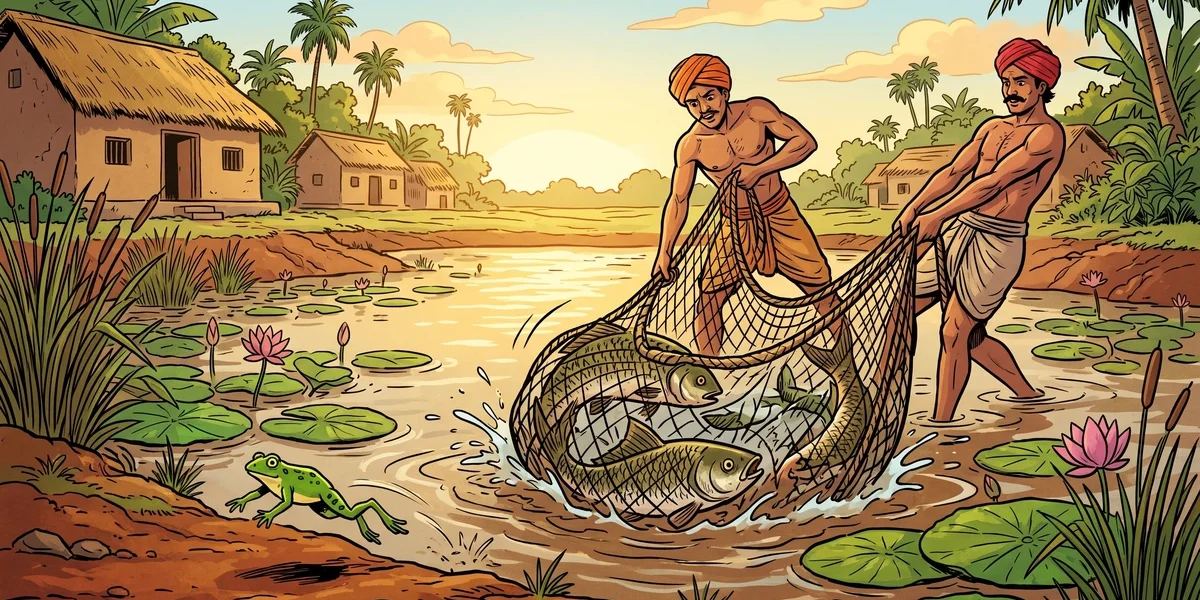
The Story of Two Fishes and the Frog: In a certain pond, there lived two fishes. Theirnames were Shatabudhi and Sahasrabuddhi. They hadmade friends with a frog
Origin & Canonical Placement
“The Story of Two Fishes and the Frog” is one of the Panchatantra’s most celebrated and philosophically precise tales about the relationship between planning, adaptability, and fatalism in the face of foreseeable danger. It appears in Vishnu Sharma’s Pancatantra (c. 300 BCE–300 CE) and is preserved in the Hitopadesha and numerous regional Sanskrit collections. The tale belongs to Book V: Aparikshitakaraka (“Ill-considered Action”) — but with an important inversion: unlike most stories in Book V, which document the cost of acting without forethought, this tale documents the cost of failing to act when forethought has already delivered a clear warning. It is the Panchatantra’s sharpest statement on the danger of over-confidence and the virtue of adaptive response.
“Prajnam api vipannam plavate yo bahun upayan sa jivati.”
“Even in extreme danger, he who has many stratagems survives.”
— Panchatantra maxim, Book V
Beat I — The Pond and Its Three Inhabitants
In a forest pond lived two large fish — named Shatabhuddi (Hundred-witted) and Sahasrabuddhi (Thousand-witted) — and a frog named Ekabuddhi (Single-witted). The names were not ironic labels attached by the author but the characters’ own self-assessments, and the frog’s honest acknowledgment of a single wit was, as the story makes clear, more practically valuable than either fish’s claim to multiple hundreds or thousands.
One evening they overheard two fishermen at the pond’s edge discussing their plans: the fishing in this pond had been excellent, there were large fish here, and they would return the following morning with nets. The warning was clear, specific, and timely — the creatures had the entire night to act on it. The frog spoke first and directly: “I have heard them. I am going to leave this pond tonight. I have only one wit, and that one wit tells me that when fishermen announce they are coming in the morning, the appropriate response is to be somewhere else by morning.” The frog left immediately.
Beat II — Confidence and Its Price
The two fish remained. Shatabhuddi observed that the fishermen might not come; that weather might change their plans; that the pond had always been safe; that running at every heard word was an overreaction unworthy of a creature of his intelligence. Besides, he had a hundred stratagems for evading fishermen’s nets — he had never encountered a net from which he could not escape. Sahasrabuddhi agreed, with the additional observation that his thousand wits included extensive knowledge of fishing techniques and the precise evasive manoeuvres that defeated each one. They would remain.
The fishermen returned the next morning as promised. Their nets were thorough. Shatabhuddi was caught. He attempted one stratagem, then another, then a third, becoming increasingly frantic as each failed. He died in the net. Sahasrabuddhi was also caught, applied his thousand wits in sequence as the net tightened, and also died. The frog, sitting safely on the bank of a different water body some distance away, watched the fishermen return past him with their catch — including the great Hundred-witted and the great Thousand-witted — and continued his modest life with his single wit intact and functioning.
Beat III — The Analysis: The Paradox of Intelligence and Adaptability
Vishnu Sharma’s analysis of this tale is deliberately paradoxical. The fish were not stupid. Shatabhuddi and Sahasrabuddhi were genuinely intelligent creatures whose reputation for multiple wits was presumably based on genuine past experience. What killed them was not a lack of intelligence but a specific kind of intelligence failure: the inability to recognise that the current situation required not the application of accumulated stratagems but the willingness to abandon the pond entirely.
This is what the Panchatantra tradition calls the failure of parityaga-buddhi — the wisdom of relinquishment, the capacity to give up what one has for what one needs. The fish had invested their entire identity in their ability to survive in the pond through cleverness. The thought of leaving — of abandoning their territory, their food sources, their accumulated social position — was so fundamentally incompatible with who they understood themselves to be that they could not entertain it even when the evidence for leaving was overwhelming.
The frog’s single wit, by contrast, was unconstrained by investment in any particular pond. He had no hundred stratagems for defeating nets — and therefore no reason to believe that staying and fighting was the appropriate response to fishermen’s nets. His single wit produced the single question that mattered: “Is this place still safe?” and the single action the answer required: “Leave.” Simplicity of analysis, in this case, produced survival that sophistication could not.
Kautilya’s Arthashastra addresses this pattern in its discussion of the six forms of state policy (shadgunya), one of which is asana (remaining in place) and another yana (marching away). The text is explicit that the choice between these policies must be made on the basis of actual circumstances, not on the basis of which policy is more consistent with the ruler’s self-image. A king who remains in a position that has become untenable because retreating is inconsistent with his understanding of himself as unconquerable commits the same error as Sahasrabuddhi.
Beat IV — Moral Dimension & Enduring Relevance
The tale’s moral is not an argument against intelligence or for simplicity as a general strategy. It is an argument for a specific kind of meta-intelligence: the capacity to assess whether the current situation calls for the application of one’s accumulated skills or for their abandonment in favour of a fundamentally different response. This meta-intelligence — the ability to step outside one’s own repertoire and ask whether the repertoire is the right tool for the current problem — is precisely what the fish lacked and the frog possessed.
In contemporary terms, the story speaks to individuals and organisations that have invested heavily in particular capabilities, strategies, or positions, and find those investments creating a bias toward continuing to apply them even when circumstances have changed to make a fundamentally different response appropriate. The sunk cost of capability — the hundred stratagems, the thousand wits — can become the very thing that prevents the one response that survival requires: leaving.
The frog’s departure also encodes a lesson about the value of honest self-assessment. He did not pretend to have stratagems he lacked. He knew what his single wit told him and he acted on it without delay. This directness — no gap between perception and action, no internal negotiation with one’s self-image — is what the Panchatantra consistently presents as the practical advantage of simplicity over sophistication in moments that require immediate, unambiguous response.
Moral: Many stratagems are worthless if the one required stratagem is to leave; the wise person knows when their accumulated capabilities are the problem rather than the solution.
Why This Story Has Lasted 2,000 Years
The two fish and the frog have remained one of the Panchatantra’s most discussed triads because their story distils a genuinely paradoxical truth: that sophistication can be a liability and simplicity a survival advantage, that the capacity for complex response can crowd out the simple response that the situation requires. The tale travelled through the Panchatantra’s translation networks into Arabic, Persian, and European literary traditions, where it was absorbed into the broad body of wisdom about the dangers of over-confidence. Its central image — two great fish with a hundred and a thousand wits dying in a net while a single-witted frog sits safely on the bank — is one of world literature’s most precise pictures of the gap between intelligence and wisdom.
About the Panchatantra
The Panchatantra (“Five Treatises”) was composed in Sanskrit by the scholar Vishnu Sharma around 300 BCE–300 CE as a niti-shastra — a guide to wise conduct and statecraft — framed as animal fables for the instruction of young princes. Its five books cover the dissolution of allies, the winning of allies, war and peace, the dangers of naivety, and the hazards of rashness. The text spread westward through Pahlavi and Arabic translations to become the most widely translated secular book of the ancient world after the Bible.
You May Also Like
 Panchatantra Stories
Ages 9-12
Panchatantra Stories
Ages 9-12
The Lion, the Camel, the Jackal and the Crow
Trust given despite proven dishonesty proves fatal when a camel ignores a jackal's conspiracy.
 Panchatantra Stories
Ages 3-5
Panchatantra Stories
Ages 3-5
The Story of the King and the Foolish Monkey
The Story of the King and the Foolish Monkey: A certain king had a pet monkey. He was allowed toenter the king’s palace, even when other confidentialservants
 Panchatantra Stories
Ages 3-5
Panchatantra Stories
Ages 3-5
The Lion And The Crane
The Lion And The Crane: The Bodhisatta was at one time born in the region of Himavanta as a white crane; now Brahmadatta was at that time reigning in Benares.