The Rat that ate Iron
The Rat that ate Iron: Tit for tat’ is the best policy in life.” Jveernadhana was a merchant’s son who was not successful. He faced a loss in his business and

The Rat That Ate Iron
Canonical Attribution and Manuscript Tradition
This tale belongs to Pancatantra Book I, Mitra-bheda, and is one of the collection’s most structurally unusual entries: a tale in which fraud is met not with honest exposure but with a more elaborate counter-fraud, and the point is the legal and ethical principle that governs the relationship between the two. The story is preserved in all major Sanskrit recensions including the Tantrakhyayika (c. 200 BCE, Kashmir) and appears in parallel in the Hitopadesha. It entered Arabic culture through Kalila wa Dimna (c. 750 CE). Within the Pancatantra’s didactic programme it occupies a specific position: it is addressed not to the victim of fraud but to the fraudster, demonstrating that the implausible lie — the lie that the listener cannot challenge without entering equally absurd territory — creates a logical trap that leaves the fraudster with no honest remedy. The tale is, in effect, a juridical parable: it demonstrates through narrative what contract law and equity would later articulate as doctrine.

Beat I — The Deposit and the Fraud
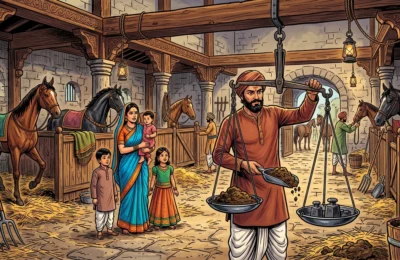
A merchant, preparing to travel, left a large iron balance-weight with a neighbour for safekeeping. When he returned and asked for the weight, the neighbour claimed it had been eaten by rats. This was, of course, physically impossible: rats cannot eat iron. The merchant, understanding that he had been defrauded — the neighbour had sold or used the weight and invented a story to avoid returning it — did not immediately protest. He accepted the explanation with apparent equanimity and offered to take the neighbour’s son on a visit to the river.
The fraud the neighbour had committed relied on the merchant’s inability to disprove the claim through direct evidence. The weight was gone; the neighbour said rats ate it; the merchant could not produce the weight to refute this. The fraudster’s calculation is transparent: the lie is implausible but technically unrefutable by direct evidence, and the victim will have no practical remedy because no court will accept the fraudster’s word against the merchant’s word on the basis of physical plausibility alone. This calculation was correct as far as it went. What the fraudster had not considered was the logical consequence of the implausible lie: that it established a precedent for implausibility in the relationship that the merchant could now exploit equally.
Beat II — The Counter-Fraud
The merchant took the neighbour’s son to the river and then locked him in a house, telling the neighbour on his return that a hawk had carried the boy away. The neighbour was outraged: a hawk cannot carry a boy; this was obviously false; where was his son? The merchant expressed calm regret. Hawks take boys; what could he do? The neighbour threatened legal action. The merchant welcomed it.
At the hearing, the judge heard both claims. The neighbour claimed his son had been taken by a hawk; the merchant claimed his iron weight had been eaten by rats. The judge — who in this tale serves as Vishnu Sharma’s stand-in for the principle of legal equity — saw the symmetry immediately. If one accepted that rats eat iron, one must accept that hawks carry boys. If one rejected the hawk story as physically impossible, one must reject the rat story on the same grounds. The two claims stood or fell together. The judge ruled that the merchant would return the boy when the neighbour returned the iron weight. The weight was returned; the boy was released.

Beat III — The Legal Principle
The tale’s juridical point is elegant and has genuine doctrinal content. In Sanskrit legal tradition, as in most legal systems, claims must meet a basic standard of physical plausibility to be adjudicated seriously. A claim that rats ate an iron weight fails this standard; it cannot be true. A claim that a hawk carried a human child fails the same standard. The judge’s ruling applies the principle of samatvam — symmetry or equality of treatment — to the two claims: since they are equal in their implausibility, they must be treated equally. Either both are accepted or both are rejected, and the practical consequence of rejecting both is that both parties must make restitution simultaneously.
The Pancatantra’s framing is not simply that the merchant outsmarted the fraudster; it is that the merchant’s counter-fraud was legally equivalent to the fraudster’s original fraud in a way that forced a symmetrical resolution. The fraudster had created a situation that was logically self-sealing in one direction — the rat story could not be disproved by direct evidence — but it was open in another direction: once an implausibility standard was admitted for one party, it was admitted for both. The merchant used that opening.

Beat IV — What the Rat Story Teaches About Fraud and Legal Equity
Vishnu Sharma’s selection of this tale for the Pancatantra’s collection serves his pedagogical purpose on multiple levels. For pupils who would become rulers or ministers, it demonstrates the principle of symmetrical equity: legal reasoning must apply the same standards consistently, and a party that introduces an impossible premise into a legal dispute cannot then object when the opposing party uses the same standard. For pupils who would manage disputes, it demonstrates that the implausible lie, while temporarily effective, creates a logical vulnerability that a sufficiently intelligent adversary can exploit.
The deeper lesson is about the relationship between the lie and its logical consequences. The neighbour who invented the rat story was thinking only about the immediate problem: avoiding the return of the iron weight. The neighbour was not thinking about what standards of plausibility the rat story implied for any subsequent dispute between the same parties. The merchant was. The merchant’s genius is not in the counter-fraud as a trick; it is in the recognition that the fraudster had, by their own implausible claim, created the logical space for an equally implausible counter-claim that would produce the same juridical impasse. Once both parties have made impossible claims, the only resolution is symmetric restitution.

Moral and Sanskrit Wisdom Tradition
“The implausible lie creates the logical space for an equally implausible counter-truth; the fraudster who invokes impossibility cannot object when impossibility is invoked against them.”
— Moral of The Rat That Ate Iron, Pancatantra Book I (Mitra-bheda)
This moral encapsulates a principle that Sanskrit legal tradition (Dharmashastra) articulates as the requirement of internal consistency in claims and the principle of samatvam (equal treatment) in adjudication. The Manusmriti and the Arthashastra both address the standards of plausibility required in legal claims, and both identify the impossibility of a claim as grounds for its rejection. What the Pancatantra adds, characteristically, is the dynamic consequence: the party that introduces impossibility into a legal relationship opens the logical door for impossibility from the other side. The tale is Vishnu Sharma’s most compact contribution to the jurisprudence of fraud.
Why This Story Has Lasted 2,300 Years
The Rat That Ate Iron endures because the principle it illustrates — that an impossible premise creates logical space for an equally impossible counter-premise, and that legal equity requires both to be treated consistently — is genuinely durable. Fraud that relies on the victim’s inability to disprove an impossible claim remains a recognisable pattern. The merchant’s response — meet impossibility with impossibility, force the legal symmetry, achieve resolution through symmetric restitution — remains a recognisable and satisfying form of justice in a world where the direct disproof of many frauds is unavailable. The tale’s wide transmission through Kalila wa Dimna and subsequent collections suggests how broadly this juridical pattern has been recognised as both accurate and useful.
Sanskrit Tradition: Tantrakhyayika (c. 200 BCE, Kashmir); Hitopadesha; Kalila wa Dimna (Arabic, c. 750 CE)
Legal Principle: Samatvam (symmetry/equal treatment); implausibility must be applied consistently across both parties
Author: Vishnu Sharma (attributed, c. 3rd century BCE)
Dharmashastra Parallel: Standards of plausibility in claims; equal treatment as the foundation of equity
You May Also Like
 Panchatantra Stories
Ages 6-8
Panchatantra Stories
Ages 6-8
The Tale of Two Fishes and a Frog
The Tale of Two Fishes and a Frog: A Panchatantra Lesson in Wisdom In ancient India, there lived a wise king named Vikarma who loved to hear stories. One day
 Panchatantra Stories
Ages 6-8
Panchatantra Stories
Ages 6-8
The Greedy Cobra and the King of Frogs
Read 'The Greedy Cobra and the King of Frogs' — a classic Panchatantra story about moral lessons about greed. The Greedy Cobra and the King of Frogs is ...
 Panchatantra Stories
Ages 3-5
Panchatantra Stories
Ages 3-5
The Intelligent Merchant – Hindi Folktales from India
The Intelligent Merchant – Hindi Folktales from India: Long ago, there was a king who was very unjust and cunning. He used to look for opportunities to tax his