The Story of Nanda and Vararuchi
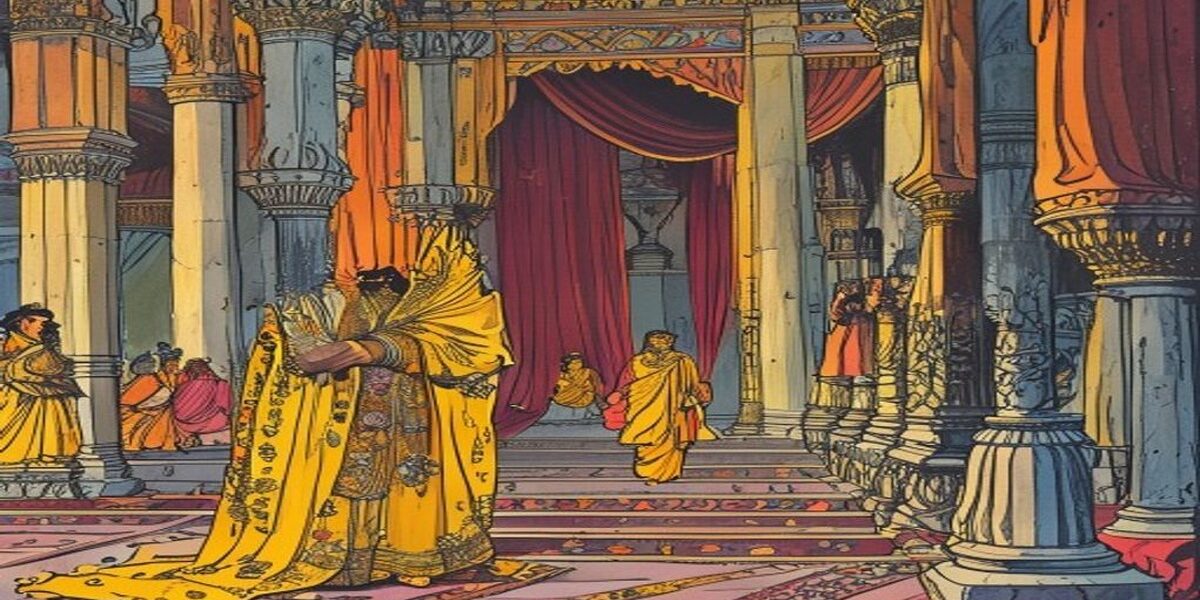
The Story of Nanda and Vararuchi: Once upon a time, there lived a king, by the nameof Nanda. He ruled the entire land surrounded by theseas and his power was
Origin & Canonical Placement
“The Story of Nanda and Vararuchi” is a celebrated tale from the Sanskrit narrative tradition that bridges the Panchatantra’s niti-shastra (statecraft literature) with the wider corpus of legendary accounts about the court of the Nanda dynasty and the great grammarian Vararuchi. The story appears in expanded form in the Kathasaritsagara (“Ocean of the Streams of Story”) compiled by Somadeva in the 11th century, drawing on older Panchatantra and Brihatkatha material. It is positioned within the tradition of Book IV: Labdhapranasham (“Loss of Gains”), which examines the consequences of rash judgment, the nature of true wisdom, and how appearances routinely deceive.
“Na hi prajnaparam kimcit sahayam purushasyeha.”
“There is no ally superior to wisdom in this world.”
— Sanskrit maxim, Panchatantra tradition
Beat I — The Court of Nanda: Where Wit Determined Worth
King Nanda of Magadha presided over one of the most intellectually competitive courts in ancient India. His advisors, scholars, and courtiers were chosen not by birth or wealth but by demonstrated mastery of grammar, logic, and the subtlety of verbal argument. In this atmosphere, the scholar Vararuchi — destined to become one of the most celebrated grammarians of his age — arrived as a young man of exceptional promise but modest social standing. He was known to have mastered Panini’s grammar at an age when most students had barely memorised the foundational sutras, and his reputation for finding the precise and irrefutable formulation of any proposition had preceded him to the capital.
Yet the royal court was a treacherous environment for a young man without patrons. Rival scholars watched Vararuchi with a mixture of admiration and resentment. They observed that the king treated intellectual contests as a form of entertainment and that defeat before the court could end a scholar’s career as swiftly as military failure ended a general’s. The story’s central conflict is thus not merely between two individuals but between the ideal of meritocratic scholarship and the brutal social dynamics of patronage and power.
Beat II — The Test: Grammar as Statecraft
King Nanda, who had a taste for verbal puzzles, posed a grammatical riddle to his assembled court that had stumped every scholar present for several days. The riddle concerned an ambiguous construction in classical Sanskrit whose meaning shifted depending on which grammatical rule one applied — two leading scholars had given diametrically opposite interpretations, each well supported by Paninian authority. The court was at an impasse and the king, growing impatient, declared that he would honour the scholar who resolved the dispute definitively.
Vararuchi listened to both arguments carefully and then asked permission to speak. He demonstrated that both interpretations were technically valid under different assumptions about the speaker’s intent, but that the construction had been deliberately chosen by its original author to sustain the ambiguity as a rhetorical device — a figure of speech called shlesa (double meaning). The “correct” interpretation was therefore not one meaning or the other but the productive tension between both. The king, delighted, recognised that Vararuchi had transcended the terms of the dispute itself, offering not a judgment but a higher-order analysis that dissolved the impasse. He appointed Vararuchi to a position of honour at court and the young grammarian’s career was established.
Beat III — The Analysis: Intelligence, Humility, and the Trap of Certainty
The tale’s philosophical contribution lies in its treatment of certainty as a trap and ambiguity as a resource. The rival scholars who argued for a single definitive interpretation each possessed genuine knowledge but were limited by their assumption that grammatical analysis must produce a single, unambiguous answer. Vararuchi’s insight — that the ambiguity was intentional and meaningful — required not superior grammatical knowledge (the rivals were his equals there) but superior meta-cognitive awareness: the capacity to step outside the frame of the problem and examine the assumptions on which it rested.
This is precisely the quality that the Panchatantra identifies as the highest form of intelligence throughout its corpus. The pandita (learned person) who can only apply rules is valuable; the mahabuddhi (great intellect) who can interrogate the rules themselves is priceless. Vararuchi’s response to the king’s riddle demonstrates viveka — discriminating wisdom — which the text consistently ranks above mere technical proficiency.
The story also encodes a warning about the dangers of intellectual rivalry conducted without ethical grounding. The rival scholars who attempted to undermine Vararuchi were technically accomplished but morally compromised by their need to “win.” Their knowledge served their pride rather than the truth. The Panchatantra tradition consistently presents this combination — great skill in the service of ego rather than wisdom — as one of the most dangerous forces in any court or community.
Beat IV — Moral Dimension & Enduring Relevance
The story’s moral trajectory is from technical competence to wisdom — from knowing the rules to understanding why the rules exist and when to look past them. This distinction resonates far beyond the world of Sanskrit grammar. In any professional or intellectual domain, there is a class of practitioner who applies established methods with great skill and another class who understands those methods deeply enough to know their limits and transcend them when necessary. The Panchatantra consistently honours the second class while respecting the first.
Kautilya’s Arthashastra makes a parallel distinction between the mantri (minister who advises within established categories) and the amatya (counsellor who can reconceive the categories themselves when circumstances demand it). Vararuchi functions in this tale as an ideal amatya — a person whose counsel transcends the framework of the question posed. Such advisors are rare and, the text implies, a king who can recognise and retain them has an extraordinary advantage over rivals who fill their courts with technically proficient but intellectually rigid scholars.
In contemporary terms, the story speaks to the difference between expertise and wisdom, between domain knowledge and systems thinking. The capacity to identify when a question has been wrongly framed — and to offer a reframing rather than an answer within the original frame — is among the most valued and rarest cognitive gifts in any field. Vararuchi’s resolution of the grammatical dispute is structurally identical to the kind of strategic reframing that transforms intractable institutional conflicts into productive collaborations.
Moral: The highest intelligence lies not in mastering the rules but in knowing when the rules themselves must be re-examined; wisdom transcends cleverness as a lamp transcends a spark.
Why This Story Has Lasted 2,000 Years
The story of Nanda and Vararuchi endures because it addresses a permanent human puzzle: what is the relationship between knowledge and wisdom, and why do so many brilliant people fail to make the leap from one to the other? The Panchatantra’s answer — that wisdom requires the willingness to step outside one’s own assumptions and examine the frame of a problem rather than merely solving within it — is as fresh today as when Vishnu Sharma first embedded it in the court of a legendary Magadhan king. The story survived into the Kathasaritsagara and thence into regional storytelling traditions across South Asia, where Vararuchi became a legendary figure associated with grammatical brilliance, linguistic creativity, and the quiet authority of the truly learned. His name became shorthand for the ideal of scholarship fully in service of truth rather than prestige.
About the Panchatantra
The Panchatantra (“Five Treatises”) was composed in Sanskrit by the scholar Vishnu Sharma around 300 BCE–300 CE as a niti-shastra — a guide to wise conduct and statecraft — framed as animal fables for the instruction of young princes. Its five books cover the dissolution of allies, the winning of allies, war and peace, the dangers of naivety, and the hazards of rashness. The text spread westward through Pahlavi and Arabic translations to become the most widely translated secular book of the ancient world after the Bible.
You May Also Like
 Panchatantra Stories
Ages 6-8
Panchatantra Stories
Ages 6-8
The Lioness and the Young Jackal
A warm Indian folk tale about a lioness who raises an orphan jackal alongside her own cubs — and the gentle lesson about who we really are.
 Panchatantra Stories
Ages 3-5
Panchatantra Stories
Ages 3-5
The Cat’s Judgement
Two gullible rats trust a flattering cat's promises and pay the ultimate price for their foolish faith.
 Panchatantra Stories
Ages 3-5
Panchatantra Stories
Ages 3-5
The Blue Jackal
A Panchatantra tale about a jackal accidentally dyed blue who briefly rules the jungle until his true nature gives him away. A classic story about honesty.