The Story of the Jackal and the Sanyasi
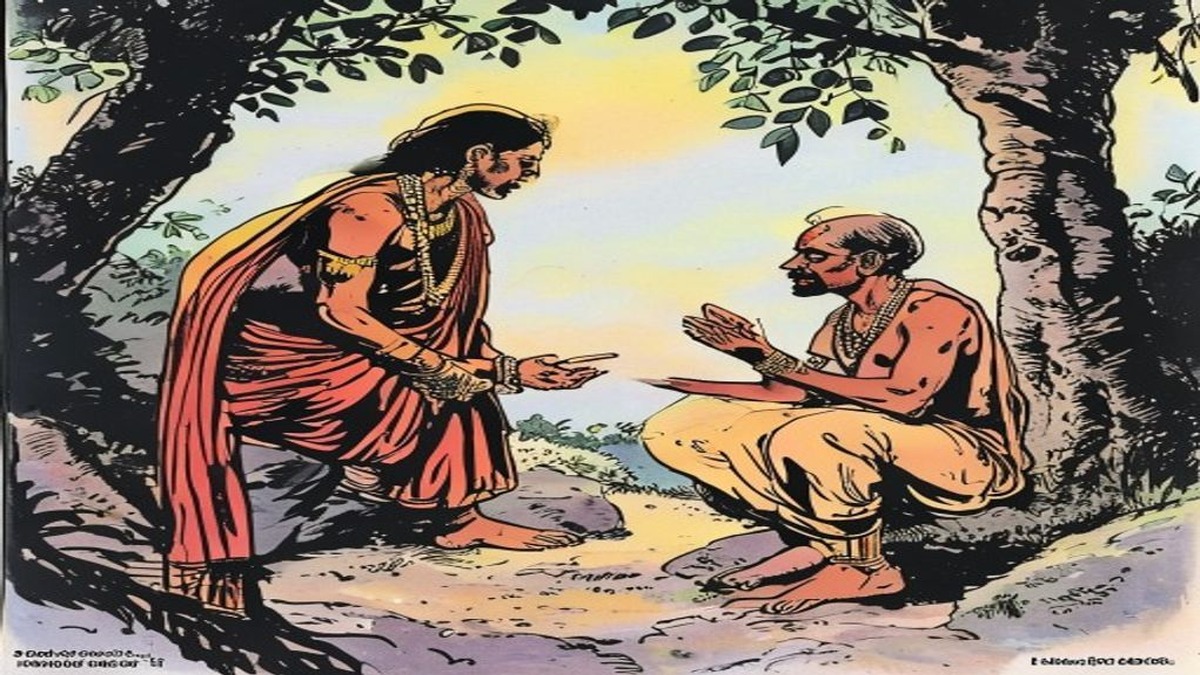
The Story of the Jackal and the Sanyasi: Once upon a time, in a lonely matha, there lived a Sanyasi called Dev Sharma. Many people sed to visithim and present

The Story of the Jackal and the Sanyasi
Origin and Manuscript Tradition
This tale belongs to a cluster of Panchatantra stories that examine the relationship between religious virtue and practical discernment. Vishnu Sharma was deeply sceptical of piety that operated without intelligence: in his framework, a holy man who cannot distinguish a genuine supplicant from a calculating one is not virtuous but merely credulous, and credulity in a position of authority causes the same harm as malice but claims the moral exemption of good intentions. The story survives in the Tantrakhyayika and Purnabhadra recensions with only minor variations, and its core argument — that dana (charity) without viveka (discernment) is a form of foolishness — runs through the entire Panchatantra as one of its organising moral principles.
The Sanyasi’s Open Hand
A sanyasi of genuine attainment lived alone in a forest hermitage, subsisting on forest fruit and whatever rice and grain his disciples brought as offerings. He was known throughout the region for his open hand: no creature that came to his door was turned away. Birds ate from the grain he scattered each morning; deer and monkeys ate from his garden; wandering ascetics and householders in difficulty were given food and shelter without question. He saw his giving as an expression of the universal consciousness in which all beings participated, and he asked no questions of those who received it.
A jackal named Chandraraka had been watching the hermitage for some days from the wood’s edge. He had noted the rhythm of the sanyasi’s giving, the absence of any gate or guard, and the complete lack of discrimination between one supplicant and another. The sanyasi gave to anyone who came close enough to receive. A jackal who approached respectfully, without aggression, without bared teeth, moving slowly as a suppliant rather than a predator, would likely receive what the birds and monkeys received.
Chandraraka had no religious feeling whatsoever. He did, however, have patience and an accurate understanding of human psychology as filtered through his considerable experience of humans at the edge of forests. He waited until dusk, arranged his ears in a submissive angle, tucked his tail, and walked slowly to the hermitage entrance. The sanyasi looked up from his meditation. The jackal sat and waited. The sanyasi placed a portion of cooked rice at the threshold. Chandraraka ate it quietly, bowed his head — or produced a gesture close enough to a bow that the sanyasi interpreted it as one — and withdrew into the trees.

The Escalation of Entitlement
Chandraraka returned the next evening, and the next. By the end of the first week the sanyasi was leaving food at the threshold without waiting to be asked. By the end of the second week, Chandraraka was arriving at midday as well as dusk. The sanyasi, delighted by what he interpreted as a deepening spiritual bond with a wild creature, began giving larger portions. He mentioned to his disciples that the jackal was surely a spiritually advanced being in animal form, perhaps working through the last stages of a previous life’s karma before a higher rebirth.
The disciples were less enchanted. One of them, a young man named Devashakti who had studied with the sanyasi for three years, observed that the jackal was growing bolder by the day — no longer waiting at the threshold but entering the outer courtyard, no longer eating quietly but watching the sanyasi’s store-rooms with the focused attention of an animal calculating quantities. He raised this with his teacher. The sanyasi replied that all beings deserved compassion and that suspicion was a lower form of consciousness. Devashakti bowed and said nothing further, but he continued to watch.
By the third week Chandraraka had begun testing the limits more explicitly. He entered the inner courtyard. He approached the sanyasi’s sleeping mat while the old man dozed. He investigated the clay pots where the grain was stored and was only deterred by the fact that he lacked hands. He was no longer performing submission; he was conducting an inventory.

The Disciple’s Intervention
Devashakti returned from the forest one afternoon to find Chandraraka standing over the sanyasi’s manuscript chest, which had been knocked open. The jackal looked at him without flinching. Devashakti picked up a stick, not aggressively but firmly, and held his ground. The jackal assessed the situation for a moment, decided the calculation had shifted, and withdrew from the courtyard at a pace that was neither hurried nor submissive — the pace of a creature that is leaving because it has decided to leave, not because it is afraid.
That evening Devashakti described what he had seen to the sanyasi. The old man listened in silence. He asked where the jackal was now. Devashakti said it was sitting at the treeline, watching. The sanyasi looked in that direction for a long time. He did not stop feeling compassion for the jackal, but he recognised that compassion and food had been used as instruments of access rather than received as gifts, and that the access being sought was not spiritual. He placed no food at the threshold that evening. The jackal waited until dark and then moved on to the next settlement.
The sanyasi told Devashakti: “Charity given without discernment does not cultivate virtue in the receiver; it cultivates expectation. And expectation, once cultivated, becomes entitlement. I was not practising dana. I was manufacturing a dependency that would eventually have required me to either keep feeding it or expel it with force. Neither is wisdom.”

Moral and Sanskrit Wisdom
विवेकहीनं दानं न फलं ददाति
Vivekaheenam daanam na phalam dadaati — “Charity without discernment does not yield its fruit.”
— Sanskrit proverbial tradition, Panchatantra I
The Sanskrit concept of sadaana (right giving) requires that dana be given to the right person, at the right time, in the right amount, with the right intention. Vishnu Sharma does not argue against generosity; he argues that generosity operating without discernment is not generosity but a failure of the discriminating faculty that is, in his ethical system, the primary instrument of the wise person. The sanyasi’s error was not that he gave but that he gave without attending to what he was building.
Why This Story Has Lasted 2,300 Years
The tale endures because the dynamic it describes — the exploitation of virtue by the calculating — is both perennial and uncomfortable. Every tradition that values generosity must also grapple with the fact that generosity, systematically applied without discernment, creates incentives for exactly the behaviour the sanyasi encountered. Vishnu Sharma does not resolve this tension by arguing for less generosity; he resolves it by arguing for more attention to what the generosity is producing in the receiver over time.
The jackal’s behaviour follows a pattern that ethologists and behavioural economists have both documented independently: reward given without conditions or boundaries escalates the rewarded behaviour and reduces the effort invested in earning it. Chandraraka’s arc from submissive visitor to entitled resident maps precisely onto what psychologists call the escalation of demands in relationships structured around unconditional giving. The sanyasi’s students could see this happening; only the sanyasi himself, committed to a framework of universal compassion that had no mechanism for differential response, could not.
The story’s resolution is notably gentle. The sanyasi does not condemn the jackal, does not pursue it, does not ask for the food returned. He simply stops providing the reward and the jackal moves on. This is the minimum effective intervention: not punishment, not confrontation, not elaborate exclusion, but the withdrawal of the thing that was being exploited. Vishnu Sharma consistently favours minimum effective intervention in the Panchatantra — the response precisely calibrated to the problem rather than the response that expresses the full intensity of the offended party’s feelings.
Frequently Asked Questions
What is the moral of the Jackal and the Sanyasi?
Charity without discernment cultivates entitlement rather than virtue. The sanyasi's unconditional giving transformed a cautious visitor into a bold intruder. Right giving requires attending to what the generosity is producing in the receiver over time.
What does the Sanskrit term viveka mean in this context?
Viveka means discriminating wisdom or discernment — the faculty that distinguishes one thing from another. In the Panchatantra's ethics, viveka applied to charity means giving to the right person, in the right amount, at the right time, for the right purpose.
Which Panchatantra book is this story from?
The tale belongs to Panchatantra Book I (Mitra-bheda, The Separation of Friends), compiled by Vishnu Sharma around the 3rd century BCE as part of a royal education in practical wisdom and governance.
Why does the disciple Devashakti see the jackal's danger when the sanyasi cannot?
The sanyasi is committed to a framework of universal compassion that has no mechanism for differential response. Devashakti, without that ideological commitment, simply watches what is happening rather than interpreting it through a predetermined lens.
What is the concept of sadaana in Sanskrit tradition?
Sadaana (right giving) holds that true dana must be given to the right recipient, at the right time, in the right quantity, and with the right intention. Giving that meets none of these conditions is not virtue but a failure of the discriminating faculty.
You May Also Like
 Panchatantra Stories
Ages 9-12
Panchatantra Stories
Ages 9-12
The Unforgiving Monkey
The Unforgiving Monkey: Chandra was a king, whose sons kept a group of monkeys as pets. These monkeys were treated as royal pets, and were provided with the
 Panchatantra Stories
Ages 6-8
Panchatantra Stories
Ages 6-8
The Greedy Cobra and the King of Frogs
Read 'The Greedy Cobra and the King of Frogs' — a classic Panchatantra story about moral lessons about greed. The Greedy Cobra and the King of Frogs is ...
 Panchatantra Stories
All Ages
Panchatantra Stories
All Ages
The Story of Vajradaunstra the Lion and Chaturaka the Jackal
The Story of Vajradaunstra the Lion and Chaturaka the Jackal: In a jungle, there lived a lion by the name of Vajradaunstra. A jackal called Chaturaka and a