The Story of the Lion and the Donkey
The Story of the Lion and the Donkey: In a certain jungle, there lived a lion, by the nameof Karalakesara. He had a servant, a jackal named Dhusaraka, who was
Origin & Canonical Placement
“The Story of the Lion and the Donkey” is a compact and comic fable of misplaced confidence, inappropriate role-assumption, and the swift reckoning that awaits those who mistake association with the powerful for a share of the powerful’s actual capabilities. The tale belongs to Vishnu Sharma’s Pancatantra (c. 300 BCE–300 CE) and appears in related Sanskrit collections including the Hitopadesha. It is thematically aligned with Book III: Kakolukiyam (“Of Crows and Owls”), which examines the dynamics of power, service relationships, and the catastrophic errors that arise from miscalibrated self-assessment in dangerous contexts.
“Mahabalasamyogat durbalopi balavantah bhavet iti manyamanam nashayati.”
“He who imagines himself made powerful through association with the strong destroys himself.”
— Panchatantra maxim, Book III tradition
Beat I — The Partnership: The Lion and His Unusual Collaborator
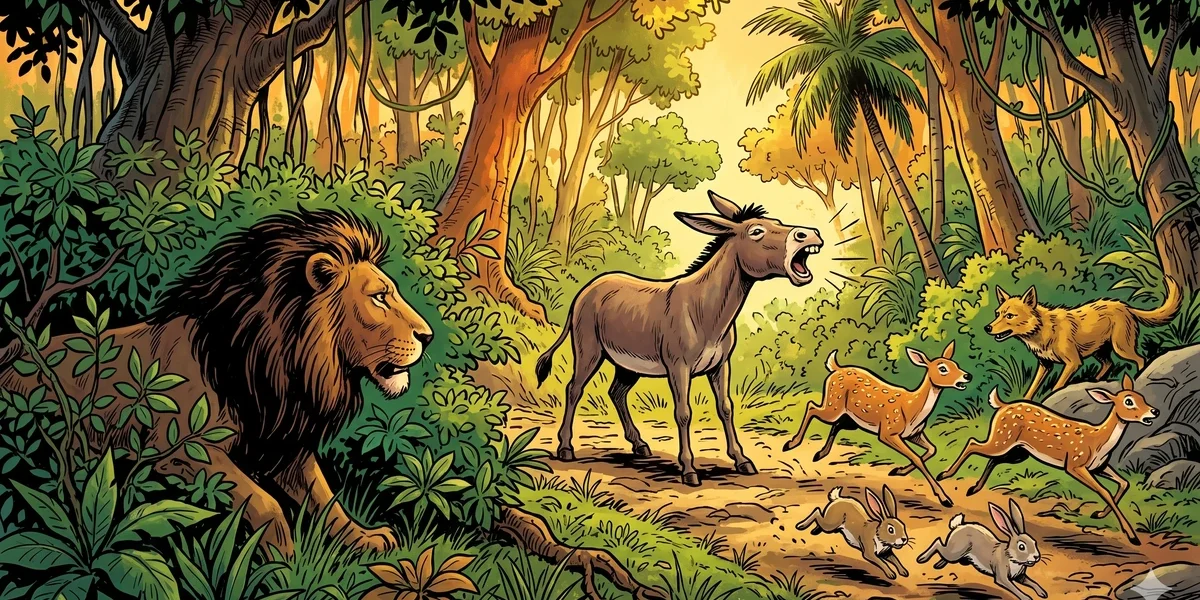
A lion who had grown old and found sustained hunting increasingly difficult entered into an unusual arrangement with a donkey. The donkey, who was considerably more agile in rough terrain than the lion and possessed a formidable bray, would serve as a beater — crashing through the undergrowth and braying loudly to startle deer and other prey animals into flight. The panicked animals would then run directly into the lion’s waiting ambush. The lion would make the kill and share a portion of the meat with the donkey. It was an efficient division of labour: the donkey contributed noise and mobility; the lion contributed lethal capability and the authority of his presence.
The arrangement worked well. The donkey became accustomed to the hunt’s successful rhythm and — crucially — began to associate himself with the lion’s power rather than merely with the lion’s service. He saw frightened animals fleeing before him and began to believe that they feared him, rather than the lion behind them. He saw the kills made and began to feel that he was, in some meaningful sense, a hunter. The lion, for his part, was pleased with his assistant and gave him no reason to examine these assumptions more carefully.
Beat II — The Overreach: A Donkey Who Thinks He Is a Lion
One day the donkey, flushed with accumulated confidence, declared that he wished to make a kill himself. The lion, amused and perhaps curious, withdrew to watch. The donkey selected a target — a large deer — and charged at it with all the momentum and noise he could muster, fully expecting the same result he produced every day in partnership with the lion. The deer, who had fled the donkey’s bray before because the lion was behind it, now simply stopped, assessed the situation, and walked away. The donkey pursued. The deer accelerated into the forest. The donkey gave chase, braying with increasing frustration, and returned eventually empty-handed, winded, and profoundly confused.
The lion watched this sequence with the patience of a creature who already knew its outcome. When the donkey returned, the lion explained, with some economy of words, what had just been demonstrated: the animals had never feared the donkey. They had feared what stood behind the donkey. The donkey’s noise and movement were useful instruments in the lion’s hands; on their own, they were simply a donkey making noise in a forest. The partnership was valuable precisely because each party contributed what it could actually contribute — not what it imagined it could contribute through proximity to the other.
Beat III — The Analysis: The Difference Between Reflected Power and Real Power
Vishnu Sharma’s analysis of this tale focuses on the distinction between instrumental power — the capacity to function effectively as a tool in someone else’s strategy — and independent power — the capacity to execute a strategy on one’s own. The donkey possessed the former in abundance: his bray was genuinely useful, his terrain-crossing agility genuinely valuable, his contribution to the partnership genuinely real. What he lacked was the capacity to convert these qualities into outcomes without the lion’s lethal capability completing the sequence.
The error the donkey makes is not merely self-aggrandisement; it is a specific cognitive failure that the Panchatantra tradition identifies as one of the most dangerous in political and military contexts. It is the confusion of nimitta (instrumental cause) with karana (efficient cause) — mistaking the trigger for the engine. The donkey was the nimitta of every kill: he set the animals running. But the lion was the karana: he was the actual source of the outcome. An advisor who mistakes his role in setting an agenda for authorship of the policy that follows makes the same error; a general who mistakes his logistical contribution to a campaign for the decisive military capability that won it makes the same error.
Kautilya’s Arthashastra is attentive to precisely this distinction in its treatment of ministers, counsellors, and commanders. The most valuable subordinate is one who knows exactly what he contributes and what remains the ruler’s independent prerogative — and who does not mistake access to power for possession of it.
Beat IV — Moral Dimension & Enduring Relevance
The tale’s moral speaks to the permanent human tendency to appropriate reflected status. We tend to attribute our achievements, when they occur in collaboration, to our own capability — and to assume that the capabilities that made the collaboration work are transferable to independent contexts. The donkey’s experience on the hunt that day was, in every superficial respect, identical to his experience on previous days: he charged, he brayed, the animals moved. That the outcome was entirely different reveals how much of the previous days’ success had depended on the context he had not fully perceived.
This insight applies with particular force to careers built within large, powerful institutions. An individual who has developed expertise and influence within a major organisation, then attempts to transfer the same approach to an independent context, often discovers that much of what they attributed to personal capability was in fact institutional: the brand, the relationships, the resources, the implied authority of the institution’s presence behind every interaction. The lion was always behind the donkey. When the donkey hunts alone, the lion is no longer behind him, and the forest knows it.
The Panchatantra’s counsel is not against ambition or against attempting independent action — it is against unexamined ambition, against the assumption that success in one context automatically transfers to another. The wise donkey would have asked: “When the animals run, is it from me or from what stands behind me?” That question, asked honestly, is the beginning of accurate self-knowledge.
Moral: Know the source of your power before you act on it alone; what you achieve through association with the strong is not the same as what you can achieve through your own strength.
Why This Story Has Lasted 2,000 Years
“The Story of the Lion and the Donkey” endures because the donkey’s delusion — that proximity to power is the same as possession of power — is one of the most consistently renewable errors in human social life. It appears in courts, corporations, armies, and households wherever a weaker party finds itself reliably useful to a stronger one and begins to conflate utility with capability. The image of the donkey pursuing an unimpressed deer through a forest, braying with mounting frustration, is funny in the way that only deeply recognisable errors can be funny — we laugh, and we know exactly which version of the donkey we have been, or may be, or may meet tomorrow.
About the Panchatantra
The Panchatantra (“Five Treatises”) was composed in Sanskrit by the scholar Vishnu Sharma around 300 BCE–300 CE as a niti-shastra — a guide to wise conduct and statecraft — framed as animal fables for the instruction of young princes. Its five books cover the dissolution of allies, the winning of allies, war and peace, the dangers of naivety, and the hazards of rashness. The text spread westward through Pahlavi and Arabic translations to become the most widely translated secular book of the ancient world after the Bible.
You May Also Like
 Panchatantra Stories
Ages 9-12
Panchatantra Stories
Ages 9-12
The Story of the Elephant and the Sparrow
The Story of the Elephant and the Sparrow: Somewhere in the jungle, a pair of sparrows hadmade their nest in a Tamal tree. In due course, thefemale sparrow
 Panchatantra Stories
Ages 6-8
Panchatantra Stories
Ages 6-8
Of Crows and Owls
Of Crows and Owls: Keep your counsel to yourself and thus stay away from trouble.” Once upon a time, all the birds the swans, cranes, parrots, cuckoos, owls
 Panchatantra Stories
Ages 3-5
Panchatantra Stories
Ages 3-5
The Story of the Lion, the Jackal and the Cave
The Story of the Lion, the Jackal and the Cave: In a certain part of the jungle, there lived a lion, by the name of Kharanakhara. One day, he felt hungryand