The Story of the Lion, the Jackal and the Cave
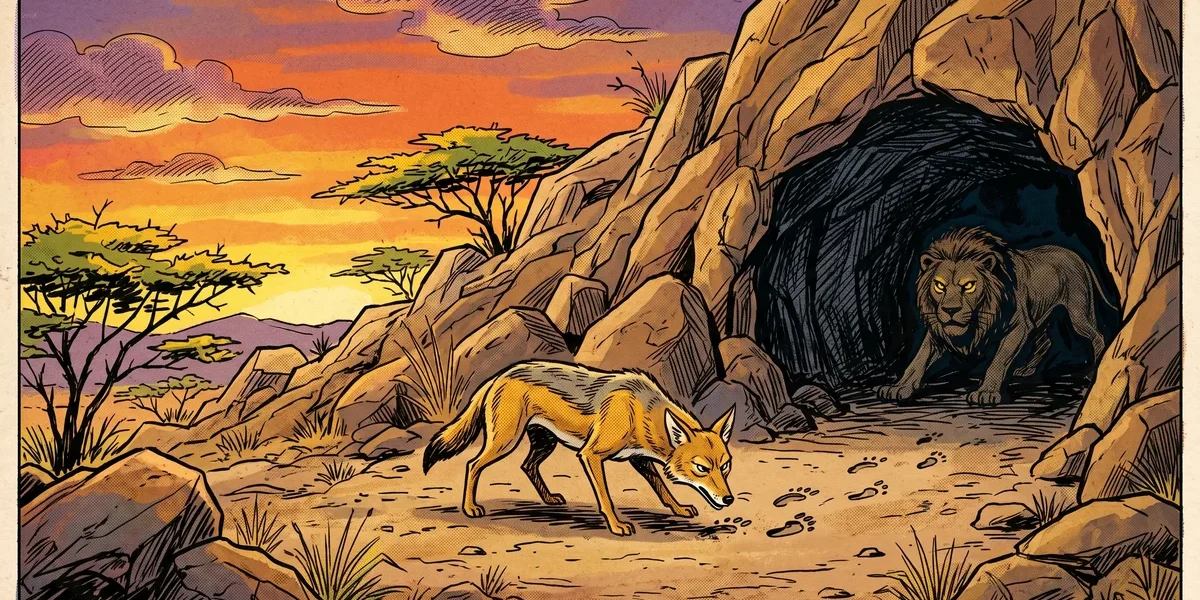
The Story of the Lion, the Jackal and the Cave: In a certain part of the jungle, there lived a lion, by the name of Kharanakhara. One day, he felt hungryand
The Story of the Lion, the Jackal and the Cave
Canonical Attribution and Manuscript Tradition
This tale is preserved in the major Sanskrit recensions of the Pancatantra including the Tantrakhyayika (c. 200 BCE, Kashmir) and the Hitopadesha. A jackal has been using a cave as his dwelling. A lion, hunting in the area, enters the cave to rest and wait for prey. The jackal, returning to find fresh lion tracks leading into but not out of the cave, assesses the situation through inference rather than direct observation and devises a plan: he calls out to the cave, claiming that it is the custom of the cave to reply when he returns. The lion, inside and not knowing how to evaluate this unusual situation, roars in reply. The jackal, confirmed in his inference, flees. The tale demonstrates the supremacy of inference-based reasoning over both direct observation and brute force in conditions of information asymmetry.
Beat I — The Tracks and the Inference
The jackal returned to his cave and found what he did not expect: large paw prints in the earth at the entrance. He examined the prints carefully. They were lion prints, clearly; they led into the cave; he could find no corresponding prints leading out. The inference was direct: a lion had entered the cave and had not left. If the jackal entered, he would be entering the lion’s current position.
The Pancatantra’s account of the jackal’s reasoning is one of its most explicit treatments of inference (anumana) as a pramana (valid source of knowledge). The jackal did not see the lion; he could not, from outside the cave, directly observe whether the lion was present. But he had evidence from which the lion’s presence could be reliably inferred. The inference was not certain — there might be an exit he had not found, or the prints might have been made some time ago and the lion might have left through a different route — but it was strong enough to treat as a reliable guide to action. The jackal acted on the inference rather than entering to verify through direct observation.
Beat II — The Stratagem
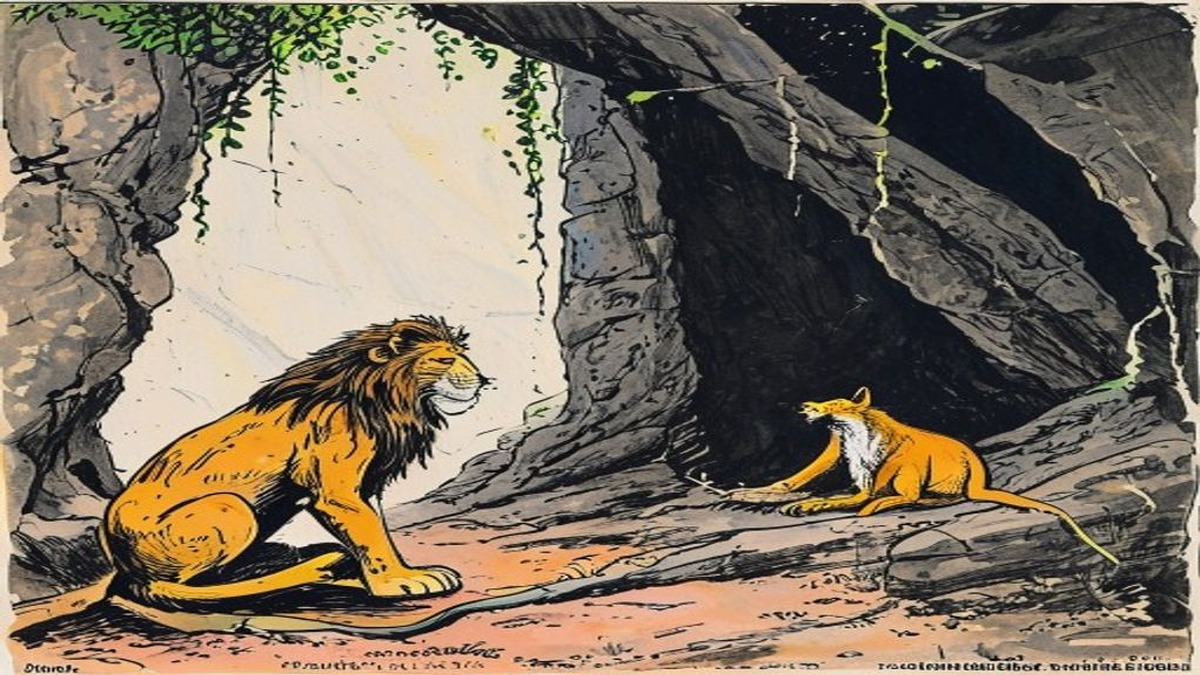
Rather than fleeing immediately — which would have been safe but would have cost him his dwelling — the jackal devised a plan to confirm his inference while managing the risk of direct confrontation. He called out to the cave in a loud voice, saying: “O Cave! You know it is our custom that when I return, you always call out to greet me. Why are you silent today?” He then waited.
The lion, inside the cave and faced with an unexpected situation, reasoned through it incorrectly. He did not know whether caves in this region had such a custom; he had no basis for evaluating the claim. If the cave’s failure to respond would cause the jackal to leave without entering, the lion would lose his prey. To prevent the jackal’s departure, the lion called out in a roar from inside the cave — performing the role of the cave greeting its returning inhabitant. The roar confirmed the jackal’s inference absolutely and with vivid precision. The jackal fled.
Beat III — The Lion’s Error and Its Cause
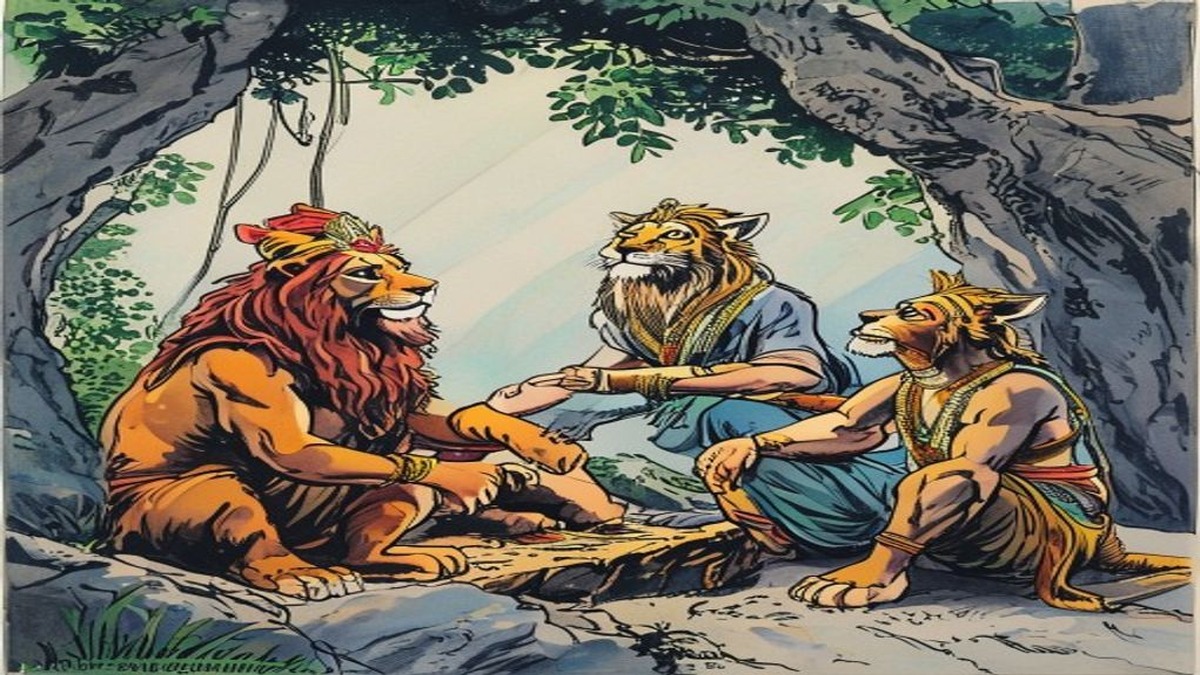
The Pancatantra’s analysis of the lion’s error is as important as its account of the jackal’s success. The lion was not stupid; he was reasoning under conditions of genuine uncertainty about an unusual claim. He did not know whether caves in this region greeted their inhabitants; he had no prior experience of this custom, but he also had no basis for definitively disconfirming it. His error was the specific one of reasoning backward from his desired outcome: he wanted the jackal to enter, so he took an action (roaring) that would make this more likely, without adequately considering that the same action would reveal his presence to the jackal if the jackal was already suspicious.
The lion’s reasoning failure is the inverse of the jackal’s success. The jackal reasoned forward from evidence to conclusion; the lion reasoned backward from desired outcome to action. Forward reasoning from evidence is epistemically sound; backward reasoning from desired outcome is epistemically corrupted by the desire. The lion’s desire for prey distorted his processing of the unusual situation, causing him to take an action that served his desire in the short term and destroyed it in the medium term.
Beat IV — What the Lion, the Jackal and the Cave Teaches About Inference and Information
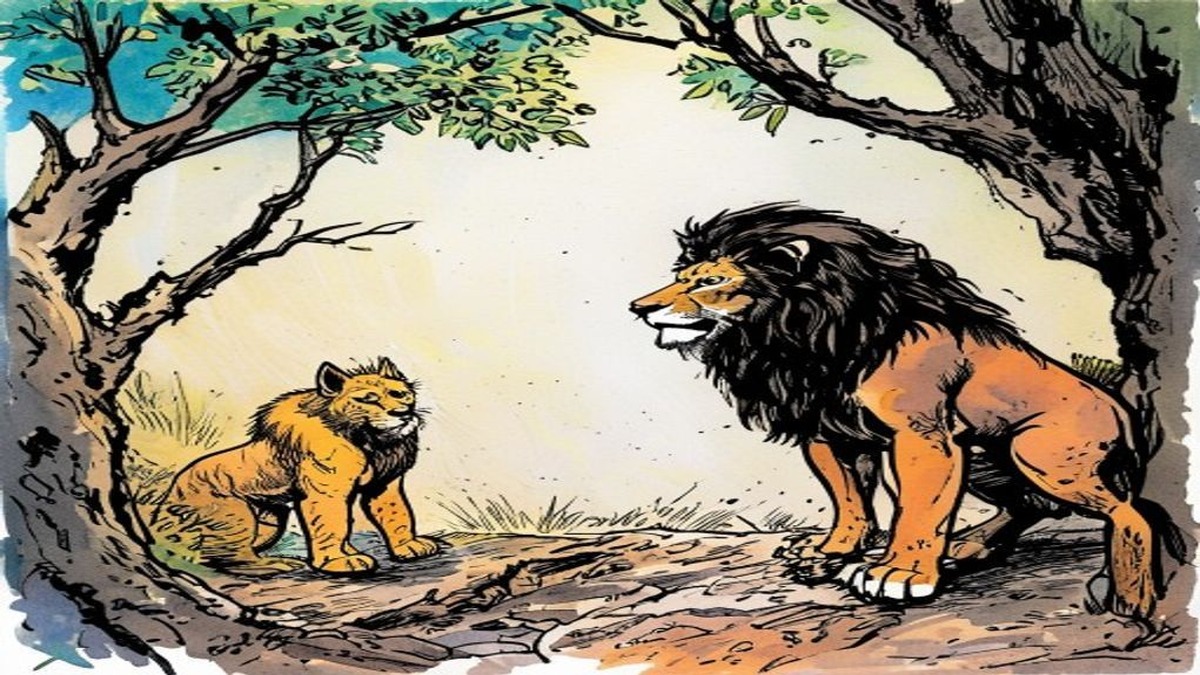
Vishnu Sharma’s argument in this tale is epistemological and strategic simultaneously. The jackal’s survival was the product of superior reasoning under conditions of information asymmetry: he inferred what he could not directly observe, designed a test that would confirm or disconfirm his inference at minimal risk, and acted on the confirmed inference with speed. The lion’s failure was the product of inferior reasoning under the same conditions: he reasoned backward from his desired outcome, took an action that served his desire without adequately considering its other effects, and revealed himself.
For Vishnu Sharma’s royal pupils the strategic application is direct. The weaker party facing a stronger opponent in conditions of information asymmetry — where neither party can directly observe the other’s intentions or positions — wins through superior inference and the strategic use of tests designed to elicit revealing responses from the stronger party. The Arthashastra’s extensive treatment of intelligence operations rests on exactly this premise: the king who knows more about the adversary’s situation than the adversary knows about the king’s situation has a decisive advantage regardless of the balance of forces.
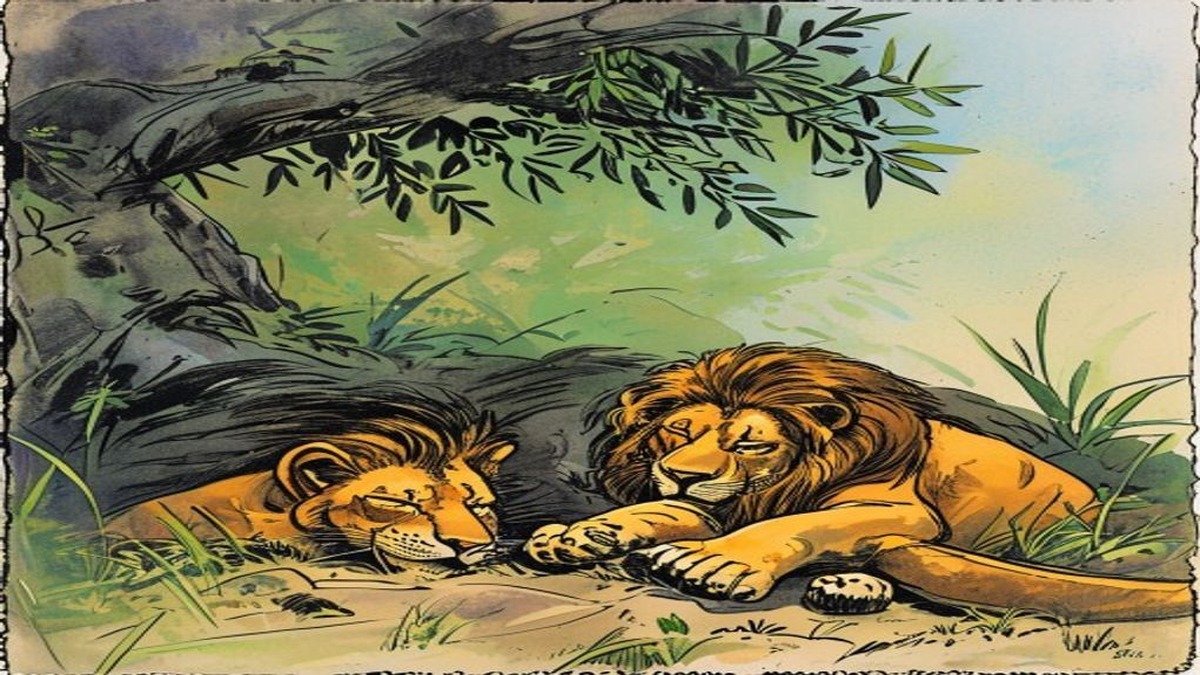
Moral and Sanskrit Wisdom Tradition
“Reason forward from evidence to conclusion; the one who reasons backward from desired outcome to action will give himself away.”
— Moral of The Story of the Lion, the Jackal and the Cave, Pancatantra Book III (Kakolukiyam)
This moral engages the Sanskrit epistemological tradition’s treatment of anumana (inference) as the most reliable pramana for situations where direct perception is unavailable. The Nyaya school identifies anumana as the second of the four pramanas and provides extensive treatment of valid and invalid forms of inference. The Pancatantra’s practical application is that correct inference under conditions of uncertainty is the foundation of effective action, and that desire-driven reasoning — reasoning backward from outcome to action — is the most common and most dangerous form of invalid inference. The lion’s roar is the canonical example of what desire-driven reasoning produces: an action that achieves the opposite of its intended outcome.
Why This Story Has Lasted 2,300 Years
The Story of the Lion, the Jackal and the Cave endures because the contrast it presents — forward reasoning from evidence versus backward reasoning from desired outcome — is the fundamental distinction between effective and ineffective reasoning under uncertainty. The jackal’s method is correct: gather available evidence, infer the most probable situation, design a low-cost test, act on the confirmed inference. The lion’s method is incorrect: identify the desired outcome, take the action that serves it most directly, fail to consider the action’s other effects. The Pancatantra’s demonstration of this contrast through a physical confrontation between a small, intelligent animal and a large, powerful but reasoning-impaired one is among its most memorable and most durable contributions to the practical literature on thought and action.
Sanskrit Tradition: Tantrakhyayika (c. 200 BCE, Kashmir); Hitopadesha
Key Concept: Anumana (inference) as pramana; forward reasoning from evidence vs. backward reasoning from desired outcome; information asymmetry; testing to confirm inference at minimal risk
Author: Vishnu Sharma (attributed, c. 3rd century BCE)
Arthashastra Parallel: Intelligence superiority as strategic advantage; knowledge of the adversary’s situation as force multiplier regardless of the balance of forces
Frequently Asked Questions
What is the moral of the Story of the Lion, the Jackal and the Cave in the Panchatantra?
The moral is to reason forward from evidence to conclusion; the one who reasons backward from desired outcome to action will give himself away. The jackal inferred the lion's presence from tracks, designed a low-risk test, and fled when the test confirmed his inference. The lion, reasoning backward from his desire to catch the jackal, roared to make the jackal enter — an action that achieved the exact opposite of its intended outcome by confirming the jackal's suspicion.
What happens in the Story of the Lion, the Jackal and the Cave in the Panchatantra?
A jackal returns to his cave to find lion tracks leading in but not out. He infers the lion is inside, then calls out: 'Cave, why do you not greet me as is our custom?' The lion, wanting to prevent the jackal from leaving, roars in reply. The roar confirms the jackal's inference absolutely. The jackal flees. The lion has revealed himself through desire-driven reasoning: he took the action most likely to achieve his immediate goal without considering its other effects.
How does the jackal use inference (anumana) to survive in this Panchatantra story?
The jackal applies classical anumana (inference): he gathers available evidence (tracks leading in, none leading out), infers the most probable situation (lion is inside), and designs a low-cost test to confirm or disconfirm before committing to action. The test — calling out about the cave's greeting custom — is brilliant because it costs nothing if wrong but produces irrefutable confirmation if right. The lion's roar is both the confirmation the jackal needed and the demonstration that the jackal's inferential method was correct.
What reasoning error does the lion make in this Panchatantra story?
The lion reasons backward from his desired outcome: he wants the jackal to enter the cave, so he takes the action (roaring) most directly serving this desire. He does not adequately consider the action's other effects — specifically, that if the jackal is already suspicious, the roar will confirm the suspicion and cause flight rather than entry. This desire-driven backward reasoning is the inverse of the jackal's evidence-driven forward reasoning. The lion's physical superiority is neutralised by his reasoning inferiority.
How does this story illustrate the Arthashastra's emphasis on intelligence superiority?
The Arthashastra argues that the king who knows more about the adversary's situation than the adversary knows about the king's has a decisive advantage regardless of the balance of forces. The jackal-lion encounter illustrates this at the individual scale: the jackal's superior knowledge (inferred from tracks) and superior testing strategy defeated a physically overwhelmingly superior opponent. The Arthashastra's extensive treatment of intelligence operations — gathering information, testing adversary intentions through probes — rests on the same principle the jackal demonstrates.
You May Also Like
 Panchatantra Stories
Ages 9-12
Panchatantra Stories
Ages 9-12
The Story of the Jackal Who Fell Into a Vat of Indigo Dye
The Story of the Jackal Who Fell Into a Vat of Indigo Dye: In a jungle, there lived a jac; kal by the name of Chandarava. One day he was very hungry, so he
 Panchatantra Stories
Ages 6-8
Panchatantra Stories
Ages 6-8
The Foolish Sage And The Jackal
The Foolish Sage And The Jackal: In a monastery far away from human habitation lived a saint called Deva Sarma. He amassed a lot of wealth by selling clothes
 Panchatantra Stories
Ages 6-8
Panchatantra Stories
Ages 6-8
The Elephant and the Sparrow
The Elephant and the Sparrow: Even the low and humble achieve results when they work together.” A couple of sparrows lived happily in their nest on top of a