The Elephant and the Sparrow
The Elephant and the Sparrow: Even the low and humble achieve results when they work together.” A couple of sparrows lived happily in their nest on top of a

The Elephant and the Sparrow
Canonical Attribution and Manuscript Tradition
This tale belongs to Pancatantra Book I, Mitra-bheda, and illustrates one of the collection’s most developed themes: the power of collective solidarity among the weak against an overwhelming aggressor. The story is preserved in all major Sanskrit recensions including the Tantrakhyayika (c. 200 BCE, Kashmir) and paralleled in the Hitopadesha. In its structure it belongs to the widespread type of the small creature achieving revenge through the mobilisation of allies, a pattern that appears across Aesopic tradition (the mouse releasing the lion), Jataka literature, and later European fable collections. The tale’s particular contribution to the Pancatantra’s didactic programme is its demonstration that individual weakness need not mean collective helplessness: a sparrow, unable to confront an elephant alone, recruits a woodpecker, a fly, and a frog, and through their coordinated action achieves a result no single creature could have managed. The moral belongs to the Pancatantra’s sustained argument that intelligence and alliance are the proper substitutes for physical power in asymmetric conflicts.

Beat I — The Injury and the Vow
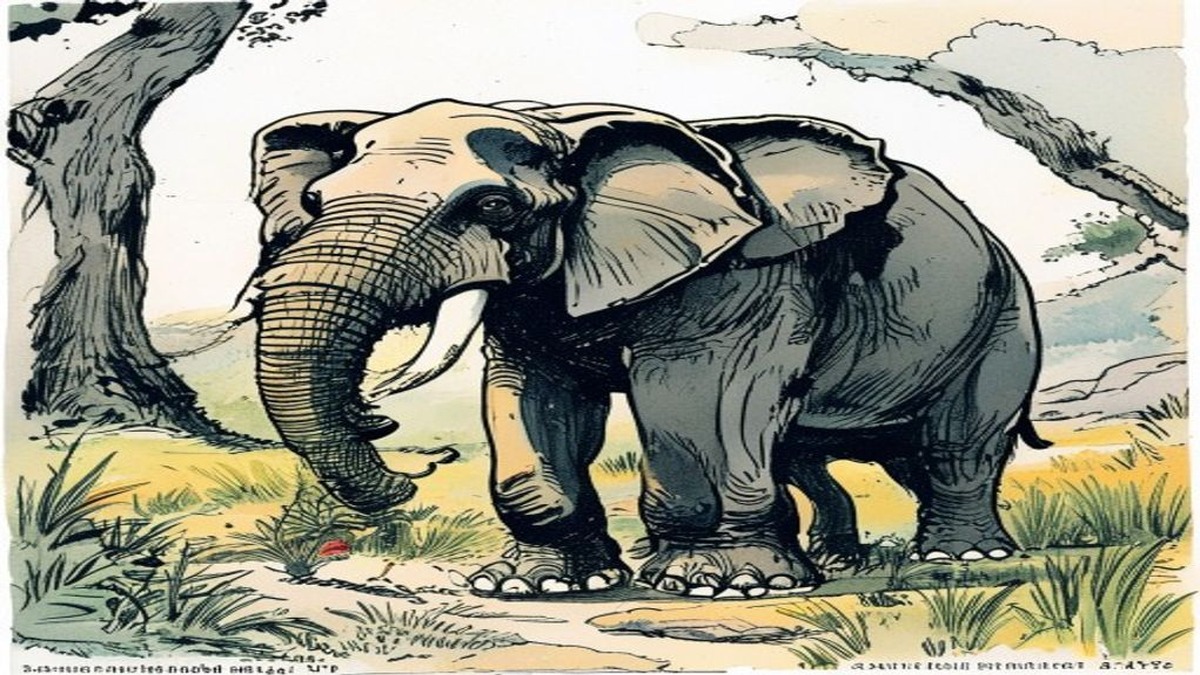
A pair of sparrows nested in a large tree. The female sparrow was about to lay eggs when a bull elephant, moving through the grove in heat, struck the tree with his trunk, breaking the branch that held the nest. The eggs fell and shattered. The female sparrow, her young lost before they had hatched, cried out in grief. The male sparrow came to her and found her inconsolable.
The female sparrow’s grief turned to something harder: she declared that the elephant would be punished. The male sparrow did not counsel acceptance or resignation. He too vowed that retribution would be sought. This is the tale’s first departure from the expected: two of the smallest birds in the forest making a vow of retribution against the largest land animal in it. The Pancatantra does not present this as foolishness or hybris. It presents it as the correct response. An injury without accountability is an invitation to further injury; the sparrows’ vow is the beginning of a process that will restore the principle of accountability to the grove.
Beat II — The Alliance Assembled
The male sparrow went first to a woodpecker, his friend, and told the story. The woodpecker agreed immediately to help and asked what was needed. The sparrow said: first, a fly. The woodpecker knew a fly who owed a debt of friendship and went to her. The fly also agreed and asked what was needed. The sparrow said: a frog. The fly knew a frog, went to him, and told him the story. The frog also agreed.
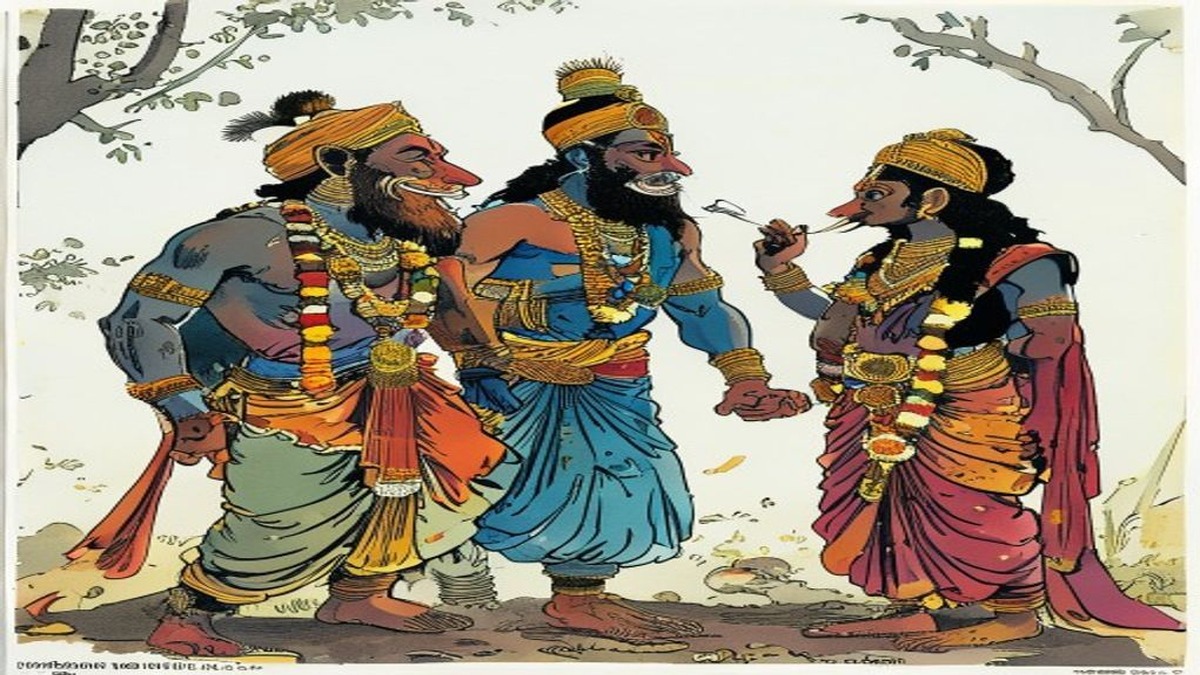
The four creatures met and the frog, the most strategically minded of the group, laid out the plan. It was elegant in its precision. The fly would find the elephant during midday rest and hum inside his ears until he closed his eyes in pleasure. While his eyes were closed, the woodpecker would blind him, gouging out both eyes. Blinded and in pain, the elephant would be driven by thirst to seek a water hole. The frog would call from a dry pit rather than from a real pond, leading the elephant toward the sound. The elephant would follow the frog’s calls and fall into the pit.
Beat III — The Execution
The plan was executed in sequence. The fly found the resting elephant and hummed softly inside his ears; the elephant, soothed, closed his eyes. The woodpecker struck swiftly and blinded him. The elephant lurched to his feet in agony, trumpeting, stumbling. Thirst overtook him. He began to move, seeking water. The frog called from the dry pit. The elephant followed the croaking, expecting a pond, and fell into the pit. He could not rise. He died there.
Each step of the plan depended on the specific capability of one creature that no other member of the alliance possessed: the fly’s access to the elephant’s senses, the woodpecker’s beak and precision, the frog’s voice and its credibility as a guide to water. Remove any one element and the plan fails. The Pancatantra’s account is compressed but the interdependence is structurally explicit: this was not four creatures helping simultaneously; it was a sequential chain in which each link was necessary and irreplaceable.

Beat IV — What the Alliance Teaches About Power and Solidarity
Vishnu Sharma’s selection of this tale for Mitra-bheda is deliberate. The separation-of-friends book is concerned with the destruction that results when communities fragment under the influence of a manipulator. The elephant-and-sparrow tale offers the counter-argument: when a community unites around a shared injury, even the smallest and most seemingly powerless of its members can execute justice against the strongest aggressor.
The strategic architecture of the alliance is worth noting precisely. Each creature contributes only what it uniquely can: the fly’s intimacy with the elephant’s body; the woodpecker’s surgical capacity; the frog’s voice and its value as a directional signal. The sparrow, who initiated everything and whose injury justified everything, does not appear in the execution at all — their role was moral and organisational, not operational. This is the Pancatantra’s model of effective coalition: the injured party does not need to be capable of direct action; they need to be capable of building the alliance that includes those who are. The frog’s plan requires no physical strength from any participant. It requires only that each creature be deployed at the point where its specific nature is decisive.
Moral and Sanskrit Wisdom Tradition
“Even the weakest, united by a just cause and organised with precision, can destroy the strongest.”
— Moral of The Elephant and the Sparrow, Pancatantra Book I (Mitra-bheda)
This moral operates on two registers simultaneously. At the political level it is advice for courts and kingdoms: an alliance built around a shared injury and disciplined in its execution can overcome vastly superior individual power. The Kautilya Arthashastra makes parallel arguments under the doctrine of mandala — the circle of kings — where weaker states achieve through coordinated action what none could achieve alone. At the ethical level the moral makes a claim about justice: that the weakest are entitled to seek accountability from the strongest, and that this entitlement is not invalidated by the disparity in power. Vishnu Sharma does not counsel the sparrows to accept their loss. He shows that their refusal to accept it, combined with strategic clarity, is the only correct response to illegitimate power used without restraint.
Why This Story Has Lasted 2,300 Years
The Elephant and the Sparrow endures because it addresses a universal experience: the injury that cannot be answered directly. The sparrows cannot fight the elephant; no sparrow ever could. But the story insists that this physical fact does not end the matter. What it demands instead is a different kind of capacity — the ability to identify allies, to understand what each ally can contribute, and to design a plan in which those contributions combine into an outcome that individual strength could never achieve. The tale’s international parallels, from Aesop to the Jatakas, suggest how consistently this problem has resonated across cultures. The specific solution — solidarity organised around complementary capabilities — is one of the Pancatantra’s most durable contributions to political and ethical thought.
Sanskrit Tradition: Tantrakhyayika (c. 200 BCE, Kashmir); Hitopadesha; parallel in Buddhist Jataka literature and Aesopic tradition
Alliance members: Sparrow (injured), Woodpecker, Fly, Frog
Author: Vishnu Sharma (attributed, c. 3rd century BCE)
Core Principle: Coalition built on complementary capabilities, each member deployed at the point where their specific nature is decisive
You May Also Like
 Panchatantra Stories
Ages 3-5
Panchatantra Stories
Ages 3-5
The Brahmin & The Crooks
The Brahmin & The Crooks: Once a brahmin (holy man) received a goat as a gift after per forming a religious ceremony. The brahmin lifted the goat on his
 Panchatantra Stories
Ages 9-12
Panchatantra Stories
Ages 9-12
The Musical Donkey: A Panchatantra Fable
The Panchatantra's hard-edged little fable of Uddhata — the "haughty" washerman's donkey — who feasts on stolen cucumbers under the moon, mistakes his longing for talent, and brays the song that brings the farmers running with sticks. The story is found in Book V of the Panchatantra (Aparīkṣitakāraka, "Ill-Considered Action"), and it is one of Vishnu Sharma's quietest and most devastating lessons: a donkey called Raised On High is going to be brought low, and the only question is how.
 Panchatantra Stories
Ages 6-8
Panchatantra Stories
Ages 6-8
The Story of King Chandra
The Story of King Chandra: In a certain city, there lived a king, by the nameof Chandra. His sons kept a troop of monkeys. Theyal ways fed them on a variety of