The Lioness and the Young Jackal
A warm Indian folk tale about a lioness who raises an orphan jackal alongside her own cubs — and the gentle lesson about who we really are.

The Lioness and the Young Jackal
Source: Panchatantra, Book I — Mitrabheda (The Separation of Friends), attributed to the sage Vishnu Sharma, composed c. 300 BCE–300 CE; this redaction follows the Sanskrit text edited by Franklin Edgerton (American Oriental Society, 1924) and the annotated translation by Chandra Rajan (Penguin Classics, 1993).
स्नेहं न जायते जात्या, जायते सेव्यमानतांः
A lioness finds a jackal cub orphaned in the forest and raises him alongside her own cubs. The young jackal grows up believing himself a lion — in courage, in identity, in his sense of what he owes the world. When the moment of truth arrives and a real threat reveals his nature to himself, the story refuses the easy ending: it asks instead whether the courage that family teaches can substitute for the courage that blood provides, and concludes, with characteristic Panchatantra complexity, that it can — but only if the jackal understands what he truly is.
Part I: The Adoption
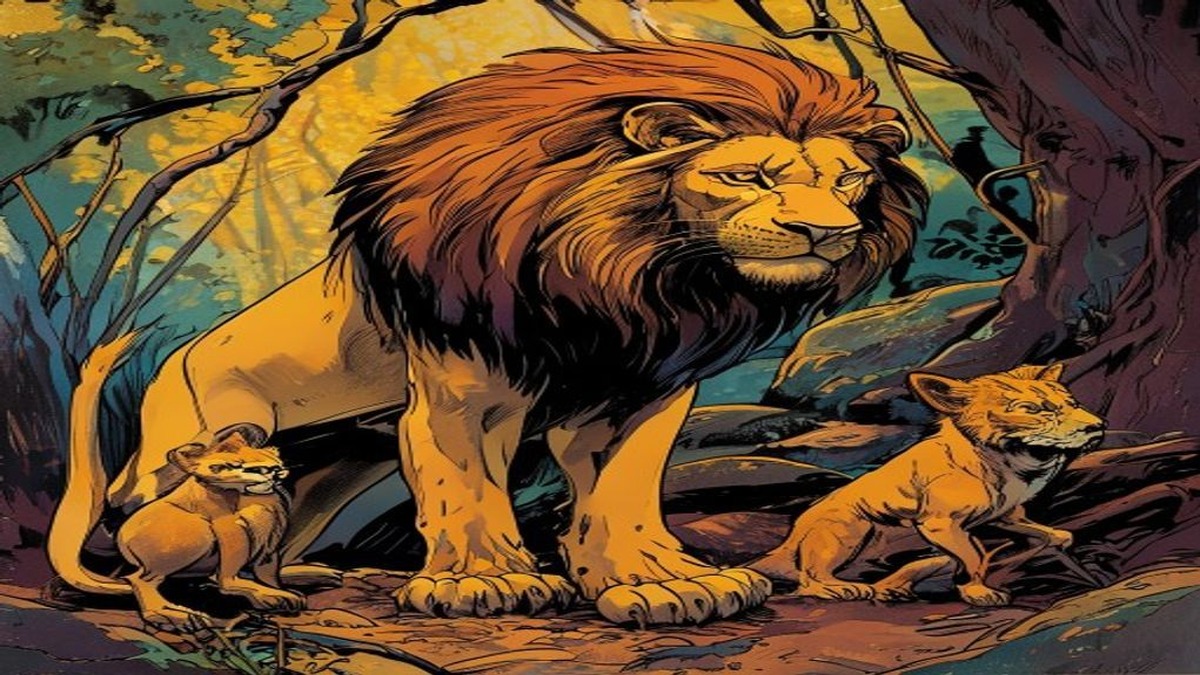
On a morning when the monsoon rains had flooded the lower forest, the lioness Chandravati was returning from a hunt when she found a jackal cub wedged in the hollow of a fallen sal tree. He was very young — perhaps ten days old, still unopened to the world in the full sense, his ears too big for his head, his cry a thin sound almost lost in the rain. No parent came when Chandravati waited. The flood had taken everything below the ridge; she could smell it in the mud around the cub’s hollow.
Chandravati carried the cub home in her mouth. Her own two cubs were three weeks older, already beginning to wrestle and explore the boundaries of the den. She placed the jackal cub among them with the instinctive economy of a mother who has milk and sees need. The question of species did not arise in her mind; it rarely does in the minds of nursing animals confronted with an infant.
The jackal cub, whom the storyteller names Shrigala, fed alongside the lion cubs through the monsoon. He grew more slowly — his frame would never approach theirs — but in temperament he was indistinguishable from his brothers. He played as they played, learned what they learned, adopted their vocalizations so thoroughly that his own jackal-call atrophied from disuse. By the time the three were old enough to leave the den on short forays, Shrigala moved through the world as a lion moves: unhurried, direct, assuming the right of way.

Part II: The Encounter with the Elephant
The crisis came on an afternoon when the three young animals were ranging at the edge of the pride’s territory. They encountered a wild elephant — an older male in musth, his temples streaming, his gait the rolling, self-absorbed walk of an animal whose instincts have temporarily overridden his judgment. An elephant in musth does not necessarily charge; but he is capable of it without warning, and the earth trembles differently under his step.
The two lion cubs squared their shoulders and stood their ground — not from bravado but from the bred-in confidence that lions are the apex of this forest, that an elephant in musth is dangerous but not ontologically threatening to a lion family. Their mother had taught them this posture; their grandfather’s bones somewhere in the territory had validated it.
Shrigala felt something he had never felt before. It moved through him from his hindquarters forward: a loosening of muscle, a sudden awareness of how small he was, a conviction that the correct response to this particular configuration of grey mass and smell and ground-tremor was to run. Not retreat strategically — run. He had no name for this feeling because nothing in his upbringing had prepared him to recognize it. Lions do not feel this. He ran.
He ran hard and fast through the undergrowth until the smell of the elephant was gone and then he sat in a clearing and shook for a long time. When his lion brothers found him they said nothing directly. But their glances at each other had a quality he had not seen before, and that quality — he understood it without being able to name it — was recognition of a difference they had always known but never had occasion to name.

Part III: The Mother’s Wisdom
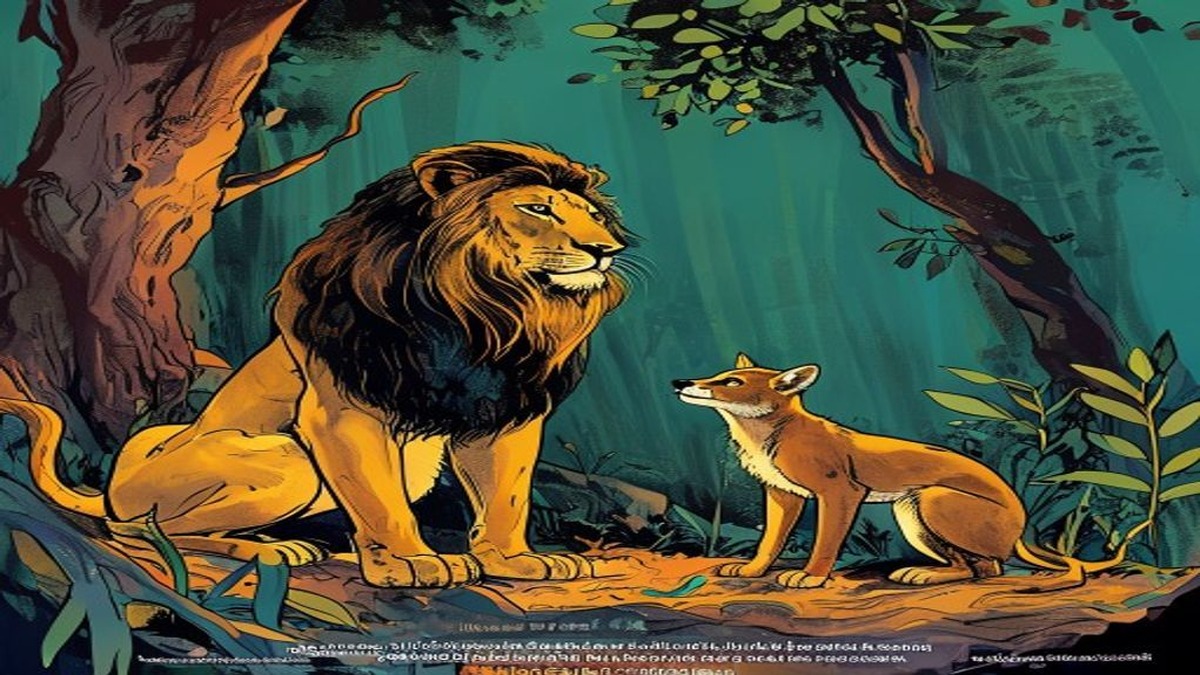
That evening Shrigala went to Chandravati. He told her what had happened — not because he had decided to, but because the day’s events had left a pressure inside him that needed a listener. She heard him out. Then she said what she had been preparing to say for some time.
“Shrigala,” she said, “you are a jackal. Your mother died in the flood when you were ten days old. I found you and brought you here because you needed milk and I had milk. Your brothers do not know this and I have not told them because you are as much my son as they are.”
She let this settle. Then she said: “A jackal who knows he is a jackal and chooses to be brave is braver than a lion who is brave because he has never had a reason to doubt himself. Your brothers did not feel what you felt today. That does not make them stronger than you. It makes them untested in a way you are not.”
Shrigala sat with this for a long time. The feeling had a name now: it was jackal-fear, the body’s honest assessment of an elephant’s mass relative to his own. It was not cowardice. It was accurate information. The question was not whether he felt it but what he did after he felt it.
He went back to his brothers. He did not explain where he had been. Over the following weeks he returned to the territory where they had seen the elephant and he stood at the edge of it until the ground-tremor no longer loosened his hindquarters. He did not stop feeling the fear. He stopped running from it.
Part IV: What the Story Teaches
Vishnu Sharma’s Panchatantra closes the tale at the point of Shrigala’s understanding, not at a moment of heroic vindication. He does not kill an elephant. He does not prove himself in single combat. The story ends with a young animal who knows what he is, knows what he feels, and has chosen to stay — not because he is unafraid, but because the love of the family that raised him is a stronger fact than the fear that his body reports.
The Sanskrit commentarial tradition reads this story as a meditation on kulasamskar — the culture of the family as the primary shaper of identity — and on the tension between janma (birth) and karma (action) as sources of character. Shrigala’s birth is jackal; his karma, his accumulated action and habit, is lion. The story’s position is subtle: it does not say birth is irrelevant (the body’s response to the elephant is real and cannot be willed away) but it insists that what one does with one’s nature is the larger part of who one is.
This places the tale in productive tension with the Panchatantra’s many stories about the importance of knowing one’s station and acting accordingly. Shrigala breaks that rule: he is a jackal who lives as a lion-adjacent being. The text does not condemn him. It asks instead whether the love that created him — Chandravati’s choice on a flooded morning — has produced a creature worth more than either species could have made alone.
Why This Story Has Lasted Three Thousand Years
“The Lioness and the Young Jackal” endures because it asks the question that every adopted child, every immigrant, every person raised in a culture not native to their blood has asked: what am I, really, and does the answer to that question determine what I can become? The Panchatantra’s answer is among the earliest in world literature to resist the simple resolution. Shrigala is not secretly a lion. He is genuinely a jackal. And that is, the story implies, perfectly sufficient for the life he intends to live.
The story travelled through Arabic Kalila wa Dimna as a fable about the education of character over the accident of birth, and was cited by medieval Islamic philosophers in debates about whether virtue is innate or acquired. In later European versions it became a parable about fosterage and loyalty, the argument being that the loyalty of a chosen family exceeds that of a biological one because it is built on repeated decision rather than mere circumstance.
For modern readers the story resonates as a meditation on identity formation and the relationship between authentic feeling (Shrigala’s fear, which is real and appropriate) and chosen action (his decision to return to the territory anyway). It is, in contemporary psychological terms, a story about the difference between emotion and behavior — between what we feel and what we do — and it comes down clearly on the side of behavior as the seat of character, while refusing to dismiss the feeling that makes the choice difficult and therefore meaningful.
Frequently Asked Questions
What is the moral of The Lioness and the Young Jackal?
The story teaches that identity is shaped more by the culture of the family that raises us than by the circumstances of our birth. Shrigala the jackal grows up with lion confidence not because he is secretly a lion but because Chandravati's love and the pride's values have shaped his character. The deeper moral is that genuine courage means acting well despite fear, not the absence of fear.
Which book of the Panchatantra does this story come from?
The story comes from Book I of the Panchatantra, Mitrabheda (The Separation of Friends), which explores the formation and dissolution of relationships, including the bonds between family members and between those who choose to be family.
What is kulasamskar and how does it apply to this story?
Kulasamskar is a Sanskrit concept meaning the culture or refinement transmitted by the family — the habits, values, and ways of being that a family imparts to its members. In this story, Chandravati transmits lion-culture to a jackal through consistent daily practice, and the text's argument is that this transmitted culture is the primary shaper of Shrigala's identity, more formative than his biological species.
Why does Shrigala run from the elephant if he was raised as a lion?
Shrigala runs because his body responds with accurate information: as a jackal, he is genuinely smaller and more vulnerable than a lion relative to an elephant in musth. His lion upbringing gave him confidence but cannot override his body's physical reality. The story treats this honestly — the fear is not a moral failing but a true physiological response. What matters is what Shrigala chooses to do after he acknowledges the fear.
How does this story compare to other Panchatantra tales about identity and nature?
Many Panchatantra stories argue that creatures should know and accept their nature, often as a caution against pretension. This story is unusual in that it validates a cross-species identity: Shrigala is a jackal who lives as part of a lion family and the text does not condemn this. It places the story in productive tension with the broader tradition, suggesting that chosen loyalty and cultivated character can constitute a truer identity than birth-assigned species.
You May Also Like
 Panchatantra Stories
Ages 9-12
Panchatantra Stories
Ages 9-12
A Three-in-One Story
Some Panchatantra tales are simple. A Three-in-One Story is not. It is a tale that hides three little stories inside one bigger story — and each of the three teaches the same surprising lesson: even the wisest grown-ups become foolish when love asks them to be. King Nanda neighs like a horse for his queen, his prime minister Vararuchi shaves his head for his wife, and a third nested tale shows how this folly travels far beyond the palace walls.
 Panchatantra Stories
Ages 9-12
Panchatantra Stories
Ages 9-12
The Fall and Rise of a Merchant
The Fall and Rise of a Merchant: One should treat one and all, even the lowest, with respect.” In a city called Vardhamana, lived a very efficient and
 Panchatantra Stories
Ages 6-8
Panchatantra Stories
Ages 6-8
Of Crows and Owls
Of Crows and Owls: Keep your counsel to yourself and thus stay away from trouble.” Once upon a time, all the birds the swans, cranes, parrots, cuckoos, owls