How a Sparrow came to Grief
The Panchatantra's small, sharp tale of Sūcīmukhī — the Needle-Beaked sparrow — and the soaked, shivering monkey to whom she gave one piece of unwanted advice too many. The story is found in Book III of the Panchatantra (Kakolukiyam, "Of Crows and Owls"), and it is one of Vishnu Sharma's quietest, hardest lessons: being right is not the same as being wise. The wise person learns to read the listener — and learns, sometimes, to keep silent.

“Give your advice only to those who deserve it — else you will come to grief.”
This is one of the oldest pieces of practical wisdom in the Panchatantra, and the small, sharp story that carries it has been told to children in India for nearly two thousand years. It is a story about kindness — and about how kindness, badly delivered, can destroy a home. It is a story about being right, and about how being right is not always the same thing as being wise. And it is a story about a small bird with a clever name and a very sharp tongue, whose name in the original Sanskrit is Sūcīmukhī — “She of the Needle Beak.”
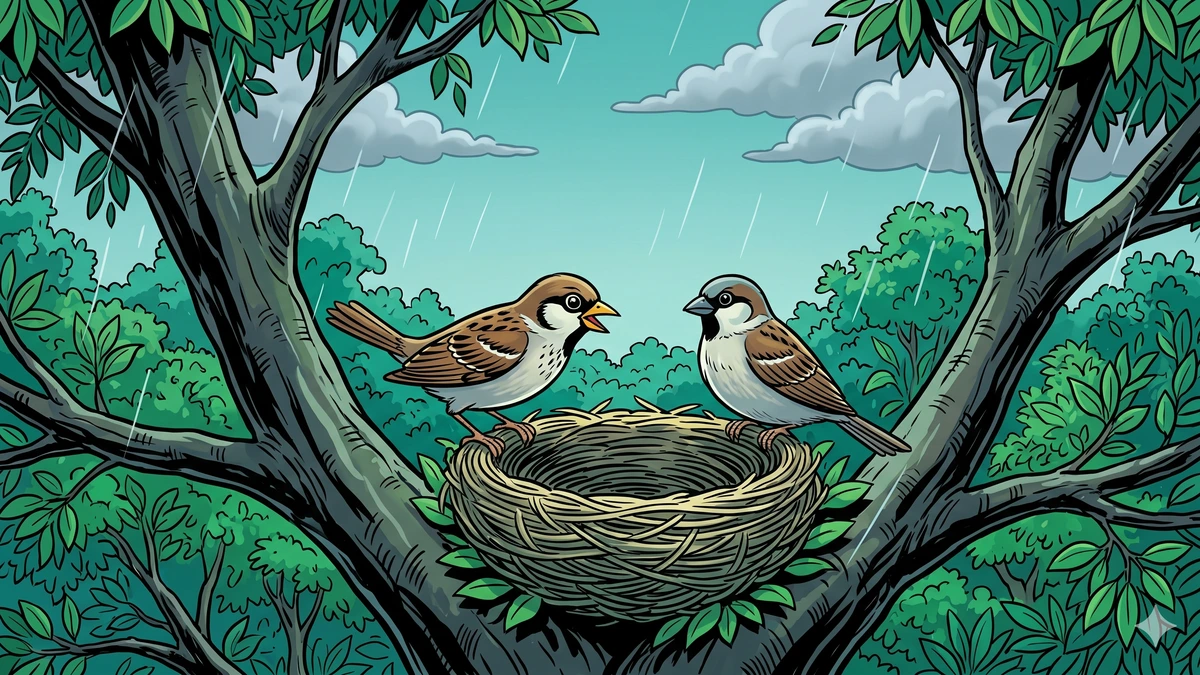
The Sparrows in the Great Tree
Deep inside an old jungle, far from any village, there grew a tree so tall that its highest branches brushed the bottom of the rain-clouds. Its trunk was wide and ancient, its bark gnarled by storms, its leaves dense enough that even the heaviest summer downpour took a long time to find the forest floor below.
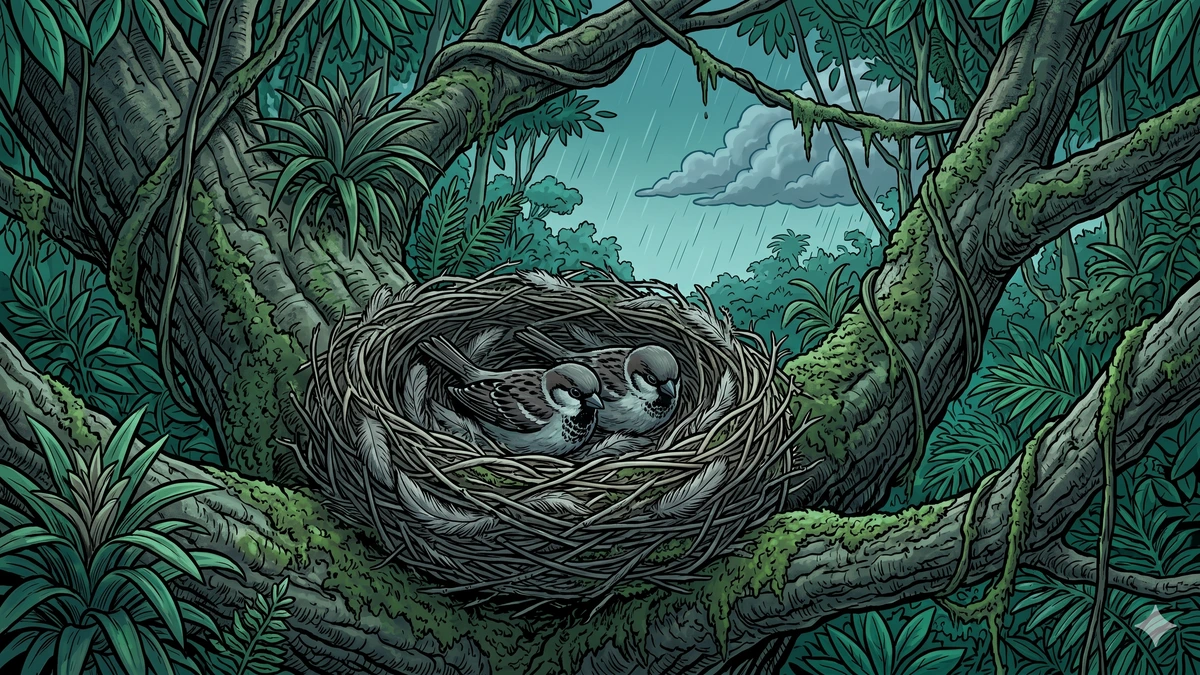
High in the safe arms of this tree lived a pair of sparrows. They had built their nest there over many days, weaving the finest twigs they could find, lining it with the softest feathers they had shed, and shaping it round and snug — a small, perfect home, just big enough for the two of them. Many seasons had come and gone, and the nest had stood through everything: the long monsoons of summer, the harsh winds of late autumn, and the cold dry nights that came with winter. Inside the nest, the two birds were warm. Outside, the world could do whatever it liked.
The female sparrow was a careful, observant little creature. She watched the forest from her perch every morning. She took quiet pride in her home, in her foresight, in the patient work the two of them had done to make their lives so comfortable. The Sanskrit storytellers gave her a name that meant exactly what she was: Sūcīmukhī — Needle-Beaked. It was a name for her sharp little beak, but also, secretly, for the sharpness of her tongue. She was not unkind. She was simply someone who could not see foolishness without commenting on it.
The Drenched Monkey
One winter evening the rain came early and came hard. The forest grew dark long before sunset. The leaves above the sparrows’ nest sang a steady silver hiss as the water beat down. Inside the nest, the two birds were dry, warm, and content; they listened to the rain the way one listens to music when one is sitting indoors by a small fire.
Below, on the forest floor, a different creature was having a very different evening.
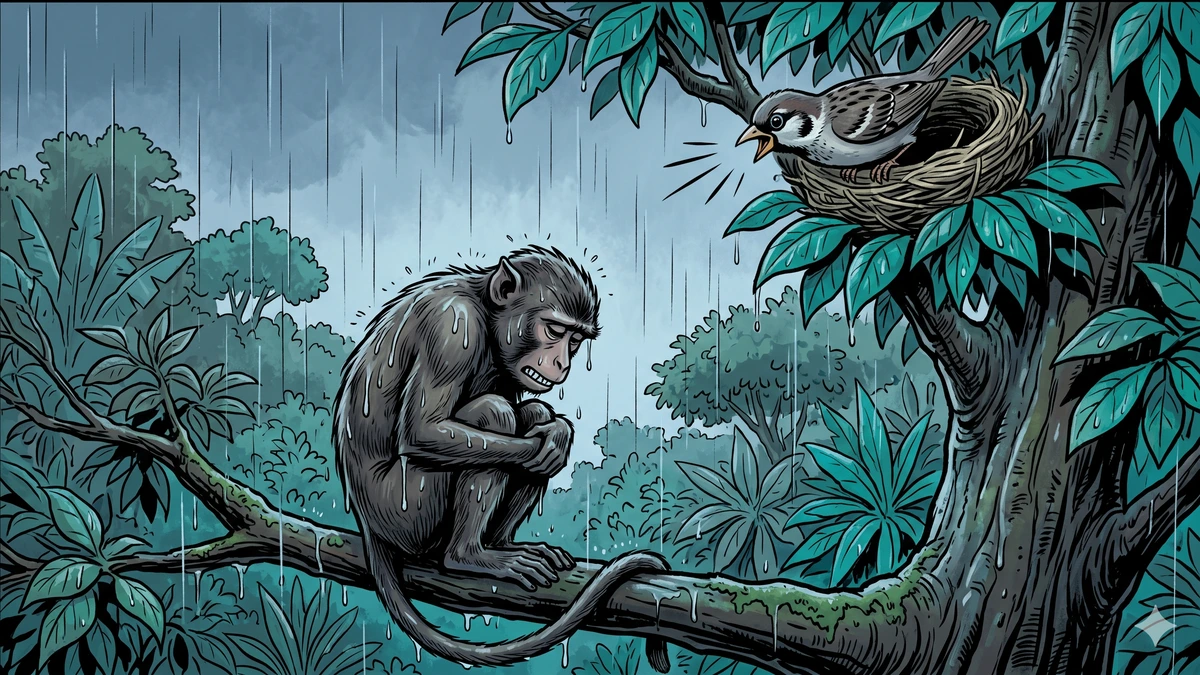
A monkey came stumbling out of the storm — soaked through, fur dark and heavy with rainwater, body shaking violently from the cold. His teeth chattered so hard that he could not have spoken even if he had wanted to. He scrambled up onto a low fork of the great tree and pressed himself against the trunk, hugging his knees, trying to find any shelter the leaves above could give him. The cold rain ran down his face and dripped from the tip of his nose. He looked, in that moment, like the most miserable animal in the whole jungle.
From her warm nest, far above, Sūcīmukhī peered down. She felt a small movement of pity in her tiny chest. Here was this large, capable creature — bigger than she was, stronger than she was, with hands and feet like a small person’s — and yet he was wet, freezing, and shivering, with no home of his own to go to. Her heart felt soft for him. And, being who she was, the moment her heart felt soft, her beak began to move.
The Advice
“O Monkey,” she called down brightly, in the cheerful, practical voice of someone who has solved her own problems and is happy to share the secret. “How sad it is to see you like this! Look at you, with hands and feet that are nearly as clever as a human’s. You can grasp, you can climb, you can carry. With those hands, you could surely have built yourself a fine little house long ago. A roof, four walls, a door — anything would have kept you out of this rain. Why have you not done so?”
The monkey did not look up. He was concentrating on staying alive. His teeth were striking each other so hard that he had begun to taste blood inside his mouth. The rain was finding new ways to crawl down his back. The last thing in the world he wanted to hear, in that exact moment, was advice.
“Be silent, wicked bird,” he growled through chattering teeth.
But Sūcīmukhī did not understand his tone, or perhaps she did not want to. Like many people who give advice, she heard his protest as proof that he needed her wisdom even more.
“You see,” she went on, gesturing with one wing toward her own beautiful, dry, snug nest, “I am only a small bird. I have no hands. I have no feet that can hold a hammer. And yet, look — my mate and I built this home with nothing more than our beaks and our patience, twig by twig. We do not suffer in the heat of summer. We do not freeze in the cold of winter. We do not get drenched in the rain. We sit in here and listen to the storm pass over us. If a creature as small as I am can do this — surely a creature as large and clever as you—”
“Bird,” said the monkey, very quietly now, “I told you to be silent.”
“—can do the same! It is only a matter of looking ahead, you see. A little forethought. A little patience. A little—”
The monkey lifted his head. The rain ran down into his eyes. Inside his chest, the cold and the shame and the small, polite voice from above had been mixing for several minutes, and they had now become something else.
“I am suffering,” he said slowly, “and you are mocking me from a warm bed. Is that wisdom?”
“It is not mocking,” chirped Sūcīmukhī, genuinely confused, because in her own mind she was being very kind. “It is helpful. If you would only listen—”
The Climb
Something turned over inside the monkey. He was no longer cold. He was no longer ashamed. He was something far more dangerous than either of those things. He was furious.
He stood up on the branch. His wet fur stuck to his body. His eyes, which had been dull with misery a moment before, had gone sharp and bright. He began, very deliberately, to climb.
From above, Sūcīmukhī could see the change in him, but she did not understand it. To her, his climbing only meant that he was finally taking her advice — perhaps coming up to look at her excellent nest as a model for his own future house. She brightened.
“Yes! Come up — I will show you exactly how it is built. You see, the trick is in the weaving. You begin with the longest, strongest—”
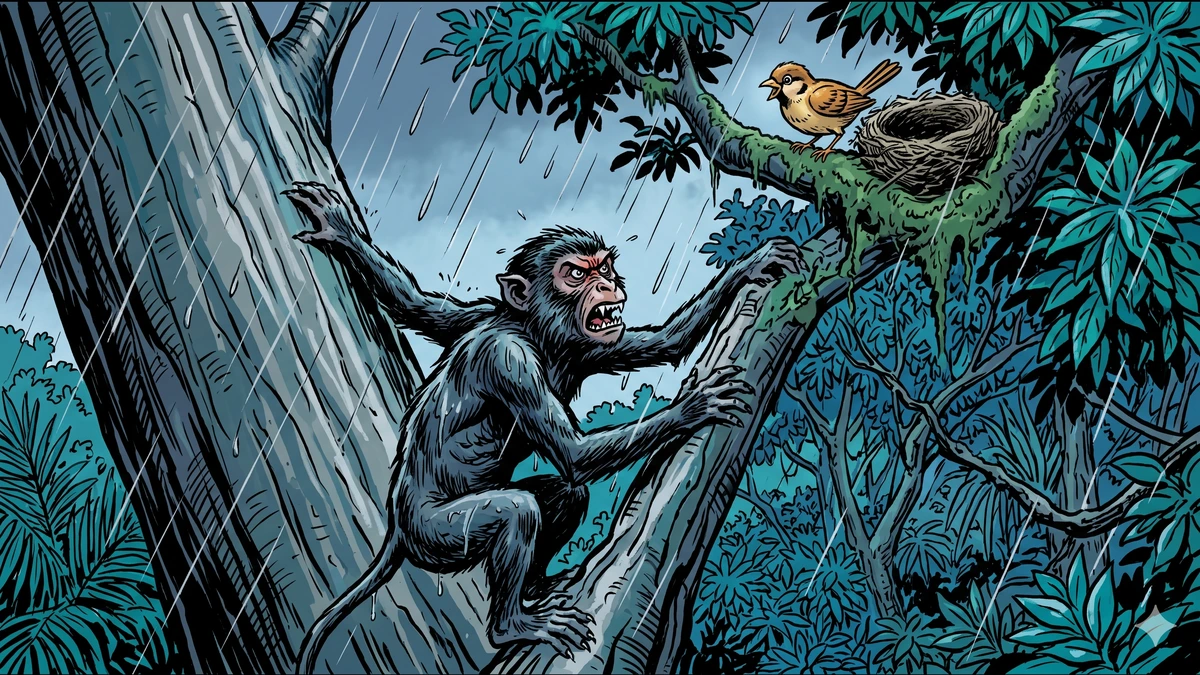
The monkey reached the branch where the nest was. He looked at it for one long moment — at this small, perfect, complacent home, at the two warm birds inside it, at the little needle-beaked one who had been chirping advice down at his cold, suffering body for what felt like a hundred years.
And then, with one violent sweep of his arm, he tore the nest from its branch.
The twigs scattered. The feathers flew loose into the rain. The careful, patient, season-after-season work of two small lives came apart in less than a heartbeat. The wind caught the pieces and dragged them away. By the time Sūcīmukhī had even understood what was happening, her home was gone.
The monkey did not say a word. He climbed back down through the wet branches and disappeared into the storm.
The Empty Branch
The rain went on falling for a long time. When it finally stopped, the forest was very quiet. The two sparrows sat together on the bare branch where their home had been. There was nothing left of it — only the place in the bark where they had built it, slightly worn and slightly darker than the surrounding wood, like the shadow of a thing that used to be there.
Sūcīmukhī did not chirp. For perhaps the first time in her small life, she was not sure what to say. Beside her, her quiet mate did not speak either. He had heard the whole conversation. He had heard her, in his patient way, the way a husband hears a wife he has loved for many years. He did not blame her. He simply sat beside her, in the cold wet wind, on the branch where their home used to be.
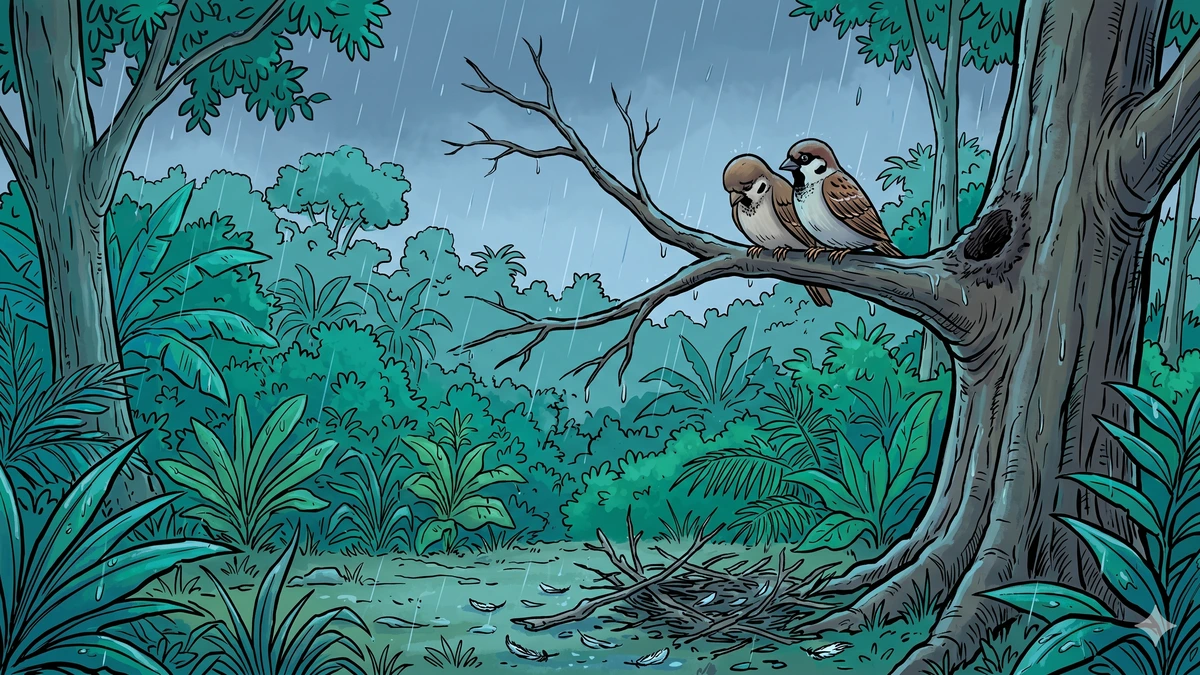
And in this way, the storyteller says, did the wise sparrow Sūcīmukhī come to grief. Not because she was wrong — she was right about everything she said. The monkey had hands. He could have built a house. He had not, and that was foolish, and the rain proved it. She was right, completely right.
But being right, as the Panchatantra knows, is not always the same thing as being wise. Wisdom includes knowing when not to say a true thing. Wisdom includes reading the listener — seeing, in the trembling jaw and the bowed head, that this is not the moment for instruction. Wisdom is gentle when it can be, and silent when it must be.
The Old Verse
The verse the storytellers attached to this tale, and that has been spoken by Indian grandmothers for many generations, is this:
“Give your advice only to those who deserve it,
Else, like the bird who advised the monkey,
You too will come to grief.”
It is a hard verse. Children sometimes find it confusing the first time they hear it: should we not always tell people the truth? Should we not always share what we know? The Panchatantra answers gently: not always. Truth offered to a closed ear is not a gift. It is, sometimes, a small cruelty dressed up as kindness. The wise person learns to tell which is which.
What the Story Quietly Teaches
This is one of those Panchatantra tales that grows with the listener. A small child hears the surface plot and laughs at the foolish bird. A teenager begins to recognize the pattern — has felt, perhaps, the small humiliation of being lectured to in a moment of weakness, and has perhaps lectured someone else without meaning to. An adult sees something more uncomfortable: how often, in our own families and friendships, we too have stood in Sūcīmukhī’s nest, watching someone we love struggle, and have offered our well-meant counsel at exactly the wrong moment, and have been hurt and bewildered when they snapped back.
The story does not say that advice is bad. It does not say that wisdom should be hoarded. It says only this: pay attention to whom you are speaking, and to where they are. A drenched, freezing creature does not need a lecture on house-building. He needs warmth, or silence, or both. Save the lecture for a sunny day, when both of you are dry. Better still — save it for the moment when he asks.
This is the patient, humane wisdom of the Panchatantra. It does not demand grand virtue or heroic sacrifice. It only asks that we be a little careful, a little gentle, a little observant of the human (or monkey) in front of us. The world has a great deal of trouble, the old storytellers seem to be saying, and most of it is made worse — not better — by people who are eager to point it out.
Where This Story Lives in the Panchatantra
“How a Sparrow came to Grief” — the story of Sūcīmukhī and the Monkey — is found in Book III of the Panchatantra, called Kākolūkīyam, “Of Crows and Owls.” Book III is the Panchatantra’s manual on enmity, alliance, and the careful management of friend and foe. It contains some of the collection’s most famous tales — the war between the crows and the owls, the story of the old hare who tricks the lion into a well, the foolish bear who killed the gardener trying to swat a fly.
The Sūcīmukhī tale is told inside Book III as an embedded tale: one wise animal advising another animal not to advise a fool. The frame itself is part of the lesson — the Panchatantra is teaching, by example, the very thing it asks the reader to learn. The wise advisor in the frame says, in essence: “Do you remember the story of the sparrow and the monkey? That is what happens when you give counsel to the wrong listener. Do not be the sparrow.”
The Panchatantra was composed in Sanskrit by the scholar Vishnu Sharma (Viṣṇu Śarmā) around 200 BCE, written for the education of three young princes who had not, until then, shown the slightest interest in books. Vishnu Sharma’s idea was simple and revolutionary: do not lecture princes. Tell them stories. Give them animals and trickery and sharp little reversals, and the princes will pick up the wisdom on their own. It worked then, and — as anyone who has ever read this story aloud to a child can tell you — it still works now.
Moral
न मूर्खजनसम्पर्कं सुरेन्द्रभवनेष्वपि। — na mūrkhajana-samparkaṃ surendra-bhavaneṣv api — “Never companion with fools, not even in the halls of Indra himself.” The Panchatantra returns again and again to one stubborn observation: that the right word delivered to the wrong listener becomes a sharper weapon than silence. Sūcīmukhī’s counsel to the rain-soaked monkey was correct on every measure — he could indeed have built shelter, foresight could indeed have spared him this cold — but correctness without audience is provocation. Vishnu Sharma’s point is not against truth-telling; it is against the small vanity of speaking truth for its own sake. The wise sparrow watches the listener before she opens her beak. The wiser one, sometimes, keeps it closed.
A Final Word
If you take only one thing from “How a Sparrow came to Grief,” let it be this small idea: watch the listener before you speak. Look at their face. Look at how their shoulders sit. See whether they are warm or cold, whether they are calm or tired or hurt. The same true sentence that lifts a person on a calm Sunday afternoon can break them at midnight in a storm. A wise person — and a wise sparrow — knows the difference, and chooses, often, to be quiet. The advice you do not give is sometimes the kindest advice of all.
And the next time you see someone soaked to the skin and shaking with cold under a tree, remember Sūcīmukhī, the little bird with the needle beak — and offer warmth instead of words.
Frequently Asked Questions
What is the moral of How a Sparrow came to Grief?
Which Panchatantra book contains How a Sparrow came to Grief?
Why did the sparrow come to grief in this story?
Who wrote How a Sparrow came to Grief?
What lesson does How a Sparrow came to Grief teach children?
You May Also Like
 Panchatantra Stories
Ages 3-5
Panchatantra Stories
Ages 3-5
The Intelligent Merchant – Hindi Folktales from India
The Intelligent Merchant – Hindi Folktales from India: Long ago, there was a king who was very unjust and cunning. He used to look for opportunities to tax his
 Panchatantra Stories
Ages 6-8
Panchatantra Stories
Ages 6-8
The Story of the Old Merchant, His Young Wife and the Thief
The Story of the Old Merchant, His Young Wife and the Thief: In a certain town, there -lived an old merchant by the name of Kamatura. After the death of his
 Panchatantra Stories
Ages 3-5
Panchatantra Stories
Ages 3-5
The Story of the Lion, the Camel, the Jackal and the Crow
The Story of the Lion, the Camel, the Jackal and the Crow: In a ertain part of the jungle, there lived a lionking, by the name of Madotkata. His retinue