The Jackal’s Strategy
The Jackal's Strategy: A jackal's clever scheme to divide his companions unravels under pressure A classic Indian folk tale retold for young readers.
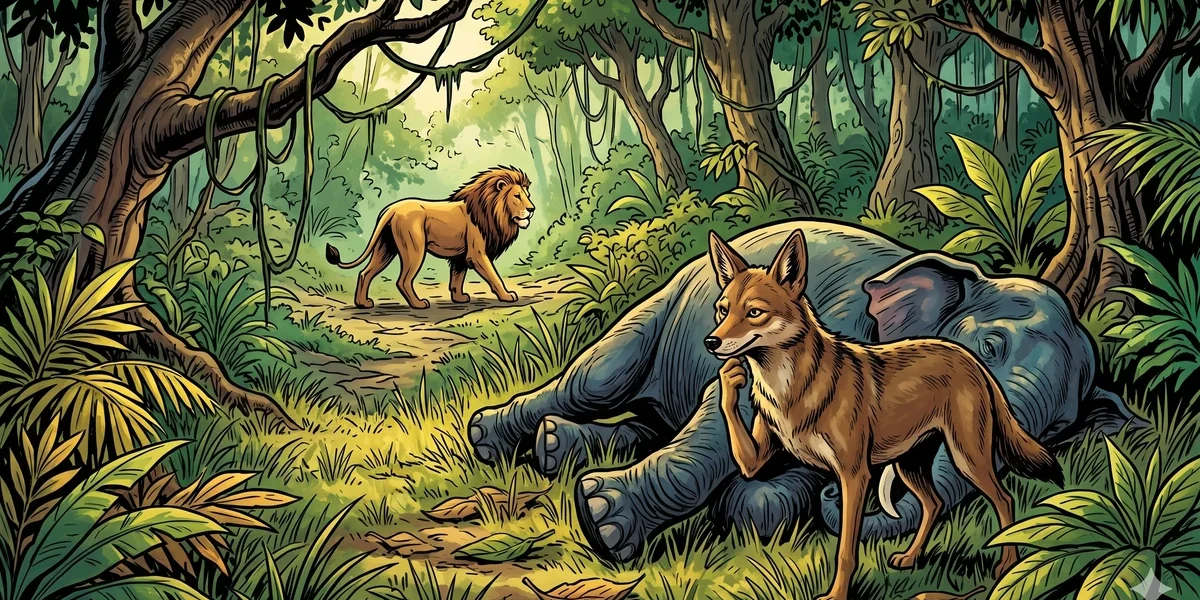
The Jackal’s Strategy
Source: Panchatantra, Book III — Kakolukiyam (Of Crows and Owls), attributed to the sage Vishnu Sharma, composed c. 300 BCE–300 CE; this redaction draws on the Sanskrit critical edition and A. N. D. Haksar’s annotated translation (HarperCollins India, 1998).
बुद्धिर् यस्य बलं तस्य, बलं निर्बुद्ध् रिपेमकम्तुम्।
A jackal trapped between two warring factions — a pride of lions and a pack of wolves — engineers his survival not through force but through careful observation, patient timing, and the deliberate sowing of distrust between his enemies. The tale stands as the Panchatantra’s most direct exposition of niti (statecraft as personal survival): intelligence deployed not to attack but to redirect the violence of others.

Part I: The Impossible Position
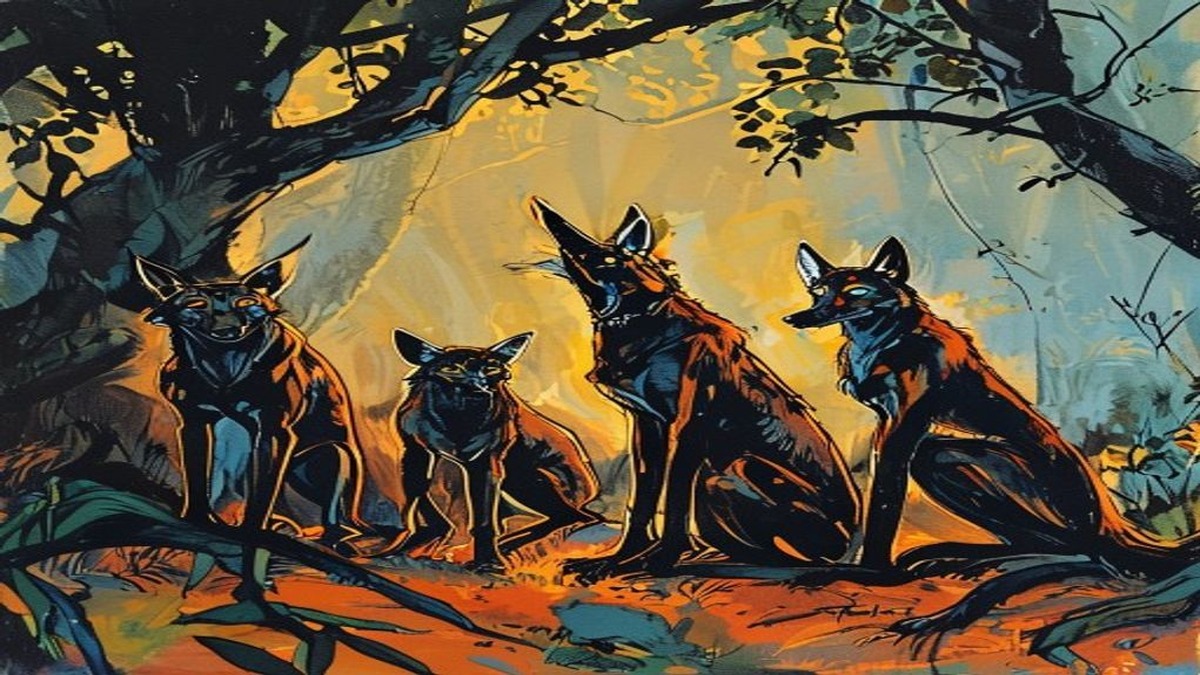
In the deep forest of the Vindhya range there lived a jackal named Chandarava, quick of eye and sharper still of mind. He had the misfortune, or so it seemed at first, of occupying the narrow strip of woodland that ran between two rival powers: to the east, the pride of the lion Vegavan, lord of all predators; to the west, the pack of Stambhaka the wolf-chief, who commanded forty wolves and had long coveted the lion’s territory.
For three dry seasons Chandarava had survived by moving carefully between them, taking food from the margins of each group’s kills without drawing attention. But the peace between the lion and the wolves was deteriorating. Skirmishes had begun — a wolf found dead near the eastern waterhole, two lion cubs missing from the pride’s resting ground. Both sides were preparing for open war, and the strip of forest Chandarava called home would become the battlefield.
Any creature of less intelligence would have fled. Chandarava instead sat very still for an entire day, watching the patrols of both sides, mapping their rhythms, listening to the direction of their roars and howls. By dusk he had formulated a plan that was audacious precisely because it required no strength at all — only perfect information, perfect timing, and a voice that could persuade a lion to distrust his own senses.

Part II: The Art of Manufactured Evidence
Chandarava’s first move was to approach Vegavan. He waited for the lion to be alone — a moment after the morning patrol but before the midday rest — and presented himself with the posture of a creature torn between loyalty and fear. “My lord,” he said, “I have long carried this secret and it eats at me like a thorn I cannot reach. I overheard the wolf-chief Stambhaka last night, speaking with the vultures who serve him. He has arranged a truce with the tigers to the north. When the tiger-clan moves south in three days, Stambhaka’s pack will attack from the west simultaneously. You will be encircled.”
There were no tigers. There was no truce. But Chandarava had spent the previous morning observing a gathering of vultures near the wolf-pack’s territory — they were simply feeding on a zebra carcass — and had constructed from that one verifiable fact a detailed and plausible fiction. The genius of the lie lay in what it contained that was true: the wolves were indeed preparing to fight; Stambhaka did sometimes trade information with the vultures; tigers did sometimes come south in the dry season. Chandarava had wrapped a fabrication in enough reality that any fact-checking Vegavan might do would confirm the surrounding details, not the invention at the centre.
The lion’s eyes narrowed. “How do I know this is not a trick?” Chandarava had anticipated this. “Go to the northern ridge at dawn tomorrow,” he said. “You will see Stambhaka’s scouts there — he sends them each morning to watch the tiger territory. I have seen it myself for seven mornings.” This too was true. The wolf scouts did patrol the northern ridge — to watch for other wolves intruding from the north, not for tigers. But Vegavan, now primed to see what Chandarava had told him to expect, would find exactly what was described.
The Sanskrit rhetorical tradition calls this technique bhrantimad-alankara — the ornament of productive confusion — and the Panchatantra’s use of it here is deliberately instructive: Chandarava does not ask the lion to believe something without evidence; he engineers the evidence.

Part III: The Second Visit
That same afternoon, Chandarava made his second call — to Stambhaka. The approach was different: no posture of reluctant loyalty, but instead the air of a practical animal offering a mutually beneficial arrangement. “Wolf-lord,” he said, “you know me. I eat what both sides leave behind, which means I watch what both sides do. Today Vegavan sent a runner to the northern tiger territory. I watched the lion’s messenger go and come back, and the runner carried in his mouth what looked like a branch from the tiger-chief’s marking tree.”
Again: partial truth, total fiction. There had been a lion cub playing near the northern edge of the territory with a branch in its mouth. Chandarava had seen it. The interpretation was entirely his invention. But Stambhaka, who was already afraid of the lion and looking for evidence of exactly this kind of betrayal, received it as confirmation of his darkest suspicion. His upper lip pulled back. “Then we attack before they are ready.”
“Three days,” Chandarava said smoothly. “Strike in three days, before the tigers can move south.” Three days was exactly the timeline he had given the lion pride for the alleged tiger attack — meaning both sides would initiate on the same morning, neither expecting the other to be the aggressor, each believing they were pre-empting an encirclement.
Chandarava spent those three days in a location he had carefully selected: a high rocky outcrop that jutted over the clearing between the two territories. It commanded a view of both approaches. It had only one entrance, too narrow for a lion or wolf to navigate at speed. It had fresh water from a seasonal spring. He brought enough food for four days and waited.
Part IV: The Aftermath and the Lesson
On the third morning the battle was exactly as Chandarava had calculated. Both sides believed they were the aggressor; both were therefore fully committed, neither held anything in reserve. The clearing between the territories became the site of the most savage fight the forest had seen in a generation. When it was over, Vegavan had lost six lions and driven the wolves from the territory. Stambhaka had lost half his pack and retreated to the western hills. The strip of forest Chandarava had occupied — the margin that had been marked for destruction — was now unclaimed territory, rich with the food that battle always leaves behind.
Chandarava descended from his rock and ate well for many days.
Vishnu Sharma’s commentary at the close of this tale is unusually direct: the jackal is not presented as morally admirable, only as competent. The Panchatantra’s concern is never with what ought to be done in an ideal world, but with what works in the world as it is. Chandarava survives because he invests in information while his enemies invest in force. He plans for four contingencies while they plan for one. He places himself in a position of safety before initiating events he cannot fully control.
The story is the Panchatantra’s clearest illustration of the third principle of rajniti (statecraft): when two stronger powers are in conflict, the wisest position for a weaker third party is not neutrality but the engineering of maximum mutual damage, so that the survivor is weakened enough to coexist with.
Why This Story Has Lasted Three Thousand Years
“The Jackal’s Strategy” endures because it is perhaps the oldest surviving articulation of what modern political scientists call “balance of power” theory from the perspective of the smallest player in the system. Chandarava does not attempt to become powerful; he attempts to ensure that no one else remains powerful enough to harm him. This is a fundamentally different ambition from the heroic ideal, and the Panchatantra’s willingness to celebrate it without apology is part of what makes the text so radical within its literary tradition.
The story travelled through Arabic as a political fable in Kalila wa Dimna, was commented upon by medieval Islamic strategists, and re-entered European thought through the Latin Directorium Humanae Vitae. Machiavelli’s observation in The Prince that a weak state should never remain neutral between two stronger powers in conflict has a precise structural ancestor in Chandarava’s three-day calculation.
For modern readers, the story resonates in every institutional context where a smaller party navigates between two larger competing interests: the mid-level manager between two executives, the small nation between two powers, the entrepreneur between two established competitors. Chandarava’s tools — information advantage, pre-positioned safety, precisely timed revelation — translate without loss across three millennia because the underlying geometry of power has not changed. What has changed, the story gently implies, is only whether we have the discipline to use our minds before we use our strength.
Frequently Asked Questions
What is the moral of The Jackal's Strategy?
The story teaches that intelligence and careful planning are more powerful than brute strength. The jackal Chandarava survives by engineering conflict between two stronger enemies rather than confronting either directly, illustrating the Panchatantra's core principle: wisdom is the truest form of strength.
Which book of the Panchatantra is The Jackal's Strategy from?
The story comes from Book III of the Panchatantra, Kakolukiyam (Of Crows and Owls), which collects fables about the use of intelligence and strategy to overcome enemies who are physically more powerful.
What technique does the jackal use to defeat his enemies?
Chandarava uses a method the Sanskrit rhetorical tradition calls bhrantimad-alankara — productive confusion — by constructing believable lies from genuine facts. He tells each enemy that the other is about to attack, timed so that both strike simultaneously and exhaust each other, leaving the jackal unharmed.
How does The Jackal's Strategy relate to modern political theory?
The story is among the oldest articulations of balance-of-power theory from a weaker party's perspective. Its structural logic — that a small power should never remain neutral between two stronger rivals — anticipates arguments made by Machiavelli in The Prince and by modern international relations theorists about the optimal strategy for minor states between great powers.
How did this story travel to other cultures?
The story entered Arabic literature as part of Kalila wa Dimna, translated by Ibn al-Muqaffa in the eighth century. It was then commented on by medieval Islamic political writers, entered Latin as Directorium Humanae Vitae, and influenced European fable traditions. Its core strategic lesson has appeared in variant forms across Persian, Hebrew, and Italian literary traditions.
You May Also Like
 Panchatantra Stories
Ages 9-12
Panchatantra Stories
Ages 9-12
The Grain of Corn
A farmer plants a single grain of corn and cultivates it into an abundant harvest through faith and hard work.
 Panchatantra Stories
Ages 9-12
Panchatantra Stories
Ages 9-12
Foolish Lion Clever Rabbit
The Panchatantra's most famous Book I fable. A lazy, tyrannical lion named Bhasuraka devours the forest until a small clever hare named Lambakarna walks him to an old stone well — and lets the lion meet the one opponent pride cannot defeat: his own reflection. Full origin, Sanskrit names, age-agnostic retelling, and lessons for today.
 Panchatantra Stories
Ages 9-12
Panchatantra Stories
Ages 9-12
The Lion, the Camel, the Jackal and the Crow
Trust given despite proven dishonesty proves fatal when a camel ignores a jackal's conspiracy.