The Story of the Turtle Who Fell Off the Stick
The Story of the Turtle Who Fell Off the Stick: In a certain lake, there lived a turtle, by the nameof Kambugriva. Two swans, whose names were Sankata and

The Story of the Turtle Who Fell Off the Stick
Origin and Manuscript Tradition
This is among the most widely transmitted fables in world literature, appearing in the Panchatantra, the Pali Jataka collection (as the Kacchapa Jataka, no. 215), the Persian Kalila wa Dimna, Arabic adaptations, and eventually every major European fable tradition from La Fontaine to Aesop’s retellings. The story’s simplicity is its strength: one instruction, one failure to follow it, one fatal consequence. Vishnu Sharma placed it in Book V, Aparikshitakaraka (Acting Without Thinking), as the clearest possible illustration of how a creature can survive the most extreme external challenge — being carried through the air by two geese while biting a stick — and perish from a single failure of self-control at the moment when the instruction to maintain it was most critical. The lesson requires no elaboration: the turtle knew what it was not supposed to do; it did it anyway.
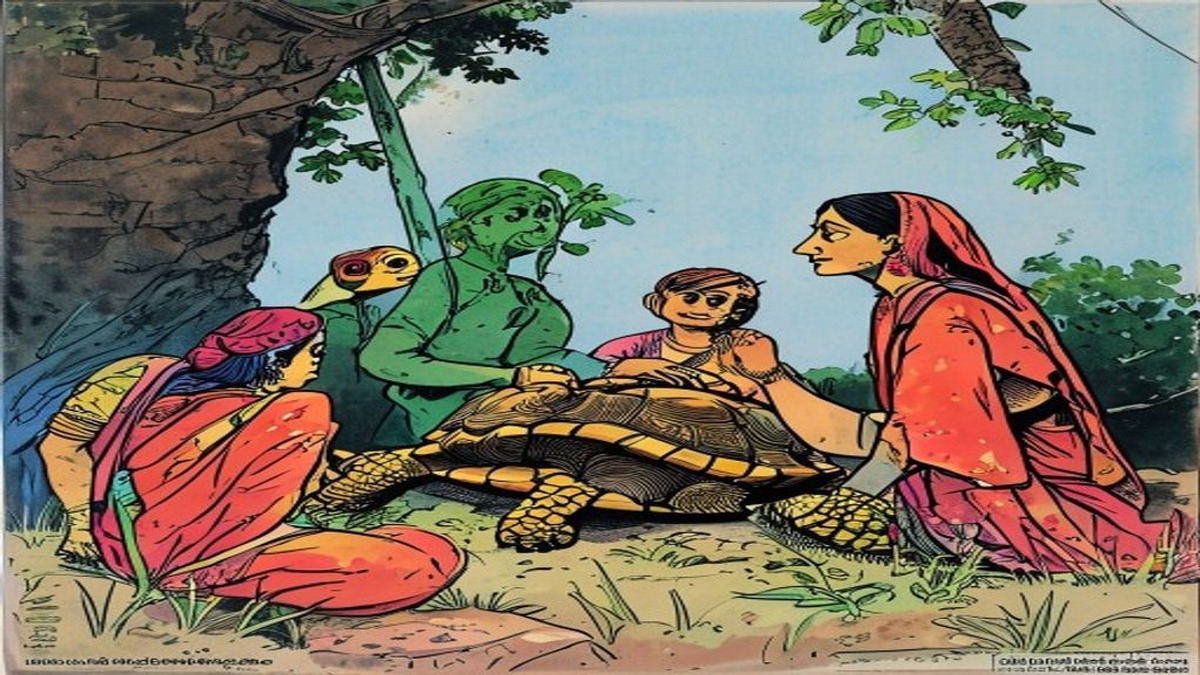
The Drying Pond and the Geese’s Offer
A turtle named Kambugriva had lived in a large pond for many years alongside two geese who had become his closest friends. The three spent their days in the easy companionship of creatures who have shared a home long enough to have established comfortable habits. Then the rains failed. The pond shrank through the dry season and did not recover in the monsoon. By the following spring it was clear to all three that the pond would be dust within a year.
The geese could fly to any of a dozen lakes within a day’s journey. The turtle could not. He could walk, but the distance to any suitable water was beyond what a turtle could manage on foot across summer ground. The geese were not willing to abandon their friend. They devised a plan: they would carry the turtle between them, each holding one end of a stick in their beaks, while the turtle held the middle of the stick in his mouth. They would fly to a suitable lake and deposit the turtle safely at its edge.
The plan was sound. The geese had carried heavier loads. The turtle was compact and his bite was strong. The only condition — and the geese stated it clearly, and then repeated it — was that the turtle must not open his mouth under any circumstances until they landed. He must not speak, not cry out, not even shift his grip. If he opened his mouth, he would fall. The turtle understood. He agreed. He bit the middle of the stick and the three rose into the air.

The Village Below and the One Word
The three flew over fields and forests without incident. Then they passed over a village. The villagers looked up, as people in villages always do when something unusual passes over their heads, and saw the extraordinary sight: two large geese carrying a stick, a turtle hanging from the middle of it, all three moving steadily through the late afternoon sky. The village erupted in noise. People called to each other, children pointed, farmers left their work. The laughter and commentary rose up with the noise of a crowd that has encountered something genuinely remarkable.
Among the comments rising from below, one thread kept repeating: how clever, someone must have thought of this, who could have come up with such an idea? The geese had thought of it and were flying it in silence. The turtle had agreed to it and was executing it in silence. But the turtle also knew that he had agreed to it — had, in fact, endorsed the plan and committed to the journey — and the voices below seemed to be giving the credit to some unspecified someone rather than to the turtle who was actually biting the stick and making the whole enterprise possible.
The turtle wanted to say: “It was my idea.” Or perhaps: “I am the one doing the work here.” Or perhaps simply to reply to the general noise below with some acknowledgment of his existence and his role. He had one clear instruction, stated twice, with the consequence attached: do not open your mouth. He opened his mouth.

The Fall and What It Teaches
The turtle fell. He had been high enough that the fall was fatal. The geese, unable to do anything once the stick was released, circled once and then continued to the lake they had been heading for, where they arrived without their friend.
Vishnu Sharma does not render this as tragedy in the Greek sense — a noble figure brought down by a flaw that is also a greatness. The turtle was not brought down by a greatness. He was brought down by the inability to remain silent for the duration of a flight when he had agreed to remain silent and had been told exactly what would happen if he did not. The flaw is not pride in the grand sense; it is the much smaller and more common failure of being unable to endure not responding to something when responding is prohibited and dangerous. The crowd was not saying anything important. The credit was not actually at stake. There was nothing the turtle needed to say that could not have been said in ten minutes, on the ground, at the lake they were almost certainly going to reach if he had simply kept his mouth closed.
This is the specific failure that Book V exists to name: the action taken without examining whether this is the moment for the action. The turtle examined nothing. He felt the impulse to speak and he spoke. The consequence had been explicitly stated in advance. He had agreed to prevent it. He did not prevent it. The stick, and the lake, and his life were all immediately ahead of him. He chose the word instead.

Moral and Sanskrit Wisdom
वाचं नियम्य सर्वत्र सुखु तिष्ठति
Vaacham niyamya sarvatra sukhu tishthati — “One who controls speech lives comfortably everywhere.”
— Sanskrit proverbial tradition, Panchatantra V
The control of speech — vaaksamyama in Sanskrit — is one of the foundational disciplines in the Indian ethical tradition, appearing in Vedic, Buddhist, Jain, and classical Sanskrit texts alike. Vishnu Sharma chose a turtle rather than a more cognitively complex creature to make a specific point: the failure of speech-control is not an intellectual failing. It is a failure of the most basic self-regulation, available to any creature with sufficient attention. A turtle that cannot do it has no complexity to blame; it simply did not do the one thing it was asked to do.
Why This Story Has Lasted 2,300 Years
The Turtle and the Stick endures because it dramatises the most ordinary and most devastating failure in human social and professional life: saying the unnecessary thing at the necessary moment of silence. The crowd below was not important. The credit they were not awarding was not real. The time until landing was short. None of this registered. What registered was the felt need to respond — to exist verbally in a situation that was acknowledging the geese and ignoring the turtle — and that felt need overrode the explicit instruction, the known consequence, and the proximity of safety.
The story’s global reach — through the Jataka, through Kalila wa Dimna, through La Fontaine’s version (Le Tortue et les deux Canards, Fables X.2, 1694), and through dozens of regional adaptations — suggests that the failure it describes is not culturally specific. Every tradition that has encountered the tale has recognised it as describing something its own members do. La Fontaine’s turtle falls for exactly the same reason as Vishnu Sharma’s turtle. The provocation changes; the failure of self-regulation that produces the fatal word does not.
What makes the story particularly useful as a teaching tool is its clarity about the asymmetry of cost and benefit. The benefit of speaking was: a fleeting sense of being acknowledged. The cost was: everything. Vishnu Sharma does not need to argue that the turtle made an irrational trade; he simply presents the trade and its result. Any reader who has ever said the wrong thing at the wrong moment — the remark that cost a relationship, the outburst that cost a job, the word in the meeting that cost the negotiation — does not need the lesson explained. They need only to be shown the turtle, in the air, deciding to speak, and they understand.
Frequently Asked Questions
What is the moral of the Turtle Who Fell Off the Stick?
Control your speech, especially when you have explicitly agreed to silence and the consequence of breaking it is known. The turtle's fatal word was unnecessary, the crowd below unimportant, and the lake almost within reach — but the impulse to respond overrode all of this.
What is the Sanskrit concept of vaaksamyama?
Vaaksamyama means control of speech — one of the foundational disciplines in the Indian ethical tradition, appearing in Vedic, Buddhist, Jain, and classical Sanskrit texts alike. Vishnu Sharma uses a turtle to make the point: this is not an intellectual skill but the most basic form of self-regulation, available to any creature with sufficient attention.
Did this story influence Western literature?
Yes. La Fontaine included a version as Le Tortue et les deux Canards (Fables X.2, 1694), drawn from the Arabic and Persian Kalila wa Dimna transmission. The turtle falls for exactly the same reason in La Fontaine as in the Panchatantra. The story's global reach confirms that the failure it describes is not culturally specific.
Why couldn't the turtle simply wait until landing to speak?
The turtle could have waited — the lake was close, the flight was short, the crowd below was saying nothing important. The story's point is that the failure was not about a pressing need to speak; it was about the inability to endure not speaking when the impulse arose. That gap between impulse and considered action is exactly what vaaksamyama is meant to close.
Which Panchatantra book contains this story?
The tale is in Panchatantra Book V (Aparikshitakaraka — Acting Without Thinking), compiled by Vishnu Sharma around the 3rd century BCE. It also appears in the Pali Jataka collection as the Kacchapa Jataka (no. 215), giving it authority in both Brahmanical and Buddhist traditions.
You May Also Like
 Panchatantra Stories
Ages 3-5
Panchatantra Stories
Ages 3-5
The Story Of Cat A Mouse A Lizard And An Owl
The Story Of Cat A Mouse A Lizard And An Owl: This is the story of four creatures, none of whom loved each other, who lived in the same banyan tree in a forest
 Panchatantra Stories
Ages 9-12
Panchatantra Stories
Ages 9-12
The Story of the Four Learned Fools
The Story of the Four Learned Fools: In a certain town, there lived four Brahmins whohad become great friends. They were all extremely naiveby nature. The
 Panchatantra Stories
Ages 6-8
Panchatantra Stories
Ages 6-8
The Story of the Donkey and the Washerman
The Story of the Donkey and the Washerman: In a town, there lived a washerman, by the name of Shuddhapata. He had only one donkey. Because oflack of grass and