The Potter Who Became a Warrior
A humble potter with a strange scar nearly marches into battle - until a wise captain sees the truth.

The Potter Who Became a Warrior — Panchatantra, Book V: Aparīkṣitakāraka (Ill-Considered Action)
This tale is one of the Panchatantra’s most sophisticated treatments of false identity and its consequences — and also one of its most nuanced, because it includes a moment of voluntary confession that redeems the protagonist without erasing the moral complexity of what came before. Compiled by Vishnu Sharma around 300 BCE, the story concerns Yudhisthira the potter — a name already discussed in the Panchatantra’s story of the Potter Called Yudhisthira — who receives an honourable scar by accident, presents himself at court as a warrior, rises to high military command, and is eventually confronted with a battle that his actual capacity cannot meet. The story explores what honest self-disclosure costs versus what continued deception costs, and finds the answer in the specific moment of crisis where the two calculations diverge irreversibly.
Beat I — The Scar and the Opportunity
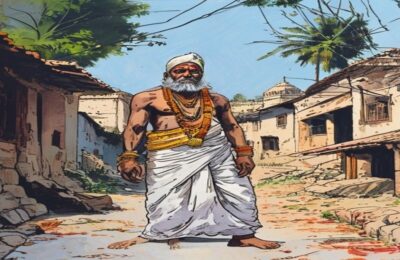
Yudhisthira was a potter by birth and trade — a man of the kumbhakāra caste, skilled with clay, without martial training or military lineage. One night, drunk on palm wine, he had fallen and struck his face against the edge of a broken pot. The wound had healed into a prominent scar across his forehead that, in the morning light and at a distance, had exactly the appearance of a battle scar — the kind that warriors wore as evidence of courage tested in close combat.
Yudhisthira, surveying himself in a still pool the next morning and seeing the scar with fresh eyes, made a calculation. He was poor; potters in his region were poorly compensated; his skills with clay had a limited ceiling of prosperity. The scar, on the other hand, was an asset in a world that rewarded apparent martial achievement. He dressed in borrowed martial clothing, presented himself at a king’s court, and when asked about his scar, described a heroic engagement that he had not fought. The king, who was actively recruiting capable soldiers for a military campaign, was impressed. Yudhisthira received a position, a salary, a rank, and — because he was genuinely intelligent and administratively capable — performed his non-combat duties well enough to rise through the hierarchy.
Beat II — The Rise and the Growing Gap
The Panchatantra traces Yudhisthira’s career with careful attention to what he could do and what he could not. He could plan. He could organise supply lines, manage personnel disputes, read terrain on a map, and communicate strategic assessments clearly. These were genuine capacities that he exercised genuinely, and they were valued. He rose on the basis of real merit in real administrative functions — which is what makes his story more complex than a simple fraud narrative.
What he could not do was fight. He had no martial training, no combat reflexes, no experience of the specific fear and decision-making required in actual close-quarters battle. His rank had advanced to a point where, if a major engagement occurred, he would be expected to lead men in the field. He had managed to avoid this test through a combination of circumstance and careful management of assignments. But the gap between his title and his actual capacity was growing, and the campaign the king was planning was of a scale that would require every senior commander in the field.
Yudhisthira could feel the approach of the test he could not pass. The Panchatantra notes his awareness of this with the precision it reserves for actors who understand their own situation clearly even when they cannot correct it: he knew what was coming, and he had no resource available to him that would close the gap before it arrived.
Beat III — The Confession and Its Consequences
On the eve of the major battle, Yudhisthira went to the king and told him everything: the broken pot, the palm wine, the fabricated story, the years of effective administrative service performed under a false martial identity. He did not attempt to minimise the deception or argue that his genuine service had compensated for it. He disclosed fully and accepted the king’s judgement.
The king’s response is what the Panchatantra presents as the story’s moral crux. He was angry — genuinely, and appropriately — at the deception. He was also confronted with a practical reality: Yudhisthira had been an effective administrator for years. His actual capacities were real and documented. The campaign needed administrators as much as fighters, and Yudhisthira’s capabilities in that domain were accurately assessed and genuinely valuable.
The king resolved the situation with the pragmatism that the Panchatantra consistently presents as the mark of capable leadership: he demoted Yudhisthira from combat command and reassigned him to the administrative role his actual capabilities justified. He was not executed; he was not imprisoned; he was placed accurately. The deception was acknowledged and its specific consequence addressed — Yudhisthira would not lead men into combat he was not equipped to manage. But the genuine value he had provided was not erased by the deception that had accompanied it.
Beat IV — The Panchatantra’s Argument About Honest Disclosure
The Panchatantra uses Yudhisthira’s story to make a specific argument about the timing and value of honest disclosure: confession before the crisis that would expose the deception is categorically different from exposure by the crisis. Yudhisthira came forward the night before the battle — not because discovery was certain at that moment, but because he had assessed that the cost of continued deception now exceeded the cost of disclosure. Men’s lives, in the battle the next day, would depend on a commander who could not perform. The calculation was no longer personal advantage versus personal cost; it was personal honesty versus the welfare of others, and Yudhisthira made the right calculation at the last available moment.
The Arthashastra of Kautilya addresses this in terms of administrative intelligence: a minister who discovers a placement error — a person in a role their actual capacity cannot sustain — should correct the error before the crisis it will produce, not after. The cost of correction before the crisis is always lower than the cost of failure during it. Yudhisthira’s self-disclosure is the personal version of this principle: he corrected the placement error himself, at the last moment before it would have produced a military catastrophe, and the king responded to the honesty of the correction rather than exclusively to the history of the error.
“Honest disclosure before the crisis costs less than exposure by the crisis — and costs infinitely less than the catastrophe the crisis produces when the deception holds too long.”
For related Panchatantra lessons about identity, judgment, and responsibility, compare The Barber Who Killed the Monks, The Story of King Chandra, and The Wedge-Pulling Monkey.
Why This Story Has Lasted 2,300 Years
The Potter Who Became a Warrior endures because its central predicament — the person who has advanced beyond their actual capacity through a combination of false impression and genuine partial competence — is not rare or historically remote. Every institution produces versions of Yudhisthira: people whose real abilities in one domain are genuine and valuable, who arrived in their position through some misrepresentation of abilities in another domain, and who are now approaching a test that the misrepresented domain will not allow them to pass. The Panchatantra’s answer — disclose before the battle, accept accurate placement, allow genuine capacities to be used genuinely — is difficult to execute and permanently correct. The alternative, demonstrated across the Panchatantra’s many fraud narratives, is always worse.
About the Panchatantra
The Panchatantra (“Five Treatises”) was composed by Vishnu Sharma circa 300 BCE as a compendium of nītiśāstra — statecraft, ethics, and worldly wisdom — expressed through interlocking animal and human fables. Book V, Aparīkṣitakāraka (“Ill-Considered Action”), collects tales about the long-term consequences of acting on false foundations. The Potter-Warrior story is among the tradition’s most ethically complex, presenting a protagonist who is simultaneously guilty of sustained deception and capable of genuine honesty at the critical moment. Translated into Pahlavi, Arabic, Hebrew, Latin, and all major European languages, the Panchatantra became one of the most widely read books in the pre-modern world.
You May Also Like
 Panchatantra Stories
Ages 9-12
Panchatantra Stories
Ages 9-12
The Story of the Jackal Who Fell Into a Vat of Indigo Dye
The Story of the Jackal Who Fell Into a Vat of Indigo Dye: In a jungle, there lived a jac; kal by the name of Chandarava. One day he was very hungry, so he
 Panchatantra Stories
Ages 6-8
Panchatantra Stories
Ages 6-8
The Story of Soma Sharma’s Father
The Story of Soma Sharma’s Father: In a certain village, there lived a Brahmin, by the name of Swabhavakripana He used to live by begging. Whenever he got
 Panchatantra Stories
Ages 3-5
Panchatantra Stories
Ages 3-5
The Young Greedy Bird – A Panchatantra Tale from India
The Young Greedy Bird – A Panchatantra Tale from India: Long ago, a flock of birds stayed on the trees near a lake. The flock was ruled by an old queen bird.