The Brahmani and the Mongoose
The Brahmani and the Mongoose: A timeless Indian folk tale where one moment of rage destroys lifelong trust. the brahmani's hasty act reveals wisdom's price.
Among the cautionary tales preserved in the Panchatantra’s third book, Kākolūkīyam (Of Crows and Owls), and more prominently in the Hitopadeśa, the story of the Brahmin’s wife and the loyal mongoose ranks as one of classical Indian literature’s most unflinching meditations on the catastrophe of precipitate judgment. In fewer than three hundred words of original Sanskrit prose, the tale achieves what a modern psychologist might require a full case-study to demonstrate: that grief, when it arrives faster than thought, destroys the very thing it grieves for. The mongoose, who in Indian zoological tradition was already celebrated as the natural enemy of the serpent, becomes in this story the emblem of a fidelity betrayed by the hand that raised it.
The Story: Dev Sharma’s Household
In a prosperous town of the Gangetic plain there lived a Brahmin scholar named Dev Sharma with his devoted wife. The couple had long prayed for a child, and when at last a son was born to them, their joy was complete. On that same day, in a hollow beneath the roots of the banyan tree at the edge of the compound, a female mongoose gave birth to a single kit — and then died, leaving the newborn creature without a mother to nurse it.
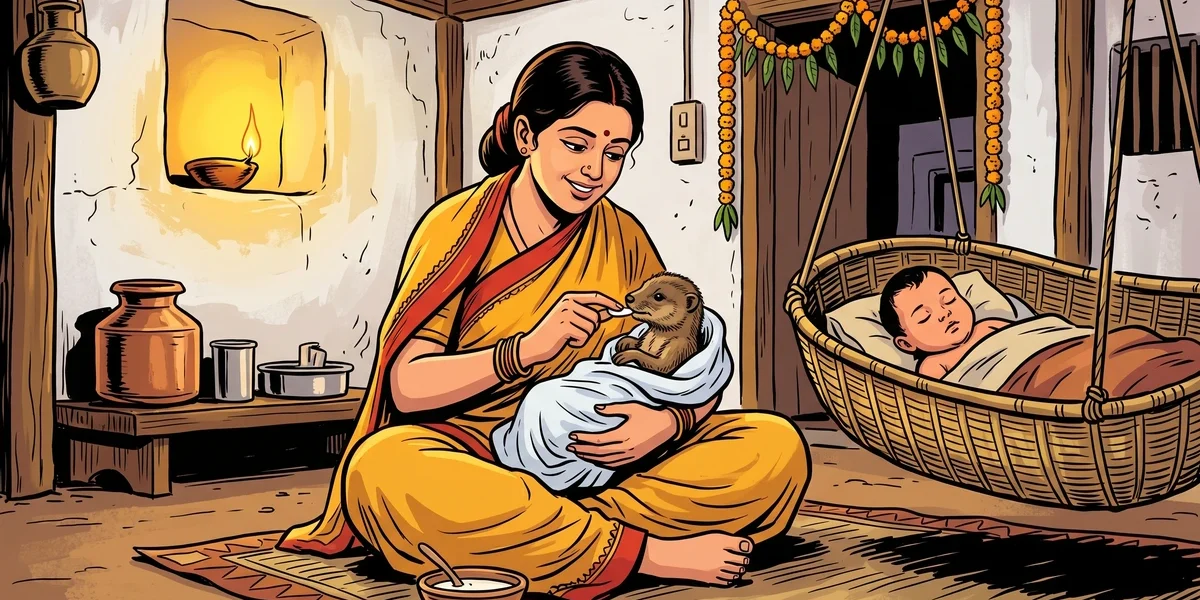
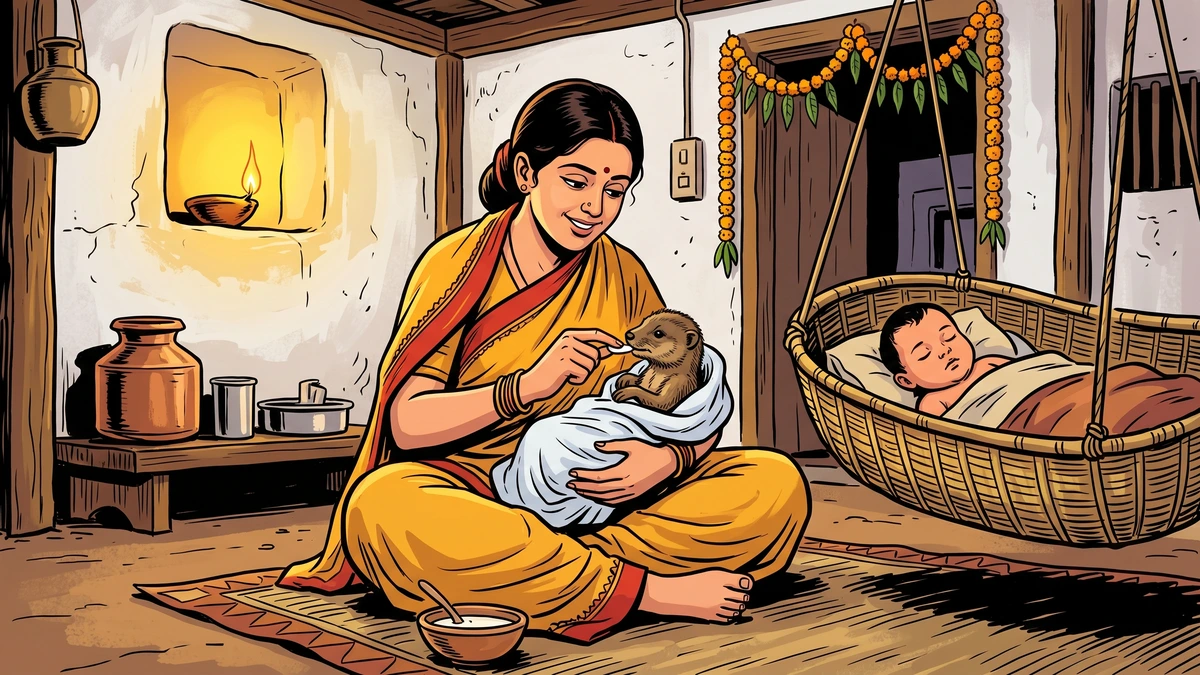
Dev Sharma’s wife had a capacious heart. She carried the tiny mongoose indoors, wrapped it in cotton, fed it warm milk from her finger, and raised it alongside her own son. The two grew up together: the human child in his reed cradle, the mongoose in a basket of clean straw by the hearth. To the wife, both were her children. To the mongoose, the Brahmin’s house was the only world it had ever known.
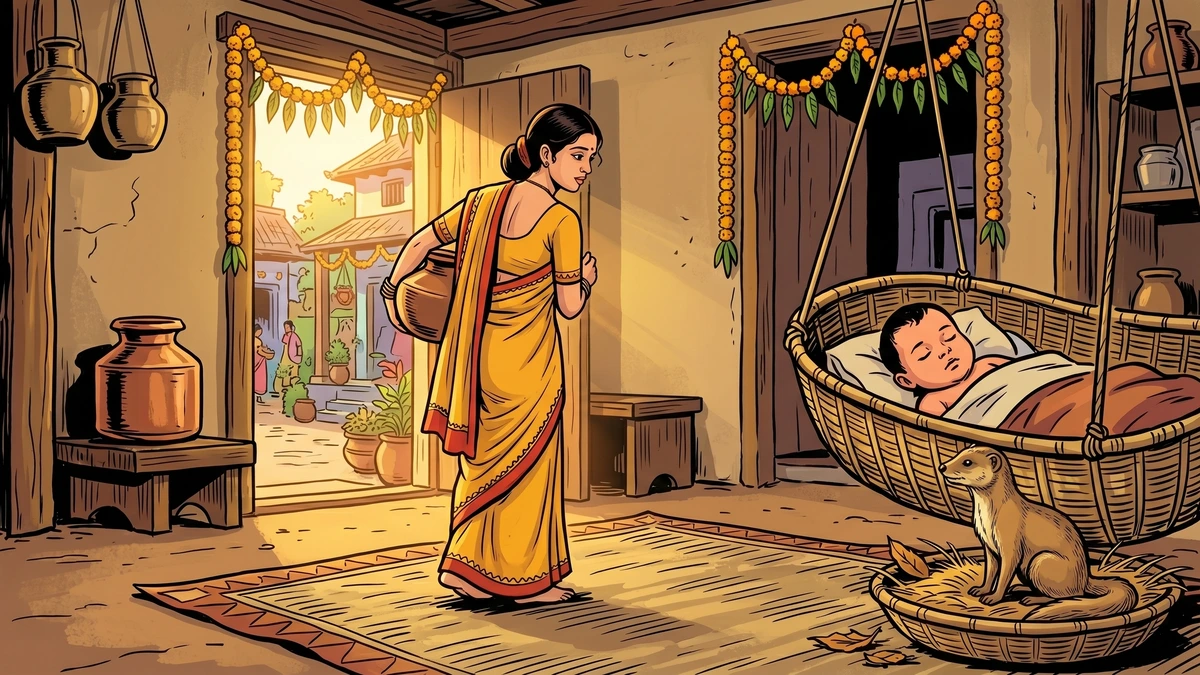
One afternoon the wife needed to fetch water from the village well. Her husband was away on his teaching rounds; there was no one else in the house. She laid her son in his cradle, checked that the mongoose was drowsing in its customary corner, and picked up her clay water-pot. At the door she hesitated — the Sanskrit text pauses here, as if the author himself holds his breath — but the well was close, the day was warm, and she had made this trip a hundred times. She left.
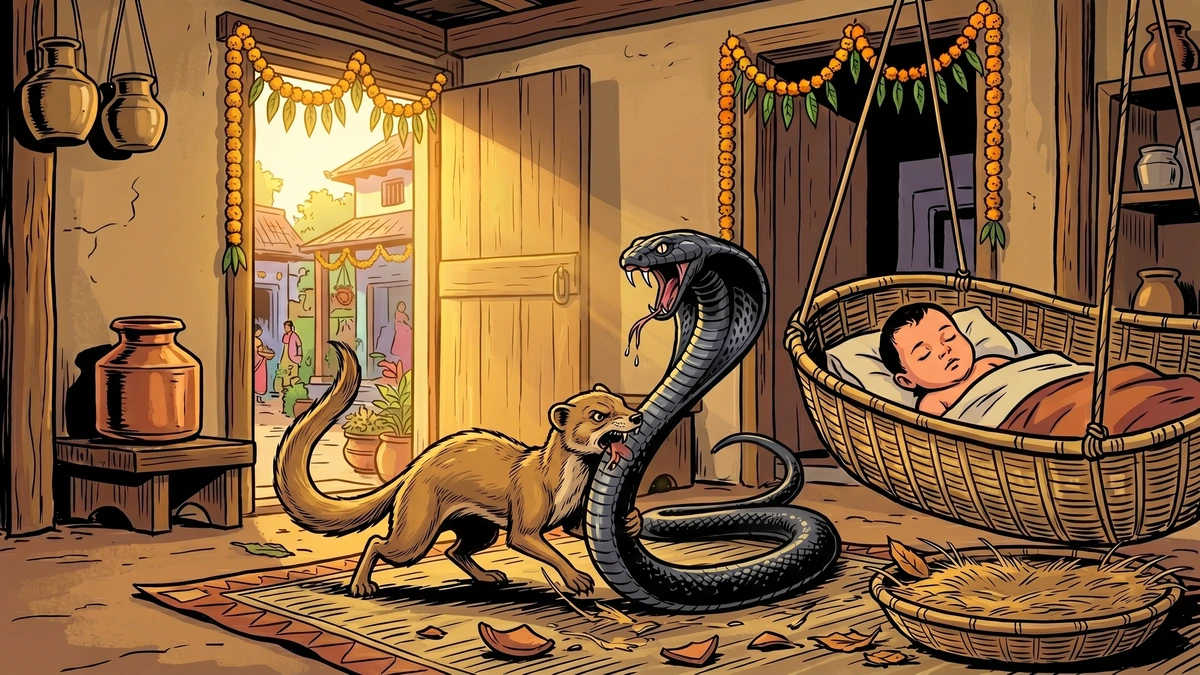
She had barely reached the lane when a black cobra slipped through a crack in the mud-brick wall and found its way toward the cradle. The mongoose woke. What followed was swift and without mercy: a coil of dark muscle against a streak of tawny fur, the cobra’s fangs striking air, the mongoose’s jaws finding the back of the serpent’s neck. By the time the child had stirred and whimpered, the cobra was dead, lying in pieces on the earthen floor. The mongoose sat back on its haunches, panting, its muzzle dark with blood, and waited for the footstep it knew better than any other in the world.
The wife came around the corner of the compound wall, her pot balanced on her head, and saw the mongoose at the threshold. It ran toward her eagerly — as it always did when she returned — its blood-stained face lifted in greeting. The pot hit the ground. In the single second between seeing the blood and reaching the cradle, the wife’s mind drew the only conclusion it could bear to hold: the mongoose had attacked the baby. She seized the heavy water-pot as it rolled — some versions say she picked up a grinding stone, others a wooden pestle — and brought it down on the mongoose’s skull before it had time to flinch.
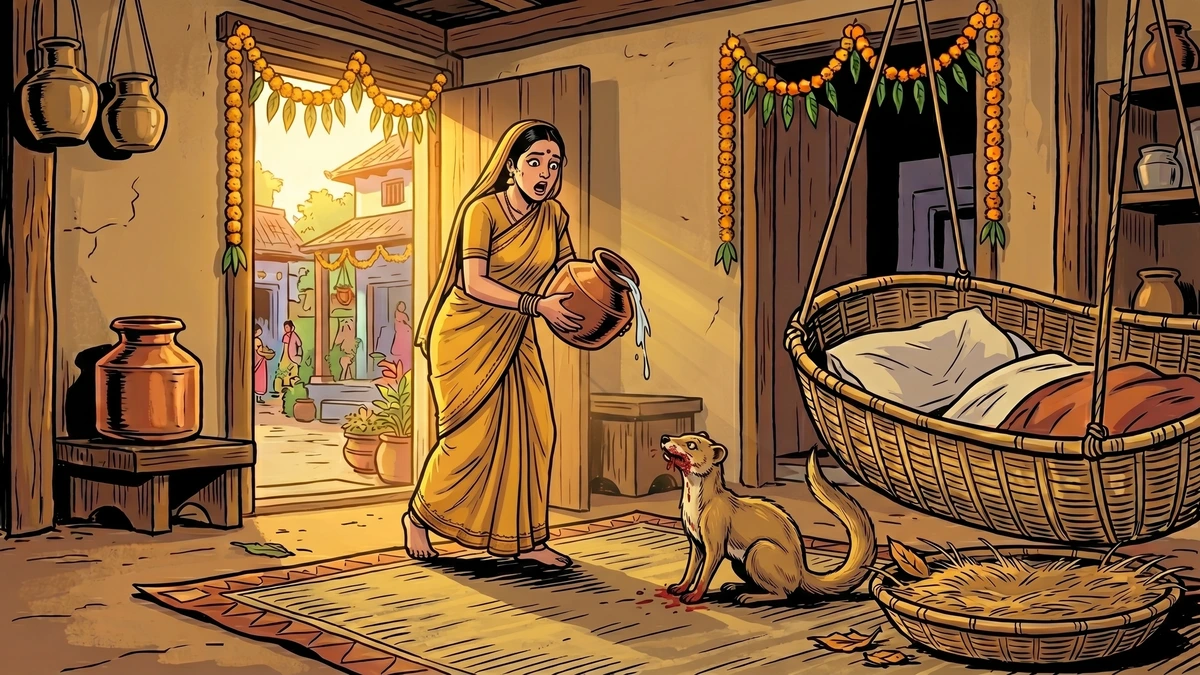
She ran to the cradle. Her son lay sleeping peacefully, one fist curled under his chin. On the floor beside the cradle she saw the dead cobra, torn apart, still coiled in its last attitude of strike. She understood everything in that moment — the guardian, the battle, the victory, the loyalty — and she began to weep. But the mongoose was already dead. She had killed, in her panic, the creature that had saved her child’s life.
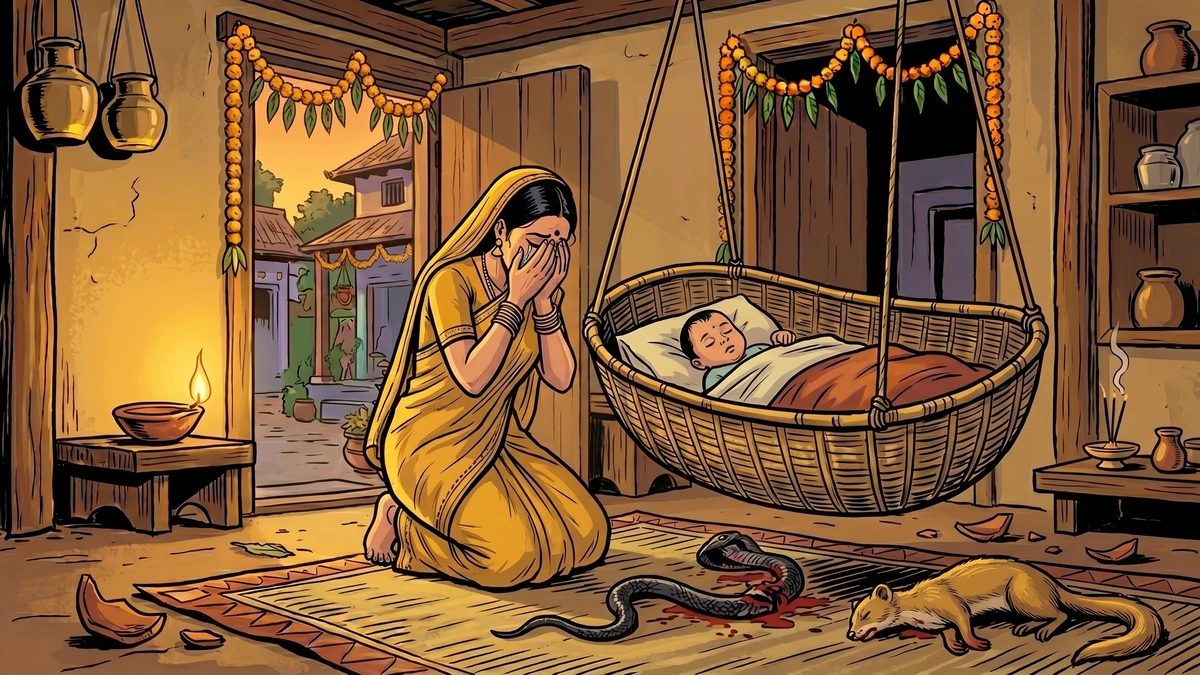
Dev Sharma returned in the evening to find his wife keening over the mongoose’s body while their son slept undisturbed. When she had told him everything, he said only this, and the Sanskrit original gives it as a single half-verse: “One should not act in haste; one who acts in haste repents at leisure.” In the larger frame-narrative of the Hitopadeśa, these words serve as the master-teacher Viṣṇuśarman’s demonstration to his royal pupils that hasty action, even when sprung from love, is indistinguishable in its effects from malice.
Textual Lineage and Sanskrit Sources
The earliest traceable Sanskrit version appears in the Pañcatantra of Viṣṇuśarman (c. 300–500 CE), though most Panchatantra scholars — including Edgerton (1924) and Olivelle (2006) — assign the mongoose tale to the Tantrākhyāyikā recension. The tale is also prominently embedded in Nārāyaṇa’s Hitopadeśa (c. 800–1100 CE), Book I (Mitralābha), where it carries the explicit moral label asaṃhita-kārya-karma — “the danger of actions undertaken without deliberation.”
The mongoose appears in both texts as nakula (Sanskrit), a word carrying a double association: the animal itself, celebrated in the Arthaśāstra of Kauṭilya for its serpent-killing, and Nakula, the fourth Pāṇḍava prince of the Mahābhārata, famed for his loyalty. Viṣṇuśarman’s choice of the mongoose allows the story to vibrate with heroic connotations that make the wife’s error more terrible: she has killed not merely a pet but an embodiment of faithful service.
The International Diffusion of the Tale
Few folk narratives have traveled as widely as this one. The story belongs to what Aarne–Thompson–Uther tale type ATU 178A (“The Faithful Animal Falsely Suspected”), a cluster that includes the Welsh legend of Gelert, in which Prince Llywelyn kills his hound Gelert believing the bloodied dog has devoured his infant son, only to find the child unharmed and a dead wolf beneath the cradle. The Gelert legend — attached by the eighteenth-century tourist industry to the village of Beddgelert (“Gelert’s grave”) — is now known to scholars as a literary transplant from the Indian subcontinent: it arrived in medieval Europe through the Arabic collection Kalīla wa-Dimna (eighth century CE), thence into the Hebrew Mišlê Sendebar and the Latin Directorium Vitae Humanae of John of Capua (c. 1263–1278).
By the thirteenth century the mongoose story — with the faithful animal variously transformed into a hound, a weasel, a greyhound, or a falcon — appeared in the Gesta Romanorum, the Seven Sages of Rome, and the French Chevalier de la Tour Landry. In the twentieth century the motif was catalogued by Stith Thompson as motif B331.2 (Weasel killed for having saved master’s child from serpent) and K2150 (Innocent animal accused of killing master’s child). The persistence and geographic breadth of the diffusion constitute one of the strongest documented cases for the “Indian origin” hypothesis of international folktale transmission championed by scholars from Theodor Benfey (1859) onward.
Moral Philosophy: Haste and the Hierarchy of Virtue
The moral the story drives toward — do not act hastily — risks appearing obvious. What the Sanskrit tradition preserves that its European adaptations generally flatten is the story’s psychological precision. The wife’s error is not stupidity; it is the compression of grief. She does not think the mongoose might have harmed her child: in the single second of perception, the blood and the proximity of the sleeping infant collapse into a certainty that feels like knowledge. This is what Nārāyaṇa’s commentary identifies as prajñā-nāśa — the destruction of discriminative wisdom by overwhelming emotion.
Kauṭilya’s Arthaśāstra (Book I, Chapter 5) warns the king against the same failure: “The man who acts before he has heard all sides causes injury to himself.” The Panchatantra positions the mongoose story as a pedagogical case study for princes, reminding them that governance requires the ability to suspend reaction long enough for intelligence to arrive. The wife is not merely a grieving mother; she is the type of every administrator, general, or king who has ever issued an order in the heat of incomplete information.
The Jain philosophical tradition read the story differently. In the Jain commentary tradition, the emphasis falls on the mongoose itself — on the ahiṃsā paradox of an act that kills to protect. Some Jain retellings conclude with the teacher pointing out that if the mongoose had merely stood guard without striking, the cobra might have withdrawn; the kill, however loyal its motivation, opened the door to tragedy. This is a characteristically Jain inversion: the hero’s violent act becomes the first link in the causal chain leading to its own death.
The Mongoose in Indian Natural and Symbolic Tradition
The Indian grey mongoose (Herpestes edwardsii) occupies a unique place in South Asian natural history and symbolism. Its resistance to cobra venom — partial, achieved through rapid movement and thick fur rather than physiological immunity — was documented in Sanskrit medical texts including the Suśruta Saṃhitā. In the popular imagination, the mongoose was the natural karmic enemy of the serpent, and the two were sometimes linked in temple iconography as emblems of the eternal struggle between protective and destructive forces.
The god Kubera, the yakṣa lord of wealth, is traditionally depicted holding a mongoose that spits jewels — an image derived from the ancient belief that mongooses, as destroyers of the nagas (serpent-deities who guard underground treasure), were themselves associated with abundance liberated from danger. The mongoose of the Brahmani story thus stands at the intersection of the domestic and the mythological: simultaneously a household pet acting from simple affection and an archetypal serpent-slayer fulfilling its cosmic role, destroyed by a human failure of understanding.
Legacy: Retellings and Modern Reception
Rudyard Kipling’s “Rikki-Tikki-Tavi” (The Jungle Book, 1894) is the most widely read modern English descendant of this tradition. Kipling transforms the story’s tragic register into triumphant adventure: the mongoose wins, the cobras die, and the human family is saved without misunderstanding or loss. Where the Panchatantra uses the scene to teach princes to pause before acting, Kipling uses it to celebrate animal courage — a Victorian reworking of an ancient Indian pedagogical tool.
In contemporary Indian children’s literature and Amar Chitra Katha comics, the story is typically rendered with emphasis on maternal grief and the moral of reflection before action. In Indian classical dance, particularly in Bharatanatyam abhinaya traditions, the scene of the wife’s horror has been set as a solo teaching piece, with the dancer’s face required to express within a few seconds the full arc from loving anticipation to murderous terror to desolate understanding.
Frequently Asked Questions
Q: What is the moral of The Brahmani and the Mongoose?
Never act hastily on incomplete information, however certain grief makes you feel. The wife’s love for her child was real, but her certainty was a feeling, not a fact. By the time she knew the truth, no apology could undo the blow.
Q: Where does this story come from?
The Panchatantra (c. 300–500 CE) and the Hitopadeśa (c. 800–1100 CE) are its primary Sanskrit homes. Through the Arabic Kalīla wa-Dimna and its Latin descendants, the story spread across medieval Europe, where it became the Welsh Gelert legend and dozens of related tales.
Q: How is it related to Rikki-Tikki-Tavi?
Kipling’s 1894 story inherits the same mongoose-versus-cobra arena but deliberately replaces the tragic misunderstanding with unambiguous triumph. Where the Panchatantra uses the scene to teach princes to pause, Kipling uses it to celebrate animal courage — a Victorian reworking of an ancient Indian pedagogical tool.
You May Also Like
 Panchatantra Stories
Ages 3-5
Panchatantra Stories
Ages 3-5
The Donkey and the Washerman
The Donkey and the Washerman: A lion's skin gives a donkey false courage until one cry reveals his true nature A classic Indian folk tale retold for young...
 Panchatantra Stories
Ages 6-8
Panchatantra Stories
Ages 6-8
The Lion and The Foolish Donkey
The Lion and The Foolish Donkey: A lion named Karalakesara was living in a forest, loyally served by Dhoosaraka, a jackal that used to accompany the lion
 Panchatantra Stories
Ages 3-5
Panchatantra Stories
Ages 3-5
Pride Goeth Before A Fall
Pride Goeth Before A Fall: In a certain village there lived ten cloth merchants, who always went about together. Once upon a time they had travelled far