The Greedy Cobra and the King of Frogs
Read 'The Greedy Cobra and the King of Frogs' — a classic Panchatantra story about moral lessons about greed. The Greedy Cobra and the King of Frogs is ...
The Greedy Cobra and the King of Frogs
Source: Panchatantra, Book IV — Labdhapranasham (Loss of Gains), attributed to the sage Vishnu Sharma, composed c. 300 BCE–300 CE; this redaction follows the Sanskrit recension of the Tantrakhyayika and Chandra Rajan’s critical translation (Penguin Classics, 1993).
लोभाद् भवति नाशश्च, नाशात् लोभढं पुनःःू
A desperate old cobra turns his misfortune into an opportunity, persuading the frog king to let him serve as a royal mount. Meal by meal, the cobra depletes the frog colony until nothing remains. The tale is a masterclass in how self-serving flattery, combined with a victim’s vanity, can convert a predator into a catastrophe hiding in plain sight.
Part I: The Cobra’s Stratagem
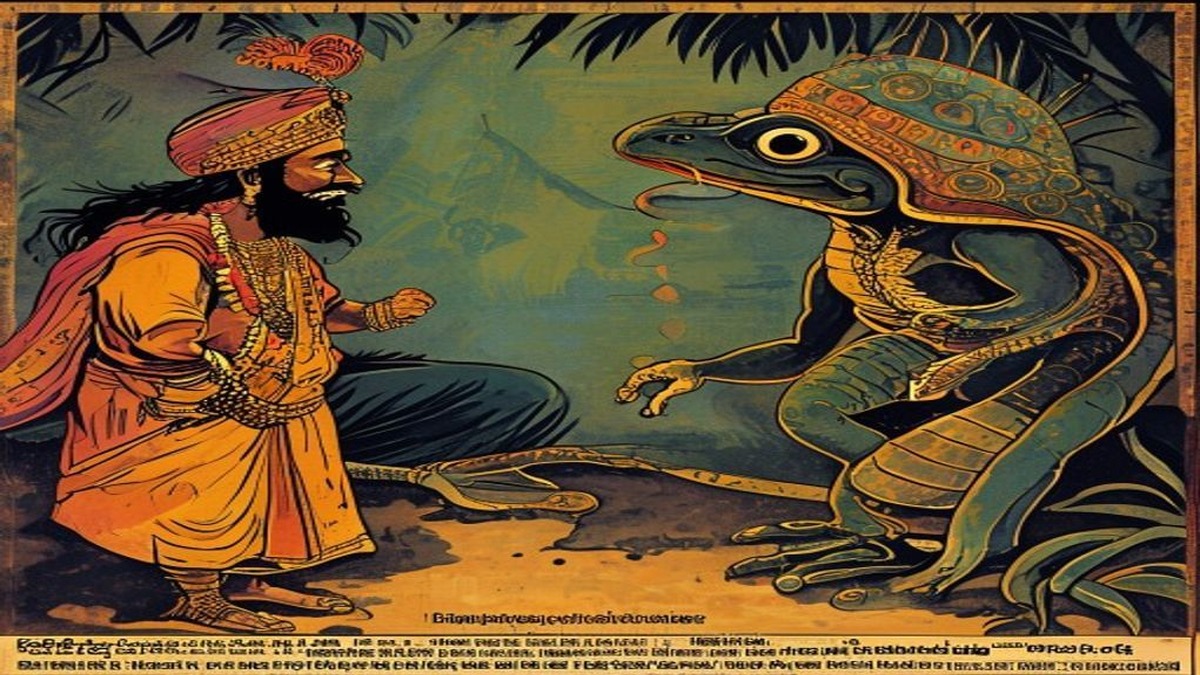
In the great reed-forest bordering the River Gambhira there lived an ancient cobra named Mandavishya, whose fangs had dulled and whose coils had grown slow with age. Once lord of a flourishing burrow, he now struggled to catch even the smallest tadpole; hunger gnawed at him as relentlessly as a mongoose gnaws a root.
One evening, watching the frog colony celebrate the monsoon on the far bank, Mandavishya formulated a plan of breathtaking audacity. He slithered to the water’s edge, assumed a posture of extreme humility—hood flattened, body coiled low—and waited. When King Jalapada, resplendent in his damp green robes, hopped close enough to peer at him, the cobra spoke in honeyed tones.
“O Mighty Jalapada,” he said, “I am a wretched sinner. Long ago I was cursed by a learned Brahmin whose son I bit by mistake in a moment of darkness. The sage’s words were these: ‘You shall be condemned to carry frogs upon your back for the remainder of your days, fed only what they deign to give you.’ I surrender myself to your mercy, great king, so that the curse may be discharged and I may earn merit before I die.”
The story was entirely false, of course. Mandavishya had invented it on the spot, tailoring it perfectly to the king’s known pride. The cobra understood that no frog who had ever dreamed of riding a cobra could resist the spectacle of a cobra begging to be ridden.
Part II: The Royal Mount
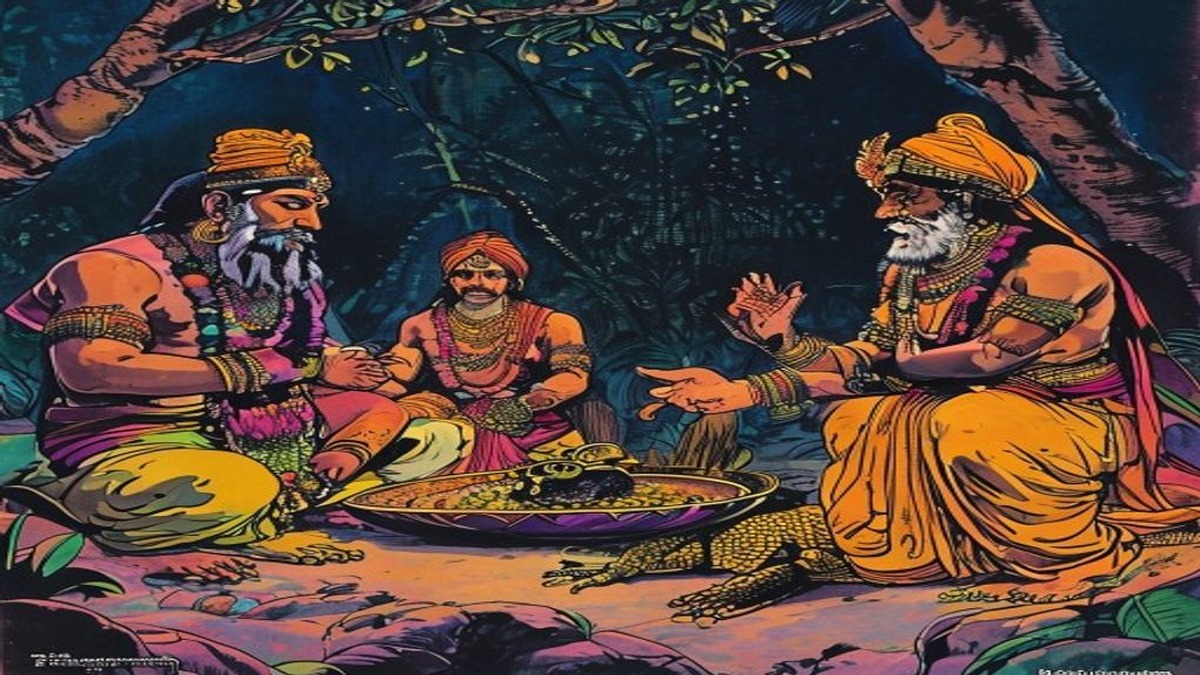
Jalapada’s vanity was a great pond of still water into which Mandavishya had thrown a perfectly shaped stone. The king convened his ministers at once. “A cobra has come to serve as our royal mount,” he announced. “Send word to every village: the King of Frogs rides a cobra!” His counselors exchanged uneasy glances, but vanity in a king tends to be contagious, and soon the entire court had convinced itself that the arrangement was a magnificent honour.
The first day, Mandavishya carried Jalapada around the pond in slow, stately loops while frogs lined every bank to gawk. The cobra moved with carefully performed weakness—a slight trembling of the neck, a laboured breathing—suggesting that only the most heroic effort kept him upright under his kingly burden. Jalapada was moved. “Poor creature,” he said. “You must be famished. Take one of the smaller frogs from the colony’s outer ring as your meal.”
Thus began the arrangement. Each day Mandavishya carried the king; each day he received one frog as payment. The feeding was gentle at first—always the most marginal members of the colony, the sick or the old—so that no one complained loudly enough to be heard. But as weeks passed and Mandavishya regained strength, his appetite grew with it. He requested two frogs, then three, citing the increasing weight of the king’s retinue. Jalapada, ever generous with lives that were not his own, agreed each time.
The Sanskrit commentarial tradition calls this stage krama-bhakshana (gradual consumption) and treats it as the most dangerous form of predation: not the sudden strike of a hawk but the slow, authorized feast of an ally. The court saw what was happening; but they had publicly endorsed the arrangement, and pride made them mute.
Part III: The Colony’s Ruin
The day came when Mandavishya could no longer maintain the pretense of weakness. He was now fully restored—his coils thick, his scales bright, his strike as fast as rain. That morning he did not even wait for Jalapada’s permission. He simply ate three frogs before the king had finished his morning bath. When Jalapada protested, Mandavishya smiled with his eyes.
“My king,” he said smoothly, “the curse has worsened. The sage’s spirit visited me in a dream and said I must eat more or the curse will transfer to whoever rides me. Surely you do not wish that fate.” Jalapada, who had by now invested his entire self-image in the cobra, could not bear the thought that the relationship might harm him. He acquiesced.
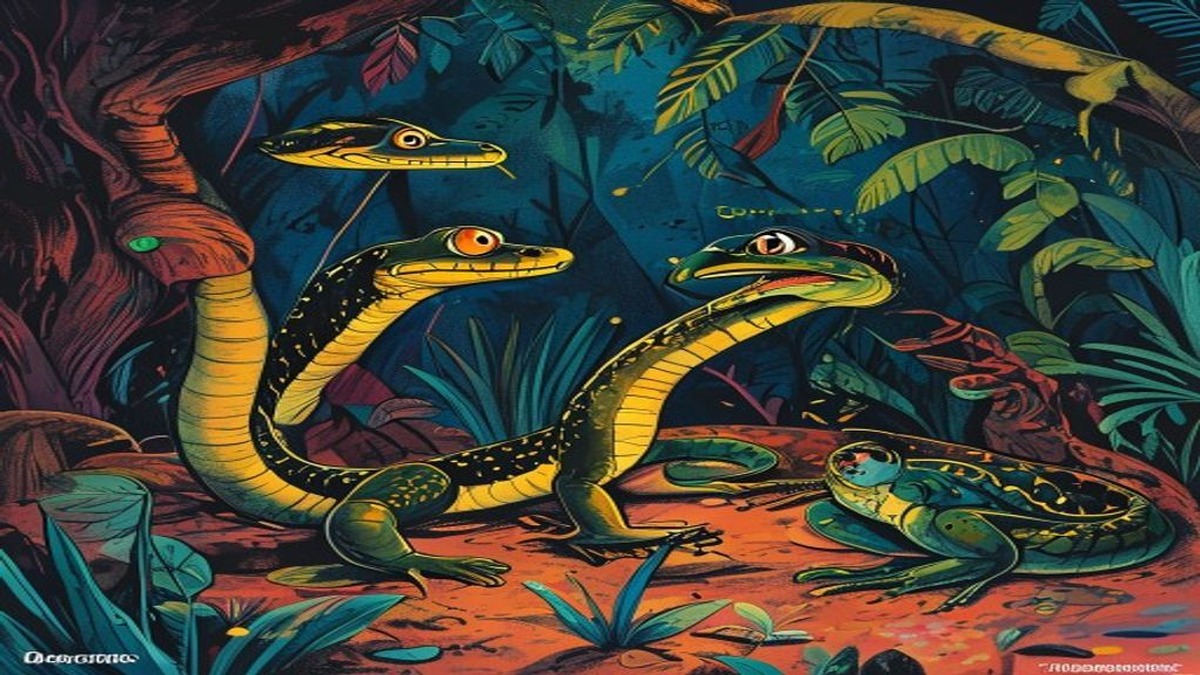
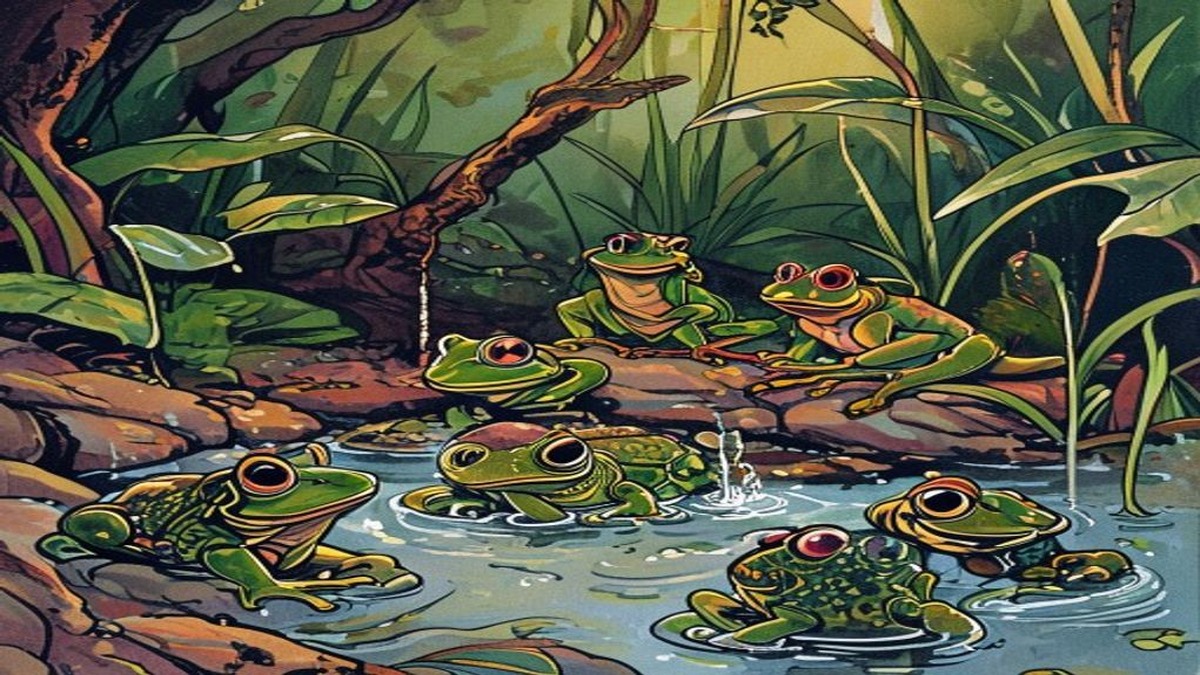
Within a month, the pond that had rung with a thousand frog-voices fell silent. The outer rings of the colony were gone. The middle tiers vanished. Only the royal household and a handful of ministers remained. Even then, Mandavishya’s pretense held: he still carried Jalapada on his back each morning, still bowed at the water’s edge each evening. But the bowl he was handed grew fuller with each passing day.
One moonlit night, with the colony reduced to a dozen survivors, an old counsellor named Vikrama finally spoke what every frog had been thinking. “My king,” he said, “there is no curse. There never was. We have fed our enemy with our own hands and called it honour. The cobra is not bound to us; we are bound to him, by our own pride.” Jalapada listened in silence, and for the first time in many weeks he looked at the cobra without the lens of vanity.
Part IV: The Reckoning and the Lesson
The recognition came too late. By the time Jalapada summoned the will to banish Mandavishya, the cobra had eaten the counsellor who advised it, using the distraction of the very council meeting to make his move. When Jalapada finally hopped toward the cobra with an order of exile, Mandavishya simply regarded him with ancient, patient eyes.
“You have no colony to command,” the cobra said, not unkindly. “You are one frog on an empty bank. What order do you give, and who obeys it?” He did not strike the king that night. A cobra with no more frogs to feed upon has no use for a dead frog king; a living king is a symbol of the cobra’s patience and craft. Mandavishya slid back into the reeds and vanished into the dark, leaving Jalapada alone on the cold mud of the empty pond.
The Panchatantra closes the tale with Vishnu Sharma’s characteristic economy: the story is not primarily about cobra-nature or frog-nature but about the universal anatomy of flattery and the point at which a leader’s vanity becomes the instrument of his people’s destruction. Jalapada was not evil; he was vain. Mandavishya was not exceptional; he was patient and observant. The catastrophe lay in the intersection of those two qualities.
Why This Story Has Lasted Three Thousand Years
“The Greedy Cobra and the King of Frogs” endures because it describes a failure mode that recurs in every era and every institution: the gradual capture of power by a patient, flattering subordinate whose harm is invisible until the damage is near-total. The story has been cited by Sanskrit political theorists as a case study in mitra-satrava (enemies disguised as allies) and appears in Kautilya’s Arthashastra commentaries as an illustration of how a king’s ego becomes the enemy’s primary weapon.
Modern readers find in Mandavishya a recognizable archetype: the consultant who becomes indispensable, the advisor whose counsel slowly erodes the institution he serves, the ally whose help is precisely calibrated to create dependency. The frog colony’s silence in the face of visible destruction—paralysed by the public endorsement of the arrangement—maps cleanly onto the social psychology of groupthink and sunk-cost commitment.
The tale’s formal structure also repays attention. Vishnu Sharma builds the escalation in precise arithmetic: one frog, then two, then three, then unrestricted access. Each step is small enough to seem reasonable; together they constitute annihilation. This graduated-harm structure is the reason the story works as a teaching tool: it trains the listener to notice not the individual transgression but the direction of travel.
Across the centuries, the story crossed into Arabic as part of Kalila wa Dimna, became a fable in Rumi’s Masnavi tradition, and entered European fabliaux through the Latin Directorium Humanae Vitae. In each retelling the local fauna changes; the lesson does not. Greed armed with patience and flattery is the most lethal combination in the natural—and political—world.
Frequently Asked Questions
What is the moral of The Greedy Cobra and the King of Frogs?
The story warns that vanity makes a leader vulnerable to manipulation. When King Jalapada accepted the cobra's false story out of pride, he unknowingly authorized the destruction of his own colony. True wisdom requires questioning flattery, especially when it arrives from an enemy asking for permission to enter.
Which book of the Panchatantra does this story come from?
This tale appears in Book IV of the Panchatantra, known as Labdhapranasham (Loss of Gains). The book collects stories about how carelessness and misplaced trust lead to the ruin of things already won or built.
Who is Mandavishya in the story?
Mandavishya is the aged cobra who devises a clever lie about a Brahmin's curse to gain the trust of the frog king. His character archetype — the patient, flattering infiltrator — is one of Vishnu Sharma's most sharply drawn.
How does the cobra gradually destroy the frog colony?
Mandavishya begins by eating only one frog per day as payment for carrying the king, starting with the weakest members of the colony. Over weeks he increases his consumption in small increments until the entire colony is consumed. This graduated-harm pattern is the story's central structural teaching.
How did this Panchatantra story spread to other cultures?
The story entered Arabic literature through Kalila wa Dimna, compiled by Ibn al-Muqaffa. From Arabic it spread into Persian, Hebrew, and eventually Latin as Directorium Humanae Vitae, from which European fabliaux drew similar cautionary tales about misplaced trust.
You May Also Like
 Panchatantra Stories
Ages 6-8
Panchatantra Stories
Ages 6-8
The Cunning Mediator
The Cunning Mediator: Beware of a rascal who pretends to be holy.” Two partridges (quail-like birds) lived in a certain tree in the jungle. While one of them
 Panchatantra Stories
Ages 3-5
Panchatantra Stories
Ages 3-5
The Donkey and the Washerman
The Donkey and the Washerman: A lion's skin gives a donkey false courage until one cry reveals his true nature A classic Indian folk tale retold for young...
 Panchatantra Stories
Ages 3-5
Panchatantra Stories
Ages 3-5
The Three Fish – Moral Story for Kids
The Three Fish – Moral Story for Kids: Once upon a time, there lived three big fish in a lake. They were close friends, but characteristically very different.