The Carpenter’s Wife
The Carpenter's Wife: Once upon a time, a carpenter lived in a village with his wife. He had heard bad stories about her and wanted to know the truth about

Origin & Canonical Placement
“The Carpenter’s Wife” is one of the Panchatantra’s most psychologically acute tales of domestic deception, examining with characteristic precision the mechanics of how a resourceful person exploits an adversary’s assumptions and turns surveillance itself into a cover for wrongdoing. The story belongs to Vishnu Sharma’s Pancatantra (c. 300 BCE–300 CE) and is also preserved in the Kathasaritsagara and related collections. It occupies the thematic space of Book IV: Labdhapranasham (“Loss of Gains”), which examines how intelligence and initiative — qualities the text usually admires — can serve ignoble ends when directed by moral failure, and how those who seek to control others through watchfulness often find the watchers themselves outmanoeuvred.
“Stri-pragalbhyam na shakyam nirvaritum api panditaih.”
“Even the learned cannot easily restrain the boldness of a determined woman.”
— Sanskrit maxim, Kathasaritsagara tradition
Beat I — The Setup: A Suspicious Husband and a Watchful Tree
A carpenter suspected his wife of conducting an affair and resolved to catch her in the act. His plan was simple: he told her that he was leaving on an extended journey to a distant town for work, made visible preparations for departure, and then doubled back to conceal himself in the branches of a large tree that stood outside his house and commanded a clear view of the courtyard and the front entrance. From this vantage point, he intended to observe everything that occurred in his absence and confirm or refute his suspicions.
The wife, who was considerably more perceptive than her husband gave her credit for, noticed the small signs that a person leaving on a genuine journey does not produce: the too-deliberate farewell, the over-prepared bundle, the glance back at the tree as he left the compound. She understood immediately that she was about to be watched. She adjusted her plans accordingly, with the quiet efficiency of someone who has considered multiple contingencies in advance.
Beat II — The Stratagem: Making the Watcher Reveal Himself
That evening, the wife sat in the courtyard with her friend — the woman she used as a go-between — and began to speak loudly and clearly about a dream she had experienced the previous night. In the dream, she said, a celestial spirit had appeared to her and declared that her husband’s life was in danger: he would fall from a great height before the night was out, and only her faithful prayers and vigil could protect him. She then proceeded to pray loudly and at length, calling upon various deities to protect her beloved husband from the fate the dream had foretold.
The carpenter, hearing this from his perch in the tree, was simultaneously moved by apparent evidence of his wife’s devotion and disconcerted by the specificity of the prophecy about falling from a height. He shifted position nervously. The branch on which he was sitting creaked. He shifted again. He fell, making a considerable impact on the ground below. The wife rushed to him with every expression of relief and gratitude, declaring that her prayers had worked and that the fall — serious but survivable — had been the fate that divine intervention had softened. The carpenter, bruised, confused, and now convinced of his wife’s devotion, abandoned his surveillance entirely.
Beat III — The Analysis: The Mechanics of Misdirection
The Panchatantra’s analysis of this tale is notably double-edged. The wife’s stratagem is technically brilliant: she constructs a narrative that simultaneously explains any suspicious sounds from the tree (fate, not a lurking husband), provides herself with an alibi for the evening (she was praying, not meeting anyone), and exploits her husband’s superstitious nature to make him the agent of his own downfall — literally. She does not need to prove her innocence; she redirects the husband’s framework of interpretation so that the evidence of his own surveillance works against his original conclusion.
The tale is also an analysis of the limits of surveillance as a method of control. The carpenter’s plan rests on the assumption that observation gives the observer an advantage over the observed. But observation only produces this advantage if the observed does not know they are being observed. Once the wife perceived that she was under surveillance, the advantage reversed: she knew more about the situation than the carpenter did (she knew he was in the tree; he did not know that she knew), and she used this asymmetry to convert his surveillance position into his greatest vulnerability.
Kautilya’s Arthashastra discusses the use of intelligence agents and covert observation extensively, but consistently warns that double-agents — observers who have been identified by those they observe — are among the most dangerous elements in any intelligence operation. The carpenter, in effect, became his wife’s unwitting double agent: conducting an operation that produced exactly the opposite of its intended outcome because its cover had been blown.
Beat IV — Moral Dimension & Enduring Relevance
The tale’s moral territory is deliberately uncomfortable: the wife’s intelligence and resourcefulness are presented with evident admiration, yet they are deployed in service of a deception. Vishnu Sharma does not moralize harshly about this; the story’s tone is closer to wry observation than condemnation. This reflects the Panchatantra’s broader willingness to present intelligence as a morally neutral capacity whose ethical valence depends on the ends it serves — and to document its operations with accuracy even when those operations are not praiseworthy.
The carpenter’s error is, at its root, an error of condescension: he did not credit his wife with sufficient intelligence to perceive his surveillance, and that failure of recognition was the direct cause of his humiliation. The Panchatantra consistently presents this kind of condescension — the assumption that the less powerful party is also the less intelligent one — as among the most reliably fatal errors available to the powerful. The carpenter had the advantage of surprise, elevation, and prior knowledge of his own plan; his wife had none of these things and still won decisively, because she observed more carefully and thought more clearly.
In contemporary terms, the story speaks to anyone who relies on covert monitoring of another party without recognising that the monitored party may perceive the monitoring — and that a monitored party who knows they are being monitored is not merely defended but positively advantaged. The lesson for intelligence operations, organisational management, and personal relationships is identical: surveillance that has been detected is worse than no surveillance, because it reveals the watcher’s suspicions and methods while providing the watched with complete information about the watcher’s position.
Moral: He who watches another without being perceived has an advantage; he who is perceived watching has surrendered it entirely — and may find his own vantage point turned against him.
Why This Story Has Lasted 2,000 Years
The carpenter’s wife endures as a figure of complex fascination because she embodies a paradox that every culture recognises: intelligence and initiative in the service of questionable ends, deployed with technical perfection, producing a result that is simultaneously admirable and troubling. The story travelled through the Panchatantra’s translation networks into Arabic (Kalila wa Dimna), Persian, and European collections where it was absorbed into the broad tradition of tales about the wit of women — a genre that simultaneously celebrates and is wary of exactly the qualities on display here. The tale endures because it refuses easy moral closure, presenting a stratagem so perfectly executed that the reader cannot help admiring the craft even while noting the purpose it served.
About the Panchatantra
The Panchatantra (“Five Treatises”) was composed in Sanskrit by the scholar Vishnu Sharma around 300 BCE–300 CE as a niti-shastra — a guide to wise conduct and statecraft — framed as animal fables for the instruction of young princes. Its five books cover the dissolution of allies, the winning of allies, war and peace, the dangers of naivety, and the hazards of rashness. The text spread westward through Pahlavi and Arabic translations to become the most widely translated secular book of the ancient world after the Bible.
You May Also Like
 Panchatantra Stories
Ages 3-5
Panchatantra Stories
Ages 3-5
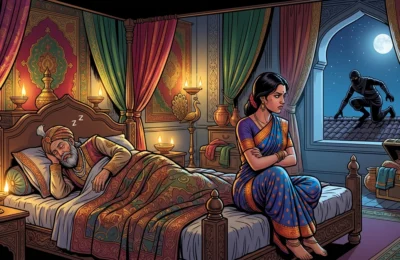
The Old Man, his Young Wife, and the Thief
The Old Man, his Young Wife, and the Thief: In India, long ago, there lived a wealthy merchant in a small village near the banks of a sacred river. The houses
 Panchatantra Stories
Ages 9-12
Panchatantra Stories
Ages 9-12
The Story of the Singing Donkey
The Story of the Singing Donkey: In a certain town, there lived a donkey, by the name of Uddhata. He belonged to a washerman. Duringthe daytime, he carried the
 Panchatantra Stories
Ages 3-5
Panchatantra Stories
Ages 3-5
The Talking Turtle
A chatty turtle flies high in the sky holding a stick between two clever geese, but his talking tongue will bring him crashing down in this funny Panchatantra fable.