Of Crows and Owls
Of Crows and Owls: Keep your counsel to yourself and thus stay away from trouble.” Once upon a time, all the birds the swans, cranes, parrots, cuckoos, owls
Of Crows and Owls
Kakolukiyam: The Book of Crows and Owls
The third book of the Pancatantra bears the name Kakolukiyam — literally “that which concerns crows and owls” — and takes as its central subject the most elaborate political and strategic argument in classical Sanskrit literature. The crow-owl enmity is among the oldest motifs in Indian folklore: references to the hatred between these two bird species appear in the Rigveda, the Mahabharata, and the Arthashastra. What Vishnu Sharma did in the Pancatantra’s third book was transform this folklore motif into a sophisticated political treatise on asymmetric conflict, the nature of permanent enmity, and the conditions under which a weaker party can defeat a structurally superior permanent adversary. The tale preserved in all major Sanskrit recensions, including the Tantrakhyayika (c. 200 BCE, Kashmir), begins with the founding act of enmity at a great bird assembly — and from that single event, an entire world of political consequence unfolds.
Beat I — The Great Bird Assembly and the Crow’s Objection
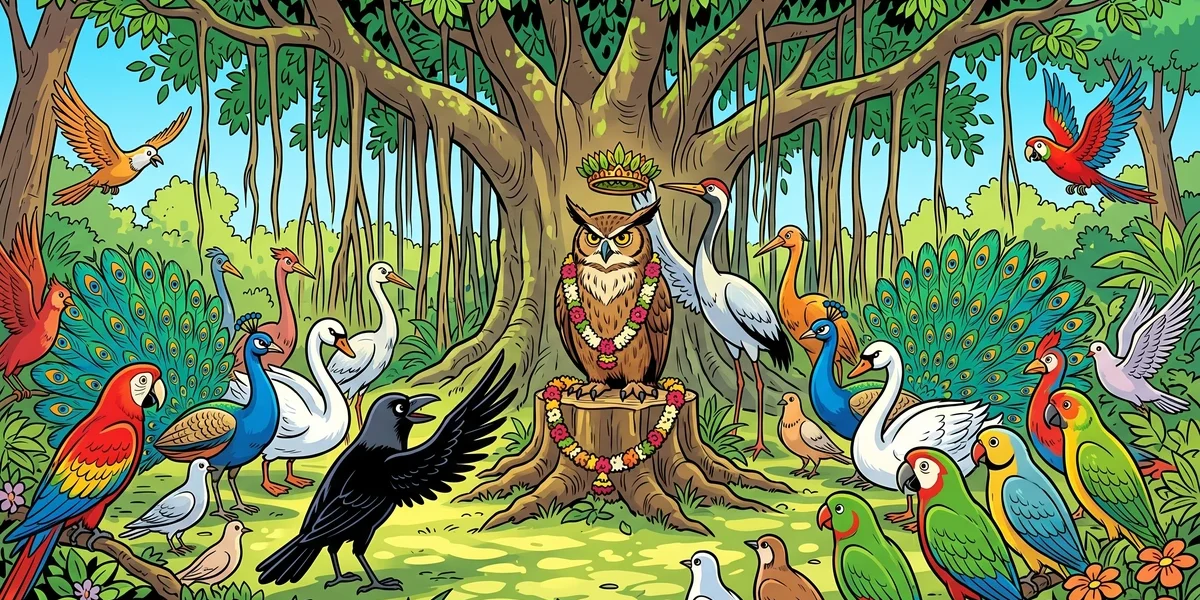
In the forest of Mahilaropya, beside a massive banyan tree that sheltered the entire crow kingdom, the birds of the world assembled for a great debate. The swans, the cranes, the parrots, the peacocks, the doves, the cuckoos — every species sent its representatives. The question before the assembly was one of governance: Garuda, the divine eagle, king of birds by ancient right, was absent and could not be reached. The birds needed a regent, a leader to govern in Garuda’s absence. After long deliberation, the owl emerged as the leading candidate. He was powerful, dignified, and possessed of the singular ability to see in the darkness when all other birds were blind. The assembled birds prepared to crown him.
At that moment, a crow arrived. He had not been present at the start of the debate, had not heard the long deliberations, and had not been part of the consensus that was forming around the owl. Looking at the owl — his hooked beak, his fierce eyes, his unsettling stillness in daylight — the crow spoke. The owl, he argued, was not fit to be king. His character was wrong, his temperament unsuited to governance, his very nature an ill omen. And besides, while Garuda the divine still lived, why choose another king at all? The crow’s words were sharp and public, delivered before the entire assembly, and they struck the owl as a mortal insult. The other birds, reconsidering, stepped back from the coronation. The owl was not elected.
The owl’s response to this public humiliation established a permanent enmity. He did not rage briefly and forgive; he did not seek private reconciliation. He declared before the assembly that from this day forward, every crow was the enemy of every owl, and every owl was the enemy of every crow, for all time. The founding crow had cost him the kingship in the eyes of all birds, and this debt could not be repaid, the relationship could not be restored. The enmity was born not as personal grievance but as categorical opposition: not this crow against this owl, but all crows against all owls, permanently and structurally.
Beat II — The Night Attacks: When the Stronger Strikes
Generations passed. In the great banyan tree at Mahilaropya lived King Meghavarna and his crow kingdom, prosperous and numerous. In a dark cave in the nearby mountains lived King Arimardana and his owl army, fierce and disciplined. The structural enmity established at the founding assembly had never been resolved; it had been inherited by every generation of both species, as the founding owl had declared it would be. And the owls held the tactical advantage: they could see in the dark, when the crows were blind. Each night, the owls swept out of their cave and attacked the crow colony in the banyan tree, killing many crows before the first light of dawn forced them back to their darkness. King Meghavarna watched his people die night after night and understood the problem clearly: in a direct confrontation, the crows would lose. He could not fight the owls on their terms, in their conditions, with their advantages. He needed a different strategy.
Meghavarna summoned his ministers. He asked each of them in turn what should be done. The ministers gave the six classical answers prescribed by the Arthashastra for a weaker king facing a stronger adversary: seek peace through submission; fight to the death despite the odds; march away and find new territory; form an alliance with a third power; use deception to divide and weaken the enemy; or pursue the dual policy of apparent peace while secretly preparing for war. Each answer was argued, each had its advocates, each had its logic. But none of them, standing alone, addressed the specific situation: the owls were structurally superior in the direct confrontation, and no conventional response would change that.
Beat III — The Spy’s Gambit: Sthirajiva Enters the Enemy Cave
It was the wise crow Sthirajiva who proposed the plan that would save the kingdom. His name means “one who lives steadily” — a name that encoded the patience and steadiness his plan would require. His proposal was simple in outline, dangerous in execution, and brilliant in concept: he would go to the owls alone, pretending to be a traitor banished by Meghavarna. He would tell them that the crow king had exiled him for counselling peace with the owls, a position that had made him unpopular with his own people. He would seek shelter with the owls, be accepted into their cave, learn their secrets and their vulnerabilities, and then use that knowledge to engineer their destruction from within.
Meghavarna publicly and elaborately “drove away” Sthirajiva in front of the other crows, beating him with wings, calling him a traitor and a coward, until Sthirajiva lay wounded and humiliated at the base of the banyan tree. When the owls’ scouts saw the injured crow lying there, abandoned by his king, they brought word to Arimardana. The owl king’s ministers were divided: some urged caution, warning that an enemy who comes to you in weakness may be a spy. But the king was convinced by Sthirajiva’s wounds, his apparent humiliation, and the plausibility of his story. He allowed Sthirajiva to enter the cave. The spy was inside.
Beat IV — Fire in the Cave: The Patient Strategy Achieves Its End
Over many days, Sthirajiva learned everything about the owl fortress: its layout, its numbers, its guards and their rotations, the exact depths of the cave, its single point of entry. He also began, carefully and patiently, to make a suggestion to the owl king. The cave, Sthirajiva observed, was damp and cold, unsuitable for a great king. Why not improve it? Twigs, dry grass, leaves — gathered and piled within the cave — would make it warmer, more comfortable, more fitting for the owl court. The owl king agreed, and ordered his owls to gather flammable material in great quantities.
When the cave was packed with dry grass and tinder, Sthirajiva slipped away and found Meghavarna. He reported everything: the layout, the numbers, the guards, the route of approach. And he gave Meghavarna the key piece of intelligence: the cave was full of kindling. At dawn, when the owls had returned to their cave and were sleeping, Meghavarna sent a hundred crows carrying burning twigs. They dropped fire at the cave’s single entrance. The dry grass caught instantly. The flames roared through the cave. The owls woke in choking smoke and rushing fire, but the single entrance was a furnace. They could not escape. By the time the sun fully rose, the owl army of Arimardana was destroyed. The night attacks on the crow colony of Mahilaropya never came again.
Moral and Sanskrit Wisdom Tradition
“Against the permanent enemy who is physically superior, intelligence and patience are the only reliable weapons. Never trust a sworn enemy, however helpless they appear — and never give a permanent adversary the means to destroy you from within.”
— Moral of Of Crows and Owls, Pancatantra Book III (Kakolukiyam)
The crow-owl story encodes two complementary morals that operate simultaneously. From the crows’ perspective: when direct confrontation with a superior adversary is impossible, intelligence, patience, and deception are the weaker party’s only reliable tools. From the owls’ perspective: never trust a sworn enemy, however wounded and helpless they appear. The owl minister who warned against admitting Sthirajiva was right — but the owl king’s certainty in his own superiority made him deaf to wise counsel. The Pancatantra uses the owl’s failure to listen to his cautious minister as a lesson about the arrogance that strength produces and the blindness that arrogance creates.
This moral connects directly to the Arthashastra’s doctrine of the permanent enemy (nitya-shatru). Kautilya’s political science identifies the structural adversary — the king whose territory borders yours and whose interests are permanently opposed to yours — as a distinct category requiring its own response. The Pancatantra’s crow-owl framework is the most sustained narrative illustration of this doctrine in Sanskrit literature, demonstrating through story the principles that the Arthashastra states as abstract political science.
Why This Story Has Lasted 2,300 Years
Of Crows and Owls endures because it addresses the problem that every weaker party facing a stronger permanent adversary must solve: how do you win when you cannot win directly? The crow’s answer — patience, intelligence, infiltration, and the use of the enemy’s own strengths against them — is one that transcends its animal fable setting. The Pancatantra’s third book launched by this tale is, in essence, a complete manual for asymmetric strategy, and its prescriptions remain as relevant in modern strategic thought as they were when Vishnu Sharma formulated them for his royal pupils in the 3rd century BCE. The story has been retold across cultures — in the Arabic Kalila wa-Dimna, in the Persian Anvar-i-Suhayli, in the medieval European fable tradition — precisely because its core political insight is universal and permanent.
Sanskrit Tradition: Tantrakhyayika (c. 200 BCE, Kashmir); Hitopadesha; Kalila wa-Dimna (Arabic)
Key Concept: Nitya-shatru (permanent enemy); asymmetric strategy; intelligence over force; the spy’s gambit
Characters: Meghavarna (crow king), Arimardana (owl king), Sthirajiva (spy crow)
Author: Vishnu Sharma (attributed, c. 3rd century BCE)
Arthashastra Parallel: Permanent enemy doctrine; shadgunya (six-fold policy); use of spies and informants
You May Also Like
 Panchatantra Stories
Ages 3-5
Panchatantra Stories
Ages 3-5
The Lion And The Crane
The Lion And The Crane: The Bodhisatta was at one time born in the region of Himavanta as a white crane; now Brahmadatta was at that time reigning in Benares.
 Panchatantra Stories
Ages 9-12
Panchatantra Stories
Ages 9-12
The Unlucky Weaver
An unlucky weaver discovers that his belief in bad fortune was his true enemy, and only determination can break the cycle.
 Panchatantra Stories
Ages 9-12
Panchatantra Stories
Ages 9-12
The Lion and the Clever Jackal
The Lion and the Clever Jackal: In a great forest of India, where the sal trees grew tall and ancient and the undergrowth was dense with life, there dwelt a