The Story of Mantharaka, the Weaver
The Story of Mantharaka, the Weaver: In a certain town, there lived a weaver, by the name of Mantharaka. One day, while he was weaving, the wooden supports of

Origin & Canonical Placement
“The Story of Mantharaka the Weaver” is one of the Panchatantra’s most striking fables of technology, ambition, and the catastrophic consequences of confusing the power one wields as a tool’s operator with the wisdom required to deploy that power appropriately. The tale appears in Vishnu Sharma’s Pancatantra (c. 300 BCE–300 CE) and in related collections. It belongs thematically to Book V: Aparikshitakaraka (“Ill-considered Action”), and specifically to the subset of tales in which a person acquires an extraordinary capability through accident or gift, and destroys himself because he has the capability without the judgment to use it.
“Shakti-pratipat tu na buddhi-pratipat; na hi khadgah chikitsitam karoti.”
“The acquisition of power is not the acquisition of wisdom; the sword does not heal.”
— Sanskrit maxim, Panchatantra tradition
Beat I — The Gift: A Weaver Receives Wings
Mantharaka was a weaver in a prosperous town who had spent his life at the loom producing cloth of decent quality at a modest income. He was not dissatisfied, exactly, but he was aware of the gap between his own station and that of the warriors, merchants, and nobles who wore what he made without ever considering who had made it. One day, while walking at the edge of the forest, he found a Garuda — a divine bird — caught in the roots of a great tree, unable to free itself. Mantharaka, who was a decent man, freed the bird with patient effort.
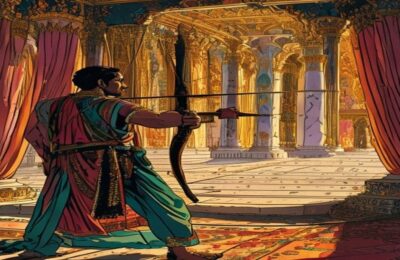
The Garuda, in gratitude, offered the weaver a gift: the ability to fly through the air as swiftly as a bird, and the gift of understanding the language of all creatures. These were extraordinary powers — the first giving him physical capability beyond any mortal, the second giving him access to information that no human possessed. The Garuda delivered these gifts and departed. Mantharaka stood for a long moment looking at his hands, at the sky, at the loom visible through his house door. Then he chose the sky.
Beat II — The Misuse: Power Without Judgment
Mantharaka’s first flights were exhilarating and innocent. He soared over the town, observed the river from above, descended to treetops where birds discussed the day’s events in languages he could now understand. He was content for a time with mere observation. Then, flying over a foreign king’s encampment, he overheard the birds discussing the king’s plans for a military campaign against a neighbouring kingdom — Mantharaka’s own. He returned home, informed his king, and was rewarded. His usefulness as a spy was now evident to the king and to himself.
The problem emerged from the logic of espionage: if flying and listening produced information, flying more and listening more would produce more information and more reward. Mantharaka began conducting independent operations — gathering intelligence that no one had requested, on targets his king had not designated, using judgment that was a weaver’s judgment amplified by divine capability without any commensurate amplification of wisdom. On one such operation, flying over a hostile army encampment, he was spotted — a man flying was not a natural sight and attracted intense attention. The enemy’s archers, unable to identify him but certain he was hostile, brought him down with a volley of arrows. He died in the air above the encampment, a tool beyond his operator’s wisdom, employed without discipline or sanction.
Beat III — The Analysis: Capability and Judgment as Distinct Gifts
Vishnu Sharma’s tale of Mantharaka is one of the Panchatantra’s most precise statements of a principle that runs throughout the corpus: that capability and judgment are entirely distinct gifts, that one may be present without the other, and that capability without judgment is more dangerous than the absence of capability, because it allows errors to be committed at a scale and speed that ordinary human limitations would have prevented.
Mantharaka’s weaver’s judgment was adequate for a weaver’s decisions: what cloth to produce, when to sell, which dye to use. It was not adequate for the decisions his new capabilities placed within reach: when to conduct intelligence operations, against which targets, under what conditions, with what level of risk. These decisions require a different kind of knowledge — strategic knowledge, knowledge of the political consequences of intelligence gathering, knowledge of what constitutes a legitimate operation versus freelance adventurism that could compromise his king’s position. He had none of this knowledge, and his capabilities gave him no access to it.
The tale anticipates a concern central to Kautilya’s Arthashastra: the proper management of intelligence assets. Kautilya prescribes rigorous tasking of espionage operatives, with clear boundaries on what they are authorised to investigate, explicit prohibitions on freelance operations, and systematic review of intelligence gathered before it is acted upon. An operative who runs his own operations without sanction is not an asset but a liability — a source of uncontrolled risk who may start military confrontations that his king has chosen not to initiate.
Beat IV — Moral Dimension & Enduring Relevance
The tale’s moral addresses anyone who acquires, through technology, training, or circumstance, a capability that significantly exceeds their previous range of action. The capability is not the problem; the problem is the assumption that the capability comes with the judgment required to deploy it responsibly. Mantharaka was not a bad person — he was a decent man who freed a trapped bird out of genuine kindness. He was not malicious in his freelance operations — he thought he was being helpful. He was simply operating at a scale of consequence for which his judgment had not been prepared.
In contemporary terms, the story speaks directly to the ethics of technology adoption: individuals and organisations that acquire powerful new tools — whether analytical, communicative, military, or economic — frequently assume that the tool’s capability is the only new variable in their situation. The Panchatantra’s counsel is that the acquisition of a powerful tool also requires a commensurate acquisition of judgment about that tool’s appropriate deployment, its risks, its unintended consequences, and the limits of its legitimate use. Without this commensurate judgment, the capability is more dangerous than beneficial.
Mantharaka’s death is not a punishment for his kindness to the Garuda. It is the natural consequence of operating without the institutional constraints — the sanction of his king, the discipline of a defined mission, the knowledge of what constitutes a legitimate target — that convert raw capability into productive and safe action.
Moral: Capability without judgment is more dangerous than the absence of capability; acquiring extraordinary power requires acquiring extraordinary wisdom about when and how to use it.
Why This Story Has Lasted 2,000 Years
Mantharaka the weaver endures as a cautionary figure because his story captures a permanent feature of human experience: the tendency to assume that acquiring a new capability automatically confers the judgment to deploy it wisely. Every era has its Mantharakas — individuals or institutions that have acquired capabilities unprecedented in scale or kind, and have deployed them without the institutional frameworks, ethical disciplines, or strategic knowledge that responsible deployment requires. The Panchatantra’s weaver, soaring confidently over an enemy encampment on wings he received as a gift and was never trained to use operationally, is one of world literature’s most precise images of this perennial and dangerous gap.
About the Panchatantra
The Panchatantra (“Five Treatises”) was composed in Sanskrit by the scholar Vishnu Sharma around 300 BCE–300 CE as a niti-shastra — a guide to wise conduct and statecraft — framed as animal fables for the instruction of young princes. Its five books cover the dissolution of allies, the winning of allies, war and peace, the dangers of naivety, and the hazards of rashness. The text spread westward through Pahlavi and Arabic translations to become the most widely translated secular book of the ancient world after the Bible.
You May Also Like
 Panchatantra Stories
Ages 3-5
Panchatantra Stories
Ages 3-5
The Blue Jackal
A Panchatantra tale about a jackal accidentally dyed blue who briefly rules the jungle until his true nature gives him away. A classic story about honesty.
 Panchatantra Stories
Ages 9-12
Panchatantra Stories
Ages 9-12
Home (far) away from home!!!
The famous Efik folk tale from southern Nigeria — Sun and Moon were old friends with the great Water, and they built a house big enough to welcome him in. But Water brought every fish and every wave with him, and the friends had to learn that some friendships are honored best across a great distance. A West African pourquoi tale, first written down in English by Elphinstone Dayrell in 1910 — and the gentle origin of why the Sun and Moon live in the sky.
 Panchatantra Stories
Ages 9-12
Panchatantra Stories
Ages 9-12
The Dove and the Hunter
The Dove and the Hunter: Self-sacrifice is the highest stage of sacrifice.” There was a mean hunter, who used to roam in the jungle in search of birds and