The Monkey and the Crocodile
Read 'The Monkey and the Crocodile' — a classic Panchatantra story about nature and animals. The Monkey and the Crocodile is a beloved Panchatantra tale...

The Monkey and the Crocodile
Source: Panchatantra, Book II — Mitralabha (The Gaining of Friends), attributed to the sage Vishnu Sharma, composed c. 300 BCE–300 CE; this redaction draws on the Sanskrit critical text established by Franklin Edgerton and Patrick Olivelle’s annotated translation (Oxford University Press, 2006), cross-referenced with the Jataka parallel (Jataka no. 208, Sumsumara-jataka).
बुद्धिमान् आपदि न मुह्यति, मूर्खः मुह्यते सुखेन चࣽः
A monkey and a river crocodile build a warm friendship across the water that separates their habitats. When the crocodile’s wife demands his friend’s heart as a delicacy, the crocodile is trapped between loyalty and domestic obligation. The monkey, learning mid-river that he is being carried to his death, must outwit a creature three times his size using only his wits and the crocodile’s own gullibility. This is the Panchatantra’s most beloved tale of intelligence under mortal pressure — and one of its most complex meditations on what friendship costs when it is tested by outside demands.

Part I: The Friendship Across the Water
On the bank of a broad river that ran through the Deccan forest there grew a magnificent rose-apple tree, its branches extending out over the water so that the ripest fruit fell directly into the current. The monkey Raktamukha had lived in this tree for as long as he could remember. He ate well, slept in the high branches, and had developed the pleasant habit of tossing overripe fruit into the river each morning simply to watch the splash.
One morning a large crocodile surfaced near the falling fruit. His name was Chakradanta, and he was, for a crocodile, unusually sociable. He ate the fallen rose-apples with visible pleasure and remained near the bank after the fruit was gone, watching the monkey with something that was not quite hunger. The two began to talk — tentatively at first, in the way of creatures who share a resource but not a habitat — and found they enjoyed each other’s company. Raktamukha’s quick observations about the forest; Chakradanta’s slower, deeper knowledge of the river and its moods. Neither had previously had a friend from another world.
The friendship grew across several seasons. Raktamukha threw down rose-apples every morning; Chakradanta surfaced to receive them and to talk. The Sanskrit text notes with quiet warmth that Chakradanta sometimes brought his young children to meet the monkey, and that the children were afraid of Raktamukha at first, then enchanted. The friendship had the quality of a good thing that both participants had given up expecting.

Part II: The Wife’s Demand
Chakradanta’s wife, Karala, had observed the friendship from the beginning with a crocodile’s patient attention to eventual opportunity. She had tasted the rose-apples her husband brought home and formed a theory: a monkey who eats such extraordinarily sweet fruit every day must have a heart sweetened by the same. A monkey’s heart, eaten fresh, would be the most remarkable thing she had ever tasted. She wanted it.
She told her husband. Chakradanta refused. She pressed him with the full weight of domestic obligation and the language of duty that spouses deploy when they wish to make selfishness sound like principle. Chakradanta refused again. She threatened to stop eating. He refused once more. She fell ill — genuinely, from the fever of wanting a thing she could not have — and when he came to her side she told him, with the conviction of the genuinely unwell, that only the monkey’s heart could restore her.
Chakradanta gave way. This is the story’s first great moral crux, and Vishnu Sharma does not soften it: the crocodile chooses his wife’s demand over his friend’s life, and the text does not entirely condemn him for it. The pull of spousal obligation against the pull of friendship is presented as a genuine and agonizing conflict, not a simple case of villainy. What he does next, however — the method by which he intends to deliver the monkey — is where his moral capacity truly shows its limits. He lies. And he is not good at it.
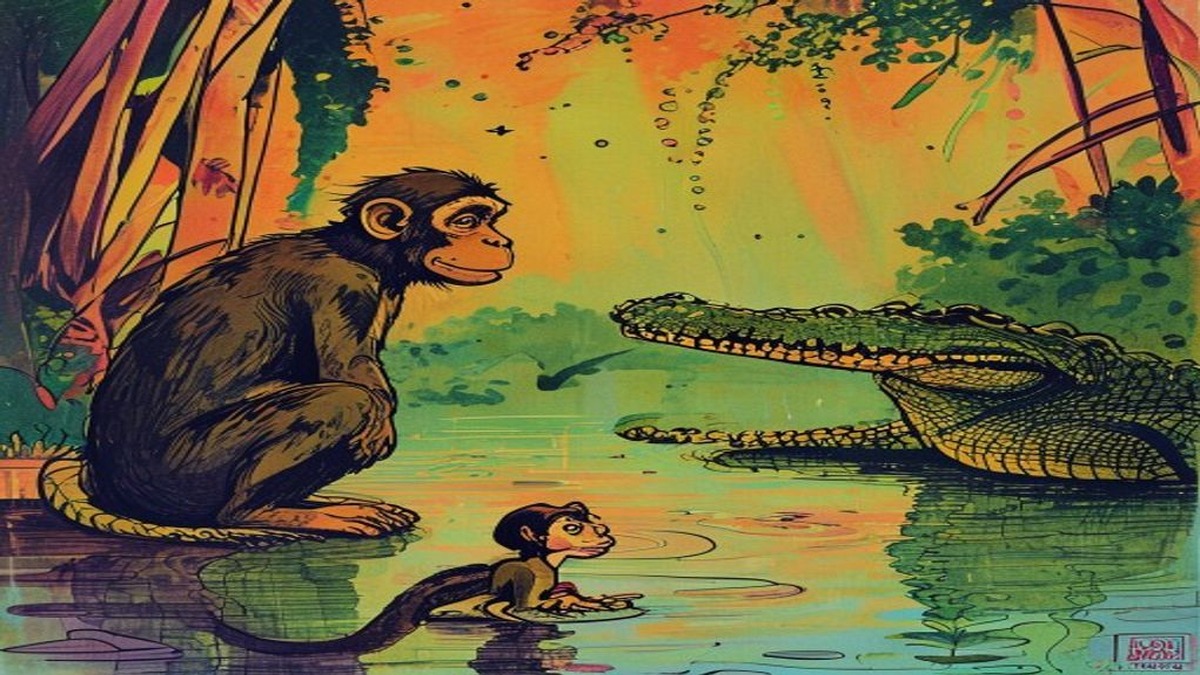
He told Raktamukha that his wife wished to meet the monkey and had prepared a feast in his honour on the far bank. He invited Raktamukha to ride across the river on his back. The monkey, who could not swim, accepted. It did not occur to him that his friend might be conveying him toward his death.
Part III: The Wit That Saved a Life
They were in the deepest part of the river — no bank visible in either direction through the midday haze — when Chakradanta’s resolve broke under the weight of what he was doing. He could not arrive at the delivery having maintained the fiction all the way. He told the monkey the truth: his wife wanted the monkey’s heart; that was where they were going; he was sorry.
Raktamukha understood in an instant exactly what his situation was. He was on the back of a crocodile in deep water with no tree in any direction. He had perhaps thirty seconds before the crocodile completed his reasoning and began the actual work of delivering him. He felt fear — the text is honest about this — and then, immediately after the fear, something else: a clarity that comes to intelligent creatures when all the soft options have been removed.
He laughed. It was a convincing laugh, and Chakradanta, confused, paused.
“Is that all?” Raktamukha said. “My friend, I would have told you immediately if you had asked. I do keep my heart in the tree — monkeys always do, for safekeeping; we leave them in the hollows when we swim or travel, otherwise they are too vulnerable. My heart is not in my chest right now. I left it in the rose-apple tree this morning as I always do. Take me back and I will fetch it for your wife gladly.”
The crocodile had never studied monkey anatomy. He was also not, despite his size and his deadly patience in the water, a sophisticated evaluator of deception. The statement had a confident specificity that rang, to him, like the truth. He turned and swam back to the bank.
The moment Raktamukha’s feet touched the root-system of the rose-apple tree, he leapt up through ten feet of branches in a single movement. From a height safely beyond the crocodile’s reach, he looked down.
“You told your wife before you told me,” he said. “That is not something a friend does. That was the moment our friendship ended — not this moment, not what I said in the river, but that one. Go home.”

Part IV: The Weight of Betrayal
Chakradanta returned to his wife without the monkey’s heart. He told her what had happened. She recovered from her illness with remarkable speed — the illness, it turned out, had been persuasion by other means rather than genuine disease — and proceeded to berate her husband for his stupidity. The text records her words without comment: she had wanted a monkey’s heart and instead she had a husband who had believed that hearts were kept in trees.
The crocodile returned to the rose-apple bank the next day, and the day after, and several days after that. He brought mangoes from the riverbed, river-fish, a smooth stone he thought the monkey might find interesting. Raktamukha accepted none of these. He watched from his high branches with the patient, unemotional gaze of an animal who has recalibrated a relationship and will not be moved by sentiment to recalibrate it back.
Vishnu Sharma’s closing lines are among the most precise in the entire Panchatantra: “The friend who has been betrayed is the one who decides whether the friendship continues. That decision belongs to no one else. And a wise man, having nearly died for his trust, does not quickly give that trust again — not from bitterness, but from knowledge.”
Why This Story Has Lasted Three Thousand Years
“The Monkey and the Crocodile” is the most widely distributed Panchatantra fable in world literature. Versions of it appear in the Jataka tales (no. 208, Sumsumara-jataka), in Arabic Kalila wa Dimna, in the Persian Anvar-i-Suhayli, in Turkish, Swahili, Korean, and Japanese folk traditions, and in the European fabliaux. The core structure — a creature carried toward death who escapes by claiming the thing the predator wants is elsewhere — is one of the most ancient and widely distributed folktale motifs in the world, classified as ATU 91 in the Aarne–Thompson–Uther Index.
The story endures because it operates simultaneously on multiple registers. As a tale of wit under pressure it is impeccably constructed: the setup (friendship across the water), the complication (the wife’s demand), the crisis (mid-river), the escape (the impossible lie delivered with perfect confidence), and the denouement (the cool severance of the friendship) follow each other with the inevitability of a well-made argument. Nothing is wasted; every earlier detail pays off.
But the story also works as a meditation on what friendship requires and what it cannot survive. Chakradanta is not a villain; he is a husband who chose wrong. The text’s refusal to let him back into the friendship at the end — its insistence that the betrayal, once committed, cannot be undone by regret or gifts — is the moral that resonates beyond the comic premise. Some trust, once broken, cannot be rebuilt. The monkey is not angry; he is simply accurate. And accuracy, Vishnu Sharma implies, is the highest form of wisdom available to those who have survived being betrayed.
Frequently Asked Questions
What is the moral of The Monkey and the Crocodile?
The story teaches two lessons. First, intelligence and quick thinking can save you even in the most desperate situations — the monkey escapes not by strength but by a clever lie delivered with perfect confidence. Second, some betrayals cannot be undone: when the monkey learns that his friend chose to deliver him to his death, he ends the friendship permanently, not from bitterness but from the accurate understanding that trust once broken at that level cannot be safely rebuilt.
Which book of the Panchatantra is The Monkey and the Crocodile from?
The story appears in Book II, Mitralabha (The Gaining of Friends), which explores how friendships are formed and what they require to survive. This tale serves as a counterpoint — a story of how a friendship is destroyed — within a book otherwise devoted to how valuable alliances are built and maintained.
How does the monkey escape the crocodile?
When the crocodile reveals mid-river that he is carrying the monkey to his death, the monkey instantly invents a lie: he says that monkeys always leave their hearts stored safely in their trees, and that his heart is back in the rose-apple tree. The crocodile, who has no knowledge of monkey anatomy, believes him and turns back. The moment the monkey's feet touch the tree roots he leaps to safety.
Is there a Buddhist version of The Monkey and the Crocodile?
Yes. The story appears in the Jataka tales as number 208, the Sumsumara-jataka, where the monkey is identified as a previous incarnation of the Buddha and the crocodile as a figure he will encounter again in future lives. The Buddhist version emphasizes the monkey's wisdom and compassion, while the Panchatantra version focuses more sharply on the mechanics of betrayal and the appropriate response to it.
How widely has The Monkey and the Crocodile spread across world cultures?
This is one of the most widely distributed folktales in the world. It appears in Arabic Kalila wa Dimna, Persian Anvar-i-Suhayli, Turkish, Swahili, Korean, and Japanese traditions. The core motif — a creature escaping death by claiming the desired object is stored elsewhere — is classified as ATU 91 in the Aarne-Thompson-Uther folktale index, one of the most ancient and geographically widespread story patterns ever documented.
You May Also Like
 Panchatantra Stories
Ages 9-12
Panchatantra Stories
Ages 9-12
The Story of Chakradhara.
The Story of Chakradhara.: In a certain town, there lived four young fellows, who were the sons of Brahmins They were very friendlywith each other. But they
 Panchatantra Stories
Ages 9-12
Panchatantra Stories
Ages 9-12
The Lion, the Camel, the Jackal and the Crow
Trust given despite proven dishonesty proves fatal when a camel ignores a jackal's conspiracy.
 Panchatantra Stories
Ages 6-8
Panchatantra Stories
Ages 6-8
The Story of the Brahmin and the Cobra
The Story of the Brahmin and the Cobra: In a certain town, there lived a Brahmin, by the nameof Haridatta. In spite of the fact that he workedextremely hard on