The Cave that Talked
Read 'The Cave that Talked' — a classic Panchatantra story about wisdom. The Cave that Talked is a beloved Panchatantra tale featuring a ant. This ancie...
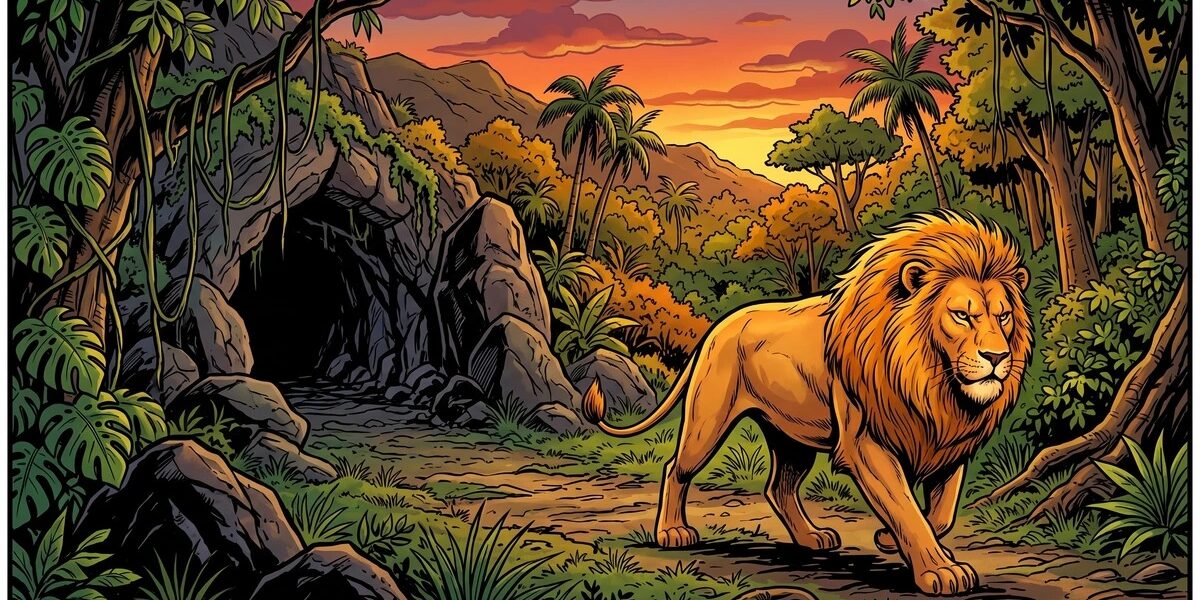
The Jackal Who Listened to Silence
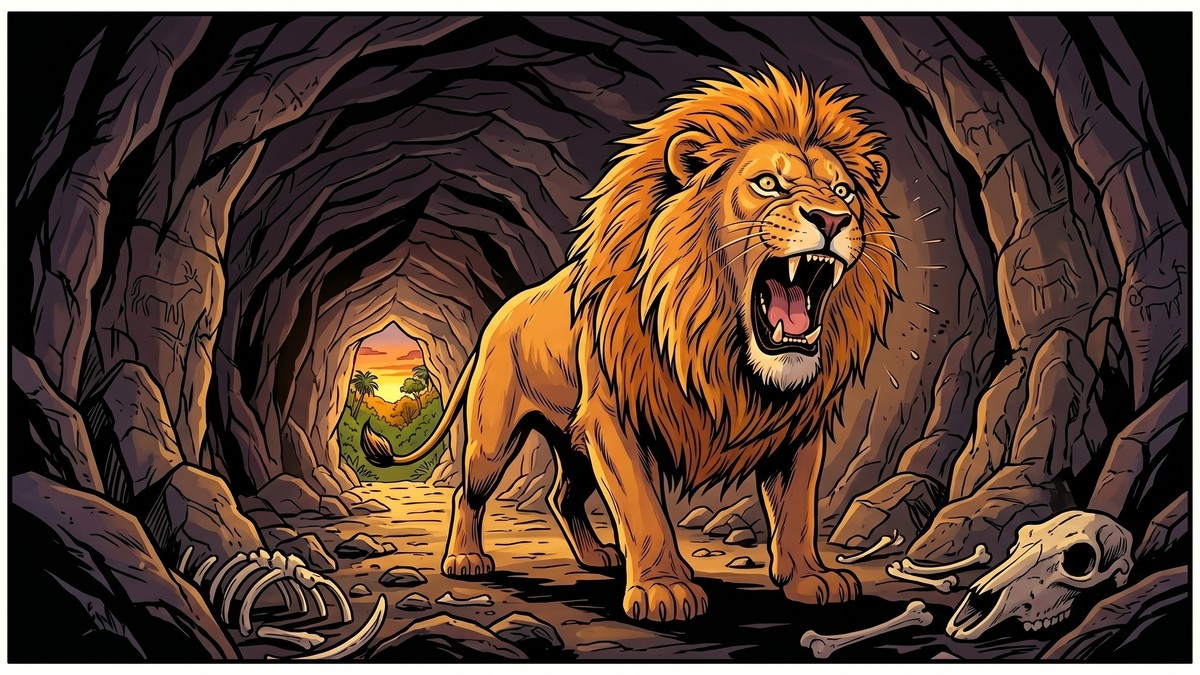
“The Cave that Talked” is one of the most elegant and widely loved tales in the Pañcatantra‘s third book, Kākolūkīyam — “Of Crows and Owls” — which is devoted to the theme of war, strategy, and the art of detecting danger before it strikes. A hungry lion discovers a rocky cave, enters it, and lies in wait for whatever animal lives there to return. A jackal who makes the cave his home approaches but notices something crucial before entering: footprints leading into the cave, and none leading out. Reasoning correctly that a predator has taken up residence inside, the jackal invents a ruse: he calls out aloud, ostensibly greeting the cave as per an old custom. “O Cave! Have you forgotten our agreement? You always used to call back!” The lion, eagerly hoping to draw the jackal inside, roars an answer from within. The jackal, hearing the roar from what should be an empty cave, immediately flees to safety.
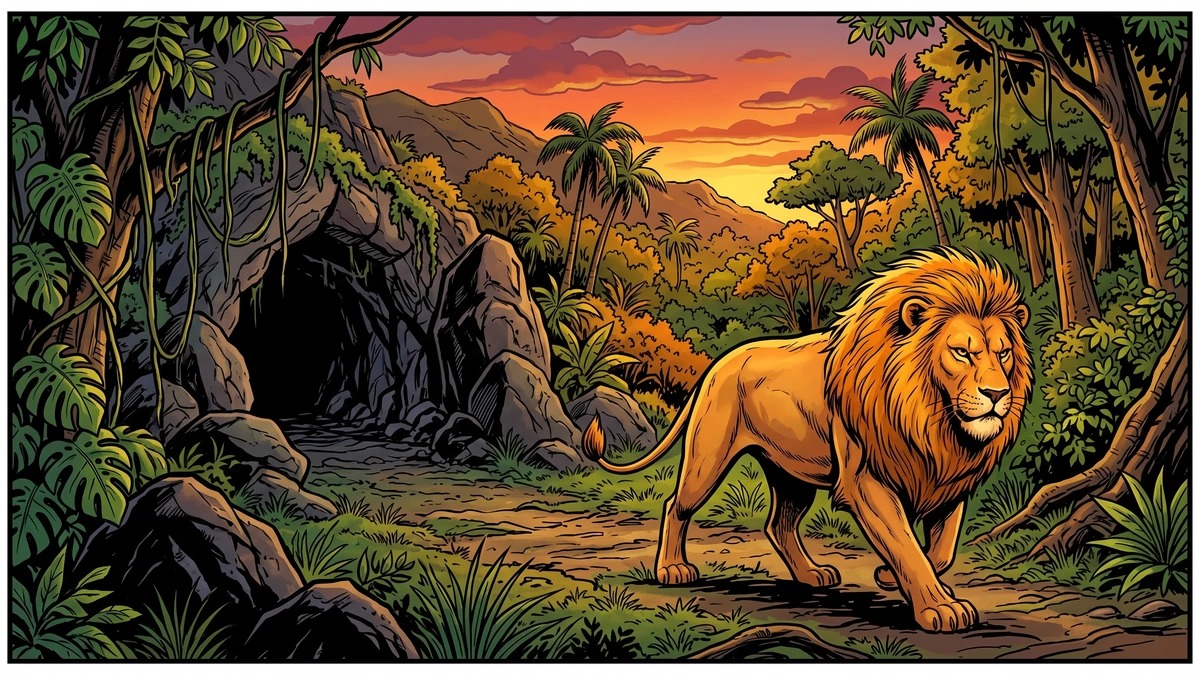
The tale’s wit is as clean as a mathematical proof. The jackal does not need courage to survive — he needs only the discipline to observe before he acts, and the ingenuity to test his hypothesis safely. The lion, conversely, is undone entirely by greed: desperate to make the jackal enter, he throws away his only advantage (silence) in an attempt to gain a meal. The cave “talks” because the lion’s appetite overrides his judgment. It is a story about information asymmetry, the ethics of caution, and the fatal vulnerability of those who cannot control their desire.
The Story: Footprints, Silence, and a Roar
The Panchatantra frames this tale within its larger treatise on inter-species conflict. A lion named Kharanakhara — in some versions simply called “the lion” — has been unsuccessfully hunting all day. Exhausted and hungry, he comes across a large cave in a hillside and notices that it is clearly inhabited: bones, tufts of fur, and the smell of a regular occupant are present. He enters and waits, reasoning that the animal will return at night. The cave belongs to a jackal named Mahācaturaka (“The Very Clever One” — another speaking name of the type the Pañcatantra favours).
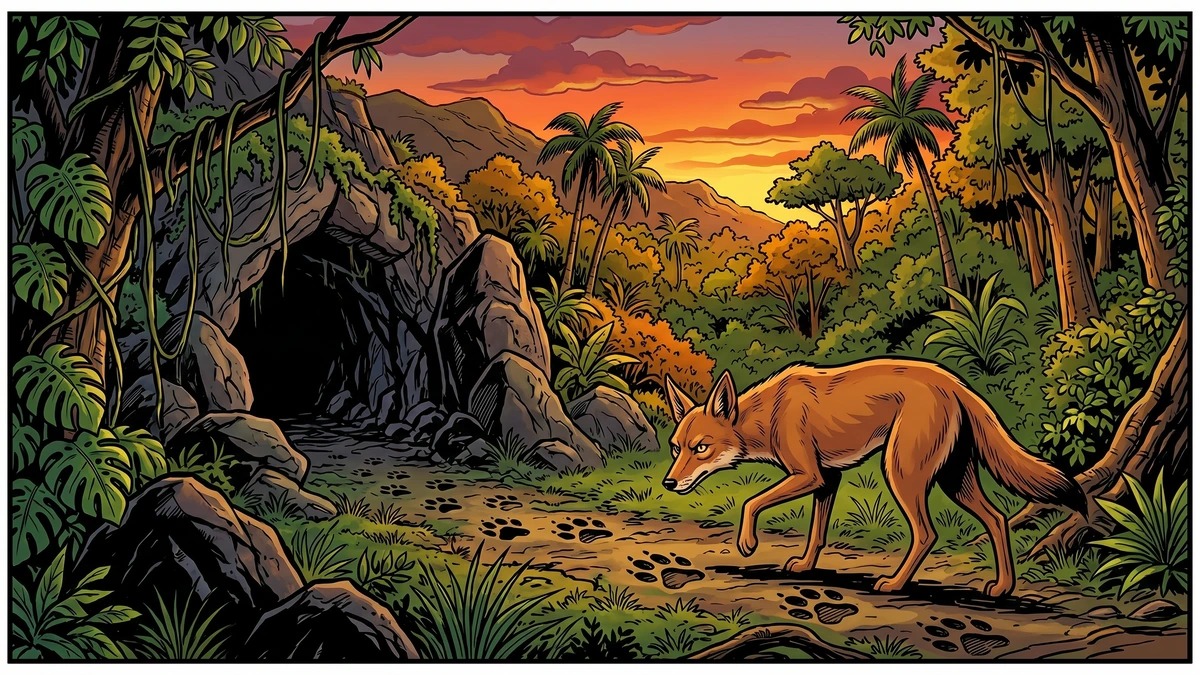
When Mahācaturaka approaches his cave at dusk, he stops at the entrance and studies the ground. He sees paw prints — unmistakably lion-sized — going in, and none coming out. He does not panic. He does not flee immediately. Instead, he reasons: “The lion is inside. I cannot see him but the evidence is conclusive. However, perhaps I am wrong — perhaps the lion left without making prints on the stone ledge at the mouth. I need to test this.” He devises the test immediately: he will call out a greeting to the cave, claiming that they have an old custom of the cave calling back. If the cave responds — that is, if anyone is inside — he will know his hypothesis is confirmed and flee. If there is no response, the cave is empty and safe to enter.
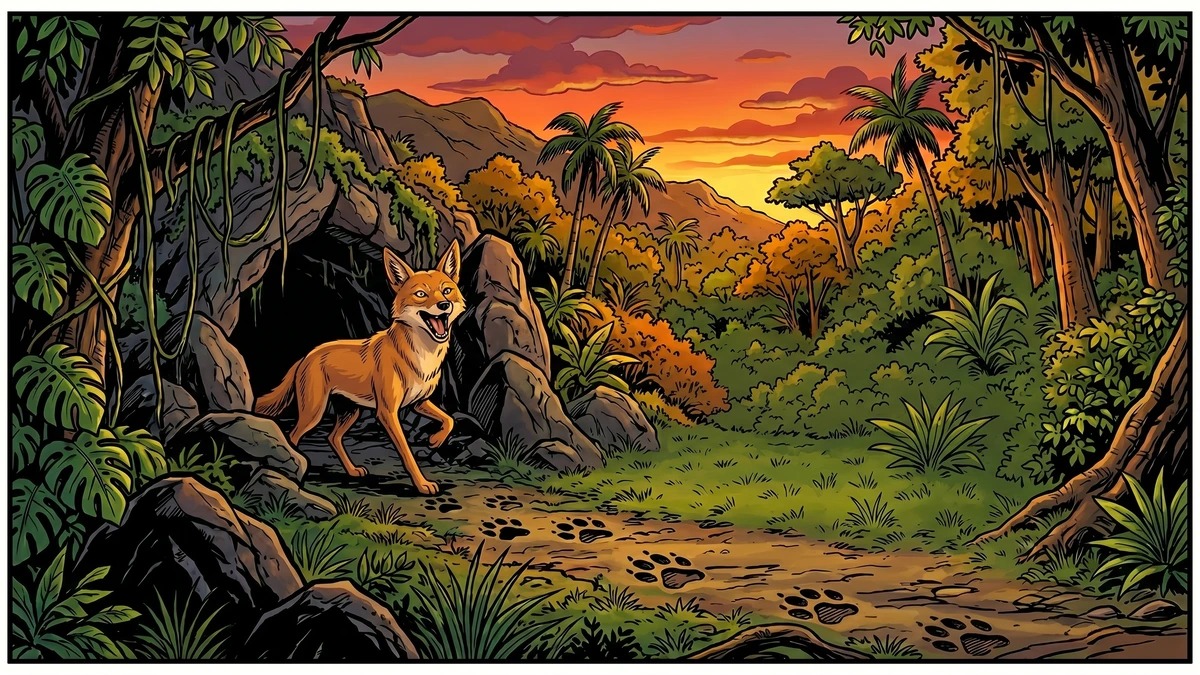
“O Cave! O Cave!” he calls cheerfully. “Have you forgotten our old agreement? Every evening you used to greet me when I came home! Why are you silent today?” The lion inside, hearing this and convinced the jackal will not enter a silent cave, cannot contain himself. He roars a response. The jackal hears the lion’s voice boom out of what should be an empty cave — confirmation of everything he suspected — and runs as fast as his legs can carry him. The lion emerges to find nothing but the echo of his own foolishness.
The Third Book: Kākolūkīyam and the Art of Intelligence
The Pañcatantra‘s third book, in which this tale appears, is structurally the most complex of the five. It takes as its central situation a war between crows and owls — an ancient, escalating inter-species conflict — and uses this frame to explore every classical category of political intelligence: reconnaissance, deception, counter-intelligence, double agents, and strategic withdrawal. “The Cave that Talked” functions within this context as a gem-like illustration of a single principle: śatru-saṃśaya-pariccheda — “resolving uncertainty about the enemy before committing to action.”
The jackal’s method is precisely what a Sanskrit political theorist would recommend. The Arthaśāstra of Kauṭilya, composed roughly contemporaneously with the Pañcatantra‘s nucleus, devotes extensive passages to the theory of intelligence gathering. The spy (cāra) is instructed never to assume the presence or absence of an enemy but to verify through indirect means before exposing himself. The jackal’s “cave greeting” is exactly such an indirect verification — he extracts information from the enemy without revealing his own position or intention. The lion’s roar is the intelligence failure: in attempting to deceive, he instead provides precisely the confirmation that undoes him.
Global Distribution: The Clever Animal Who Reads Signs
The motif of the clever animal who reads environmental signs and escapes a hidden predator is classified under ATU 1,004 in the broad sense, but more specifically belongs to the family of tales involving “the animal who tests the lair before entering.” The specific device of the false greeting — calling out to provoke a response from the enemy — has cognates in multiple traditions. In Aesopic tradition, a parallel structure appears in the fable of the sick lion whose visitors notice that footprints lead only into his den and not out (Perry 142). The Greek and Indian versions are structurally independent but share the same epistemological insight: the direction of footprints is sufficient evidence to infer the presence of a predator.
The tale entered the Arabic Kalīla wa-Dimna tradition (8th century CE) and from there into Persian, Hebrew, and eventually European literary culture. In European versions, the clever animal is typically the fox (substituting for the Indian jackal, which is not native to Europe), and the hidden predator is a lion, wolf, or bear. The substitution reflects ecological reality while preserving the logical structure exactly: the fox who refuses to enter a den where only inward footprints are visible demonstrates the same reasoning as Mahācaturaka at the cave mouth.
Silence as a Weapon: The Information Theory of the Tale
Modern information theorists would immediately recognise the tale’s central mechanism. The jackal needs to determine whether the cave is safe. He cannot observe the interior directly. He can, however, design a test: send a signal (the greeting) and observe whether a response is generated. The correct response from a genuinely empty cave is silence — caves do not talk. Any other response is information: specifically, it is the enemy revealing himself by trying to deceive.
The lion’s error is a classic case of what game theorists call “signalling under asymmetric information.” The lion has a private information advantage (he knows he is there; the jackal does not). By roaring, he converts this private advantage into a public one — he tells the jackal exactly what he needed to know. The jackal’s brilliance is in designing a test that makes it in the lion’s apparent interest to reveal himself: the lion believes that roaring will lure the jackal inside, but in fact it achieves the opposite. This kind of information trap — designing a test where the enemy’s response to deception reveals the truth — is one of the most sophisticated concepts in strategic intelligence, and the Pañcatantra dramatises it with absolute economy in fewer than two hundred Sanskrit words.

Reception and Cultural Legacy
In the Indian oral tradition, “The Cave that Talked” has become one of the most commonly cited Panchatantra tales precisely because its moral is so viscerally satisfying: the weak outwit the strong not by fighting but by thinking. The jackal as a figure of cunning intelligence — contrasted with the lion’s brute power — is a recurring archetype in South Asian narrative, appearing in the Jātaka tales, the Kathāsaritsāgara, regional folk collections, and children’s literature across the subcontinent. The story’s clean three-beat structure (lion enters, jackal tests, lion roars and loses) makes it ideal for oral performance, and its length — short enough to tell in two minutes — ensures it has survived in living oral tradition long after many longer tales have faded.
In modern Indian cinema and television, the image of the jackal calling to the cave and the lion’s answering roar has become an almost proverbial shorthand for the idea that a clever question is more powerful than a strong blow. The tale’s place in Indian children’s education is secure: it appears in textbooks from Tamil Nadu to Punjab, and translations into every major Indian language number in the dozens. Its message — observe before you act; use intelligence to resolve uncertainty; never let appetite override judgment — speaks as directly to the 21st century as it did to the ancient audiences Viṣṇuśarman was educating.
Frequently Asked Questions
The Jackal Archetype: Intelligence Over Strength in Indian Narrative
The jackal (śṛgāla in Sanskrit) occupies a uniquely ambivalent position in the Indian literary imagination. Unlike the fox of European fable, who is primarily associated with trickery and moral ambiguity, the Sanskrit jackal is valorised for a specific cognitive virtue: the ability to gather and correctly interpret evidence before acting. The Pañcatantra is populated with jackals of various kinds — some admirable, some cautionary — but Mahācaturaka of “The Cave that Talked” represents the archetype at its most idealised: a creature who combines empirical observation with deductive reasoning and arrives at a correct conclusion without ever endangering himself.
This cognitive profile mirrors the Sanskrit ideal of the paṇḍita — the learned man who acts only after properly knowing the situation (yathārtha-jñāna). The contrast with the lion is deliberate and pointed. The lion embodies bala (physical power) without prajñā (wisdom). He is not stupid — he correctly reasons that hiding inside will bring the jackal to him — but his reasoning is corrupted by desire (kāma), which causes him to abandon his tactical advantage the moment he believes he can seize an immediate gratification. The Pañcatantra‘s consistent thesis is that wisdom defeats strength not through any mystical advantage but through the simple mechanism of making fewer errors in judgment. The jackal makes no errors. The lion makes exactly one, and it is fatal to his purpose.
Textual Variants and Manuscript Traditions
The earliest Sanskrit recensions of the Pañcatantra — scholars recognise at least five major manuscript families, including the Southern or Tantrākhyāyikā version and the Northwestern recension that formed the basis of the Pahlavi translation — all include a version of this tale. The minor variations between recensions are telling. In the Tantrākhyāyikā (preserved primarily in Jaina manuscript traditions in Gujarat and Rajasthan), the jackal is named explicitly and his internal monologue is more extended: he enumerates three possible explanations for the inward-only footprints before settling on the most probable. This deliberative internal voice — reasoning through hypotheses — reinforces the tale’s didactic purpose as a model of correct epistemic procedure.
In the Persian Kalīla wa-Dimna adaptation (8th century CE, translated by Ibn al-Muqaffaʿ), the tale is preserved with remarkable fidelity, which is notable given Ibn al-Muqaffaʿ’s general tendency to adapt the material for his Abbasid court audience. The retention of the tale nearly unchanged suggests that its logical structure was recognised as universally valid across cultural contexts — a story whose point is so crystalline that no cultural translation is needed. Only the species names shift to accommodate the new readership’s ecological familiarity.
The Hebrew translation by Rabbi Joel (c. 12th century CE), derived from the Arabic, became one of the primary vectors through which the tale entered medieval European literary culture, appearing in the Directorium Humanae Vitae of John of Capua and subsequently influencing La Fontaine, whose fable tradition in France circulated the core motif to a European literary audience who had no idea they were reading a tale that had originated in the Sanskrit tradition two millennia earlier.
You May Also Like
 Panchatantra Stories
Ages 9-12
Panchatantra Stories
Ages 9-12
The Musical Donkey: A Panchatantra Fable
The Panchatantra's hard-edged little fable of Uddhata — the "haughty" washerman's donkey — who feasts on stolen cucumbers under the moon, mistakes his longing for talent, and brays the song that brings the farmers running with sticks. The story is found in Book V of the Panchatantra (Aparīkṣitakāraka, "Ill-Considered Action"), and it is one of Vishnu Sharma's quietest and most devastating lessons: a donkey called Raised On High is going to be brought low, and the only question is how.
 Panchatantra Stories
Ages 9-12
Panchatantra Stories
Ages 9-12
The Story of the Sadhu and the Mouse
The Story of the Sadhu and the Mouse: In the southern part of the country, there is a citycalled Mahilaropyam. Not far from the city, there wasa temple
 Panchatantra Stories
Ages 6-8
Panchatantra Stories
Ages 6-8
The Brahmani and the Mongoose
The Brahmani and the Mongoose: A timeless Indian folk tale where one moment of rage destroys lifelong trust. the brahmani's hasty act reveals wisdom's price.