The Story of the Sadhu and the Mouse
The Story of the Sadhu and the Mouse: In the southern part of the country, there is a citycalled Mahilaropyam. Not far from the city, there wasa temple

The Story of the Sadhu and the Mouse
Canonical Attribution and Manuscript Tradition
This tale is among the Pancatantra’s most philosophically concentrated: a sadhu (holy man) with yogic powers transforms a mouse into a girl to save her from a cat, raises her, and when she is of marriageable age offers her the greatest possible husband — the sun, the cloud, the wind, the mountain — each of which she rejects in favour of a mouse. The sadhu, recognising that the girl’s svabhava (inherent nature) has persisted through the magical transformation of her form, transforms her back into a mouse and gives her to the mouse she has chosen. The tale is preserved in all major Sanskrit recensions of the Pancatantra including the Tantrakhyayika (c. 200 BCE, Kashmir) and appears in the Hitopadesha. Its theme — that inherent nature persists through change of circumstance and even change of form — is central to the Pancatantra’s broader argument about the limits of education and environment as shapers of character.

Beat I — The Transformation and the Upbringing
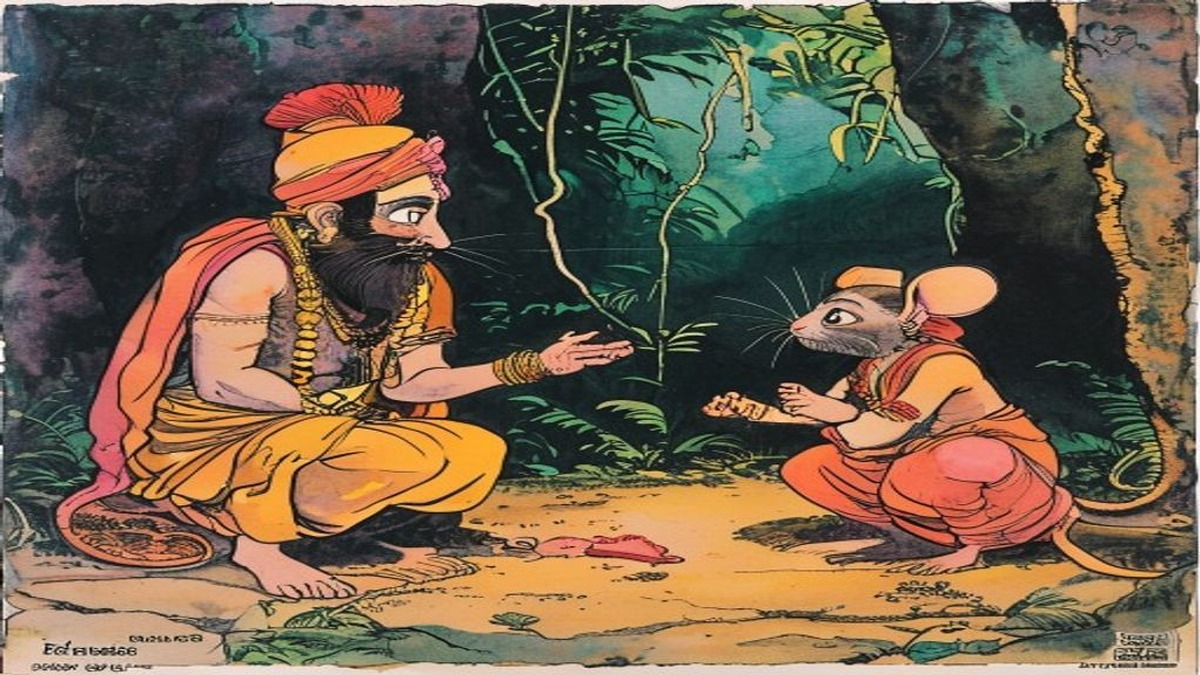
A sadhu living in a hermitage saw a hawk drop a mouse. Taking pity on the creature, he used his yogic powers to transform it into a girl. He and his wife raised the girl as their own daughter in the hermitage, with all the love and care they would have given a child of their own flesh. The girl grew up in the environment of the hermitage: surrounded by spiritual practice, educated in the ways of the ashram, entirely separated from the world of mice from which she had come. By the time she was of marriageable age she appeared, to all observation, to be fully human.
The Pancatantra sets up the tale carefully. The transformation was real: this was not a disguise or a costume but an actual change of form. The upbringing was genuine: the sadhu and his wife loved the girl and gave her every advantage their life could provide. The question the tale is building toward is whether the form and the upbringing have changed what the girl actually is — whether svabhava can be altered by transformation of circumstance, however radical and however complete.
Beat II — The Suitors and the Rejections
When the time came to find her a husband the sadhu, applying his powers to secure the greatest possible match, offered the girl in succession to the sun, the cloud, the wind, and the mountain. Each was a being of extraordinary power; each represented a kind of cosmic greatness that a human girl of the hermitage could not have aspired to through ordinary means. The sadhu was giving his daughter the best he could imagine.
The girl rejected each suitor. The sun was too hot; the cloud blocked the sun and was therefore greater; the wind moved the cloud and was therefore greater; the mountain stopped the wind and was therefore greater. But at the mountain she stopped. Who, she asked, was greater than the mountain? The mountain itself answered: the mouse, who burrows beneath him and undermines his foundations. The girl immediately declared that the mouse was her choice. The sadhu, confronted with this result, understood what had happened: the transformation of form had not transformed svabhava. The girl’s inherent nature had persisted through everything.

Beat III — The Recognition and the Retransformation
The sadhu’s recognition is the philosophical heart of the tale. He had done everything within his considerable power to give the girl a different life: he had changed her form, raised her with genuine love, offered her the greatest suitors in the cosmos. None of it had changed her svabhava. The inclination toward mice — which is to say, the inclination toward her own kind, toward what she actually was at the level of inherent nature — had persisted through every transformation of circumstance.
Rather than lamenting this result or persisting in the attempt to override it, the sadhu accepted the reality the tale had demonstrated. He transformed the girl back into a mouse and gave her to the mouse she had chosen. This is the Pancatantra’s most important narrative movement: the recognition that svabhava is real and that the correct response to its discovery is acceptance and alignment, not continued resistance. The sadhu’s greatness is not diminished by this recognition; it is demonstrated by his ability to recognise and accept what the suitor sequence had revealed.

Beat IV — What the Sadhu and the Mouse Teaches About Svabhava
Vishnu Sharma’s argument in this tale is the Pancatantra’s most direct statement of the doctrine of svabhava. Inherent nature is not a superficial characteristic that can be altered by changing form, environment, or upbringing. It is the deepest structure of what a being is, and it expresses itself regardless of what has been overlaid upon it. The girl was given every advantage; she was transformed, loved, educated, and offered the greatest possible matches. Her svabhava was unmoved by all of it. When the suitor sequence created conditions under which her deepest preference could express itself, it expressed itself without hesitation.
The governance application is subtle but important. The ruler who attempts to transform the inherent character of a minister, courtier, or ally through rewards, education, or changed circumstances will be disappointed: what the person does under pressure will reveal what they actually are, not what the investment made of them. The Arthashastra’s character-testing methods rest on this premise: test before you trust, because observation under normal conditions reveals performance, not nature.
Moral and Sanskrit Wisdom Tradition
“Change the form as radically as you will; svabhava does not change. The mouse raised as a princess will still choose a mouse.”
— Moral of The Story of the Sadhu and the Mouse, Pancatantra Book I (Mitra-bheda)
This moral engages one of Sanskrit philosophy’s central debates: the relationship between svabhava (inherent nature), samskara (conditioning), and the possibility of transformation through practice and circumstance. The Pancatantra takes a clear position: svabhava is prior to and more durable than samskara. The Mahabharata’s Shanti Parva addresses the same tension, generally concluding that while samskara shapes the expression of svabhava, it cannot replace it. The tale’s use of magical transformation — the most radical possible change of circumstance — to demonstrate the persistence of svabhava gives the argument its maximum force.
Why This Story Has Lasted 2,300 Years
The Story of the Sadhu and the Mouse endures because the question it poses — can inherent character be changed by changing circumstances? — is among the most consequential in human experience, touching education, child-rearing, rehabilitation, institutional design, and the assessment of people. The Pancatantra’s answer is conservative but not despairing: svabhava persists, but recognising and aligning with it, as the sadhu does, is a form of wisdom. The tale does not say that inherent nature is good or bad; it says it is real. What remains with the reader is not pessimism but the specific kind of realism that comes from understanding what can and cannot be changed — and acting accordingly.
Sanskrit Tradition: Tantrakhyayika (c. 200 BCE, Kashmir); Hitopadesha
Key Concept: Svabhava (inherent nature) persists through radical transformation of form and circumstance; the limits of samskara (conditioning)
Author: Vishnu Sharma (attributed, c. 3rd century BCE)
Arthashastra Parallel: Character-testing before trust; observation under pressure reveals nature, not performance
Frequently Asked Questions
What is the moral of the Story of the Sadhu and the Mouse in the Panchatantra?
The moral is that inherent nature (svabhava) cannot be changed by changing form, environment, or upbringing. The mouse transformed into a girl, raised with love and offered the greatest possible suitors, still chose a mouse. The Pancatantra uses the most radical transformation imaginable — magical change of form — to make the strongest possible case: svabhava persists through everything, and the wise response is to recognise and align with it rather than resist.
What happens in the Story of the Sadhu and the Mouse in the Panchatantra?
A sadhu sees a hawk drop a mouse and uses his yogic powers to transform it into a girl. He and his wife raise her with love and genuine care. When she is of marriageable age, the sadhu offers her the sun, the cloud, the wind, and the mountain as husbands — each rejected in turn. The girl finally chooses a mouse, who the mountain says is greater because he burrows beneath it. The sadhu recognises that her inherent nature has persisted unchanged, transforms her back into a mouse, and gives her to the mouse she has chosen.
What does svabhava mean in this Panchatantra story?
Svabhava (inherent nature) is the deepest structure of what a being is — the characteristic that persists through change of form, environment, upbringing, and circumstance. In this tale, the mouse-girl's svabhava is her fundamental orientation toward mice, toward her own kind, which no amount of transformation can alter. The Pancatantra treats svabhava as prior to and more durable than samskara (conditioning): however carefully you shape the environment, the inherent nature will express itself when given the opportunity.
Why does the sadhu transform the girl back into a mouse at the end?
The sadhu transforms her back because he recognises that her svabhava has persisted unchanged through everything he did. This recognition is presented as wisdom, not failure. The Pancatantra's point is that alignment with inherent nature is more honest and ultimately more just than continued resistance to it. The sadhu had done everything in his power; the suitor sequence revealed what no amount of power could change. His greatness is demonstrated precisely by his ability to accept this reality and act accordingly.
How does this Panchatantra story relate to questions of education and character formation?
The tale directly addresses whether inherent character can be altered by changing circumstances, environment, or upbringing — the central question of education and character formation. The Pancatantra's answer is that svabhava is more durable than samskara: the girl received the best possible upbringing and the greatest possible opportunities, and her svabhava was unmoved. For governance, the implication is that character-testing under pressure (as the Arthashastra prescribes) is more reliable than assessment of performance under comfortable conditions.
You May Also Like
 Panchatantra Stories
Ages 3-5
Panchatantra Stories
Ages 3-5
The King and The Foolish Monkey
The King and The Foolish Monkey: In a magnificent kingdom surrounded by lush gardens and sparkling fountains, there once lived a powerful king who was very
 Panchatantra Stories
Ages 9-12
Panchatantra Stories
Ages 9-12
The Lion and the Clever Jackal
The Lion and the Clever Jackal: In a great forest of India, where the sal trees grew tall and ancient and the undergrowth was dense with life, there dwelt a
 Panchatantra Stories
Ages 6-8
Panchatantra Stories
Ages 6-8
The Rat that ate Iron
The Rat that ate Iron: Tit for tat’ is the best policy in life.” Jveernadhana was a merchant’s son who was not successful. He faced a loss in his business and