5 Panchatantra Stories About Animals That Kids Love
5 Panchatantra Stories About Animals That Kids Love: Kids love stories with animals in them. Stories of dense forests, strange birds and animals, beautiful
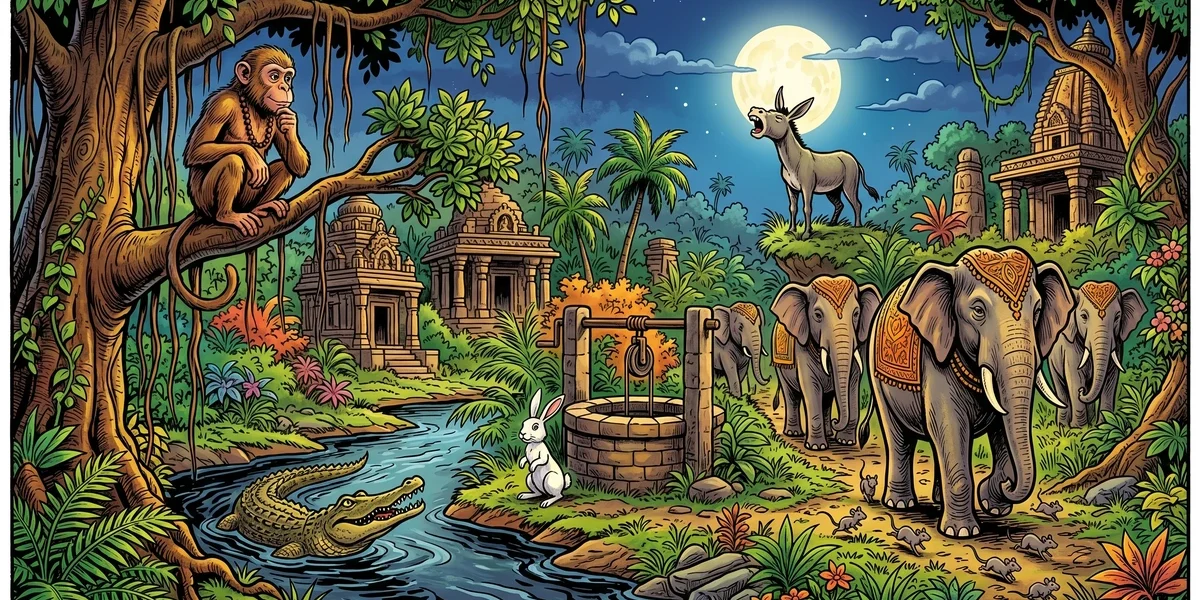
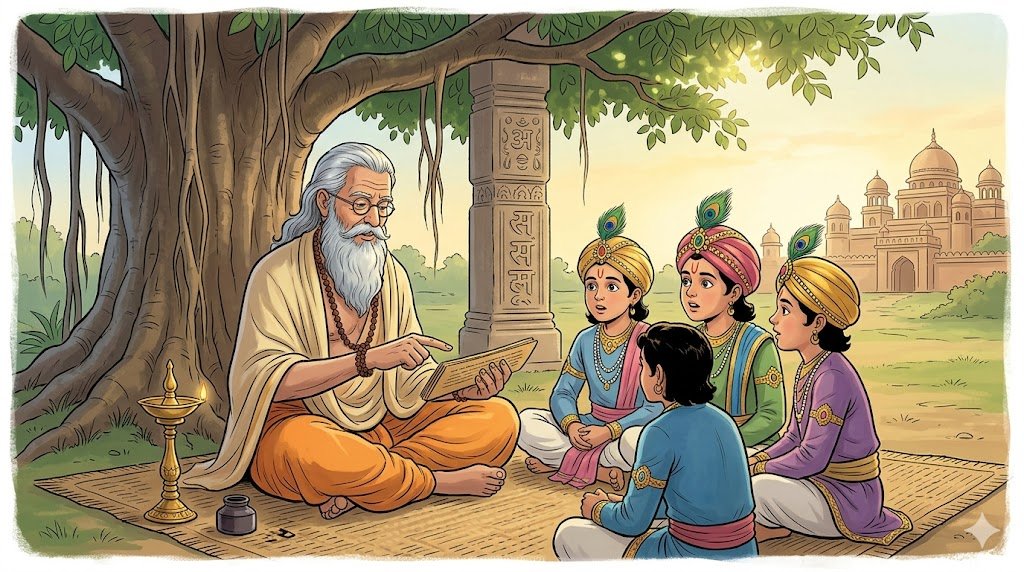
The Panchatantra (पञ्चतन्त्र, “Five Treatises”) is the great ancient Indian beast-fable cycle, traditionally ascribed to the Brahmin Vishnu Sharma in the courtly Sanskrit of the third or fourth century BCE. The five books — Mitra-bheda, Mitra-lābha, Kākolūkīyam, Labdha-praṇāśa, Aparīkṣita-kāraka — were composed, according to the framing-tale, to teach three indolent princes the art of nīti, the science of wise conduct. Through Persian (the Sasanian Karīrak ud Damanak, c. 570 CE), Arabic (Ibn al-Muqaffaʿ’s Kalīla wa-Dimna, c. 750 CE), Hebrew, Syriac, Greek and Latin retellings, the Panchatantra spread through every literate culture from Java to Iceland. It is the single most-translated work of ancient Indian literature outside the religious canon. The tales below are five of the best-loved animal stories from that two-thousand-year-old tradition, retold here with their Sanskrit names preserved and the original animal characters intact.
Kids love stories with animals in them. Stories of dense forests, strange birds and animals, beautiful flowers and sparkling rivers never fail to ignite their imagination. Fortunately, Indian folklore is full of stories with animals and birds and every other creature of the forest. Here we list 5 such stories which children everywhere will absolutely love.
Note: Beware of the questions that will undoubtedly follow!
-
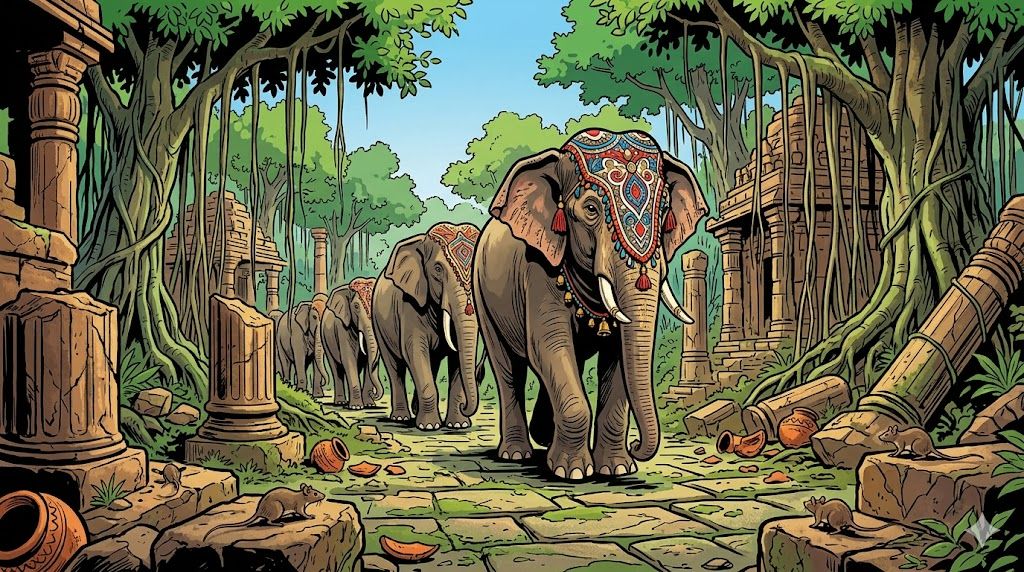
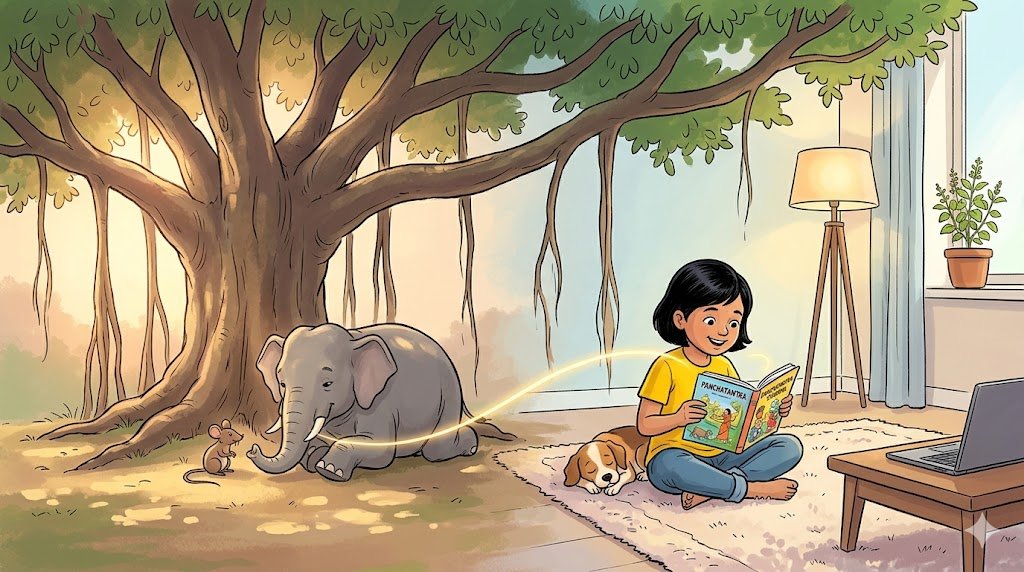
The Elephants and The Mice The Elephants and The Mice – This is the story about a deserted city, where generations of mice live together, and are one day trampled upon by a herd of elephants passing through the city. The mice request the queen elephant to take her herd back by some other way and spare them. The queen agrees. A good deed is always rewarded and the mice are soon able to repay the favor, when they are called upon to rescue the herd who has been caught by some hunters.
-

The Monkey and The Crocodile The Monkey and The Crocodile – Forever a favorite with kids and adults alike, the Monkey and The Crocodile is one of the most read and widely narrated story from the Panchatantra. Kids love the friendly monkey who saves his neck by the use of his wits at the right time.
-
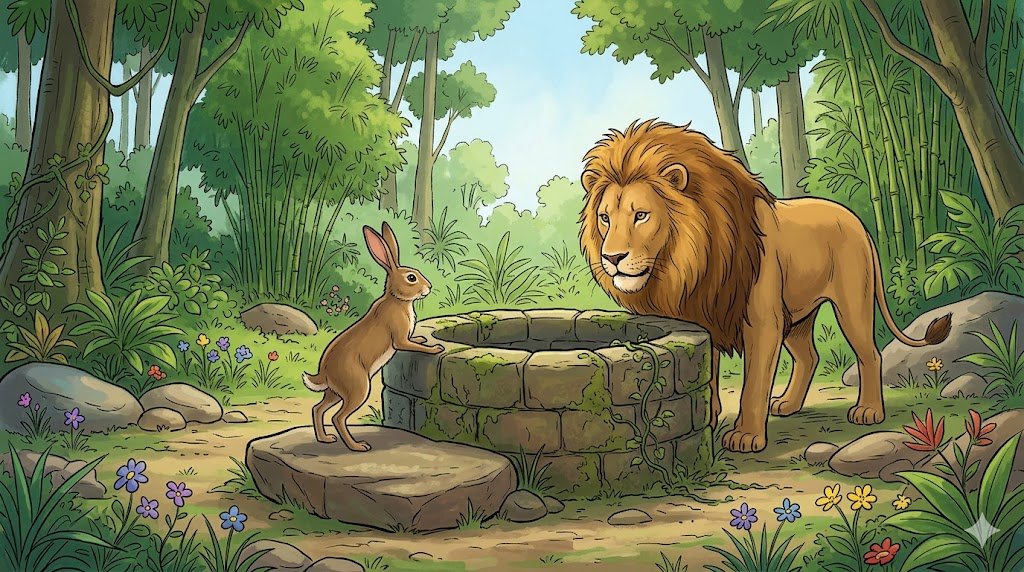
The Foolish Lion and The Clever Rabbit The Foolish Lion and The Clever Rabbit – Another favorite with kids, the story of the clever rabbit who hoodwinks the ferocious but hungry lion into jumping into a well to his death, makes for an excellent narration, be it a bedtime read or a storytelling session.
-

The Musical Donkey The Musical Donkey – Who doesn’t like singers? Especially if it is an adorable, albeit stupid donkey who feels like singing (or braying) in the middle of the night, while stealing cucumbers from a farmer’s field. Only to get caught. One actually feels sad to see him beaten up.
-

The Blue Jackal The Blue Jackal – This is a Panchatantra story about a jackal who hides in a vat of blue dye to escape the wild dogs chasing him, only to emerge blue colored. He goes back to the forest and fools all animals into thinking that he is special.
Read the complete list of Panchatantra stories here.
Which stories do your kids love? Let us know in the comments below.
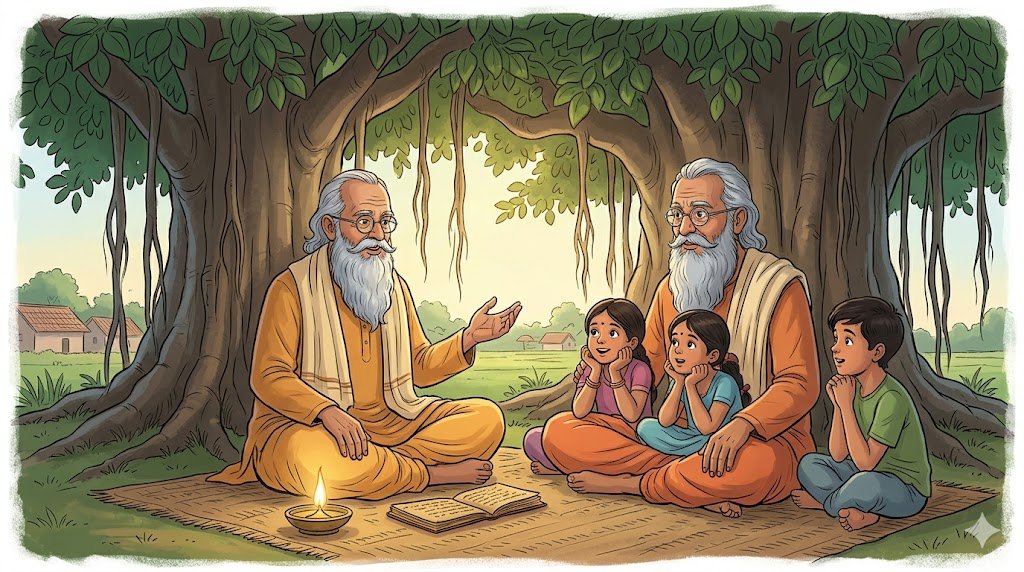
Moral
“दुर्बला विद्यया युक्ता बलवन्तं विनिर्जयन्।”
“The weak, when furnished with wisdom, defeat the strong.” — Panchatantra, Mitra-Lābha, frame-verse
These five tales collectively teach that the wisest characters are those who think carefully before acting, recognize danger early, and understand that true strength comes from cleverness, loyalty, and virtue rather than size or power alone.
Historical & Cultural Context
5 Panchatantra Stories About Animals That Kids Love Retold for Modern Readers is part of the Panchatantra, one of the oldest and most influential collections of fables in world literature. Composed by the scholar Vishnu Sharma around 200 BCE, the Panchatantra was designed to teach statecraft and practical wisdom to young princes through engaging animal tales. This collection has been translated into more than 50 languages and has influenced storytelling traditions from Aesop’s Fables to the Arabian Nights.
Why This Story Endures
5 Panchatantra Stories About Animals That Kids Love Retold for Modern Readers has survived centuries of retelling because it captures a truth about human nature that every generation rediscovers for itself. The characters, situations, and choices in this tale are as recognizable today as they were when the story was first told around an ancient hearth. Great folk tales do not merely entertain – they hold up a mirror in which we see our own hopes, fears, and moral dilemmas reflected with startling clarity.
This story is particularly valuable for young readers because it presents complex moral ideas in accessible, memorable form. By following the characters through their journey, children develop empathy, critical thinking, and an intuitive understanding of cause and consequence – skills that serve them throughout life.
What This Tale Teaches Us Today
Old stories keep their power because their lessons never stop being useful. Here is how this one still applies:
- Alliances shift with circumstance. Trust is earned over time, not granted by titles or speeches.
- Patience rewards itself. The characters who wait for the right moment usually outperform those who rush.
- Generosity, when offered to the right creature, returns in forms you could not have predicted.
Why This Story Still Matters
This folk story from the Panchatantra preserves wisdom that Indian teachers have used for over two thousand years to teach practical ethics. 5 Panchatantra Stories About Animals That Kids Love is a small but finished piece of moral engineering – each character represents a recognizable human type, each decision is a lesson in how people actually behave. Indian grandparents still tell these stories to grandchildren for the same reason ancient royal tutors told them to young princes: because the patterns described in the Panchatantra are eternal. Those who listen early in life make better decisions for the rest of it.
Cultural Context and Continuing Influence
Folk tales like this one survived for hundreds of years through oral storytelling before any scholar thought to write them down. Grandparents told them to grandchildren, travelers traded them along roads and rivers, and mothers repeated them to babies who would one day repeat them to their own children. Each small retelling sharpened the story, discarded unnecessary parts, and polished the essential lesson. That long process of refinement is why a good folk tale feels so weighty – it has been shaped by thousands of listeners across generations, each contributing something small to the story we read today.
Modern readers sometimes wonder whether folk tales are still relevant in an age of apps and smartphones. The answer is yes, perhaps more than ever. The technology changes, but the underlying questions – about kindness, courage, loyalty, greed, family, fear, love – do not. These are the same questions that children asked around a fire in ancient India, around a hearth in medieval Ireland, around a campfire in 19th-century Korea. And they are the same questions children ask their parents today, just phrased differently. That is why a family that reads folk tales together is doing real cultural and emotional work, not simply entertaining itself.
Reading Folk Tales With Children
Reading folk tales aloud to children is one of the oldest and most effective forms of moral education. Unlike a lecture or a rule, a story slides past a child’s natural resistance and plants its lesson in the imagination, where it quietly grows. Years later, when the child meets a real situation that resembles the story – a bully at school, a dishonest coworker, a moment of temptation – the old tale rises to the surface of memory and offers guidance. That is why parents and teachers across every culture have trusted stories to do the work of raising good humans, long before formal schools or textbooks existed.
When reading this story with a young listener, try pausing at key moments and asking what the child thinks will happen next. Let them guess, even if they are wrong. That small act of prediction turns a passive listener into an active thinker. After the story ends, a simple open question – “What would you have done?” or “Who do you think was the smartest character?” – invites the child to connect the tale to their own life. Those conversations are where real learning happens, not during the reading itself but in the quiet moments that follow.
Older children and teenagers sometimes think they have outgrown folk tales. In reality, the best tales only deepen with age. A ten-year-old hears the surface plot; a fifteen-year-old notices the irony; a twenty-year-old sees the economic and political pressures on the characters; a forty-year-old understands the parents in the story for the first time. A good folk tale is a gift that keeps unfolding for decades. Families who read and reread the same stories across the years discover this naturally, and pass the discovery down.
A Final Word
Every folk tale carries within it the accumulated judgment of thousands of listeners across many generations. When a story has been told for a thousand years and still moves children today, that is not an accident. It is proof that the story is saying something true about the human condition. The wiser the listener, the more they see in a tale they have heard a hundred times before. Reading these stories slowly, out loud, with children beside us, we are joining the longest conversation our species has ever had with itself. Every tale we share is a quiet vote for patience, for meaning, and for the old idea that a good story is one of the finest things one generation can hand down to the next.
We hope this telling gave you something worth carrying into your day – a small lesson, a useful image, a question to ask your child at dinner. Folk tales do their best work in the hours and years after the reading ends, quietly shaping how we see the world and each other. Thank you for spending time with this story, and for keeping the old tradition of careful listening and thoughtful retelling alive.
Reflection & Discussion
- Which of the five stories showed the most important lesson about thinking ahead of time?
- Pick one animal character from the stories and explain how their choice matches something you’ve seen people do.
- If the animals in these stories had made different choices, what worse or better endings could have happened?
Did You Know?
Each animal in the Panchatantra stories carries a lesson for us, just as the characters in our own lives teach us through their actions. The crow’s cleverness, the elephant’s wisdom, and the mouse’s loyalty—these are not just traits of forest creatures, but qualities we can recognize in ourselves and others. When children read these stories, they begin to understand that intelligence comes in many forms, that friendship can overcome size differences, and that even the smallest creature can make a big difference. These ancient tales, told for thousands of years across India and the world, remind us that the rules of friendship and honesty never grow old. They remain as true today as they were when the Panchatantra was first written down by the wise sage Vishnu Sharma.
- Ants can carry objects 50 times their own body weight.
- The Panchatantra was written around 200 BCE by Vishnu Sharma to educate three young princes.
- The Panchatantra has been translated into over 50 languages, making it one of the most translated works in history.
Frequently Asked Questions
**Q: Why is this story important?**
You May Also Like
 Panchatantra Stories
Ages 3-5
Panchatantra Stories
Ages 3-5
The Brahmin’s Dream: A Panchatantra Fable of Wishful Thinking
The Brahmin’s Dream: Long ago, there lived a poor Brahmin in a village. He used to beg for a living and sometimes, had to go without food for many days. Never
 Panchatantra Stories
Ages 3-5
Panchatantra Stories
Ages 3-5
The Young Greedy Bird – A Panchatantra Tale from India
The Young Greedy Bird – A Panchatantra Tale from India: Long ago, a flock of birds stayed on the trees near a lake. The flock was ruled by an old queen bird.
 Panchatantra Stories
Ages 6-8
Panchatantra Stories
Ages 6-8
The Carpenter’s Wife
The Carpenter's Wife: Once upon a time, a carpenter lived in a village with his wife. He had heard bad stories about her and wanted to know the truth about