The Tiger, the Brahman, and the Jackal (Another Version)
The Tiger, the Brahman, and the Jackal (Another Version): Once upon a time a tiger was caught in a trap. He tried in vain to get out through the bars, and
The Tiger, the Brâhman, and the Jackal is one of the most widely travelled stories on earth. The version preserved here — carefully marked as “Another Version” on this site to distinguish it from the more commonly anthologised reprint — is the unedited Punjabi original first set down by Mrs. Flora Annie Steel (1847–1929), Anglo-Indian novelist and folklorist, with comparative notes by Major (later Sir) Richard Carnac Temple (1850–1931), Cantonment Magistrate of Ambala and editor of the Indian Antiquary, in their joint volume Tales of the Punjab: Folklore of India (Macmillan & Co., London, 1894), illustrated by J. Lockwood Kipling, C.I.E. — the father of Rudyard, Principal of the Mayo School of Art at Lahore, and a man who knew the Punjab’s village idiom in pen and ink as well as Steel knew it in prose. The tale had first been published a decade earlier, in less polished form, as part of the joint “Wide-awake Stories” series in Indian Antiquary, volume XII (Bombay, 1883), at pages 170 ff., where Steel and Temple took the unusual step of recording the original Punjabi storyteller: a Jaṭṭ boy of Chûhâr-khâna, a small village in the Gujrânwâlâ district of the central Punjab (now in Pakistan, north-west of Lahore). It is the boy’s telling, lightly Anglicised, that survives in “Another Version”. Folklorists today classify the tale as ATU 155 “The Ungrateful Animal Returned to Captivity” — the international type known to D. L. Ashliman as “Ingratitude is the World’s Reward” — with motif clusters J1172.3 (ungrateful animal returned to captivity), K581.2 (jackal as crooked judge), W154.2.1 (rescued animal threatens rescuer), and J1172.0.1 (clever counter-trick by helper). The same plot recurs from the Pañcatantra through Petrus Alphonsi’s Disciplina Clericalis, the Gesta Romanorum, John of Capua’s Directorium Vitae Humanae, the Mahâbhârata, the Hitopadeśa, and a hundred living Indian, Persian, Arab, Mexican, and Zimbabwean variants — one of the most stubbornly memorable plots the human species has ever produced.
I. The Tiger in the Trap and the Brâhman’s Soft Heart
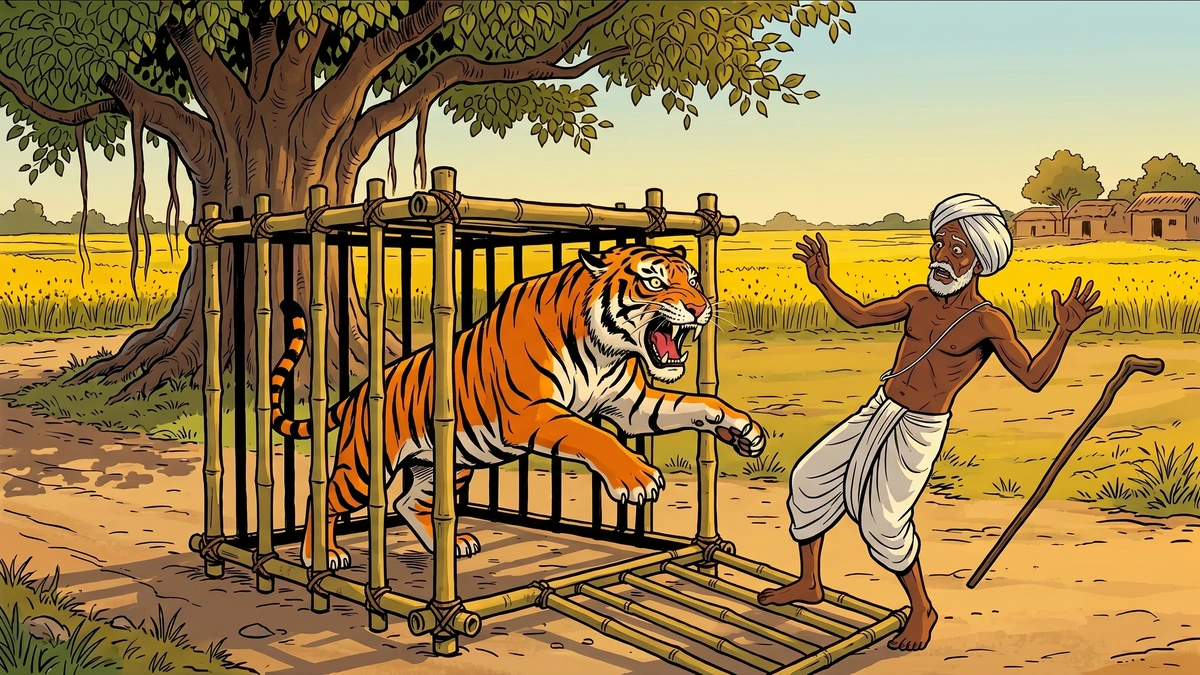
The story opens with a tiger caught in a cage-trap — a piñjarâ, the bamboo-and-iron pit-cage that village shikâris had been laying for tigers since long before the British came. Steel’s Jaṭṭ informant called it simply “the cage”, but Temple’s comparative note in the 1894 volume identifies the trap as the standard double-door baghela of the Punjab, sprung when the bait-goat is touched. The tiger has been caught for several days. He has “rolled and bit with rage and grief when he failed”, in Steel’s telling phrase — a deliberately childlike pairing of verbs that gives the reader his first warning that this animal is not the noble tiger of the Mahâbhârata but the moral tiger of the village fable: a creature whose hunger is matched only by his theatrical self-pity. Down the road comes a Brâhmaṇa, on foot, in the worn-out white turban of the small-town purohita: not a temple priest, not a court priest, but the kind of poor village ritualist (grama-purohita) who walks ten miles a day between weddings, funerals, and naming-ceremonies, eating whatever the householders give him.
The tiger sees him and begins to weep. “Let me out of this cage, O pious one!” he calls. The Brâhman, with the practical caution his caste-training has drilled into him, replies “Nay, my friend — you would probably eat me if I did.” Note the word “probably”: in Steel’s English, as in the underlying Punjabi, it is a courtly understatement, the kind of formal politeness that allows two creatures of unequal power to pretend they are still in conversation. The tiger swears great oaths — “not at all”, “on the contrary”, “I should be for ever grateful, and serve you as a slave” — and then, the master-touch of the village storyteller, “sobbed and sighed and wept and swore”. The four verbs are not redundant. They are the four canonical stages of theatrical persuasion identified in the Nâṭyaśâstra: krandana (sobbing), niḥśvasita (sighing), aśrupâta (weeping), and śapatha (swearing). Bharata’s ancient stage-manual gave actors a checklist; the Jaṭṭ boy in Chûhâr-khâna, who had never read the Nâṭyaśâstra, used exactly the same checklist for his tiger. That is one of the smaller wonders of Indian folk transmission.
The pious Brâhman’s heart softened, in Steel’s lovely phrase, and at last he opened the door. Out popped the tiger — the verb “popped” is again deliberately undignified, signalling that the tiger has not earned the gravity of nobler verbs — and seized the poor man, crying “What a fool you are! What is to prevent my eating you now, for after being cooped up so long I am just terribly hungry!” The reversal is total, instantaneous, and morally familiar to every reader who has ever loaned money to the wrong relative. The Brâhman pleads, and the tiger — partly out of cruelty, partly out of the sportive vanity of a powerful creature who likes to be admired even when he has decided to kill — agrees to the classic Indic counter-bargain: he will abide by the verdict of three judges chosen by the Brâhman as to whether the tiger’s action is just. This three-judge structure, common to ATU 155 and to the Buddhist Vyâghra-jâtaka alike, is the formal hinge of the whole tale.
II. The Three False Judges: The Pîpal, the Buffalo, and the Road
The Brâhman, sad at heart, asks first the great pîpal-tree (Ficus religiosa, sacred to Vishnu, the same tree under which Buddha attained bodhi, and the indispensable presiding deity of every Punjabi village square) what it thinks of the matter. The pîpal’s answer is one of the great cynical speeches of world folk-literature: “What have you to complain about? Don’t I give shade and shelter to every one who passes by, and don’t they in return tear down my branches to feed their cattle? Don’t whimper — be a man!” The pîpal speaks not with the soft voice of a god’s tree but with the bitter voice of a hard-used village servant: a tree that has been pollarded, branched, broken, and bled by fodder-cutters its entire life, and which sees in the Brâhman’s plight nothing but the universal injustice of the world. The injunction “don’t whimper — be a man” is in Punjabi roṇâ chhoḍ — mard ban, an idiom Temple’s 1894 footnote glosses as “the ordinary peasant’s consolation to a complainer”. It is perhaps the only fragment of the original Punjabi that the English translation preserves verbatim, and it carries with it the unmistakable timbre of village male speech — rough, unsentimental, almost contemptuous of grief.
The Brâhman, “sad at heart, went farther afield”, and met next a buffalo turning a well-wheel. The image is precisely observed: the Punjabi Persian wheel (rahaṭ) at which a yoked water-buffalo walks endlessly in a circle to lift water from the well into the irrigation channels was, in 1883, the central labour of every Gujrânwâlâ farm. The buffalo’s answer is the second great speech of bitterness in the tale: “You are a fool to expect gratitude! Look at me! While I gave milk they fed me on cotton-seed and oil-cake, but now I am dry they yoke me here, and give me refuse as fodder!” The buffalo’s grievance is not invented for the fable; it is the actual economic fact of the dry buffalo (Punjabi jhoṭâ) of pre-mechanical agriculture. A milking buffalo was fed binaulâ (cotton-seed) and khal (oil-cake); a dry buffalo was demoted to the well-wheel and given tudd (chopped straw refuse). The Jaṭṭ boy was telling the visiting English ladies a fable; he was also describing his own buffaloes. The buffalo’s judgment, like the pîpal’s, is identical: ingratitude is universal; expect nothing.

The third witness is the road itself — the dusty unmetalled village road of the Punjab, which the storytellers personified as freely as the Greeks personified their winds. “My dear sir,” says the road, with the urbane fatigue of an old courtier, “how foolish you are to expect anything else! Here am I, useful to everybody, yet all, rich and poor, great and small, trample on me as they go past, giving me nothing but the ashes of their pipes and the husks of their grain!” The detail of the ashes of their pipes (Punjabi chillam dî râkh) and the husks of their grain (Punjabi chhân) is the storyteller’s trademark naturalism: he is describing what literally lies on every village road in the Gujrânwâlâ district at the close of the harvest. Three witnesses, three identical verdicts. The world is ungrateful by nature; the Brâhman has no recourse; the tiger’s appetite is justified by the testimony of trees, beasts, and earth itself. The Brâhman turns back “sorrowfully”. It is at this lowest point of the story, with the cosmos itself standing against the just man, that the storyteller introduces his hero.
III. The Jackal’s Pretended Stupidity
The jackal — in Punjabi giddaṛ, in Sanskrit śṛgâla, in the Pañcatantra the canonical figure of the cunning trickster (kûṭa-buddhi) — meets the Brâhman on the path back to the cage and asks what is wrong. The Brâhman pours out his story. The Jaṭṭ boy of Chûhâr-khâna, with the timing of an inherited master, ends his tale at exactly that line: “You look as miserable as a fish out of water!” — a Punjabi proverbial simile (machhî pânî tô bâhar varga) that gives the listener his moment of comedic relief before the resolution begins. In the longer parallel reading preserved in the Joseph Jacobs anthology of 1892 and in the better-known “first version” on this site, the resolution continues with the jackal’s pretended stupidity, his repeated demands that the Brâhman go through the whole sequence again because he “cannot understand”, his eventual visit to the cage, his elaborate confusion about who was inside what, and his final triumphant invitation to the tiger to show him exactly how he had been positioned in the trap — whereupon, the tiger having helpfully re-entered the cage to demonstrate, the jackal slams the door, locks it, and walks the Brâhman home, free.
The jackal’s strategy is one of the most beautiful pieces of folk-tale engineering in the world’s repertoire. He does not appeal to the tiger’s gratitude; gratitude has already been tried and has failed. He does not appeal to the tiger’s honour; the three judges have already shown that honour does not exist. He appeals instead to the only quality the tiger has in surplus — vanity. A tiger who is delighted to be admired as the centre of the story will walk back into his own prison to demonstrate his importance to a foolish-seeming jackal. The motif index of Stith Thompson catalogues this device as K581.2, “jackal as crooked judge induces accused to repeat the offence and is then locked into the trap”. The Jaṭṭ boy did not know the motif index, of course; he simply knew the device, as did the Sanskrit pandits who composed the Pañcatantra a millennium and a half earlier and the Pali bhikkhus who told the Vyâghra-jâtaka. The cunning of the small upon the great is one of the oldest moral consolations narrative offers, and it is here delivered without a single supernatural element: no fairy, no god, no magic word. Just a jackal who plays dumb until a tiger locks himself up.

IV. Why the Brâhman Walks Home
The closing image of the tale — the Brâhman walking back along the same village road that had condemned him an hour earlier, the tiger now caged behind him, the jackal trotting at his side — is one of the great quiet endings in Punjabi folk-literature. There is no crowd. There is no king to reward the helpers. There is no shrine raised to the just. The Brâhman simply goes home to his small purohita’s hut, and the jackal slips back into the scrub. The Punjabi storytellers liked endings of this restrained kind. The Sanskrit aestheticians from Bharata onwards had identified śânta-rasa, the savour of peace, as the highest of the eight (later nine) rasas; the village tellers gave it without naming it. The Brâhman’s reward is to be alive, to walk in the cool of the evening, and to know — what he had not known when he set out that morning — that the world’s ingratitude is real, that three of its grandest witnesses (the sacred tree, the working beast, the public road) will testify to it, and that the only counter-weight to that ingratitude is the small daily cunning of the jackal, who is not a god, not a hero, not a king, but only a clever animal who happened to be passing.
The implicit theology of the ending is striking. The Brâhman set out as a representative of dharma — the priest, the man of religion, the “pious one” the tiger called him at the start. He returns saved by nyâya — quick wit, reasoned trickery, the intelligence of the underdog. Steel and Temple’s 1894 introduction notes this with characteristic dryness: the Punjabi village fables, they wrote, “teach piety incidentally and cleverness essentially”. That is exactly right. The Brâhman is not punished for releasing the tiger; the tale neither praises his pity nor regrets it. It only insists that pity, on its own, is not enough. The Sanskrit ethical tradition had a precise word for what is needed in addition: vyavahâra-buddhi, “the practical reasoning of the world’s affairs”. Without it, the kindest priest dies. With it — even in the form of a small grey jackal — the kindest priest walks home.

The Moral: The Old Sanskrit Verse on Ingratitude
The Punjabi storyteller did not append a verse to his tale; the Punjabi tradition was content to let the story carry its own meaning. But the underlying moral has been formulated, in Sanskrit, in one of the most often quoted couplets of classical ethical literature, attributed to the Mahâbhârata (Śânti Parva, 173.20) and repeated almost verbatim in the Hitopadeśa:
brahmaghne ca surâpe ca caure bhagnavrate tathâ —
niṣkṛtir vihitâ sadbhiḥ kṛtaghne nâsti niṣkṛtiḥ.“For the killer of a Brâhman, for the drinker of liquor,
for the thief, and for the breaker of vows,
the wise have prescribed an atonement.
For the ungrateful man, there is no atonement at all.”— Mahâbhârata, Śânti Parva 173.20; cited verbatim in the Hitopadeśa, Mitralâbha, prose preface to fable I.
The verse names four canonical sins of classical Hindu ethics — the mahâpâtakas of Brâhman-killing, drunkenness, theft, and vow-breaking — and observes that for each of them the law-books have specified an expiation (prâyaścitta): a fast, a pilgrimage, a sacrifice, a public confession. For one sin alone they have specified nothing: kṛtaghnatâ, the destruction of a kindness done. The reason, the commentators agree, is that the ungrateful person has destroyed the very faculty by which atonement could begin — the recognition that one has been helped. There can be no return to a place from which the road has been pulled up. The Punjabi tale, in its own concrete and unphilosophical way, illustrates exactly this verse: the tiger is past saving; he is the kṛtaghna, the destroyer of the kindness done him, and the only just outcome is that he be returned to the cage from which kindness took him out.
Why It Lasted: A Tale Told from Karachi to Kassel to Coyote-Country
Folklorists have long recognised “The Tiger, the Brâhman, and the Jackal” as one of the most travelled stories in the world. Hans-Jörg Uther’s revised The Types of International Folktales (FFC 284, Helsinki, 2004) lists ATU 155 attestations from Iceland to Indonesia, with India identified as the probable point of origin. The earliest written ancestor is the Pañcatantra, where, in Book IV, Labdhanâśa (“Loss of What is Gained”), an ungrateful crocodile is similarly outwitted by a quick-thinking helper. The Vyâghra-jâtaka in the Pali canon, told for monks in fifth-century Ceylon by Buddhaghosa’s school, contains a version with a tiger and a young Bodhisattva. The Hitopadeśa, compiled by Nârâyaṇa in twelfth-century Bengal under the patronage of King Dhavala-candra, retells the tale as a fable of ingratitude in Mitra-lâbha. From India the plot travelled west through the eighth-century Persian Kalîla wa Dimna, the Aramaic and Hebrew translations of the Pañcatantra, and Petrus Alphonsi’s great medieval Latin compendium Disciplina Clericalis (c. 1110), where it appears as the tale of Homo et Serpens, “The Man and the Serpent”, the dangerous animal having shifted from tiger to snake on its way through the Iranian Plateau. From the Disciplina the plot entered the Gesta Romanorum (no. 174), and from there John of Capua’s thirteenth-century Directorium Vitae Humanae, the channel through which it eventually reached the Brothers Grimm and beyond.
It travelled south as well as west. A Shona version is sung in the Zimbabwean folksong “Mutongi Gava Maenzanise”, in which the trapped beast is a leopard and the third creature is a cow. A Mexican version, “Judge Coyote”, was recorded by Sharon Creeden in Fair is Fair: World Folktales of Justice (August House, 1994). An Eastern European Jewish version, “There Is No Truth in the World”, is preserved in Ben-Amos’s Folktales of the Jews (Jewish Publication Society, 2006). Joseph Jacobs included the Steel-Temple Punjabi telling, only slightly edited, in his classic Indian Fairy Tales (David Nutt, London, 1892), pp. 69–73, where it became, for Anglophone children of the late Victorian Empire, one of the most familiar of all Indian stories. What lasts in the tale is the structure: a kindness, a betrayal, a search for justice, a verdict against justice, and a clever rescue by an unimportant outsider. So long as the human world produces the situations that require this structure — rescuers being eaten by those they have rescued, witnesses bitter from their own usage refusing to testify, small unnoticed creatures stepping in where great ones have failed — the tale will keep being told. The Jaṭṭ boy of Chûhâr-khâna, the Sanskrit pandits of the Pañcatantra, the medieval Latin abbots of the Gesta, the Zimbabwean village singers, and the present-day grandparents of the Punjab are all telling the same story because the situation never goes away.
Iconography: The Painted Cage, the Dripping Pîpal, the Smiling Jackal
The visual scenes that have entered Indian popular iconography through this tale are three: the tiger in the painted bamboo cage, his eyes rolling and tongue out; the Brâhman seated in conversation with the great spreading pîpal at the village edge, with the buffalo and the well-wheel visible in the middle distance; and the smiling jackal — head cocked, ears pricked, tail high — standing at the cage door as the tiger shouts inside. J. Lockwood Kipling’s 1894 woodcut for Tales of the Punjab placed all three motifs in a single dust-jacketed plate; the buffalo at the well-wheel was given a separate inset, captioned in Steel’s text simply “Illustration: Buffalo turning the well-wheel”. The Amar Chitra Katha retelling of the tale, drawn by Pratap Mulick for issue No. 526, “Tales from the Panchatantra”, redistributed these scenes in saturated tempera; the jackal’s sly smile in Mulick’s rendering remains, for many Indian readers, the indelible image of the story. Through the Jacobs reprint of 1892 the tale entered the Edwardian English nursery; through the Macmillan school readers of the 1920s it entered the Indian government school syllabus; through Doordarshan’s 1989 series Pañcatantra it entered the Indian televised imagination. Few stories have so many visual lives.
Reading with Children
Three small details from Steel’s text repay slowing down for when reading the tale aloud to younger listeners. First, the tiger’s four verbs. Steel’s “sobbed and sighed and wept and swore” is a ladder of escalating performance, and children love to hear the four words spoken with rising melodrama. Encourage them to repeat the line. They will laugh; they will also remember it. Second, the three witnesses’ speeches. Each of the three — tree, buffalo, road — gives a distinct kind of bitter speech, and children grasp instinctively that the tale is showing them three different ways the world disappoints. Pause and ask: “Whose complaint sounds most like a complaint you have heard?” The conversation that follows is often the moral education of the year. Third, the jackal’s pretended stupidity. Younger children initially think the jackal is genuinely confused; older children realise, often with a satisfying jolt, that he is acting. That moment of realisation — the recognition that a small, weak-seeming creature can defeat a powerful enemy by pretending to be even weaker than he looks — is one of the great teachable moments in the world’s folk repertoire.
A Note on Sources
The text on this page follows Mrs. Flora Annie Steel, with comparative notes by Major R. C. Temple and illustrations by J. Lockwood Kipling, in their Tales of the Punjab: Folklore of India (Macmillan & Co., London, 1894), tale no. XII, pages 116–120. The first publication of the tale in English was in Indian Antiquary, vol. XII (Bombay, 1883), pp. 170 ff., from a Punjabi original told to Steel by “a Jaṭṭ boy of Chûhâr-khâna in the Gujrânwâlâ district”. Joseph Jacobs reprinted the Steel-Temple version in his Indian Fairy Tales (David Nutt, London, 1892), pp. 69–73, with the source note “Steel-Temple, Wide-awake Stories, pp. 116–20; first published in Indian Antiquary, xii. p. 170 seq.” All three editions are in the public domain. For the international tale-type, the standard reference is Hans-Jörg Uther, The Types of International Folktales, FFC 284–286 (Suomalainen Tiedeakatemia, Helsinki, 2004), entry ATU 155 “The Ungrateful Animal Returned to Captivity”. For the comparative motif analysis the indispensable reference remains Stith Thompson, Motif-Index of Folk-Literature (revised edition, Indiana University Press, 1955–58), entries J1172.3, K581.2, and W154.2.1; and Stith Thompson and Jonas Balys, The Oral Tales of India (Indiana University Press, 1958), pp. 240–241. For the wider survey of the type, see D. L. Ashliman, “Ingratitude is the World’s Reward: Folktales of Aarne-Thompson-Uther Type 155” (online resource, University of Pittsburgh, 1996–present). For the Sanskrit antecedents the standard editions are Patrick Olivelle, trans., The Pañcatantra: The Book of India’s Folk Wisdom (Oxford World’s Classics, 1997); and the Hitopadeśa of Nârâyaṇa, tr. Sir Edwin Arnold (London, 1861), with Mitralâbha I. For the Punjabi village-life context of Steel’s 1883 fieldwork, see her own The Garden of Fidelity: Being the Autobiography of Flora Annie Steel (Macmillan, London, 1929), chapters VI–IX. Above all the retellings stands the 1894 Macmillan first edition, illustrated by J. Lockwood Kipling, the foundational document of late-Victorian Punjabi folkloristics, written by a woman who lived for twenty-two years in the villages whose stories she preserved.
Read time: about 10 minutes. Suitable for ages 6 and up; suitable for read-aloud from age 4, with the tiger’s threats softened to “he was very, very hungry”.
You May Also Like
 Indian Folk Tales
All Ages
Indian Folk Tales
All Ages
A Lac of Rupees for a Piece of Advice
A Lac of Rupees for a Piece of Advice: In a bustling town in ancient India, A merchant paid an enormous sum for a single piece of advice that saved his life.
 Indian Folk Tales
All Ages
Indian Folk Tales
All Ages
Mr Bunnys Carrot Soup
Mr Bunnys Carrot Soup: Once upon a time Mr. Bunny picked four carrots. I will make carrot soup, he thought. Rat asked, “May I have a carrot please?” “Yes, take
 Indian Folk Tales
Ages 3-5
Indian Folk Tales
Ages 3-5
Princess Aubergine
Princess Aubergine: Once upon a time there lived a poor Brahman and his wife, so poor, that often they did not know whither to turn for a meal, and were