Dorani
A prince marries the golden-haired Dorani, who will not say a word to him and leaves every night, so he makes himself invisible to discover her secret.
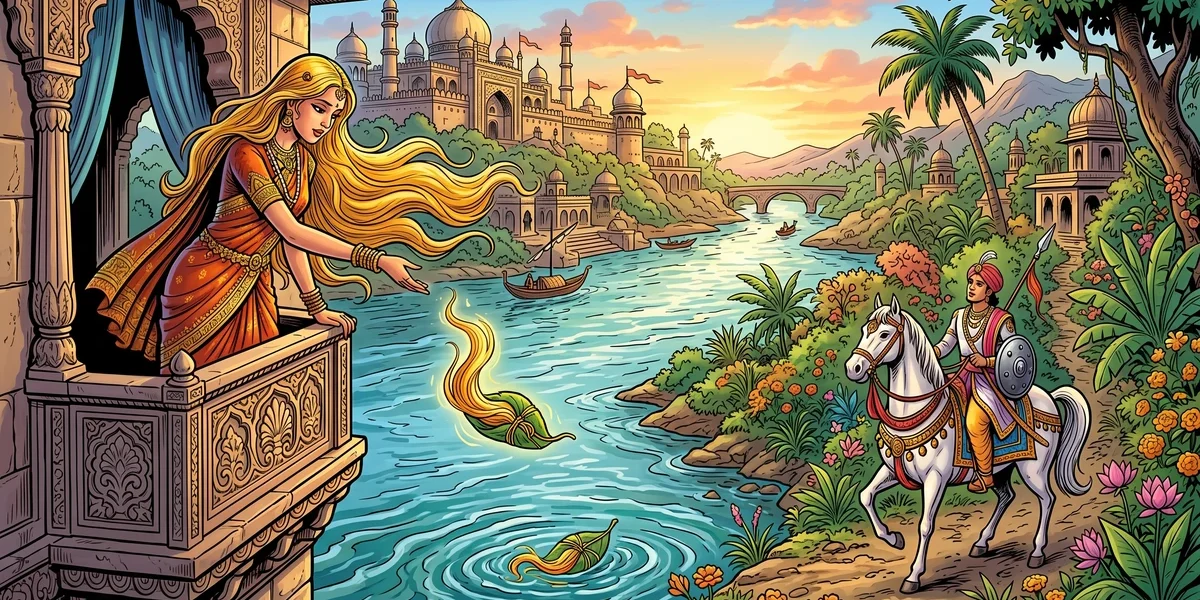
Long ago, in a city of Hindustan, there lived a man who sold perfumes and sweet-smelling oils. He had a very beautiful daughter called Dorani. Dorani had a friend who was a fairy, and the two of them were great favourites of Indra, the king of fairyland, because nobody in his kingdom could sing so sweetly or dance so gracefully as they could.
Dorani had the loveliest hair in the world. It was like spun gold, and it smelled like fresh roses. But it was so long and thick that its weight was often too much for her. One day she cut off a shining lock, wrapped it in a big leaf and threw it into the river that flowed beneath her window.
Now, the king’s son happened to be out hunting that day, and he had come down to the river for a drink. Floating towards him he saw a folded leaf that smelled of roses. Just out of curiosity, he stepped into the water and caught it as it drifted past. When he opened it, he found a lock of golden hair inside, giving off a faint and lovely scent.
When the prince came home, he was so sad and quiet that his father, the king, wondered whether something terrible had happened, and asked him what the matter was. The prince took the lock of hair from inside his coat and held it up to the light.
“Look, Father,” he said. “Have you ever seen hair like this? If I cannot win the girl it belongs to and marry her, I shall die!”
So the king sent messengers all over his kingdom to look for the girl with hair like spun gold, and at last he found out that she was the perfume seller’s daughter. News of the search soon spread, and Dorani heard about it with everyone else. One day she said to her father, “If the hair is mine and the king wants me to marry his son, I must do it. But you must tell him this: I will spend every day at the palace, but every night I will spend in my old home.”
Her father listened in astonishment, but he said nothing, because he knew she was wiser than he was. Of course the hair was Dorani’s. The messengers soon told the king, and he sent for the perfume seller and said he wanted his daughter to marry the prince. The old man bowed his head to the ground three times.
“Your Highness is our lord,” he said, “and we will do whatever you command. My daughter asks only one thing: if she spends the days at the palace after the wedding, she may go back to her father’s house every night.”
The king thought this was a very strange request. But he told himself that it was really his son’s business, and that the girl would surely soon get tired of going back and forth. So he agreed, everything was quickly arranged, and the wedding was held with great celebrations.
At first the prince did not mind the agreement much, because he thought that at least he would see his bride all day long. But to his dismay, Dorani did nothing but sit on a stool all day with her head bent down on her knees, and he could never get her to say a single word. Every evening she was carried home to her father’s house in a palanquin, a covered chair, and every morning she was carried back soon after sunrise. Yet she never made a sound, and never showed by any sign that she saw him or heard him or cared about him at all.
One evening the prince was wandering sadly in a beautiful old garden near the palace. The gardener was a very old man who had worked there since the days of the prince’s great-grandfather. When he saw the prince, he came and bowed to him.
“My child, my child,” he said, “why do you look so unhappy? Is something wrong?”
“I am unhappy, old friend,” said the prince, “because I have married a wife as lovely as the stars, but she will not speak to me, and I don’t know what to do. Every night she leaves me to go to her father’s house, and every day she sits in mine as if she had turned to stone, and says nothing, whatever I do or say.”
The old man stood and thought for a moment. Then he hobbled off to his cottage, and a little later he came back with five or six small packets, which he put into the prince’s hands.
“Tomorrow, when your bride leaves the palace,” he said, “sprinkle the powder from one of these packets over yourself. You will still be able to see everything clearly, but nobody will be able to see you. I can do no more for you than that, but I hope all goes well!”
The prince thanked him and tucked the packets safely into his turban.
The next evening, when Dorani set off in her palanquin for her father’s house, the prince sprinkled himself with the magic powder and hurried after her. Just as the old man had promised, no one could see him, though he felt exactly the same as usual and could see everything around him. He soon caught up with the palanquin and walked beside it all the way to the perfume seller’s house. When it was set down and his bride, wrapped in veils, went inside, he slipped in after her without anyone noticing.
At the first door Dorani took off one veil. At a second door at the end of a passage she took off another. Then she went upstairs, and at the door of the women’s rooms she took off a third. After that she went into her own room, where two big basins stood ready, one filled with rose oil and one with water, and she washed herself in them. Then she called for food, and a servant brought her a bowl of curds, which she ate quickly. She dressed herself in a silver robe, wound strings of pearls about her and put a crown of roses on her hair. When she was ready, she sat down on a four-legged stool with a canopy and silk curtains above it. She drew the curtains around her and called out, “Fly, stool, to the palace of Rajah Indra!”
At once the stool rose up into the air. The invisible prince had watched all this in amazement, and as it flew off, he grabbed one of its legs and found himself whizzing through the sky.
Soon they came to the house of the fairy who was Dorani’s best friend. She was waiting on her doorstep, dressed just as beautifully as Dorani. When the stool stopped at her door, she cried out in surprise, “Why, the stool is flying crookedly today! I wonder why. I suspect you have been talking to your husband, and that is why it won’t fly straight.”
But Dorani insisted that she had not said one word to him, and she could not think why the stool was flying as if one side were weighed down. The fairy still looked doubtful, but she said nothing more and sat down beside Dorani, while the prince held tightly to his leg of the stool. Then off it flew through the air until it reached Rajah Indra’s palace.
All night long the two friends sang and danced for Rajah Indra, while a magic lute played the most enchanting music all by itself. The prince sat watching and listening, quite spellbound. Just before dawn the rajah gave the sign for them to stop. The two friends sat on the stool, and with the prince clinging to its leg, it flew down to earth and carried Dorani and her husband safely to the perfume seller’s shop.
There the prince hurried off by himself, past Dorani’s palanquin and its sleepy bearers, straight to the palace. The moment he stepped into his own rooms, he could be seen again. He lay down on a couch to wait for Dorani.
When she arrived, she sat down and was as silent as ever, with her head bowed on her knees. For a while nobody made a sound. Then the prince said, “I had a strange dream last night, and since it was all about you, I am going to tell you about it, even though you never listen.”
Dorani paid no attention, but he went on and described everything that had happened the night before, leaving out nothing he had seen or heard. When he praised her singing, his voice trembled a little, and Dorani looked at him. She said nothing, but inside she was full of wonder. “What a dream!” she thought. “Could it really have been a dream? How could he learn in a dream everything I did and said?” Still she kept silent. She only looked at the prince that one time, and then sat for the rest of the day with her head bowed, just as before.
When night came, the prince made himself invisible and followed her once more. Everything happened just as it had the first time, except that Dorani sang more beautifully than ever. In the morning the prince told her everything she had done, pretending that he had dreamed it. As soon as he had finished, Dorani gazed at him and spoke.
“Did you really dream this, or were you truly there?”
“I was there,” said the prince.
“But why do you follow me?” she asked.
“Because I love you,” said the prince, “and being with you makes me happy.”
This time Dorani’s eyelids fluttered, but she said nothing more and was silent for the rest of the day. In the evening, though, as she was stepping into her palanquin, she said to him, “If you love me, prove it by not following me tonight.”
So the prince did as she asked and stayed at home.
That night the magic stool flew so jerkily that the two friends could hardly stay on it. At last the fairy cried, “There is only one reason it would jolt like this! You have been talking to your husband!”
“Yes, I have spoken,” said Dorani. “Oh yes, I have spoken!” But she would say no more.
That night Dorani sang so wonderfully that, when she finished, Rajah Indra stood up and promised to give her anything she asked for. At first she said nothing. But when he urged her, she answered, “Give me the magic lute.”
The rajah was cross with himself for making such a hasty promise, for he loved that lute more than anything else he owned. But a promise is a promise, and very unwillingly he handed it over.
“You must not come here any more,” he said. “Once you have asked for so much, how could you ever be happy with smaller gifts?”
Dorani bowed her head without a word, took the lute and went out with her friend through the great gate, where the stool was waiting. It flew down to earth more unsteadily than ever.
When Dorani reached the palace that morning, she asked the prince whether he had dreamed anything in the night. He laughed with joy, because this time she had spoken to him of her own accord. “No,” he said, “but now I am starting to dream, not about what has happened, but about what may happen in the days to come.”
That day Dorani sat very quietly, but she answered the prince whenever he spoke to her. When evening came and it was time for her to leave, she stayed where she was. The prince came close and said softly, “Aren’t you going home, Dorani?”
At that she stood up and threw herself into his arms in tears. “No, my lord,” she said gently. “I will not leave you, now or ever!”
So the prince won his beautiful bride. They had nothing more to do with fairies or their magic, but every day they learned more about the magic of love, which anyone can still learn, even though fairy magic has gone.
Where this tale comes from
This Punjabi story appears in Andrew Lang’s The Olive Fairy Book (1907), where it is credited to Major Campbell of Feroshepore. Lang’s version calls Indra both “the king of fairyland” and “rajah Indra,” and this telling keeps both names.
The story’s magic accompanies a marriage shaped by royal pressure and the prince’s secret surveillance of Dorani. Its quiet ending invites discussion of privacy, choice and the life she gives up.
Read the original: Andrew Lang, The Olive Fairy Book (Project Gutenberg #27826, Dorani)
Reading guidance: Ages 9–12 with adult discussion; includes pressure to marry, secret watching of private routines and a bride’s eventual separation from her former life.
A closer reading
The prince first knows only a lock of hair and demands its owner as a wife. Dorani’s condition preserves a separate part of her life, while the king agrees because he assumes she will abandon it. That gap between an agreement and the intention behind it matters before the magic begins.
Invisibility lets the prince learn her secret, but it does not give her a choice about being watched. He even describes his observations as dreams before admitting the truth. The clearest act of respect comes later, when Dorani asks him not to follow and he stays home. His compliance is a different action from persistence.
The lute brings both a valued object and exclusion from Indra’s court. The text does not explain whether Dorani predicts that consequence, so readers should distinguish a possible interpretation from a stated intention. Her final happiness is presented through reunion, yet it also closes a life of performance and friendship that mattered to her.
Try this with the story
Make a timeline of four moments: marriage condition, invisible following, admission of the truth and the request not to follow. At each, ask what Dorani knows and what choice she has. Separate the text’s explanation of the lute request from your own inference.
Talk about it
- Why does the king agree to Dorani’s condition?
- How does the prince’s account of a dream conceal what he has done?
- What changes when he respects her request not to follow?
- Does the story tell us whether Dorani intended to be excluded from Indra’s court?
More stories like this
- The Ivory City And Its Fairy Princess — another Indian fairy tale of a prince who falls in love with a magical princess
- Diamond Cut Diamond — another Punjabi story from The Olive Fairy Book
- The Snake Prince — another Indian fairy tale about a marriage with a magical secret
Frequently Asked Questions
How did the prince first learn of Dorani?
Why did Dorani leave every night?
How did the prince find out her secret?
You May Also Like
 Indian Folk Tales
Ages 9-12
The Magic Bed
A kind prince shares his cakes with the Ant-King and pulls a thorn from a tiger’s paw, and both friends help him win the dazzling Princess Lalun.
 Indian Folk Tales
The Snake Prince
A poor woman finds a snake in her brass pot that turns into jewels, then a baby prince—whose bride’s curiosity later sends him back into the river.
 Indian Folk Tales
Ages 9-12
Peasie and Beansie
Kind Peasie helps a tree, a fire, a pipal and a stream on her way to visit their father, and her selfish sister Beansie hopes to win the same rewards.