Peasie And Beansie
Peasie worked steadily in her garden while Beansie sought shortcuts. When harvest came, Peasie's patience yielded abundance; Beansie reaped only regret.
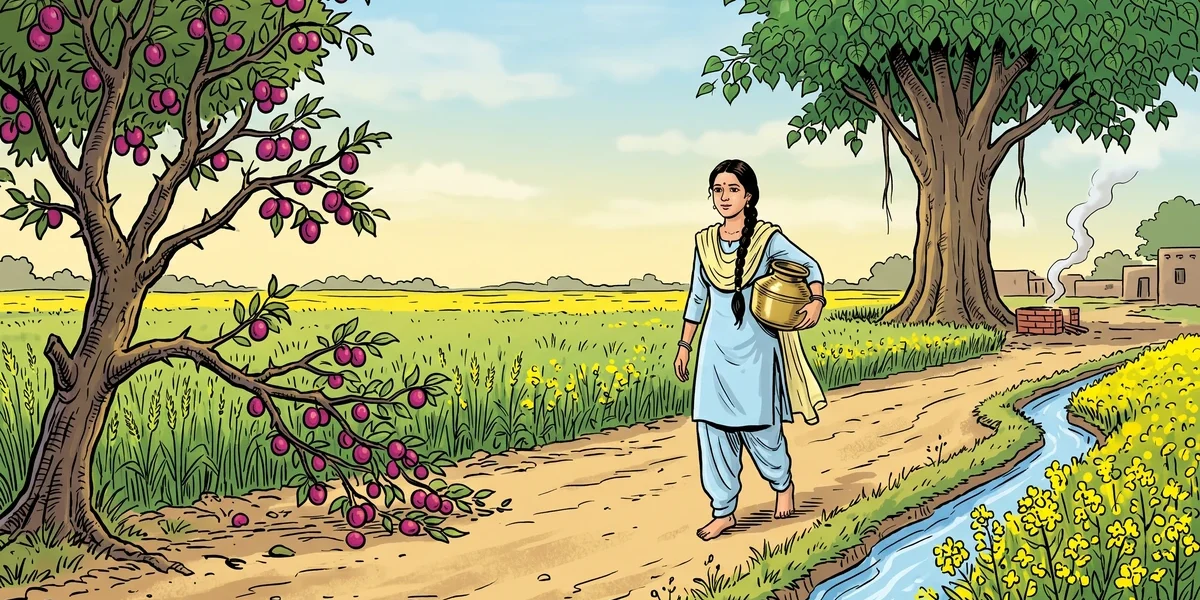
Peasie And Beansie is one of the small, perfectly carpentered moral tales that Mrs. Flora Annie Steel set down in Tales of the Punjab: Told by the People (Macmillan and Company, London, 1894), the great Anglo-Indian folklore collection she gathered during her twenty-two years in the Punjab and which her co-author Major Richard Carnac Temple annotated with the philological care of an army officer who had spent a working life in cantonment libraries. The tale is the Punjab’s contribution to one of the oldest and most widely distributed story-shapes in the world — the international tale-type catalogued by folklorists as ATU 480, The Kind and the Unkind Girls, of which the comparative folklorist Warren E. Roberts (Wayne State University Press, 1958) was eventually able to chronicle more than nine hundred recorded versions in languages from Gaelic to Tamil, Yoruba to Yiddish.
In the Punjabi version a soft-natured younger sister, Peasie, sets out alone to visit her old father at harvest time because her sharp-tongued elder sister Beansie cannot be troubled to walk in the heat. On the road Peasie tidies the thorns of a plum-tree, sweeps the choking ashes from a fire, binds up the broken branch of a sacred pîpal, and clears the silted mouth of a forest stream — not in order to be rewarded, but because each creature’s small distress catches her attention as she passes. Beansie, when she walks the same road in turn, refuses each of them in language so flat and selfish that even the listening child, hearing the tale told beside the cooking-fire, knows the ending three rivers before it arrives. The reward is not gold and the punishment is not the gallows; the road itself dispenses justice, and the moral is folded into the same matter-of-fact landscape in which the wrong was committed.
Beat I — The Quarrelsome Sister And The Soft One
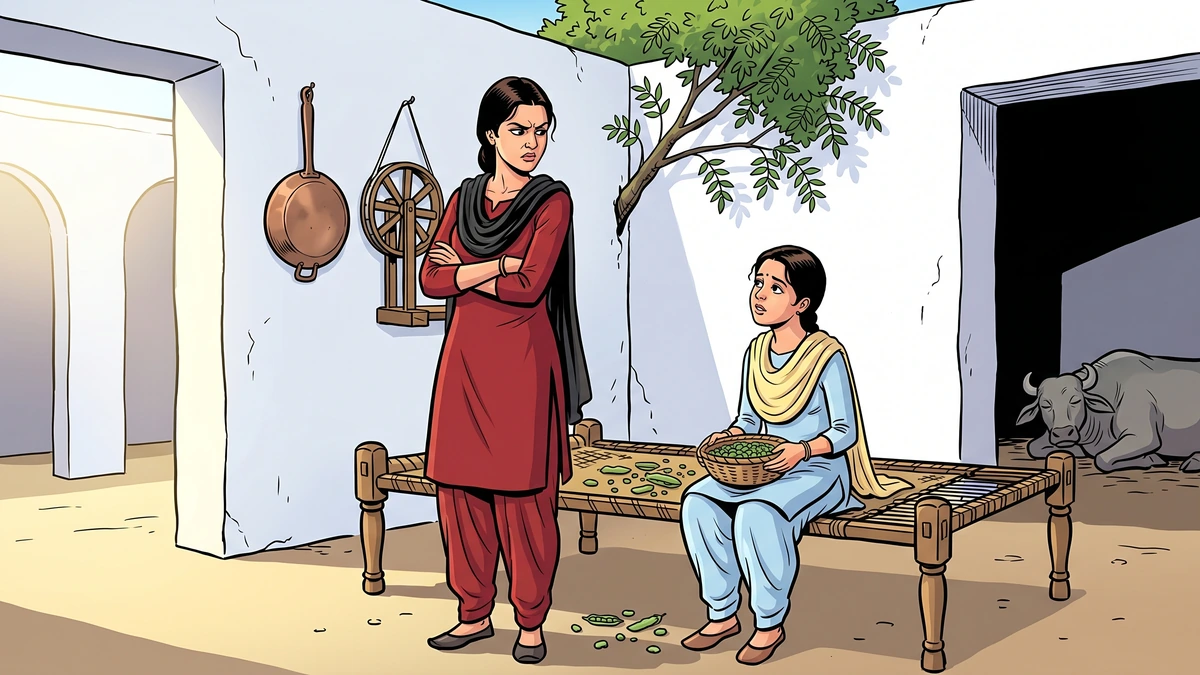
The two sisters in the tale are not stepsisters and there is no wicked mother; this is one of the small but telling differences between the Punjab telling and the European AT 480 cluster collected by the Brothers Grimm as Frau Holle (KHM 24, Kinder- und Hausmärchen, Berlin 1812) or by Madame d’Aulnoy as Les Fées (Paris, 1697). In the Steel-Temple text the elder, Beansie, is described in one decisive Punjabi sentence as “hard, quarrelsome, apt to disagree with everybody,” while the younger, Peasie, is “soft and most agreeable.” That phrasing belongs to the village; folklorists who have catalogued the variants observe that the moral character of the two sisters is normally signalled by a single domestic adjective in the opening line and never elaborated, because the listener is meant to recognise the type immediately and lean forward for the journey, not the introduction.
The trigger of the plot is small and naturalistic. It is harvest time, the family farm is empty of company, and the old father is alone in the house. Peasie, who is “for ever trying to please somebody,” suggests they walk over and visit him. Beansie refuses with the freshness of a sister who has heard the suggestion before: I don’t care if he is dull. Go yourself. I’m not going to walk about in the heat to please any old man. In the Punjab’s long summers, in the dust and the white sky between June and September when even the buffaloes lie down in the muddy hollows of the fields, the refusal would have rung true to every village audience. Peasie ties a cloth over her hair and sets off alone.
The road she walks is not a road of marvels in the European sense. It is the same ribbon of cart-track that connects every Punjabi village to its neighbours: dust in the dry months, ankle-deep mud after the monsoon, plum-trees and pîpals at the rest-stations where the bullock-drivers tether their carts, a small irrigation stream cut from the canal, the smoke of cooking-fires drifting low along the fields. The marvels in this tale do not arrive from outside the landscape. They are the landscape, given the power to speak.
Beat II — The Four Small Kindnesses Along The Road
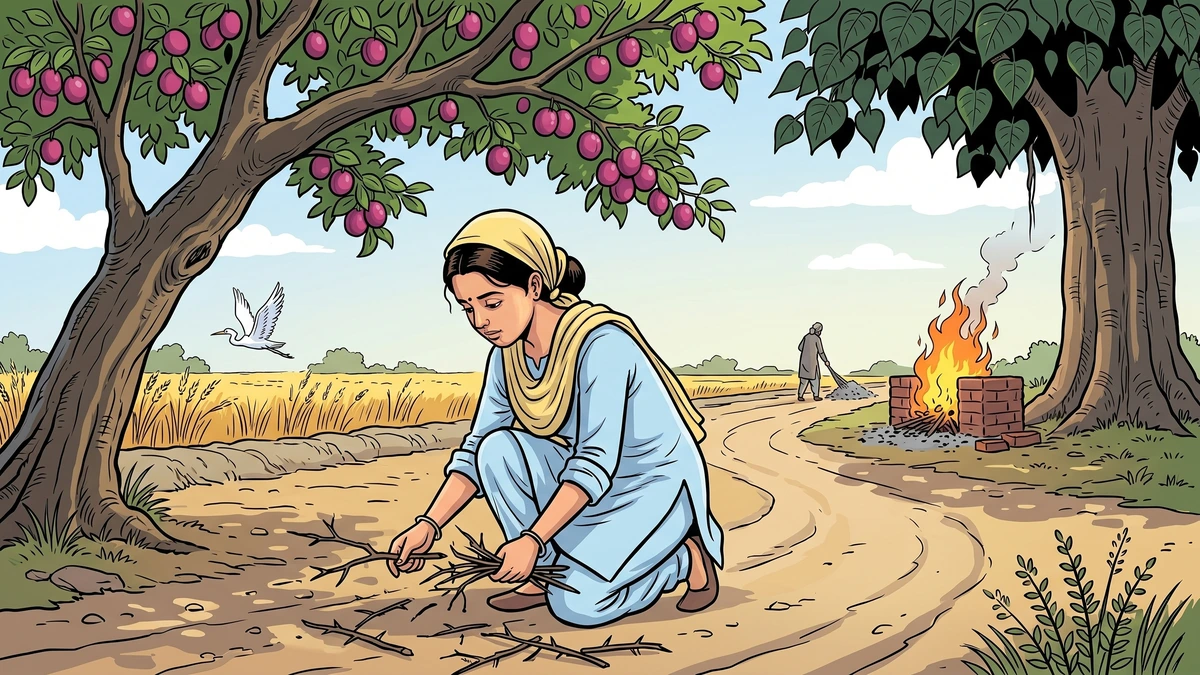
The tale’s structural heart is a quartet of micro-encounters, set out in the brisk, repetitive cadence that oral storytellers everywhere use to help children remember a sequence by heart. Peasie meets, in turn, a plum-tree whose thorns are scattered untidily, a fire half-choked by its own ashes, a pîpal-tree with a broken branch, and a small stream whose mouth is silted with sand and dead leaves. Each one calls out to her by name. Each one is answered the same way: So they are, I declare! — So you are, I declare! — Poor thing! poor thing! — No more you can! Peasie does the small physical work, scrapes, sweeps, binds, clears, and walks on without lingering for thanks.
The four objects are not random. The plum-tree is a fruiting tree of the Punjab orchards. The fire is the hearth, the centre of every household’s social life. The pîpal — Ficus religiosa, the sacred fig under which the Buddha attained enlightenment at Bodh Gayá and which in Hindu households is circumambulated on Saturdays as the seat of Vishnu — is the most religiously charged tree in the subcontinent; in Major Temple’s notes to the 1894 edition he marks it as “a sacred tree, constantly occurring in folk-tales,” and observes that it is held to be inhabited and to listen. The stream is the irrigation channel that gives the Punjab (literally the “Five Rivers” land) its name and its harvest. In a single morning’s walk Peasie has tended an orchard, a household, a temple-tree, and the very water that feeds the fields — the whole social and religious geography of village Punjab in miniature, attended to one creature at a time.
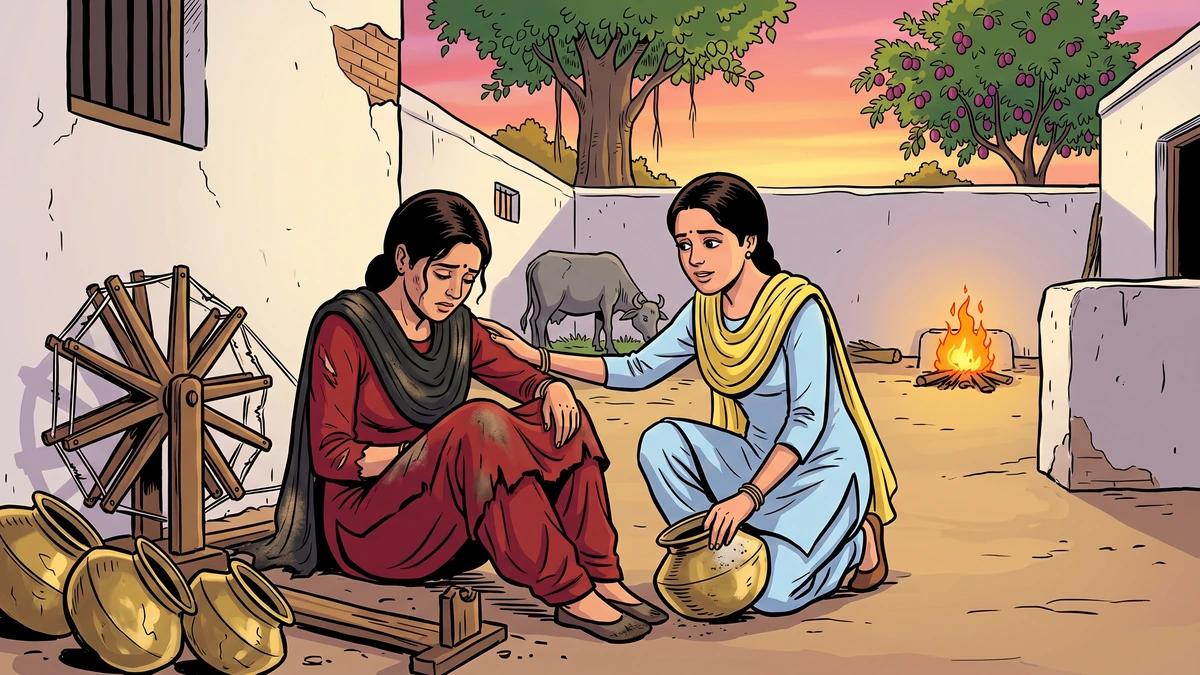
This careful patterning is what folklorists mean when they call ATU 480 a chain tale rather than a wonder tale. There is no magic spell, no fairy disguised as a beggar, no broken taboo. The wonder is that the world remembers what is done to it, and answers in kind. When Peasie reaches the old father’s house, his joy is so great that he sends her home loaded with practical gifts — a spinning-wheel, a buffalo, brass cooking-pots, a charpoy bed — the dowry of a small Punjabi household in 1890s rural Sialkot or Hoshiarpur. On the way home, the very plum-tree, fire, pîpal, and stream that she had helped before now turn aside the robbers, the wolves, and the misfortune that would otherwise have stripped her of those gifts. The road carries her safely back, because the road owes her something.
Beat III — The Sharp Sister And The Same Road
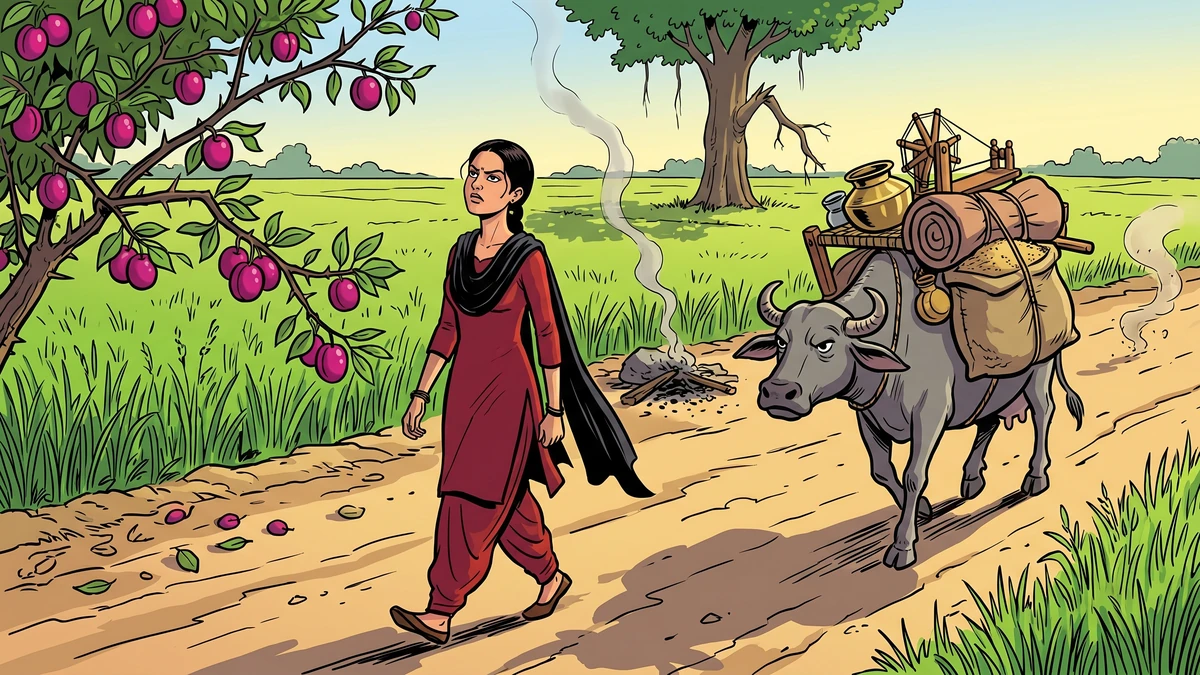
The mirroring half of the tale begins, as ATU 480 versions almost always do, with envy. Beansie sees what Peasie has brought home and decides on the same errand for the same reasons. She walks the same dust-track to the same father’s house. The plum-tree, fire, pîpal, and stream call out to her in the same words they had used for her sister. The dialogue here is the cruellest single passage in the Steel-Temple text, and it is cruel only by being flat: Beansie answers the plum-tree that she has no time for thorns, the fire that she will not blacken her hands with ashes, the pîpal that a tree may break its own branches if it likes, and the stream that the sand may keep its bed for all she cares. She walks past each of them at the same hard pace, a pace the village listener already knew was wrong because it lacked the small interruption of attention.
The old father, surprisingly, gives Beansie the same gifts — the spinning-wheel, the buffalo, the brass pots, the bed — perhaps because the tale is unwilling to let the listener attribute Peasie’s reward to any partiality on his part. The justice that follows is therefore done not by the father, not by a god, not by a fairy, but by the road itself. As Beansie walks home with her loaded buffalo, the stream rises and floods her path. The pîpal’s broken branch falls on her gifts. The fire flares out from its hearth and singes her veil. The plum-tree drops its thorns into her plaits. By the time Beansie reaches her own door she is a small disgraced figure, the buffalo lost, the brass pots dented, the spinning-wheel split, and the lesson written into her memory more permanently than any sister’s sermon could have written it.
Comparative folklorists have noted that the Punjabi tale’s restraint here is unusual. In the Italian variant collected by Italo Calvino as La fata delle sette montagne (Fiabe italiane, Einaudi, Turin 1956), the unkind sister is killed outright. In the Russian variant Morozko the unkind girl freezes to death in a snowfield. The Brothers Grimm’s Frau Holle sends the lazy girl home covered head-to-foot in pitch that no soap will remove. The Punjab tale lets Beansie live, lets her keep her kitchen and her sister, and lets her humiliation be small enough to be educational rather than tragic. This is one of the marks of the Indian moral tradition the eighteenth-century Sanskrit anthologist Vishnu Sharma had already given the world in his Pañcatantra: the lesson must be sharp enough to cut, but not so sharp that it leaves no listener to learn.
Beat IV — The Moral The Tale Is Unwilling To State
One of the most striking things about Peasie and Beansie in the 1894 Steel-Temple text is the absence of an explicit closing moral. Most of the moral tales in the same volume — The Bear’s Bad Bargain, The Lambikin, The Jackal and the Iguana — close with a single concluding line in which the storyteller addresses the listening children directly. Peasie and Beansie does not. It ends with Beansie sitting in her ruined courtyard while her sister, soft-natured to the last, helps her dust off the surviving brass pots. The moral is not stated because, in the Punjab village logic the tale assumes, the moral is what the tale just was. To say it aloud would be to insult the listener.
The implicit moral is the one Tiruvalluvar set down in the Tamil Tirukkuraḷ in roughly the fifth century of the common era, in the chapter on Iyalbuḷam (natural conduct):
“Inná ceytárkkum iniyavé ceyyákkál ennai payanaittánídal.”
— Tirukkuraḷ 314
(“If you do not return kindness even to those who have harmed you, what then was the use of all your learning?”)
The same teaching is given by Vishnu Sharma in the Pañcatantra, by the Buddha in the Pali Dhammapada chapter on Anger (Kodha-vagga, verse 223 — akkodhena jine kodham, “conquer anger by non-anger”), and by Náráyana in the twelfth-century Sanskrit Hitopadeśa. It is a teaching old enough to have been a cliché when the Romans were still arguing about Carthage. Peasie and Beansie is its village form: no Sanskrit, no Pali, no manuscript, no priest. Just a road, a plum-tree, a fire, a pîpal, a stream, and two sisters who choose differently each time they walk past.
The moral, plainly stated: Small kindnesses, done without thought of reward, are the only kindnesses that the world remembers. The road we walk every day is keeping a quiet account of how we treat the small things on it — and the road is the one that pays us back.
Why The Tale Has Lasted
It is striking that a tale so small in its events has kept its place in Punjabi household repertoires for at least a century and a half — we have it in print from 1894, but the storytellers Mrs. Steel met in the villages of Kasur and Sialkot and Jullundur in the 1880s already considered it ancient, and the four objects on the road (plum, fire, pîpal, stream) had already settled into their canonical order. The reason for its endurance is, I think, threefold.
First, the tale is portable across age. A four-year-old can follow the chain of four polite refusals and four polite acceptances and laugh at Beansie’s flat-footed selfishness. A fourteen-year-old beginning to think about character can see in it the same teaching she meets in her school’s reading of the Pañcatantra. A forty-year-old, walking past a neglected pîpal in a city park, can recognise in the tale’s small theology the great Indian intuition that the natural and the moral are the same fabric — that to clear the silt from a stream is, in some quiet sense, to clear it from one’s own life.
Second, the tale’s economy is exemplary. There are no princes, no enchanted lakes, no demons. The supernatural is so domesticated that it consists entirely of a fire that complains of its ashes. The reward is a buffalo and a spinning-wheel, not a kingdom. The punishment is a dented brass pot, not a death. This is folklore at the human scale, and it is the human scale that lets a story survive the long dilution of being told a thousand times around a thousand cooking-fires.
Third, the tale’s teaching does not date. The two sisters are recognisable in every household in every century. The road is recognisable to anyone who has ever walked one. And the small invitation it makes to its listener — tidy the thorns; sweep the ashes; bind the branch; clear the channel — is an invitation that does not stop being relevant when the listener leaves the courtyard and goes out into the world. The road is still keeping its quiet account. The plum-tree is still waiting. The pîpal still listens. And the choice between Peasie and Beansie is one we are walking up to, in the small hot afternoon of a working day, more often than we know.
Reflection & Discussion
- Why does the Punjabi storyteller leave the moral unspoken at the end, while the European versions of ATU 480 always close with a stated lesson? What does that silence tell us about how the tale was meant to be received?
- The four objects Peasie helps — plum-tree, fire, pîpal, stream — are not a random list. What do they together represent about a Punjabi village’s daily life and sacred life in 1890?
- The old father gives Beansie the same gifts he gave Peasie. Why is it important to the moral logic of the tale that the punishment comes not from the father but from the road itself?
- Compare Peasie’s story to the Brothers Grimm’s Frau Holle. What changes when the lazy girl is punished with pitch instead of with a dented brass pot?
- What small “plum-trees” and “streams” do you walk past in your own day? When have you stopped to tidy them, and when have you walked on?
Did You Know?
- Tales of the Punjab: Told by the People was first published by Macmillan and Company, London, in 1894, with text by Mrs. Flora Annie Steel and ethnographic notes by Major Richard Carnac Temple of the Bengal Staff Corps; it remains the single most important printed source for the oral folk-tale tradition of the late nineteenth-century Punjab.
- Folklorists classify Peasie and Beansie as a Punjabi version of international tale-type ATU 480, The Kind and the Unkind Girls, of which Warren E. Roberts (Wayne State University Press, 1958) catalogued more than nine hundred recorded variants worldwide.
- The pîpal tree (Ficus religiosa) that Peasie binds up is the same species under which the Buddha is held to have attained enlightenment at Bodh Gayá in the sixth century BCE; in Hindu tradition it is circumambulated on Saturdays as the seat of Vishnu and is therefore the most religiously charged tree in the Indian subcontinent.
- The names “Peasie” and “Beansie” are Mrs. Steel’s English renderings of common Punjabi pulse-names — small kitchen-staples chosen as names because the tale’s village audience would have shelled them in their laps every evening.
- The tale’s closing image — the road itself dispensing justice — is one of the oldest and most distinctive features of the Indian moral tradition, found in the Pañcatantra, the Hitopadeśa, and the Játaka tales, in which the natural world is repeatedly the agent of the lesson rather than its mere setting.
Frequently Asked Questions
**Q: Why is this story important?**
You May Also Like
 Indian Folk Tales
Ages 3-5
Indian Folk Tales
Ages 3-5
Mr. Bunny’s Carrot Soup
Mr. Bunny’s Carrot Soup: Once upon a time Mr. Bunny picked four carrots. I will make carrot soup, he thought. Rat asked, “May I have a carrot please?” Mr.
 Indian Folk Tales
Ages 3-5
Indian Folk Tales
Ages 3-5
Dorani
Dorani: Once upon a time there lived in a city of Hindustan a seller of scents and essences, who had a very beautiful daughter named Dorani. This maiden had a
 Indian Folk Tales
Ages 3-5
Indian Folk Tales
Ages 3-5
Little Anklebone
Little Anklebone: Once upon a time there was a little boy who lost his parents; so he went to live with his Auntie, and she set him to herd sheep. All day long