The Mother And The Daughter Who Worshipped The Sun
The Mother And The Daughter Who Worshipped The Sun: Once upon a time there lived a mother and a daughter who worshipped the Sun. Though they were very poor
The Mother and the Daughter Who Worshipped the Sun is a Punjabi devotional folk tale collected from village storytellers around Lahore, Jullundur and the Bari Doab in the 1880s by Flora Annie Steel and edited by Captain Richard Carnac Temple of the Bengal Staff Corps for their joint volume Tales of the Punjab Told by the People (Macmillan, London & New York, 1894), illustrated by John Lockwood Kipling, Principal of the Mayo School of Art at Lahore and father of Rudyard Kipling. Steel records the tale among the Vrat-katha cycle of women’s vow-stories, sung in Punjabi and Hindko and recited at the household chaupal on Sundays, the day sacred to Suraj Devta — the Sun. The narrative belongs to the international tale type Uther ATU 480 “The Kind and Unkind Girls” in its devotional South Asian recension, with secondary affinities to ATU 510A “Cinderella” and ATU 425C “Beauty and the Beast” through the pipal-tree refuge motif, and it carries Stith Thompson motifs Q42 (Generosity rewarded), Q41.2 (Politeness rewarded), V51.1 (Reward for sun worship), D1500.1.32 (Magic healing tears), N825.3 (Old man as helper) and L113.1.0.1 (Heroine endures unjust banishment). It joins a wider devotional literature stretching from the Vedic Sūryanāmaskara hymns of Rigveda 1.50 and 10.37 to the medieval Āditya Hridayam embedded in Vālmīki’s Ramayana (Yuddha-Kān&dotbelow;d&dotbelow;a, sarga 105) and the regional Chhath and Aitwār-vrat sun-worship festivals of Bihar, Punjab and the Bhojpur belt.
Two Cakes for Suraj
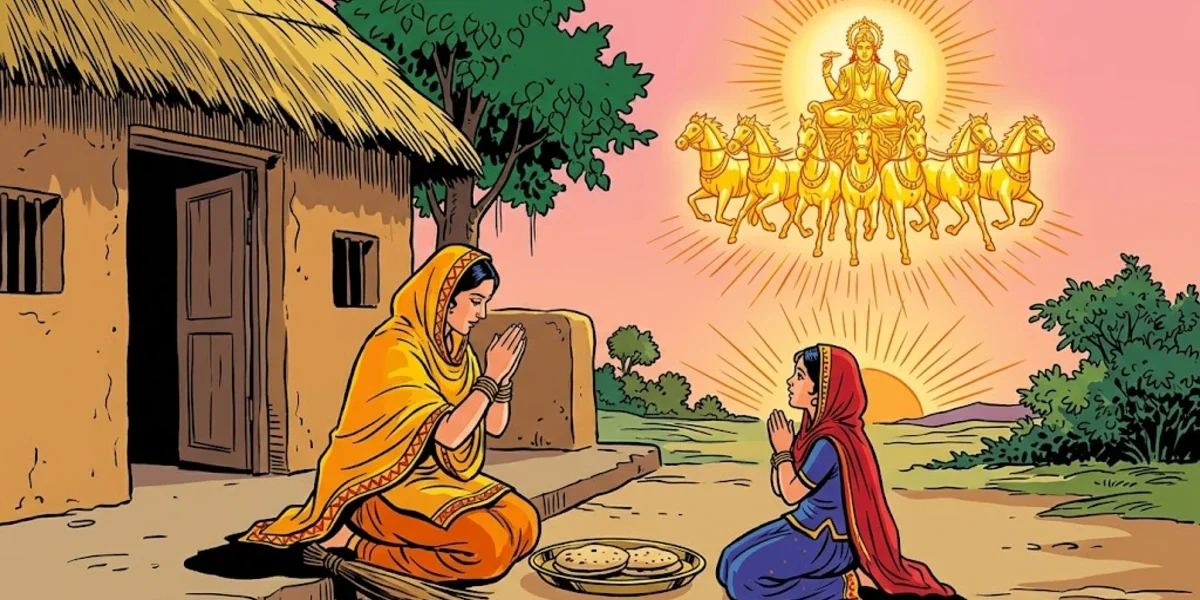
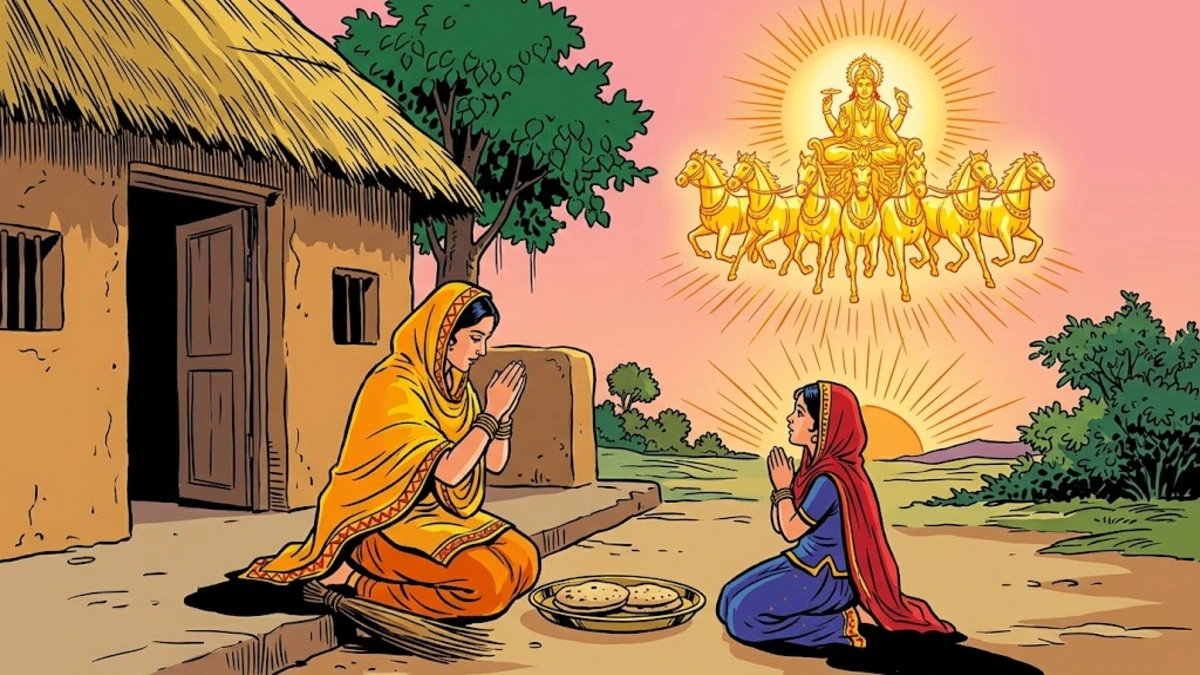
In a mud-walled village of the Bari Doab, between the Beas and the Ravi, there lived a widowed mother and her unmarried daughter so poor that the daily harvest of their hands was reckoned in handfuls of millet and a single iron tawa upon the hearth. Yet morning by morning, before the buffaloes were milked or the spinning-wheel set turning, mother and daughter rose to face the rising sun, folding their palms in the gesture called arghya and pouring a libation of well-water through joined fingers in honour of Suraj Devta. Whatever copper coins their labour earned passed into the brass alms-bowl of the village shrine, and they kept for themselves only what was needful to live, which was two coarse meal-cakes baked upon hot ash — one for the mother, one for the daughter, every day, every day. So pious was their fast that the women of the village clucked their tongues at it; so simple was their faith that the priest of the local Maharī-mata shrine would shake his head and call it satrek, the foolishness of the truly devout.
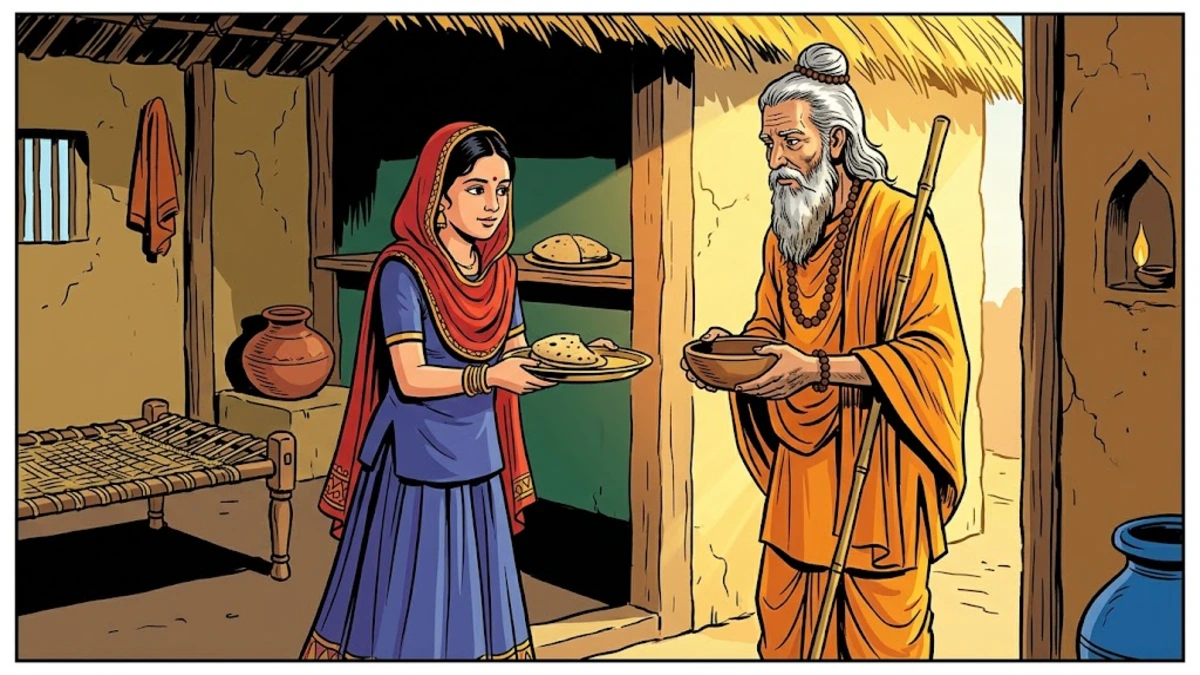
One forenoon, while the mother was away cutting fodder in the khet, the daughter’s hunger overcame her patience. She took down her share of the cake from the wooden shelf and ate it, every crumb. The morsel was scarcely swallowed when a wandering Brahman, his white beard streaked with road dust and a string of rudraksha beads at his throat, halted at the threshold and held out his begging-bowl in the customary plea: Bhikshān&dotbelow; dehi. The daughter looked into her empty hands, then at the second cake — her mother’s portion — resting upon the shelf, and her conscience held council with her hunger and her devotion. She broke the mother’s cake in two, gave half to the priest in the name of Suraj, and replaced the remainder upon the shelf, whispering aloud the customary blessing: Suraj kī sañcā nām — in the true name of the Sun.
Banished to the Pipal
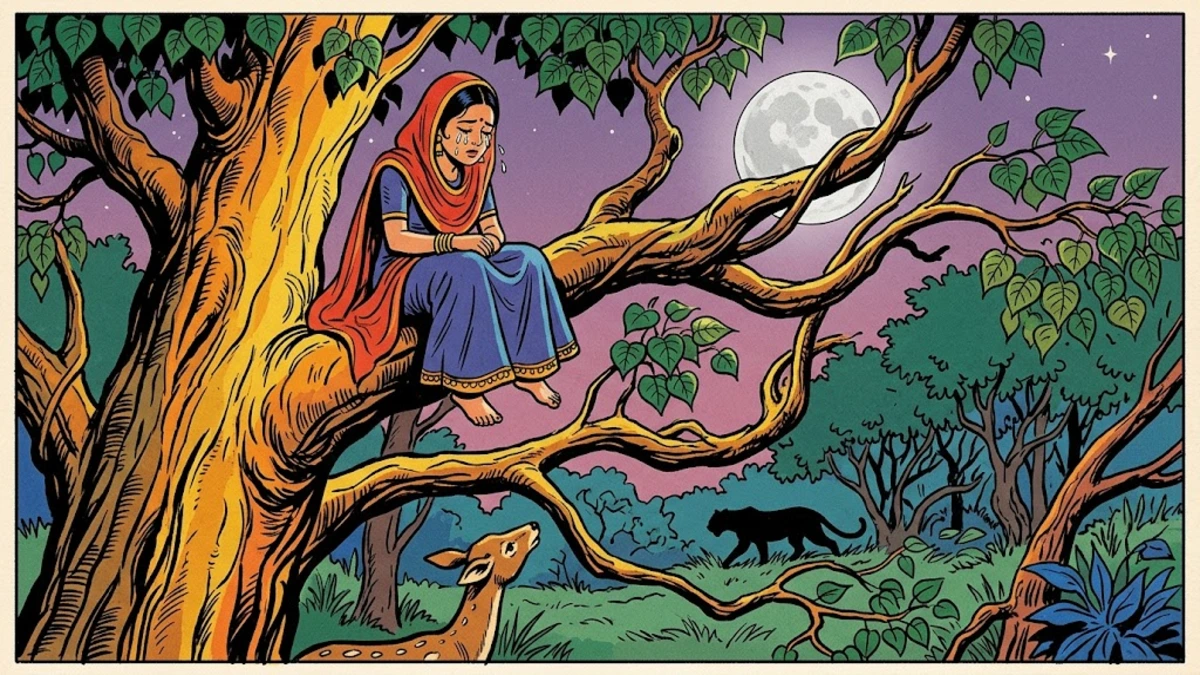
When the mother returned at midday, weary, hungry, the smell of singed millet sharp in her nostrils, she saw the half-cake upon the shelf and demanded an account of the missing portion. The daughter explained, her voice trembling, that the priest had begged at the door, that she had given alms in the name of Suraj, and that she had not meant to deprive her mother of bread. But the mother’s hunger had stripped her of charity. Easy is piety, she cried, with another’s loaf! How am I to know you ate your own portion at all? You have given my food to spare your own. In vain the daughter pleaded, in vain she promised her share on the morrow, in vain she invoked the witness of the Sun himself; the mother drove her into the lane with a broom, slammed the door of mud-and-thatch behind her, and bade her find another roof. So the daughter wandered, weeping, southward along the cart-track until the sun fell behind the kikar trees, and at last, fearing the leopards of the scrubland, she climbed into the gnarled crown of an ancient pīpal — Ficus religiosa, the bodhi-tree, sacred refuge of Vishnu and shelter of all who pray — and there, among its heart-shaped leaves, she made her bed upon a bough and wept until the moon rose.
Tears Like Summer Rain
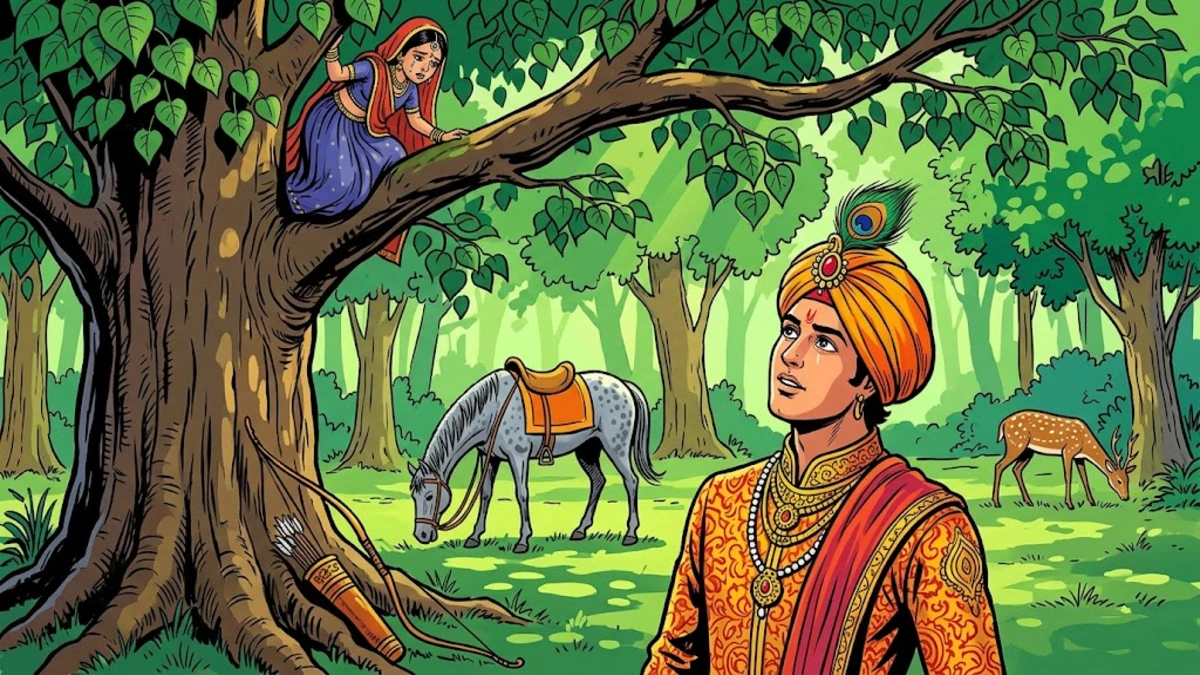
It chanced that a young prince of the neighbouring riyāsat, hawking and hunting deer in that quarter of the forest, drew rein beneath the same pipal tree at noon next day. Tired with the chase and grateful for the broad green canopy, he tethered his Marwari mare, laid aside his bow and quiver, and stretched himself in the cool shade with his face upturned to the sky. The maiden in the branches above, looking down upon his sleeping countenance — for he was as comely as a chandra-yuvrāj, a moon-prince of the old ballads — could not stop her tears, and her grief fell upon his face as warm and salt as monsoon rain. The prince started awake, stared at the cloudless blue, found no rain-cloud in any quarter of the heavens, and was about to settle again when a second drop — salt as sea water — tasted upon his lip undeceived him. He swung himself into the branches and there, hidden among the trembling leaves, he discovered a maiden whose beauty made the pipal seem the chosen seat of Lakshmī herself. Drawing her gently down, he asked her name, her village, her people; and she, with downcast face, answered only that she was homeless, that her mother had cast her out, that she had nothing in the world but the Sun overhead. The prince, seeing her grace and pitying her grief, set her upon the pillion of his mare and bore her home to his palace, where, before the household priest and the seven sacred fires, he made her his bride.
The Returning of the Sun
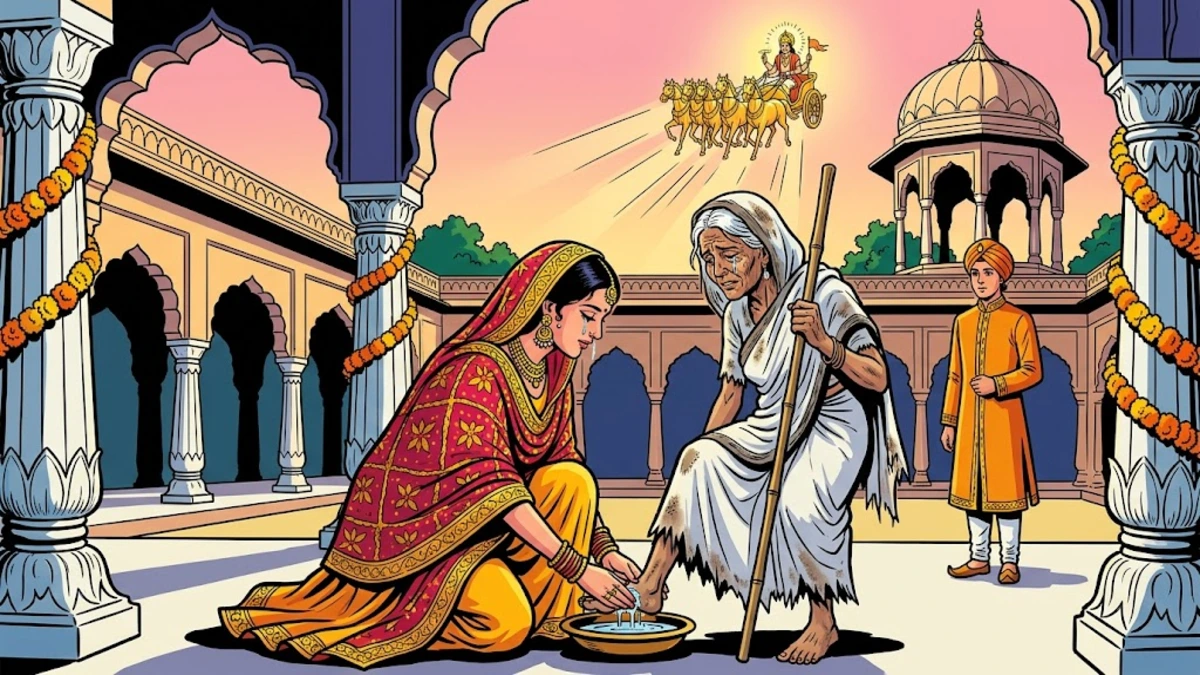
Years passed in plenty. The daughter, now a princess of the inner courtyards, wanted for nothing — gold-bordered phulkari shawls, lacquered palkis for her travels, a hundred maidservants to comb her hair with sandalwood combs — yet she never told her household whence she came, for she was ashamed of the mother who had cast her out, and yet ashamed too of her own shame. Every dawn she still rose to fold her palms before Suraj, pouring the same libation of well-water through her fingers, and every dawn she prayed in secret that her mother might be kept from beggary. Far away in the village, the mother’s poverty had ripened into ruin: famine had taken the crop, the iron tawa was sold, the alms-bowl turned beggar’s-bowl, and the woman who had once driven her child into the wilderness now wandered with a staff from door to door. One Sunday, drawn by an instinct she could not name — or drawn, as the village storytellers will tell you, by Suraj himself, riding his seven-horsed chariot through the heavens — the old mother came hobbling to the gate of a great palace where alms were being distributed in honour of the Sun. The princess saw her, recognised her, ran to her, fell at her feet, washed her dust-cracked feet with the same warm tears that had fallen upon the prince’s face beneath the pipal, and brought her into the household. The mother, weeping, asked forgiveness; the daughter forgave; and from that day forward the two women, mother and child, sat side by side at the dawn-libation, mother and daughter once again, devotees of Suraj as they had been at the very beginning, before hunger and pride had come between them.
The Moral
Steel records the moral of the tale in a single Punjabi-Hindi line spoken by the village storyteller as the closing tag — Suraj kī sañchāī bhakti pheri ghar lautāti hai, “the true devotion of the Sun returns one to one’s home.” The deeper resonance, however, lies in the Vedic conception of Sūrya as the witness of all human action — the divine eye that sees the secret cake given to the priest as clearly as it sees the mother’s anger and the daughter’s tear. The Āditya Hridayam, recited at dawn in households across North India, opens with the verse:
Ādityahr&dotbelow;dayam pun&dotbelow;yam sarvasatruvināśanam
jayāvaham japennityam ak&dotbelow;sayyam paramam śivam.— Vālmīki, Ramayana, Yuddha-Kān&dotbelow;d&dotbelow;a, sarga 105, verse 3
“The auspicious Heart-of-the-Sun, destroyer of every adversary, bringer of victory, ought always to be chanted; it is the imperishable, the supreme, the auspicious.”
The tale dramatises that Vedic claim in domestic miniature. The daughter’s secret cake, given freely in the Sun’s name, is seen by the Sun and is repaid by the Sun in the only currency the Sun deals in — light, return, restoration. Steel’s tale belongs alongside the great Tamil Bhakti hymns of An&dotbelow;d&dotbelow;al, the Bengali vrata-kathās of Lakkhī Pūjā, the Maithili Chhath songs of Bihar and the Marathi haripaths of Sant Tukaram in the long Indic tradition that holds the deity to be answerable to sincerity and indifferent to ceremony. Bhāva, inwardness, outweighs karma, ritual; the cake quietly given outweighs the alms-bowl ostentatiously filled.
Why This Tale Has Endured
Three threads keep The Mother and the Daughter Who Worshipped the Sun alive in the Punjabi oral repertoire and in every English-language anthology that has drawn upon Steel’s 1894 collection. The first is its compactness: in fewer than nine hundred Punjabi words the tale traces hunger, judgement, exile, refuge, marriage and reconciliation, the entire arc of a household’s spiritual education compressed into the span of a single day’s walk from village to forest to palace. The second is its female-centred theology. Indian women’s vow-stories — vrata-kathās, kuldevi-kathas, the long cycle of Solah Sombar tales recited on sixteen consecutive Mondays — preserve a domestic theology in which the heroines do not perform feats of arms but rather feats of fidelity: continued devotion through neglect, continued generosity through poverty, continued speech of the truth through the wrath of one’s elders. Steel’s tale is among the cleanest examples of the type. The third is its image of the pipal tree, a literary motif that gathers around it every meaning the Indic tradition has hung on that single species: refuge from danger, communion with the divine, axis-of-the-world rooted in earth and crowned in heaven. Steel’s daughter ascending the pipal in tears is, in narrative shorthand, the image of every soul who in extremity climbs above the level of ordinary suffering and is met there by grace.
For the modern reader, the moral of the story is not that the Sun rewards the worshipful with palaces, but that integrity preserved through one private act of charity — an act witnessed by no human eye, accounted by no village ledger — is itself a kind of light, and that light, kept faithfully through the dark hour of unjust banishment, eventually finds its way back to the hearth from which it came. The tale’s last image — mother and daughter side by side at the dawn libation, the small ration of cake once again divided between them — is the quiet centre of the whole narrative. Devotion, in the Punjabi imagination, is a homecoming.
Reading This Tale With Children
Read aloud, the story rewards a slow pace and the marking of three pauses: at the moment the daughter divides the second cake, at the moment she climbs the pipal, and at the moment she recognises her mother at the palace gate. After each pause the listener may be asked a single open question — what would you have done? was the mother right to be angry? would you have told the prince the truth about your home? — and any answer should be received without correction, since the work of folk tales is performed in the listener’s silent reflection rather than in the storyteller’s commentary. Older readers may be invited to compare the tale with the Grimms’ Frau Holle (KHM 24), with the Norse East of the Sun and West of the Moon, with the Korean Sun and Moon Sister and Brother (Samguk Yusa cycle), and with the Tamil Kōvalan episode of the Cilappatikāram, in each of which a banished or wronged daughter is rescued and restored through the agency of a celestial body. The pattern is global; the Punjabi inflection — the cake, the pipal, the Sunday libation — is what makes Steel’s recension a small jewel of the regional inheritance.
Sun Worship in the Punjabi Domestic Calendar
To understand the world in which Steel’s narrator told this tale, the modern reader must imagine a domestic calendar entirely organised around the seven days of the week as small theological circuits. Sunday — Aitwār, named for Ādityavāra in the Sanskritic almanac — was sacred to Suraj Devta, the Sun, and observed by women through a rotating cycle of small fasts, libations and oral recitations of Aitwār-kathā. Punjabi village women would rise before the household, draw fresh water from the village well, face east on the threshing floor and offer arghya — pouring a thin stream of well-water through joined fingers as the rim of the Sun lifted above the eastern horizon. The libation was accompanied by the chanted Punjabi name of the deity, Jai Suraj Devtā, jai Saptāśvā — victory to the Sun, victory to the Seven-Horse-Chariot — the seven horses being the personifications of the seven colours of the spectrum and the seven metres of Vedic prosody. Steel’s mother and daughter belong to that everyday world, and the daily division of two cakes is the household-scale form of a discipline that the wealthier women of the Punjab observed with brass thaals of marigold flowers, copper kalashas of Ganga-water, and recitations of the Sūrya-stotra. The tale is, in effect, the small-print reading of that calendar — a parable for the woman who has neither marigold nor Ganga-water but has a single half-cake to give in the Sun’s name.
The Story in the Wider World of Folk Tales
Comparative folklorists from Joseph Jacobs and W. A. Clouston in the late nineteenth century to A. K. Ramanujan in the late twentieth have read tales of this pattern as variants of a single Indo-European inheritance: the kind heroine, banished by an unkind elder, who is restored to honour through the intercession of a celestial body or natural spirit. Within India the closest parallels are the Bengali Sheyaler Dhol recorded by Dakshinaranjan Mitra Majumdar in Thakurmar Jhuli (Calcutta, 1907), the Maithili Chhath-vrata-katha recited at the Bihar Sun-festival, and the Tamil oral cycle of Aditya-kathai in which a poor woman’s offering of a single broken coconut is multiplied a thousandfold by the Sun. Beyond India, the “tear-rain in the tree” motif (Stith Thompson D1500.1.32) is shared with the Persian Tuti-Nāma, the Arabic Hikāyāt cycles of medieval Baghdad, and the Italian Pentamerone tale of La Penta Mano-Mozza recorded by Giambattista Basile in 1634. The image of the pipal tree as refuge has its echoes in the Norse Yggdrasil, the Celtic-Irish hawthorn, and the Korean danggu-tree under which the founder Hwanung descended; in every case the world-tree is the place where the wronged human meets the divine helper. What distinguishes the Punjabi recension is the quietness of the rescue: there is no fairy godmother, no enchanted spinning wheel, no animal helper. There is only the Sun, watching from the sky as he watches every human action, and the daughter’s tear, falling without trick or contrivance into the upturned face of the man who will become her husband.
A Final Word
Folk tales of the Punjab were collected in the 1880s and 1890s under the shadow of empire, often by British civil servants and their wives, and the texts that have survived to us bear the imprint of that collecting tradition. Steel’s English is mid-Victorian and her ear is the ear of a fluent speaker of Punjabi who lived among village women in the Hoshiarpur and Jullundur districts for more than two decades; her renderings preserve far more of the original idiom than the smoother but more Anglicised retellings of Joseph Jacobs in Indian Fairy Tales (1892) or the abridged retellings published by mission presses in the early twentieth century. To read Steel’s Mother and Daughter is to hear, at one remove, the voice of an unnamed Punjabi grandmother sitting on a charpoy in the courtyard of a mud-walled house in the 1880s, telling a child the same story her own grandmother told her, in language and cadence she had inherited from a tradition older than any written record. That is the chain we join when we read the tale today, and the simplicity of its plot — a cake divided, a daughter banished, a mother restored — is the simplicity of all great teaching: nothing wasted, nothing decorative, only what is needed to lodge the lesson permanently in the imagination of the listener. Suraj kī sañchāī bhakti pheri ghar lautāti hai — the true devotion of the Sun returns one home.
Frequently Asked Questions
**Q: Why is this story important?**
You May Also Like
 Indian Folk Tales
Ages 12+ / YA
Indian Folk Tales
Ages 12+ / YA
Chandralekha and the Eight Robbers | Indian Wit Tale (12+)
Chandralekha, a learned dancing-girl’s daughter, refuses a false bargain and outwits danger with intelligence — classic Indian wit tale.
 Indian Folk Tales
Ages 6-8
Indian Folk Tales
Ages 6-8
Keong Emas: The Golden Snail and the Kindness That Breaks Curses
Keong Emas: The Golden Snail and the Kindness That Breaks Curses: In the verdant mountains of Java, where mist clings to ancient temples and the earth speaks
 Indian Folk Tales
Ages 3-5
Indian Folk Tales
Ages 3-5
The Jogis Punishment
The Jogis Punishment: Once upon a time there came to the ancient city of Rahmatabad, a jogi of holy appearance, who took up his abode under a tree outside the