The Brahmarakshas And The Hair
The Brahmarakshas And The Hair: Long ago, in a small town near the banks of the river Narmada, there stood an ancient banyan tree so vast that its aerial roots
A scholarly retelling of one of the best-known Tamil household folktales — collected by Pandit Natêśa Sâstrî from oral tradition in the Madras Presidency, edited by Mrs. Howard Kingscote, and published as Tale XXVI of the landmark 1890 collection Tales of the Sun, or Folklore of Southern India (W. H. Allen & Co., London). The story is the locus classicus in South Indian oral literature for the international tale-type ATU 1175, “Straightening Curly Hair.”
Origin and Canonical Attribution
“The Brahmarâkshas and the Hair” stands as Chapter XXVI of Tales of the Sun, or Folklore of Southern India, the celebrated bilingual collaboration between Mrs. Howard Kingscote — Adeline Georgiana Isabella Kingscote, daughter of the diplomat Sir Henry Drummond Wolff — and the great Tamil polymath Pandit Sangêndi Mahâlinga Natêśa Sâstrî (1859–1906). The volume was issued by W. H. Allen & Co. of London in 1890, with simultaneous distribution in Calcutta. Kingscote, then living at Madras, had begun collecting tales from her household servants in the 1880s but was dissatisfied with the broken or “bazaar-corrupted” versions she was getting; she therefore turned to Natêśa Sâstrî, who had already published many of the same tales — first in his own Folklore in Southern India (Bombay, 1884–88) and earlier still in numbers of The Indian Antiquary under the editorship of Captain (later Sir) Richard Carnac Temple. Sâstrî was reputed to read eighteen languages, served in the Madras Department of Archaeology, and was the principal Tamil pandit of his generation working in English for European audiences. The two collaborators corrected one another’s drafts: Kingscote shaped the English diction, Sâstrî restored the Tamil narrative bones.
The story itself is a Dravidian South-Indian household tale (in Tamil, a kaḍaikkathai — “ledge-tale” or hearth-tale, recited to children at evening), almost certainly Tamil but circulating in cognate Telugu and Kannada forms across the old Madras Presidency. It is told in part as a nidānakathā — an etiological story — to explain a real ritual practice that Sâstrî records was still observed in late nineteenth-century South India: the custom of nailing a tuft of human hair to the trunk of a tree believed to be haunted, in order to drive away the resident demon. The tale gives that custom a narrative origin: it is the act of warding off a Brahmarâkshas with the one task he cannot perform.
In the Aarne-Thompson-Uther international index, the central episode belongs unambiguously to ATU 1175, “Straightening a Curly Hair”, one of the well-attested motifs in the Foolish-Devil cycle (ATU 1000–1199). The tale-type is recorded in oral collections from Iceland to Indonesia: a supernatural servant has agreed to work for a mortal until set a task he cannot finish; the mortal — usually with the help of his wife — gives him a single curly hair to make straight, an impossibility the demon discovers only after wasting his powers, and from which he flees in fear. Stith Thompson’s Motif-Index of Folk-Literature catalogues the motif under H1023.6, “Task: straightening curly hair”, alongside the larger family of impossible tasks (H1010–H1049). The South Indian version recorded by Sâstrî is one of the type’s most narratively complete texts in any language, and is regularly cited as a “type-specimen” by Indian folklorists, including A. K. Ramanujan in his classic Folktales from India (Pantheon, 1991).

The Miser, the Sannyāsi, and the Mantra
In a certain village of the Tamil country there lived once a great landlord — a man who owned not one village but several, and yet was known up and down the river for the smallness of his hand. So tight-fisted was he that no tenant would willingly take a plot from him, and the few who had plots were forever in dispute over share and seed. In time his tanks dried up, his irrigation channels silted over, and his lands fell out of cultivation. The man grew poorer year by year; but rather than open his purse to win his ryots back, he sat upon his diminishing chests and complained.
One evening a wandering Sannyāsi — an ash-smeared mendicant of the kind that still walked the village roads in those days — knocked at his veranda for alms. The landlord, having no one else to pour his troubles into, told the holy man the whole sorry tale. The Sannyāsi listened, nodded, and at last said:
“My dear son, I will teach you a mantra. Repeat it without break, day and night, for three full months. On the first day of the fourth month a Brahmarâkshas will appear before you. Make him your servant, and he will do the work of a hundred men. Your tanks will be deep again, your fields ploughed, your channels running clear by sunrise.”
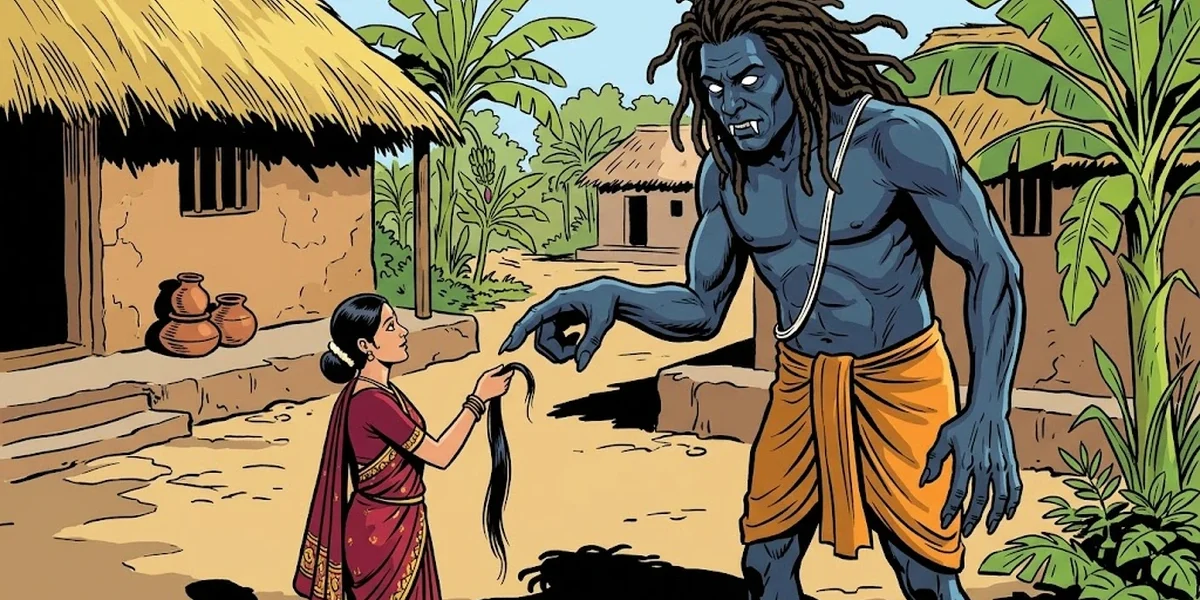
The landlord prostrated himself, received the secret syllables, and the Sannyāsi went on his way. For three months the master of those untilled fields sat in his dim back-room and recited the formula, neither sleeping nor speaking. On the dawn of the ninety-first day, the small lamp-flame in front of him bowed sideways without a draught — and a creature stood on the threshold of his courtyard. It was the height of two men. Its hair was matted into ropes that fell past its waist. Its eyes were the eyes of a dead Brahmin still hungry for argument. It opened its mouth, and the voice that came out shook the rafters.
“What do you want of me, sir? For three months you have summoned me. Speak.”
The landlord was almost too frightened to answer. But the words of the Sannyāsi held him up, and he stammered out his demand: that the spirit become his bonded servant and obey his every command. The Brahmarâkshas inclined his terrible head. “Agreed,” he said, in a voice that had grown suddenly mild — for so the rule of his kind requires: when a mortal has done the proper penance, the proud spirit must serve. “But you shall always have a task ready for me. The instant I finish one, set me another. The hour you fail — I eat you.”

The Servant Who Worked Faster than the World
The landlord, certain in his greed that no human being could give a Brahmarâkshas more work than he could swallow, led the demon out at once to his great irrigation tank, two kos long and one kos wide, dry these many years.
“Dig me this tank to the depth of two palmyra-trees, and rebuild the embankment wherever it has fallen.”
“Yes, master,” the Brahmarâkshas said gravely, and bent to the work. The landlord, calculating that this single labour would occupy his servant for two seasons at the least, walked home whistling and sat down to a sumptuous dinner. Before the rice was cool the demon was at his elbow. The tank was finished. Embankment, sluice-gates, water already shining at the bottom in the late sun.
The landlord choked on his rice. He set the demon to plough every paddy-field across all twenty of his villages. It was done in two ghaṭikās — about forty-eight minutes by the temple water-clock. He sent the demon to dig and plant every garden he owned. It was done in the time it takes to lift a brass tumbler to the lips. He sent the demon to repair every breach in every channel from the river to the village wells; it was done in the time it takes to blink. The fields lay tilled, the gardens flowered, the channels sang — and the Brahmarâkshas was back, smiling his terrible smile.
“What more work, master? My time grows short. Soon I must dine.”
The landlord at last understood the trap into which his greed had walked him. He had outsmarted himself; there was no work in twenty villages for a being who could plough a square mile in the click of a tongue. He sat down on the verandah and wept. His tears fell on his cotton uttarīyam in slow, despairing drops. His wife — who, the storyteller pauses to note, had been observing the whole affair from the kitchen door, as wives do in these tales — came out, dried her hands on her sari, and bent and wiped her husband’s face with the corner of it.
“My lord, do not lose heart. Get out of the Brahmarâkshas every job you can think of, and when you can think of no more, leave the last to me.”
The landlord thought her words mere comfort, the way men sometimes think of their wives. But there was nothing left to set, and the demon was already at his ear, urging “What more, master? What more?” — and so, weeping still, the landlord at last said: “My friend, my wife has one small task for you. Do that one. After it, the bargain is yours.”

The Hair the Demon Could Not Straighten
The wife came out into the courtyard with her left hand held a little forward. Between her thumb and her forefinger she carried a single long black hair which she had just that moment plucked from her own head. She held it out to the towering demon as if she were handing him a little flower.
“O Brahmarâkshas, here is one small thing only. Take this hair. When you have made it straight as a thread, bring it back to me.”
The demon laughed his cavernous laugh. A hair! After lakes and ploughed fields and twenty villages of garden land, a hair! He bowed, took the curl from her fingers, and walked off with it to the nearest pīpal tree. He climbed up into the high branches, sat himself among the heart-shaped leaves, and laid the long black thread across his thigh. He rolled it under his palm — the immemorial gesture of the rope-maker. He lifted it. It bent again into a curl. He rolled it harder. It curled again. He rolled it for an hour, for two, for half an afternoon. Each time he raised it to look, the little black bow sprang back into the same exact arc the wife had produced from her own scalp.
He thought of the goldsmiths who, when they wish to make a metal wire straight, hold it over a flame. So he climbed down, walked to the cooking-fire smouldering at the back of the house, and laid the hair across the embers. It crackled. It stank — that small, very particular, very offended smell of a single human hair burning. And in a heartbeat it was nothing; a black smudge of soot on the iron grill and an acrid breath upon the air.
The Brahmarâkshas stared at the empty grill. Then he stared at the kitchen door behind which the master’s wife was rinsing rice. He had been ordered to bring the hair back straightened, and he had no hair to bring back at all. The whole bottom dropped out of the demon’s stomach. He had failed his task. The mortal woman who had given it to him would now command him in her turn — by the very rule of his bondage. He turned and ran. He ran out of the courtyard, out of the village, out of the country of the Tamil land altogether, and was never again seen in the landlord’s twenty villages.
And from that day, says the storyteller, whenever a tree is suspected of harbouring a Brahmarâkshas, the wise wives of the Tamil country pluck a small hair from their heads and pin it with a nail to the bark of the tree, so that the demon — recognizing in the hair the one task at which his enormous powers were broken — flees of his own accord.


The Moral and the Tamil Sentiment Behind It
Tamil grandmothers seal this story with a saying that has the weight of proverb in the south. It is recorded in slightly differing forms by Subramania Bharati and earlier by U. V. Swaminatha Iyer, but the underlying idea is the old Sanskrit gnomic verse from the Hitopadeśa, repeated to schoolchildren across the subcontinent for a thousand years:
“बुद्धिर्यस्य बलं तस्य निर्बुद्धेस्तु कुतो बलम्।”
— “buddhir yasya balaṁ tasya, nirbuddhes tu kuto balam.”
(“Strength belongs to him who has wisdom; how can the wisdom-less have any strength at all?”)
This is the moral the story is told for, and the cleverest Tamil grandmothers will not even need to say it aloud — the children, watching the giant Brahmarâkshas defeated by a single hair, supply it for themselves. The Brahmarâkshas is not weak: he is, by definition, the most physically powerful sort of South Indian demon, the ghost of a learned Brahmin whose pride in life has bound him after death to perform the labours of a hundred men. He can move earth, water, and seed faster than any mortal. What he cannot do is recognize an impossible task before he has accepted it. The wife, who has neither mantras nor muscles, has only the one weapon that will not lose its edge: she can recognize what cannot be done and assign it. The story therefore enacts, in folktale form, the Sanskrit philosophical commonplace that buddhi (wise discernment) is older and finally stronger than bala (mere force).
A second sentiment runs underneath, equally important to the Tamil ear. The hero of the story is not the landlord. The landlord is, in fact, presented from the first sentence as an unattractive figure: a miser whose own meanness drove away his tenants, dried up his tanks, and rotted his fields. His decision to call on a Brahmarâkshas is itself a moral failure — he would rather summon a flesh-eating demon than open his purse and pay his ryots fairly. He is then nearly devoured by his own greed: the demon’s appetite for work is exactly the inverted mirror of the landlord’s appetite for unpaid labour. The wife saves not a virtuous man but a foolish one, and the storyteller permits her this rescue precisely because Tamil oral literature has always afforded a special honour to the household woman who keeps the family standing while the husband chases impossible bargains. The hair she pulls from her own head is, in the symbolic logic of the tale, the small portion of patient domestic intelligence that South Indian grandmothers have always known will save a household from any demon a man invites to dinner.
Why This Tale Has Lasted
“The Brahmarâkshas and the Hair” has lasted, first, because it is one of the cleanest and most narratively economical specimens of the international type ATU 1175 ever recorded. The full tale-type contains five obligatory beats — the bargain made in haste, the supernatural servant who works faster than the world, the master’s growing terror, the impossible task supplied (almost always by a woman), and the demon’s flight — and the Natêśa Sâstrî version delivers all five in fewer than two thousand words, with no ornamental detours and no missing parts. Folklorists studying ATU 1175 in any language quote this Tamil version as the cleanest exemplar; A. K. Ramanujan called it “the small classic on the impossibility of impossible tasks.”
It has lasted, second, because of the very particular South Indian flavour of its etiological close. Many ATU 1175 versions in Europe end with the demon’s flight and stop there; this Tamil text closes by turning the story into a still-living ritual practice. The hair-on-the-tree is real — Sâstrî records that nineteenth-century South Indian villagers really did pin tufts of hair to pīpal and tamarind trunks at crossroads where Brahmarâkshasas were said to dwell, and indeed similar small hair-offerings are visible at certain rural Tamil and Malayali shrines today. The folktale therefore does not stand outside the listener’s life: he or she has seen these hair-bunches, perhaps walked past one that very morning, and the story explains them. It is an oral footnote glued onto an everyday object in the village landscape.
It has lasted, third, because of the haunting figure of the Brahmarâkshas himself. In Sanskrit demonology — first attested in the Mahābhārata (Anuśāsana Parva) and elaborated in the Padma and Skanda Purāṇas — a Brahmarâkshas is the ghost of a Brahmin scholar whose pride or misuse of his learning bound him to the lower world. He is intelligent, eloquent, and physically formidable; he answers riddles and quotes śāstra; he is the closest thing South Indian folklore has to a tragic hero among its supernatural beings. Watching him climb down from the pīpal tree with a hair he cannot straighten is therefore not entirely a comic moment — there is, beneath the comedy, the older Indic awareness that proud learning has limits, and that even the great can be undone by the one element of the world they never thought to study.
And it has lasted, finally, because the woman in the kitchen wins. Indian oral literature has many versions of the henpecked husband and the wise wife, but few are as crisply staged as this one. The landlord’s whole arsenal — three months of recited mantras, the formula handed down by the holy Sannyāsi, the sweat and patience of his asceticism — produces a creature too powerful to manage. The wife’s whole arsenal is one black hair, plucked at the kitchen door, and a question. Tamil children listening to this story at twilight learn, before they can articulate it, what their grandmothers have always known: that the world’s biggest problems are sometimes solved not by more force but by a single well-chosen impossibility, and that the person who can recognize what cannot be done is the person who, in the end, walks home with the household intact.