Why Brahma Cannot Eat in the Dark
Why Brahma Cannot Eat in the Dark: Among Hindûs, especially among Brâhmaṇs of the Madras Presidency - and I now see from personal observation that it is the
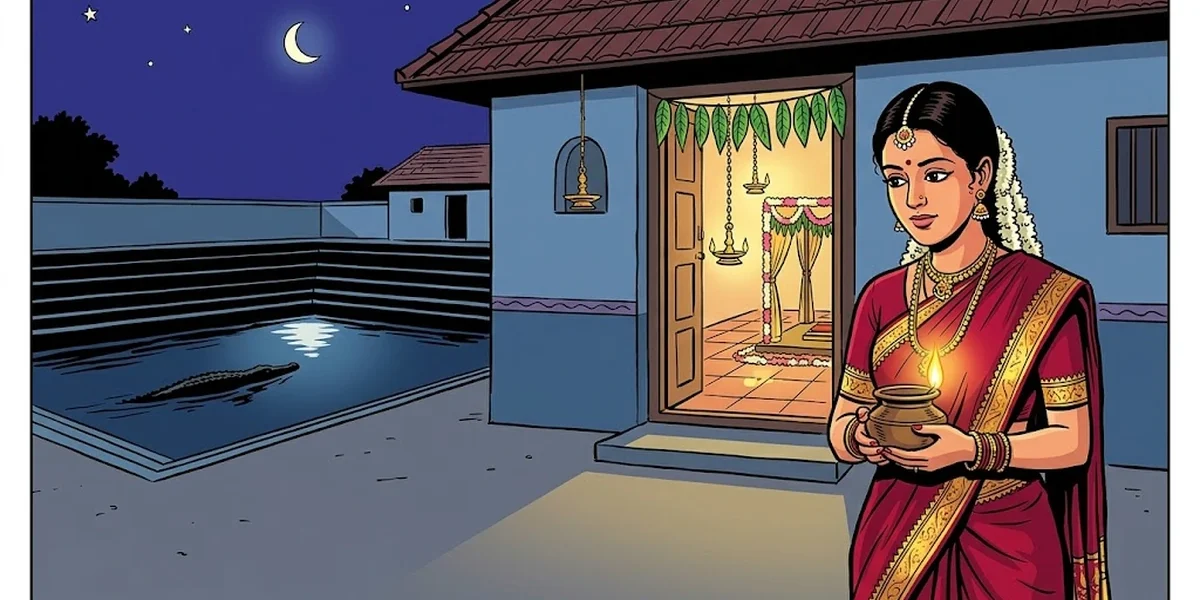


Why Brahma Cannot Eat in the Dark is one of the rare etiological folktales of South India that explains a still-living dining custom: never finish a meal once the lamp has gone out. Set down by the polyglot scholar Pandit S. M. Natesa Sastri (1859–1906) and translated for English readers by Mrs. Howard (Georgiana) Kingscote in Tales of the Sun, or Folklore of Southern India (W. H. Allen & Co., London, 1890), the tale braids two short narratives — a Brahmin bride who saves her husband from a crocodile by a flash of lamp-light, and a poor woman who discovers a Brahmarakshasa stealing her food in the dark — into a single chain of cause and effect that ends with a rule of household conduct binding even the gods.
Origin & Canonical Attribution
The tale was collected in Tamil-speaking districts of the Madras Presidency in the 1880s and first appears in print as Story XLI of Tales of the Sun, or Folklore of Southern India, the joint volume Mrs. Howard Kingscote prepared with Pandit Natesa Sastri (London: W. H. Allen & Co., 1890). Sastri’s larger four-volume Tamil collection, The Folklore of Southern India (1884–1888), supplied the source material; Kingscote rendered it into the formal late-Victorian English in which Western readers met it. The text is now in the public domain through Project Gutenberg (e-book #37002, transcribed 2011).
Sastri describes the practice it explains in unambiguous terms: Among Hindûs, especially among Brâhmaṇs of the Madras Presidency, there is a custom, while taking their meals, of leaving their food uneaten when it so happens that from any cause the light is blown out.
The custom is real, was widely observed in late nineteenth-century Tamil and Telugu Brahmin households, and survives in vestigial form into the present where dining is still done by lamp. The tale belongs to the Aarne–Thompson–Uther catalogue near ATU 178A (faithful animal / faithful spouse) crossed with ATU 113B (the cat as sham holy man) for the demon-stealing-food motif; folklorist W. H. Goodall classifies it among vidhi-katha — “rule-tales,” stories whose purpose is to fix the practice of a community by giving it a memorable cause.
The names and ritual details are scrupulously kept. The bride’s marriage is timed to the dasama ghaṭikâ — the tenth ghaṭikâ of the night, where one ghaṭikâ equals roughly twenty-four minutes — the standard auspicious window in classical Tamil muhûrtam reckoning. The young bridegroom is killed before his nuptials by a makara (crocodile) at a tank, an exact echo of the crocodile-tank dread that runs through Tamil oral literature from the Sangam period onward. Both plot strands sit inside a frame that is as much a sermon on vidhi (fate, ordained order) as it is a story.

The Bride at the Tank: Beat One
The first half opens in a quiet village where a learned Brahmin has betrothed his only daughter — herself a Sanskrit scholar of striking beauty — to a young man as accomplished as she. The wedding is fixed for that very night, at the tenth ghaṭikâ. While the groom completes his evening Sandhyâ-vandana at a nearby tank, a crocodile seizes him by the leg and begins dragging him into the water. Knowing that flight is impossible, the groom bargains: he begs leave to go through the marriage ceremony so the bride and her parents are not destroyed by the news of his death, and promises on solemn oath to return at the fifteenth ghaṭikâ to be eaten. The crocodile, fond of human flesh and famished, agrees on the strength of those oaths and lets him go.
The bridegroom returns home, masks his terror through the wedding ceremony, and at length tells his bride everything. She does not weep. Instead, she gives him a brief homily on the iron hand of vidhi — the law that what is written on the forehead must be undergone — and freely permits him to keep his word. He returns to the tank a ghaṭikâ early; the crocodile rises and seizes him a second time. At that very instant a small flame flashes once before the crocodile’s eyes and is gone. The bride had followed her husband, an oil lamp hidden in a covered vessel, and at the moment the crocodile’s jaws closed she lifted the lamp out, showed the flame for one heartbeat, and snuffed it. The crocodile lets go. You had better go now,
it says; I will never touch a man whose lamp is blown out at the start of my meal.
The Beggar-Woman’s Hut: Beat Two
Sastri immediately joins a second tale to the first, framed by the narrator as another story Brahmins tell to the same purpose. In a remote village a desperately poor woman labours from morning till night for two measures of rice — rations enough for ten ordinary mouths. She keeps no lamp; she cooks the rice over a single hearth-fire, and by the time she sits down to eat the fire has dimmed to embers. Two measures of rice nightly will not satisfy her hunger; she is wasting away in extreme want. One evening her younger sister, modestly better off, comes to visit and is shocked to find her sister eating in pitch darkness. The younger sister insists that a lamp be lit. The elder grudgingly buys a half measure of oil, sacrificing rice she could not afford to spare, and lights a small earthen lamp.
That night something unaccountable happens. The two sisters cook only what is left of the rice — less than two measures — and find that not even a fourth of the pot is consumed before they are full. The elder, who has gone to bed hungry every night for years, is satisfied for the first time. I do not know what magic you have brought into my house,
she says. The younger sister, who is sharp and observant, makes a guess. The next night she asks her sister to serve the meal once more in the dark. She does not eat. She watches.

The Brahmarakshasa Revealed: Beat Three
By the failing light of the hearth the younger sister sees, on the far side of the hut, a tall shadow squatting opposite her elder sister, mirroring her reach for the rice. Each handful the elder lifts toward her mouth, the shadow lifts an answering handful from the same plate; for every grain the woman swallows, the shadow swallows three. It is a brahmarâkṣasa — the ghost of a Brahmin who has died with an unfulfilled vow, a being condemned to dwell in dark corners and feed off the unwitnessed meals of the living. In the dark, where no lamp’s flame catches its eye and no eye’s gaze fixes on it, the demon is invisible to its host and free to take as much as it likes. With a lamp burning the demon cannot eat. With no lamp and no witness, it eats more than the woman does, and her labour goes to feed it.
The younger sister explains all this in the morning. The elder, weeping, lights the lamp and never extinguishes it again at meal times. From that day she eats her fill of half her former rations and rises out of poverty. The two sisters carry the warning into the village. Word spreads. By the time the story reaches Sastri’s notebook the conclusion has hardened into a saying: that men, being more reasonable than crocodiles and more careful than the old beggar-woman, should never eat when the lamp is blown out.
Why Even Brahma Obeys: Beat Four
The closing turn of the tale is the boldest. Brahma — caturmukha, the four-faced creator who sits on the lotus and from whose mouths the Vedas first issued — is bound by the same household rule. The reasoning is not theological but ritual. In the orthodox South Indian Smarta household every meal is, in miniature, a yajna, a sacrifice; the lamp on the dining-mat is a dîpa, a small witness-fire; the food served is an offering to the Ãtman seated within the eater. To eat in darkness is to offer in darkness, and to offer in darkness is to offer outside the gaze of Agni, the witness of all sacrifice. Without that witness the demon-mouths of the unseen world — brâhmarâkṣasas, pisâcas, hungry ancestral spirits — have an opening, and the merit of the meal flows to them and not to the eater.
The tale’s final logic is clean: if a creator-god ate in the dark, his offering would feed demons; therefore Brahma cannot. The custom of leaving food uneaten when the lamp goes out is therefore not a peasant superstition but a tiny enactment of cosmic order. A flame that the bride concealed in a vessel saved a husband from a crocodile; an absent flame let a Brahmarakshasa eat for years out of a poor woman’s hand; a lit flame at a god’s meal-place keeps the universe rightly ordered.

The Moral
स्वस्ति ब्रह्मणे दीपुं हि साक्षि सर्वेष्वभिभलेषु साक्षीदेवौ भवति साद्यदेवफलम्।
Svâsti! Brâhmaṇe dîpaṃ hi sâkṣi sarveṣv abhiṃ bhaleṣu sâkṣî-devau bhavati sâdhya-deva-phalam.
“Blessing! In the Brahmin’s house the lamp is the witness of all good deeds; it stands as the witness-god, and it accomplishes the fruit of every god.” — Tamil household maxim cited in Sastri’s apparatus, Folklore in Southern India, vol. III.
Stripped to its core lesson, the tale insists that nothing nourishing happens in the dark. A bride saves her husband not by argument but by a single stroke of light. A starving woman eats her fill the moment she illumines her meal. A demon dies of hunger the instant the wick is trimmed. The lamp is not a luxury, the tale argues, but the minimum gear of an honest life: the witness in front of which thieves of every kind — crocodiles, demons, lazy fates — refuse to operate.
Why It Has Lasted
The tale has lasted because it solves the small puzzle every household child eventually asks: why must I wait until the new lamp is lit before finishing my plate? Where a parent might say only it is the custom,
the tale supplies a vivid pair of justifications — one heroic, one horrifying — that lodge in memory for life. South Asian folkloric tradition is unusually rich in such “rule-tales”: stories whose explicit purpose is to fix in the listener’s body the discipline of a domestic practice. Sastri’s framing is honest about this: he tells us in the opening sentence that the custom is “beginning to be forgotten” and that the story exists to explain it. The tale is not the cause of the custom but the carrier that keeps the custom intelligible across generations.
It has also lasted because it does the rarest thing a folktale can do: it gives ordinary women power without theatricality. The bride who saves her husband does so without a sword, without a magical incantation, with nothing but a covered lamp and the wit to know when to uncover it. The poor woman’s younger sister sees the demon in the dark by simply not eating and watching. Both women win by attention, not force. In a corpus of South Indian folklore otherwise crowded with princes, ascetics, and warring kings, Why Brahma Cannot Eat in the Dark insists that the smallest household instrument — the clay dîpa — is mightier than fate, and that the smallest household discipline — not eating in the dark — is enough to keep demons out of one’s plate. That is a moral every tradition that has held a lamp at its dinner table has been willing to keep.
Frequently Asked Questions
- Q1. Who first wrote down “Why Brahma Cannot Eat in the Dark”?
- Pandit S. M. Natesa Sastri (1859–1906), a Tamil polyglot scholar fluent in eighteen languages, collected this tale in the Madras Presidency in the 1880s. It was first published in English in 1890 in Tales of the Sun, or Folklore of Southern India, the volume Mrs. Howard Kingscote prepared with Sastri (London: W. H. Allen & Co.), and is preserved in his earlier four-volume Tamil collection Folklore in Southern India (1884–1888).
- Q2. Is the dining custom the tale describes a real Brahmin practice?
- Yes. The custom of leaving food uneaten when the lamp at the dining-mat goes out was widely observed in late nineteenth-century Tamil and Telugu Brahmin households of the Madras and Bombay Presidencies. Sastri reports the practice from personal observation. The custom rests on a ritual reading of the household meal as a small yajna with the lamp serving as Agni-sâkṣî, the witness-fire.
- Q3. What is a Brahmarakshasa, and why does darkness suit it?
- A brahmarâkṣasa is, in classical Hindu demonology, the restless ghost of a Brahmin who died with an unfulfilled vow or who misused sacred knowledge. It haunts dark corners of houses and temples and feeds on offerings made without a witness. Darkness suits it because in the absence of lamp-flame and gaze it cannot be seen, named, or warded against, which makes the unattended meal — food set down with no flame and no observer — an ideal feeding ground.
- Q4. Why does the tale insist that even Brahma is bound by the rule?
- Because in the orthodox South Indian household theology of meals, every meal is a sacrifice; the lamp is the witness-fire of that sacrifice; and a sacrifice without its witness-fire diverts its merit to the demon-mouths of the unseen world. If even the creator-god ate in darkness, the offering would feed demons rather than the eater. The rule is therefore not voluntary piety but cosmic order: an unseen meal is a stolen meal.
- Q5. What is the deeper lesson of the bride’s lamp?
- The bride saves her husband not with magic, weapons, or persuasion, but with a single instant of attention — one flash of a lamp held in a covered vessel. The tale’s moral is that crises of life are won by quiet vigilance rather than spectacle: the smallest implement, deployed at the precise instant it is needed, is enough to undo even an oath made to a crocodile. South Indian folklore returns to this image again and again because it is, in miniature, the householder’s whole ethic of attention.
Source: Pandit S. M. Natesa Sastri (with Mrs. Howard Kingscote), Tales of the Sun, or Folklore of Southern India (London: W. H. Allen & Co., 1890), Story XLI, “Why Brâhmaṇs Cannot Eat in the Dark.” Original Tamil text from Sastri’s Folklore in Southern India (1884–1888), vol. III. Public domain via Project Gutenberg, e-book #37002.
You May Also Like
 Indian Folk Tales
All Ages
Indian Folk Tales
All Ages
The Brahmi ‘s Girl That Married A Tiger
The Brahmi 's Girl That Married A Tiger: In a small village nestled between the rolling hills of Tamil Nadu, there lived a learned Brahmin who had a beautiful
 Indian Folk Tales
Ages 3-5
Indian Folk Tales
Ages 3-5
Raja Rasalu
Raja Rasalu: Once there lived a great Raja, whose name was Salabhan, and he had a Queen, by name Lona, who, though she wept and prayed at many a shrine, had
 Indian Folk Tales
Ages 9-12
Indian Folk Tales
Ages 9-12
The Golden Deer of the Forest
The Golden Deer of the Forest: In the ancient kingdom of Ayodhya, there ruled a king named Devendra, whose palace stood white and gleaming against the backdrop