Shakespeare Visits the Globe Theatre – A Short Story
A modern literary short story in which Shakespeare wakes from his tomb, walks into present-day London, and discovers that his true legacy lives in honest performance—not costume or fame.
About this story
This is a modern literary short story set in a time-slip frame, suitable for literary browsing and family reading.
The Story
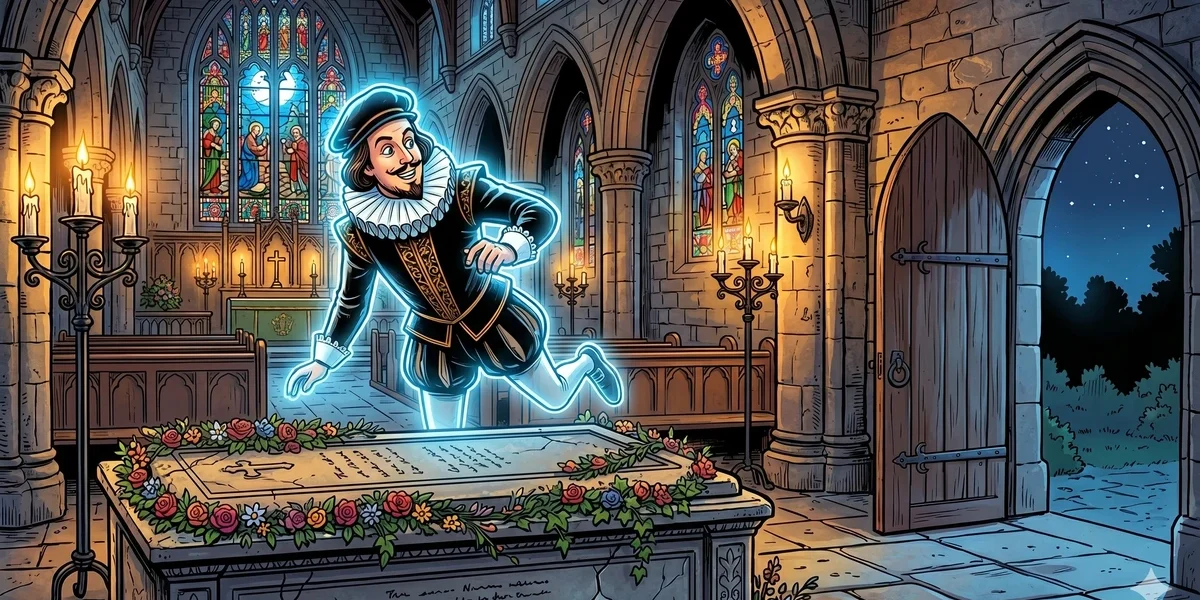
Four hundred and fifty years—or something near enough that the counting had gone softWilliam Shakespeare woke beneath stone that still bore his own curse. Visitors came yearly with wreaths and soft talk of “funds for the occasion.” The buzz of the church had become his weather. One day the witches’ old bargain and the angels’ rarer mercy lined up at once: a single leave to walk the living world again. His bones had stayed put; the epitaph had done its work. He rose without struggle, slipped past the praying, and set his mind on one destination first.
The Globe. His Globe. He meant to wear a scrap of costume, meet players, and be known.
London answered him with confusion instead of applause. People walked alone, speaking into the air, holding small bright slabs to their ears as if memorizing soliloquies no one else could hear. Across the Thames a bridge of metal caught the light. Houses rose like cliffs. He stared until the city seemed both richer and poorer than any stage he had built—noise without chorus, wonder without cue.
He found his way to a rehearsal room near the rebuilt theatre. A man dressed as Hamlet paused mid-line. “Sir, are you lost?”
“I would know which plays are staged today, Shakespeare said, puzzled already by the man’s easy indifference.
The player winked toward another figure across the room. “Talk to him—he can always get you in. Then he was gone, leaving the Bard unnamed and unremarked, a stranger in a house that still spoke his words.
Outside, the Globe rose again in wood and thatch, flag snapping in the river wind—familiar as a dream and strange as a copy. In the tiring-house the smell of sawdust and sizing met him like an old friend with a new face. Players laced costumes. Everything was remembered and not yet known.
A boy actor, scarcely twelve, wrestled with a stubborn doublet. Shakespeare moved without thinking, fingers finding the fastenings as they once had on other young shoulders.
The boy looked up—curious, open, and wholly without recognition. “Art thou the new man?”
Shakespeare’s throat tightened. He could have spoken of empires that would fall while his lines kept walking; of audiences yet unborn; of fame that had outgrown any face. He did not. Legacy, he was learning, was not a costume you put on so the world would bow.
I have watched many plays in my time,” he said quietly. “Let me help thee find thy truth in this one.”
That afternoon, when the prologue found its breath and the first scenes took the boards, Shakespeare wept. He mourned what time had already spent and celebrated what still lived in the speaking of the words—honest, present, and new enough to surprise even their author.
He left without asking for his name on a playbill. Recognition had been the wrong errand. The right one was simpler: to see that art honors the past not by dressing it up, but by living it truthfully where people still listen.
Moral
True art honors the past by living it honestly on today’s stage—not by costume, fame, or copying—but by finding fresh truth in the words.
FAQ
Why does Shakespeare go to the Globe first?
Because it was his house of work and wonder. After centuries under stone, the theatre—not a palace or a publisher’s desk—is the place that still feels like home.
What confuses him in modern London?
People talking into handheld devices as if practicing lines alone; a metal bridge over the Thames; towers that dwarf any Elizabethan skyline. The city has changed its scenery faster than its hunger for stories.
Is today’s Globe the same building as Shakespeare’s original?
No. The original Globe burned and was rebuilt in his era, then lost again. The theatre he finds is a careful modern reconstruction—wood, thatch, and spirit restored, not the identical boards he once knew.
Why doesnt anyone recognize him?
Fame preserves the words, not the face. Players see a helpful stranger in odd clothes, not a portrait come to life. Recognition was never what the visit needed.
What does the boy actor teach him about “finding truth”?
Helping a young player into a role—and urging him toward honest feeling in the lines—shows Shakespeare that living art matters more than being celebrated as its author. Truth in performance outranks costume and name.
Can old plays still speak to new audiences?
Yes. The storys point is that classic words stay alive when actors and listeners meet them freshly—on todays stage, with today’s ears—not when they are copied as museum pieces.
Frequently Asked Questions
Why does Shakespeare go to the Globe first?
What confuses him in modern London?
Is today’s Globe the same building as Shakespeare’s original?
Why doesn’t anyone recognize him?
What does the boy actor teach him about “finding truth”?
Can old plays still speak to new audiences?
You May Also Like
 African Folk Tales
Ages 6-8
African Folk Tales
Ages 6-8
Abiyoyo: The Monster and the Boy
Abiyoyo: The Monster and the Boy: In a small South African village nestled at the edge of the high veld, where grasslands stretched endlessly toward a horizon
 Aesop's Fables
Ages 3-5
Aesop's Fables
Ages 3-5
The Wooden Boy’s Lessons in Honesty
Geppetto’s latest blog entry: Some weeks ago, I visited a good friend and saw that he had a bit of plastic, which he wasn’t using. So I asked him for it, he
 Chinese Folk Tales
Ages 6-8
Chinese Folk Tales
Ages 6-8
The Dragon After His Winter Sleep
The Dragon After His Winter Sleep: Once there was a scholar who was reading in the upper story of his house. It was a rainy, cloudy day and the weather was