Vikram and the Vampire: The King’s Ultimate Test
Vikram and the Vampire: The King's Ultimate Test: The Night of Impossible Riddles In the ancient kingdom of Ujjain, there ruled a king named Vikramaditya
The tale known in English as Vikram and the Vampire belongs to one of the great Sanskrit frame-narrative cycles of the Indian tradition: the Vetālapañcaviṃśati (वेतालपञ्चविंशति), literally “Twenty-Five Tales of the Vetāla.” The oldest surviving Sanskrit redaction is attributed to the poet-scholar Śivadāsa, generally placed in the court literature of northern India between the ninth and eleventh centuries CE, though internal references and parallel versions in the Kathāsaritsāgara (“Ocean of the Streams of Story”) of Somadevabhaṭṭa (c. 1070 CE, Kashmir) suggest that the cycle was already ancient when he wrote it down. In its most celebrated Hindi reworking, the Baital Pachisi (बैताल पचीसी), the frame story was re-told in Braj Bhāṣā verse in Mughal-era Rajputana (c. 16th–17th CE). The cycle reached Western readers in Sir Richard Francis Burton’s spirited English translation: Vikram and the Vampire, or Tales of Hindu Devilry (London: Longmans, Green & Co., 1870), accompanied by a scholarly preface linking the Vetāla corpus to the Arabian Nights and the Panchatantra. The Vetālapañcaviṃśati is further embedded in the Kathāsaritsāgara, Book XII (Vetālapañcaviṃśatikā Lambaka), where Somadeva places it within his enormous frame: the tales told by Guṇāḍhya to the Sātavāhana king. International folklorists assign the broader Vikramāditya-riddler story type to the motif cluster surrounding Stith Thompson motifs H540 (Riddles posed by supernatural beings), H561 (King and clever adviser), E251 (Vampire), and H1229.2 (Impossible task: carrying a vampire without speaking), noting its relationship to ATU tale-type ATU 655 (The Wise Brothers) and the broader South Asian riddling-king cycle. The cycle is uniquely Indian in its metaphysical staging: only a tradition that had thought deeply about the liminal states between life and death, between prāṇa and mokṣa, could produce a vampire whose principal weapon is not blood-hunger but unsolvable riddles, and whose prison is not sunlight but silence.
The King Who Could Not Refuse a Challenge
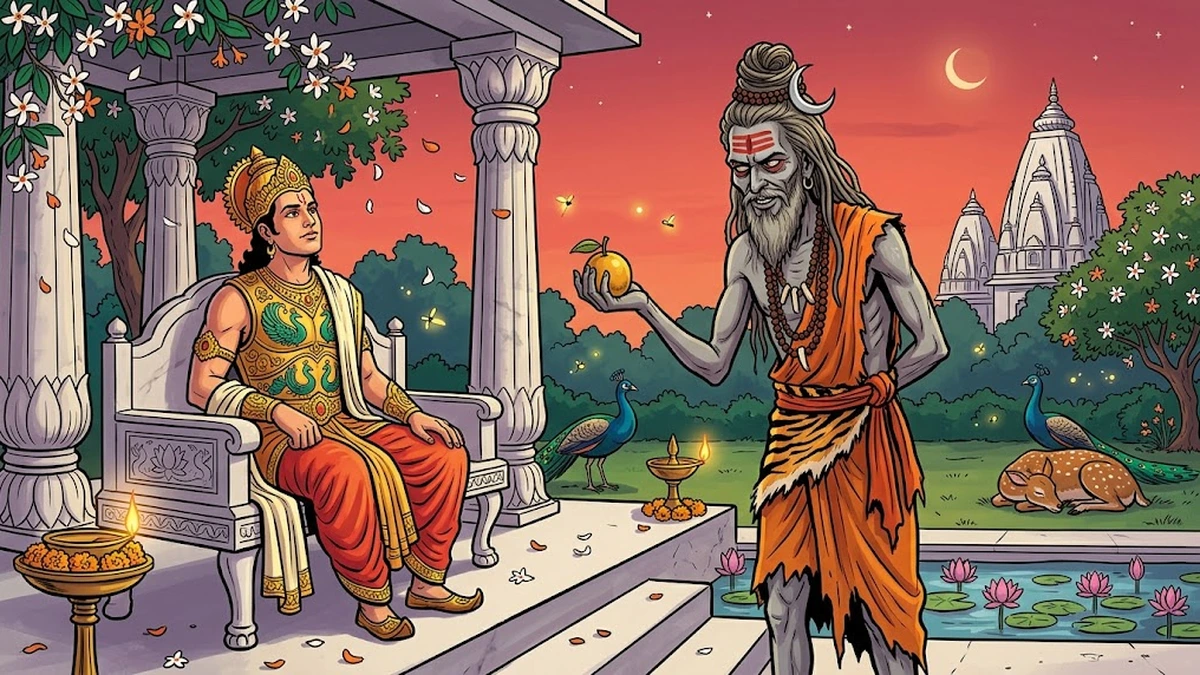
The city of Ujjain (Ujjayinī in Sanskrit — “the victorious”), on the east bank of the Śiprā river in Mālwā, was in the first century CE already one of the seven sacred cities of India, a seat of learning, commerce, and Shaivite devotion, and it was here that the legendary king Vikramāditya — Vikram of the Shining Sun — is said to have established the most just court the subcontinent had ever seen. Every account of Vikram in the Sanskrit literary tradition agrees on three things: he was without equal as a warrior, he was incapable of refusing a challenge to his courage or his wisdom, and he was constitutionally incapable of telling a lie. These three traits, taken together, made him the perfect victim for the trap the tantric sorcerer Kṣhāntiśīla was preparing. Kṣhāntiśīla had spent twelve years in the cremation ground of Ujjain performing austerities so severe that the jackals who lived among the pyres had grown to fear him. He had eaten only ash and drunk only rain-water collected in a skull. He had learned to speak with corpses and to summon the Vetāla — the class of spirit that inhabits unburned or improperly cremated bodies, feeding on the psychic residue of incomplete lives. What he could not do was lay hands on the Vetāla himself; the spirit, by its nature, could only be retrieved by a person whose integrity was absolute, whose courage was untested by defeat, and whose mind was sharp enough to answer any question in the universe. There was, in all three worlds, only one such person. Kṣhāntiśīla sent his disciple to the palace with an invitation that sounded like a simple spiritual task — and Vikram, true to his nature, set out that very night alone to fulfil it.
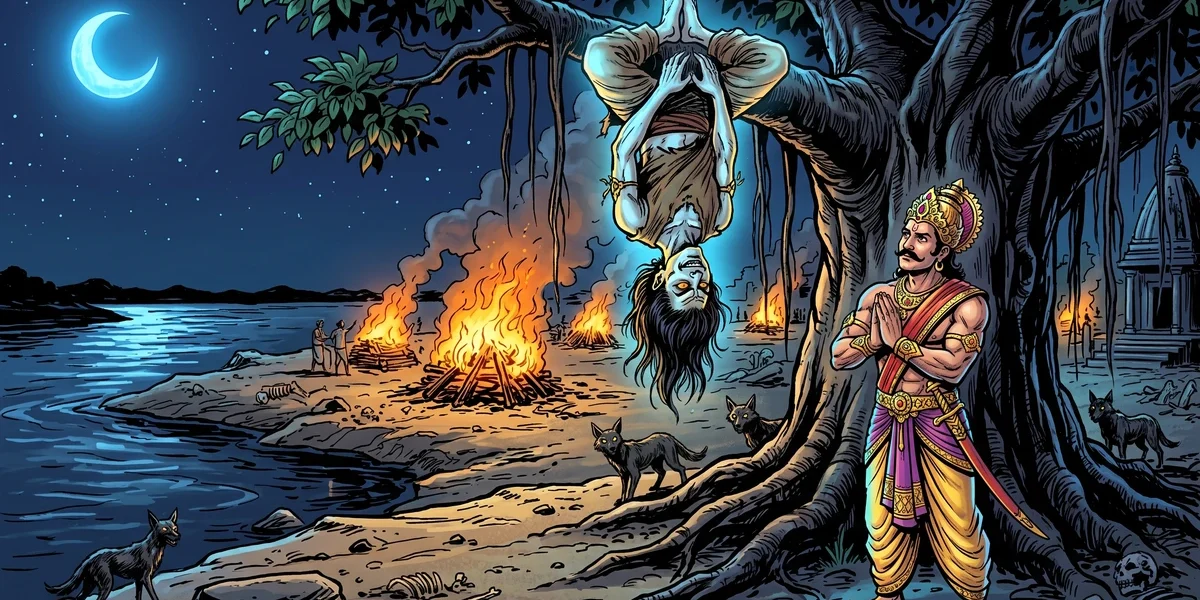
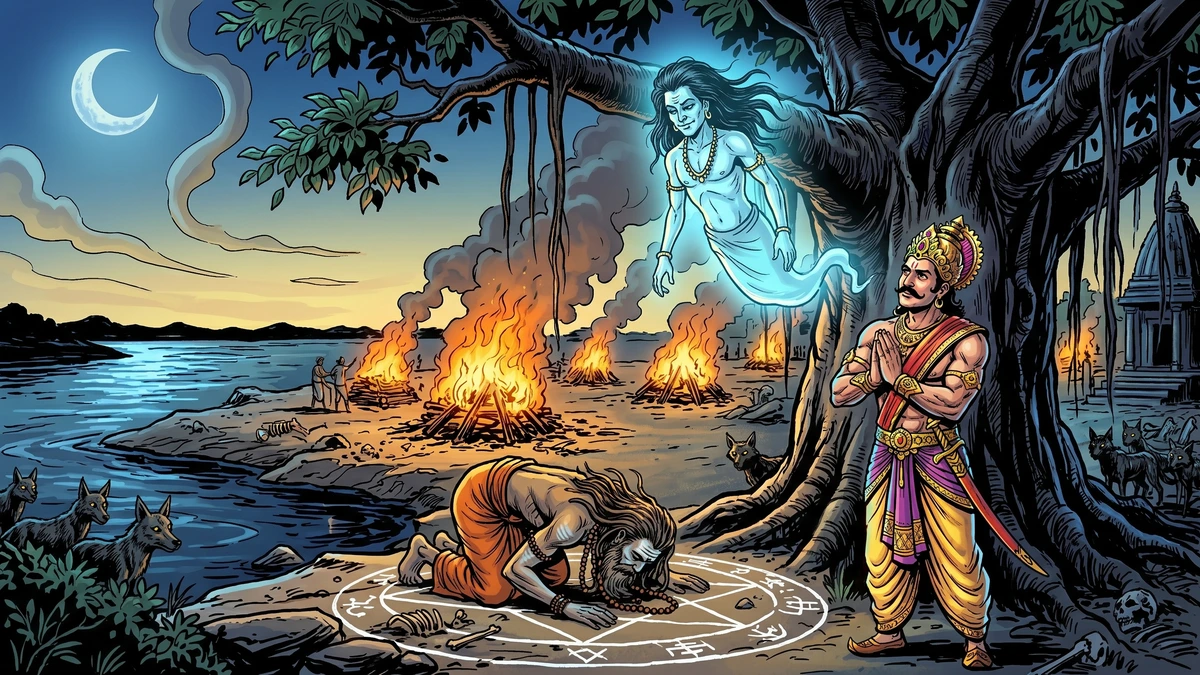
The cremation ground at midnight was a landscape that would have broken any ordinary soldier. Corpses lay at various stages of burning on raised sandstone platforms along the river’s edge; the air smelled of sandalwood smoke, marigold offerings left by mourning families, and underneath both, the denser, sweeter smell of something beyond sandalwood. Dogs and jackals moved between the fires. A trumpet-flower vine had grown over one of the older platforms and flowered pale white in the darkness, its blossoms as wide as a child’s hand. At the very edge of the ground, in the gnarled arms of an ancient banyan tree — Ficus benghalensis, the tree whose aerial roots descend from heaven to earth, whose shade covers more ground than any other tree in India, whose very form enacts the idea of the infinite returning to the finite — hung a figure that was neither alive nor dead. It was the Vetāla. It hung upside down, as the dead hang when the weight of karma has not yet been fully shed. Its skin had the translucent pallor of deep winter moonlight. Its eyes, when they opened, burned amber-red, the colour of the flame at the centre of a fire-sacrifice. Its long hair, unbound, fell in the direction of the earth. Vikram stood before it without trembling. “I have come to take you to Kṣhāntiśīla,” he said. The Vetāla opened both eyes fully and smiled — and in that smile was the expression of a creature that has been waiting a very long time for someone interesting to arrive.
The Terrible Bargain of Silence and Speech
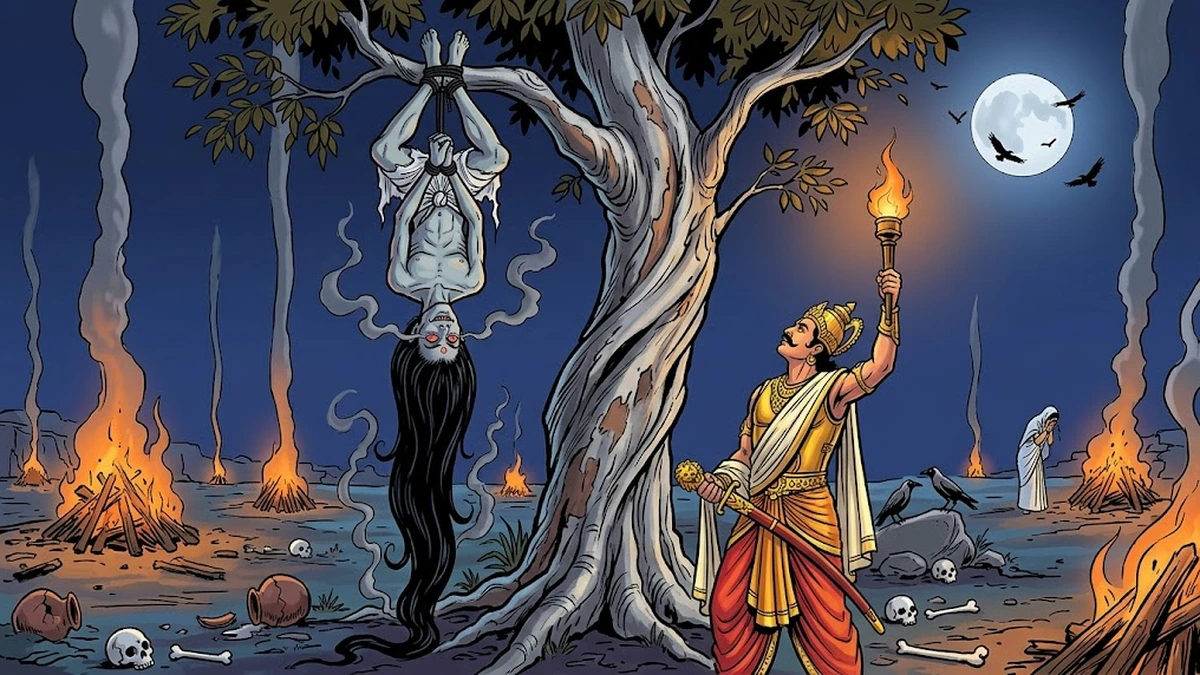
The Vetāla descended from the banyan tree with a sound like dry leaves falling and settled itself across Vikram’s broad shoulders with the weight of an old grief. It spoke the terms of their journey as Vikram turned south toward the palace and the sorcerer waiting beyond it. “Know this, Vikramāditya,” the Vetāla said, its voice resonant inside Vikram’s skull as much as in the air around him. “As you carry me, I will tell you a story. Each story ends in a riddle. If the answer is known to you and you stay silent, your head will split into a thousand pieces — for a man of your nature cannot withhold truth even from his skull. If you speak the answer aloud, I will vanish from your back and return to the banyan tree, and you must begin the journey again. There is no third choice. You cannot pretend ignorance; I will know. You cannot pretend you do not understand the riddle; I will know that too.” Vikram listened to all of this and tightened his grip on the sword he was carrying — not because he feared the Vetāla, but because he recognized, with the clarity that was his greatest gift and greatest burden, that he had walked into a trap from which only the most perfectly honest intelligence in the world could eventually escape. That, of course, was the point. The sorcerer needed someone incapable of cheating. The Vetāla needed someone incapable of silence. Vikram was both at once.
Over the twenty-four stories that follow in the full Vetālapañcaviṃśati, the Vetāla tells tales drawn from the whole range of Sanskrit ethical and philosophical literature: stories of merchants tested by fate, of Brahmin scholars undone by misplaced cleverness, of kings who chose justice over mercy or mercy over justice, of lovers who sacrificed everything for one another and were rewarded in ways they did not expect, of fathers who chose poorly between their children and learned the consequence in old age. Each story ends in a riddle that has a clear answer — and each time, Vikram, whose mind could not leave a question hanging any more than his hand could leave a sword unbuckled, spoke the answer aloud; and each time, the Vetāla slipped from his shoulders like water off stone and flew backward through the dark air to the banyan tree; and each time, Vikram turned around in the cremation-ground darkness, walked back, lifted the cold pale body from the tree again, and began the journey again. Twenty-four times. The sorcerer Kṣhāntiśīla, waiting at the edge of the consecrated circle he had drawn in the earth at the far end of the cremation ground, must have heard Vikram’s footsteps approaching and receding through the night like the ticking of an enormous clock. The Vetāla, for its part, was learning. It was learning the king’s mind. It was deciding, with the patience of a creature that has eternity, whether this man was worth what it was about to give him.
The Twenty-Fifth Riddle — and the Question That Had No Answer
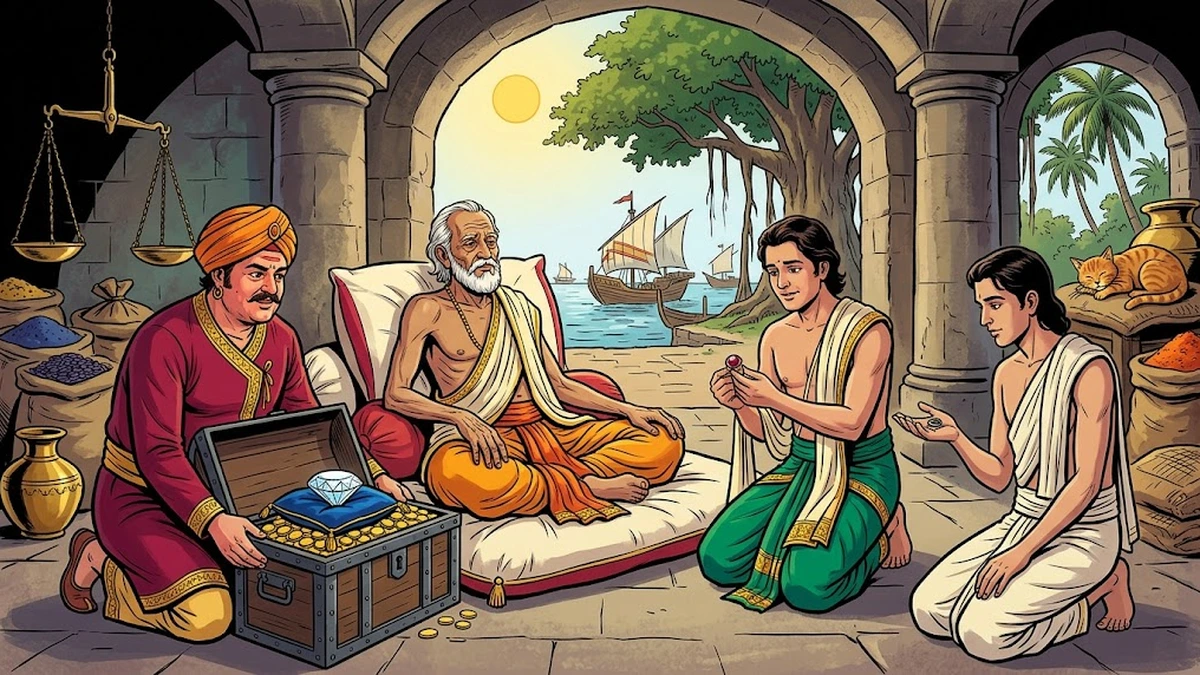
On the twenty-fifth crossing, the Vetāla told a story of a peculiar kind — a story in which the riddle at the end had, by design, no single correct answer that an honest man could give without ambiguity. The tale, in its classic Śivadāsa version as preserved in Somadeva’s retelling, concerns three Brahmin princes of equal learning, equal courage, and equal devotion, who all fall in love with the same princess on the same night at the same festival of lamps. The princess dies before any of them can declare his love. The first prince builds her funeral pyre. The second gathers her bones and performs the post-cremation rites. The third prince, maddened by grief, becomes a wandering ascetic and while sleeping in a distant forest hears from a demon that a child in a nearby village, newly dead of snakebite, can be restored to life by anyone who prostrates himself on the child’s bier and recites the Mṛityu-mantra three times. The prince does so; the dead child lives; but the prince takes on the dead child’s form and dies in its place, lying on the bier. A passing siddha — a perfected master — takes pity and restores the prince’s life with a second mantra; but in the confusion of two deaths and two revivifications on the same bier, the prince rises in the wrong body — the dead child’s body — while his own original form lies cold beside it. The first two princes, hearing of their companion’s resurrection-miracle, rush to the distant village. The siddha says: if the correct mantra is now recited, the soul can return to its original body. But a second soul — the child’s — is also present. The three princes must decide. The princess, moved by the third prince’s self-sacrifice, has consented to marry him — but which body is he, truly?
The Vetāla paused. The cremation ground was absolutely still. Even the jackals had stopped crying. Vikram walked three more steps and stood still, feeling the weight on his shoulders shift like a question settling into his bones. “Now,” said the Vetāla, with a satisfaction that had been twenty-four riddles in the making, “tell me, Vikramāditya: who is the princess’s true husband?” Vikram’s mind turned the question over in the silence of the burning ground and found, for the first time in twenty-four tellings, something unexpected: not an answer, but a recognition. The riddle was unanswerable in the terms it offered. The prince’s identity was not a matter of body, which was contingent; nor of soul, which was universal; nor of act, since all three princes had acted with equal devotion. The only truthful answer was that the question itself was a mirror, not a problem — and Vikram, whose intelligence had been trained by twenty-four correct answers to twenty-four previous riddles, had at last arrived at the limit where cleverness ends and wisdom begins. He opened his mouth. He said: “The question has no answer that one man can give alone. The princess must choose — and whatever she chooses will be right, because rightness in love is not a mathematical truth but a vow freely given.” The Vetāla was silent for three heartbeats. Then it laughed — the laugh of a very old creature that has found, after long searching, exactly what it came for. And for the first time in twenty-five attempts, it did not fly back to the banyan tree.
The Sorcerer’s Trap — and Vikram’s Ultimate Justice
The Vetāla, now riding willingly on the king’s shoulders, spoke in a different register entirely — no longer the voice of a riddler but the voice of a witness. It warned Vikram of what Kṣhāntiśīla truly intended. The sorcerer’s plan was to use Vikram as a ritual implement: he would command the king to prostrate himself before the Vetāla in the consecrated circle, using Vikram’s accumulated puṇya (merit) as the fuel for a dark rite that would grant the sorcerer mastery over the eight supernatural powers — aṣṭasiddhis — and sovereignty over the three worlds. In this ritual, Vikram’s prostration was not an act of devotion but a sacrifice; the sorcerer would use the king’s submission to bind the Vetāla to himself and drain the king’s life-force in the same moment. If Vikram went before him unsuspecting, he would prostrate himself as commanded — his nature demanded obedience to a spiritual elder — and in that act, surrender not just his life but his accumulated virtue, which was the actual object the sorcerer coveted. “Go to him,” the Vetāla said. “Go exactly as he expects. But when he tells you how to perform the prostration, ask him, as a matter of correct ritual form, to demonstrate it himself first. He will not be able to refuse without revealing his knowledge that the rite is fatal. And if he demonstrates it, the binding falls upon him instead of you.” Vikram nodded once, the slow nod of a man who has just had confirmed what his instincts had been whispering since the beginning of the night. He walked into the consecrated circle. He greeted Kṣhāntiśīla with exactly the reverence a king owes an elder ascetic. And when the sorcerer raised his arms in ecstasy and commanded, “Now prostrate thyself, O king, before the Vetāla as I have instructed!” — Vikram said, calmly, with the serene politeness of a man who has no quarrel with anyone: “Revered one, I have never performed this particular form of prostration before. Would you demonstrate it for me, that I may do it correctly?” Kṣhāntiśīla blinked. The night held its breath. The jackals had come back, a ring of yellow eyes at the edge of the firelight. And the sorcerer, cornered by his own trap, could only do what the ritual required of the person who prostrated: he bent toward the earth — and the Vetāla’s binding fell upon him. The supernatural powers he had sought for twelve years of ash-eating and skull-drinking became his chains instead of his weapons. And Vikram, who had carried a vampire through a cremation ground twenty-five times, stood in the smoke and the predawn silence and sheathed his sword without having had to draw it once.
The Moral — “He who knows must speak; he who does not know may be silent”
Somadeva’s Sanskrit text of the Vetālapañcaviṃśati closes its frame-narrative with a verse that distils the entire twenty-five-night ordeal into a single observation about the relationship between knowledge and speech:
यो जानाति स वक्ता स्यात्, यो न जानाति स मौनी।
— Vetālapañcaviṃśati, closing dohā, Somadeva’s Kathāsaritsāgara, Book XII (tr. after C. H. Tawney, 1880, rev. N. M. Penzer, 1924, vol. VI)
विक्रमस्य मतिर्यत्र, तत्र सत्यं प्रतिष्ठितम्॥
yo jānāti sa vaktā syāt, yo na jānāti sa maunī.
vikramasya matir yatra, tatra satyaṃ pratiṣṭhitam.
“He who knows must speak; he who does not know may be silent.
Where Vikrama’s mind dwells, there truth is established.”
The teaching is more complex than it first appears. The Vetāla’s challenge did not punish Vikram for knowing — it punished him for withholding knowledge he possessed. The Sanskrit tradition distinguishes carefully between the silence of ignorance (ajñāna-mauna), which is acceptable or even necessary, and the silence of concealment (gūhana-mauna), which corrodes the soul of the person who practises it. A king, the text teaches, cannot govern justly if he has learned to sit on what he knows. The same principle underlies the Mahābhārata’s doctrine of satya-vrata (the vow of truth): a king who tells the truth even at cost to himself — like Yudhiṣṭhira, who never lies even when lies would save him — is the only kind of king the cosmos will support. The Vetāla’s trap was not cruel but pedagogical. Twenty-four times Vikram answered and paid the price of starting again. He was not being punished; he was being counted. On the twenty-fifth question, when he finally gave an answer that transcended cleverness in favour of wisdom — the admission that some questions can only be answered by those most affected by them — the Vetāla recognised that the counting was finished. The king had passed every test. The sorcerer’s trap, by contrast, embodied the opposite error: Kṣhāntiśīla was a man of enormous knowledge and zero wisdom, which the Sanskrit tradition considers the most dangerous combination possible.
Vikramāditya in the Indian Literary and Cultural Tradition
The historical kernel behind the legendary Vikramāditya is a matter of ongoing scholarly debate. The Jyotirvid Ābharaṇa and the Vikramacarita both credit him as the founder of the Vikram Samvat calendar, which begins in 57 BCE and is still used across Rajasthan, Gujarat, and Himachal Pradesh for auspicious dates and religious festivals — making Vikram one of the very few legendary figures whose nominal legacy is consulted by millions of people every year. Some historians identify him with the Gupta emperor Chandragupta II (r. c. 380–415 CE), who bore the epithet Vikramāditya and ruled from Ujjain after capturing it from the Western Kṣatrapas; others consider the legendary king a composite of multiple rulers whose court included the Navaratna — the Nine Gems — nine scholars whose number includes the poet Kālidāsa, the physician Dhanvantari, and the astronomer Varāhamihira. What matters for the tale tradition is that the legendary Vikram became a vessel for the Sanskrit ideal of the dharmarāja — the righteous king — whose three constitutive virtues are dāna (generosity), śaurya (courage), and nīti (wisdom). The Baital Pachisi exploits all three: Vikram’s generosity leads him to accept the sorcerer’s task; his courage drives him into the cremation ground alone and in darkness; his wisdom, tested twenty-five times over, is what ultimately saves him. The Vetāla itself is a figure of deep cosmological significance in the Shaivite tradition. Vetāla derives from the Sanskrit and connects in folk etymology to vi-tala, meaning “below the world.” In the Atharvaveda and in later Tantric classification, the Vetāla is a category of bhūta — a spirit created when a person dies a violent or ritually incomplete death and whose soul cannot proceed to the next stage of its journey. Unlike the piśāca, which is purely malevolent, the Vetāla is neutral — even philosophical. It cannot initiate harm; it can only respond to whoever disturbs its tree. In the Vetālapañcaviṃśati, this theological neutrality is dramatised as the spirit’s insistence on giving knowledge freely and honestly, even when doing so repeatedly foils the plan that brought Vikram to it. The Vetāla does not cheat; it plays the game exactly as described. This philosophical fairness is what makes it the right teacher for a king who is also defined by his refusal to cheat or conceal.
Why the Tale Has Lasted a Thousand Years
From Śivadāsa’s Sanskrit, the Vetālapañcaviṃśati spread through every major language of the Indian subcontinent. In Telugu it became the Vikramarkuni Katha; in Tamil, the Vikkiramāttittan Kathai; in Marathi, the Vikramāditya Charitra; in Kannada, illustrated manuscripts from the Vijayanagara period survive in the Mysore Palace library. The Baital Pachisi in Hindi entered the oral tradition of North India so completely that it is impossible to meet a villager in Rajasthan or Madhya Pradesh over the age of sixty who does not know, in outline, the story of the king who carried a vampire on his back through the burning ground. Sir Richard Burton’s 1870 translation introduced it to the Victorian reading public; his framing emphasised the grotesque and the supernatural, but he was careful in his scholarly preface to note that the original cycle’s tone is philosophical rather than terrorising — “the Vampire,” Burton wrote, “is a Socrates in a charnel-house.” The cycle was translated again by C. H. Tawney in his edition of the Kathāsaritsāgara (1880), and a modern scholarly edition by A. N. D. Haksar (Vetala Tales, Penguin Classics, 1998) restored the philosophical register that Victorian sensationalism had somewhat obscured. In India, the cycle has been illustrated by Amar Chitra Katha (No. 229, “Vikram and the Vampire,” 1978, and a later expanded edition), serialised as the popular television production Vikram Aur Betaal (Doordarshan, 1985–1988; revived as Betal Pachisi on DD National, 2009), and retold for children in the Amar Chitra Katha Digest series more than any other single cycle except the Panchatantra. The story persists because its central riddle — how does a person of absolute integrity survive in a world that punishes honesty? — is one that every generation re-encounters in new forms. Vikram’s answer is not to stop telling the truth, but to acquire the wisdom to know which truths are traps and which are invitations. The cremation ground is an extreme setting for that lesson, but extreme settings are precisely where the Indian narrative tradition does its most precise philosophical thinking.
You May Also Like
 Indian Folk Tales
Ages 3-5
Indian Folk Tales
Ages 3-5
How Raja Rasalu Played Chaupur With King Sarkap
How Raja Rasalu Played Chaupur With King Sarkap: Now, when evening came, Raja Rasâlu went forth to play chaupur with King Sarkap, and as he passed some
 Indian Folk Tales
Ages 9-12
Indian Folk Tales
Ages 9-12
The Jackal And The Crocodile
The Jackal And The Crocodile: Once upon a time, Mr. Jackal was trotting along gaily, when he caught sight of a wild plum-tree laden with fruit on the other
 Indian Folk Tales
All Ages
Indian Folk Tales
All Ages
The Wrestlers
The Wrestlers: There was, once upon a time, long ago, a wrestler living in a far country, who, hearing there was a mighty man in India, determined to have a