The Jackal And The Iguana
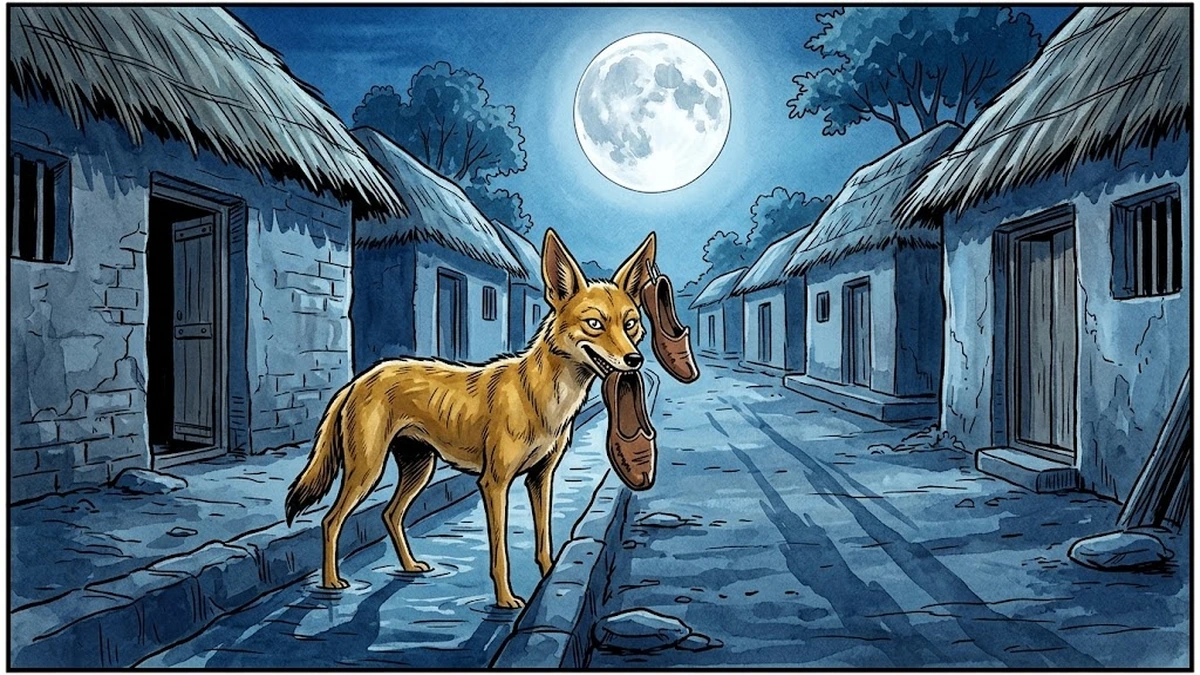
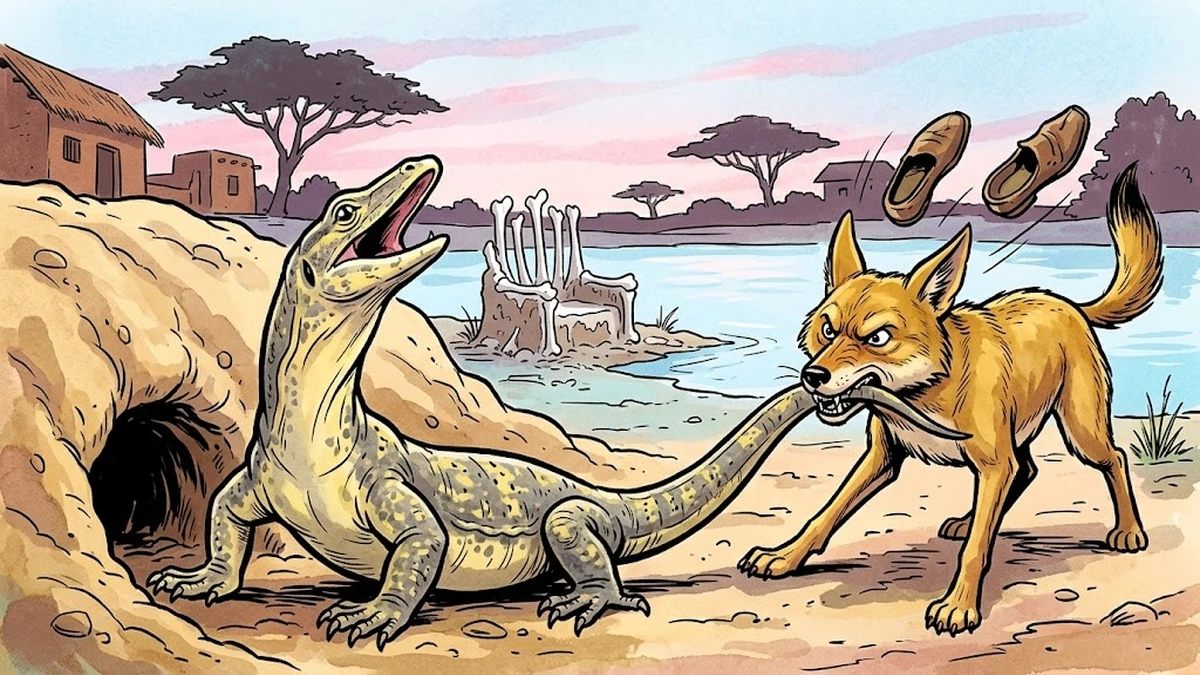
The Jackal And The Iguana: One moonlight night, a miserable, half-starved jackal, skulking through the village, found a worn-out pair of shoes in the gutter.
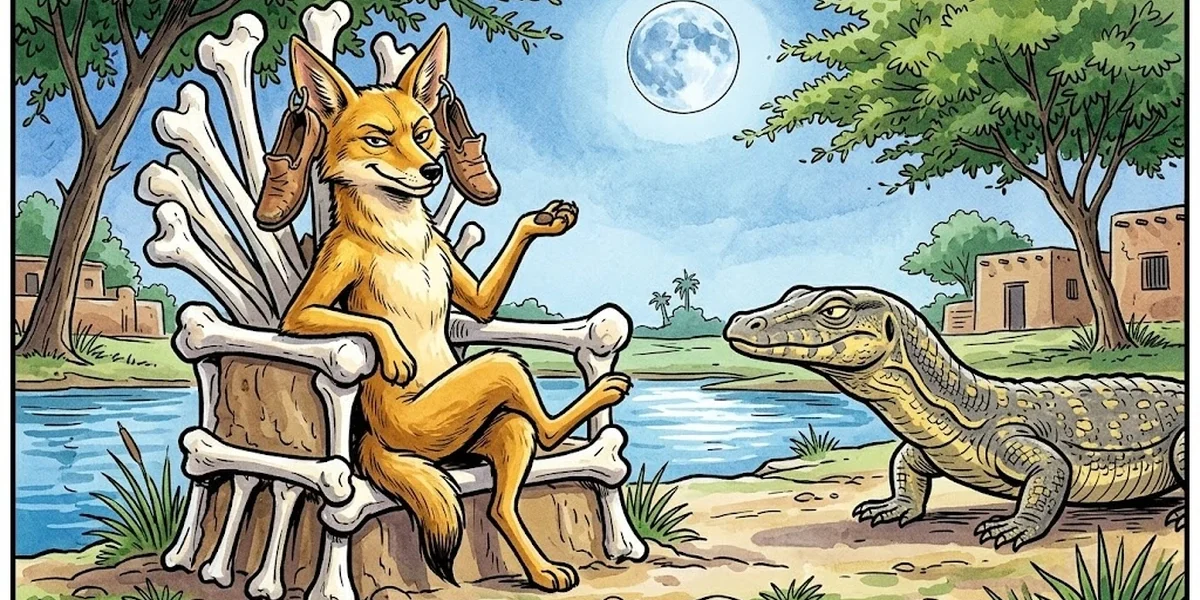
The Jackal and the Iguana is one of the briskest and most acidly comic of the trickster-tales preserved by Flora Annie Steel and Captain (later Sir) Richard Carnac Temple in their Tales of the Punjab told by the People (Macmillan & Co., London 1894; first serialised in the Indian Antiquary 1880–1882). Mrs Steel, who had grown up in the canal-towns of the Lahore district and spent her young womanhood among the village women of Kasur and Pattoki, took the tale down in the late 1870s in the Punjabi register that her ear had been trained on since childhood; Captain Temple, then on duty with the Bengal Staff Corps in Ambala, supplied the comparative folkloric notes that fill the appendix of the volume and that turn the small playful animal-fable into a useful piece of comparative philology. The tale runs to barely four pages in the 1894 Macmillan edition, but it preserves a particular Punjabi flavour of chālākī — trickster cunning — in which a self-puffed, half-starved jackal builds himself a sham throne of bones, demands tribute in verse from every thirsty animal of the pond, and is undone, in two perfectly judged lines of counter-rhyme, by a wheezing iguana who has the practical wit to drink first and answer afterwards.
This study-companion sets the tale inside its long Indian and comparative inheritance. Sources consulted include Flora Annie Steel and R. C. Temple’s Tales of the Punjab told by the People (Macmillan, London 1894), with the Temple notes and the J. Lockwood Kipling line-illustrations of the first edition; Joseph Jacobs’s Indian Fairy Tales (David Nutt, London 1892); the Pañcatantra in Franklin Edgerton’s reconstructed text (American Oriental Series 1924) and Arthur W. Ryder’s translation (Chicago 1925), Book III Kākolūkīya (“Crows and Owls”) with its famous Nīlavarṇa Śṛgāla (“The Blue-Coloured Jackal”) at chapter 7, in which the same false-king-exposed-by-his-own-howl pattern runs; the Hitopadeśa of Nārāyaṇa Paṇḍita (c. 1200 CE) Book III tale 7 (Sir Edwin Arnold’s translation, London 1861) for the Sanskrit cognate of the same pattern; the Pali Sigāla Jātaka (Jātaka 113) and Nalapāna Jātaka (Jātaka 20), edited by V. Fausbøll (Trübner London 1877–1896) and translated by E. B. Cowell and others (CUP Cambridge 1895–1907); Sir Richard Carnac Temple’s own three-volume Legends of the Panjāb (Trübner London 1884–1900); William Crooke’s Folk-Lore of Northern India 2 vols. (Allahabad 1894); A. K. Ramanujan’s Folktales from India (Pantheon 1991); Hans-Jörg Uther’s The Types of International Folktales (FFC 284–286, Helsinki 2004), where the tale belongs to ATU 44 The Sham King, ATU 57 Raven with Cheese in His Beak, and the wider ATU 1530–1574 cluster of “trickster’s pride punctured” patterns; and Stith Thompson’s Motif-Index of Folk-Literature 6 vols. (Bloomington 1955–1958), in particular K1956 (Sham wise man), K1956.2 (Sham king exposed by counter-rhyme), J1117 (Animal as trickster) and L351 (Triumph of the small over the great by quickness of mind).
Provenance and Tale-Type
The Steel–Temple recension belongs to the Indian jackal-as-sham-king family, which has at its head the famous Nīlavarṇa Śṛgāla (“The Blue-Coloured Jackal”) of Pañcatantra Book III — the Kākolūkīya or “Crows and Owls” book — in which a half-starved jackal falls into a dyer’s vat of indigo, emerges blue and shining, persuades all the beasts of the forest that he has been sent down by Brahma to be their king, and is exposed at last by his own jackal-howl when at evening the village pack lifts up its voice and his unguarded throat answers in spite of him. The Pañcatantra fable, in Edgerton’s reconstruction (1924, vol. I pp. 293–297) and in Ryder’s translation (Chicago 1925, Book III tale 7), turns on the same axis as the Steel–Temple tale: the puffed-up trickster, the sham regalia, the moment of unmasking. The Nārāyaṇa Paṇḍita Hitopadeśa Book III preserves the Sanskrit fable in nearly the same form, with the well-known closing verse tyaktvā svajātiṃ yaḥ paramāṃ prayāti, sa eva mūḍho maraṇam upādnoti — “He who deserts his own kind to seek a higher rank, that fool meets his own death” (Arnold’s verse rendering, London 1861, p. 232).
The Steel–Temple Punjabi recension keeps the structural skeleton — jackal, sham regalia, sham coronation by the deceived beasts, exposure by a single shrewd animal — but reworks the dressing entirely. The dyer’s vat of the Pañcatantra has become a moonlit village pond; the indigo robe of the sham king has become a pair of cast-off shoes worn as earrings and a “throne” of mud-plastered bones; the mass-howl of the jackal pack which betrays the Sanskrit Nīlavarṇa has become a single rhyming counter-couplet sung at the top of his voice by an unimpressed iguana. The substitutions are not arbitrary: each of them is a piece of Punjabi village sociology made visible. Cast-off shoes in the gutter and bone-fragments at the pond-edge are the small detritus of any 1880s Lahore-district village; the great dye-vat of the Sanskrit fable belonged to a courtly-urban storytelling world that the Pattoki grand-mothers had no use for. The Punjabi recension is, in effect, the Sanskrit fable lowered out of its courtly register and re-set inside the four-mile radius of a particular Kasur-district village.
Hans-Jörg Uther’s Types of International Folktales (FFC 284 vol. I, pp. 42–44) classifies the parent type as ATU 44 The Sham King Exposed, with cross-reference to ATU 38 Claw in Split Tree and ATU 47 Wolf and Tiger for related ego-puncture fables. The closing verse-duel motif belongs to ATU 57 Raven with Cheese in His Beak, in which a flatterer’s praise-rhyme is reversed by a deflating counter-rhyme, and to ATU 1530–1574 (the sub-cluster of “trickster’s pride punctured” tales). Stith Thompson’s Motif-Index of Folk-Literature (Bloomington 1955–1958, vol. IV pp. 463–464) catalogues the central trick as motif K1956 Sham wise man, with sub-motif K1956.2 Sham king exposed by counter-rhyme, and adds the cognates J1117 Animal as trickster, L351 Triumph of the small over the great by quickness of mind, and X1124 Lie: the trickster’s bone-throne. The motif-pattern is one of the very oldest in the Indo-European folk-tale repertoire, and has near-cognates in the Greek Aesop fable The Ass in the Lion’s Skin (Perry index 358 / Babrius 188), in the Latin Phaedrus Asinus et Leo (Phaedrus 1.11), in the Hebrew midrashic Mishle Shu‘alim (“Fox Fables”) of Rabbi Berechiah ha-Nakdan (12th-century Provence, ed. Hadas, Columbia 1967, no. 42), in the Persian Anvār-i Suhaylī of Husayn Vāʻiẓ Kāshifī (c. 1500 CE), in the German Grimm Der Hase und der Igel (KHM 187, Brothers Grimm 1812), and in the African Anansi-and-the-Tiger cycle of Akan oral tradition (R. S. Rattray, Akan-Ashanti Folktales, OUP 1930).
The Tale as Steel Recorded It
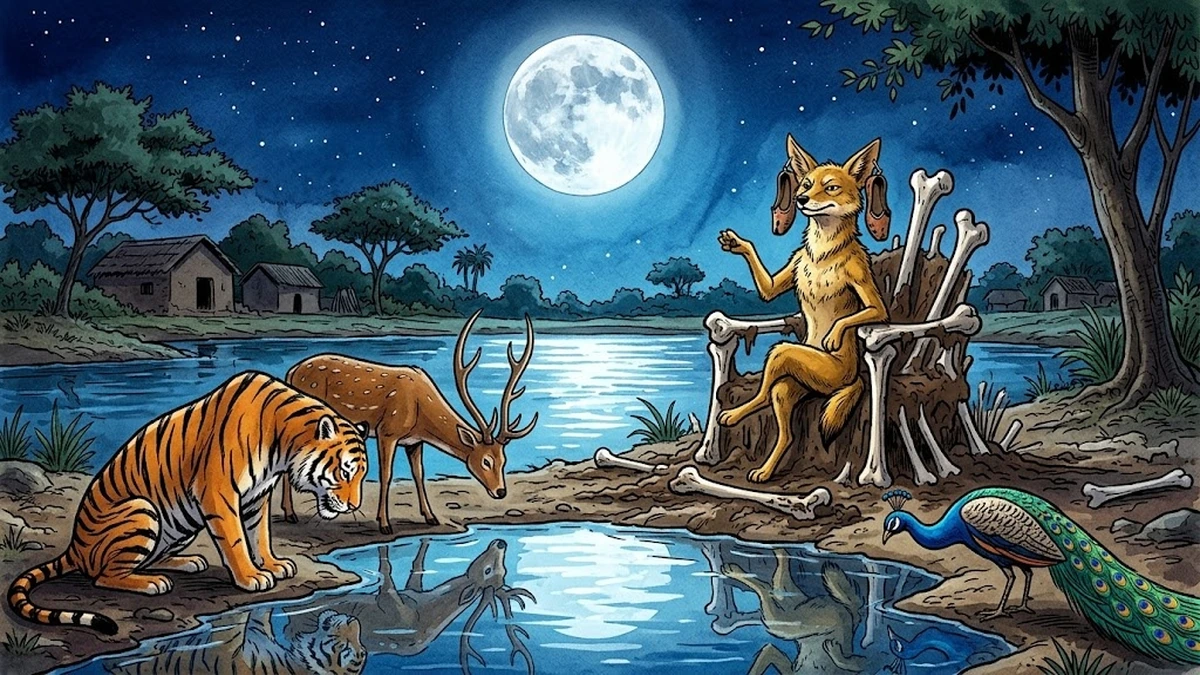
The Steel–Temple recension opens, as the village grand-mother of Pattoki opened it, with a “miserable, half-starved jackal” skulking through the village by moonlight and finding a pair of worn-out shoes lying in the gutter. The shoes are too tough for him to eat — an honest detail, since famine-thin Punjabi village jackals of the 1880s really did try to eat shoe-leather — and so the trickster’s mind, deprived of nourishment, turns instead to ornament. He strings the shoes through his ears like jewelled earrings, gathers a heap of cast-aside bones at the edge of the village pond, plasters them with mud into a “platform,” and seats himself on this throne of refuse with the dignity of a tribal raja. When the thirsty animals of the village come down to the pond at moonrise, the jackal calls out in a loud voice that they may not taste a drop until they have recited the verses he has just composed in his own honour:
“Silver is his daïs, plastered o’er with gold;
In his ears are jewels, — some prince I must behold!”
Most of the animals are too thirsty and in too great a hurry to dispute the matter, and they gabble off the words without a second thought; even the royal Bengal tiger, “treating it as a jest,” repeats the rhyme. The flattery has its predictable effect on the trickster’s small head: by the time the moon is high the jackal has so often heard the lines that he has begun to half-believe them himself, and “really began to believe he was a personage of great importance.” The Steel–Temple text gives that detail a sharp little ironical edge: the trickster is the first victim of his own trick, and his self-deception is the necessary preparation for his exposure.
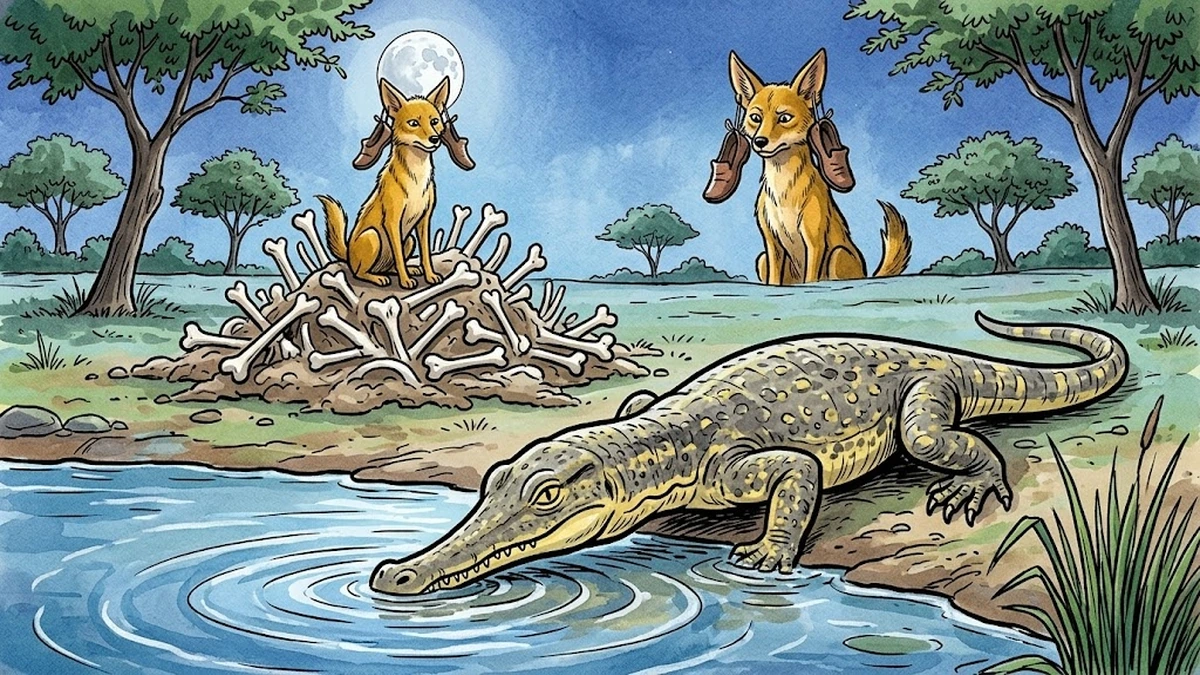
By and by an iguana — goh in Punjabi, the Bengal monitor-lizard Varanus bengalensis, which still inhabits the canal-banks and ruined wells of the Lahore district — comes “waddling and wheezing down to the water, looking for all the world like a baby alligator.” The jackal’s challenge meets him as it has met everyone else: stop and sing the praise-couplet first. But the iguana, with the practical-mindedness of every Punjabi village reptile from the Pañcatantra onwards, asks if he might first have a wee sip of water, since his throat is “as hoarse as a crow”; he could not possibly do justice to such admirable verses without it. The flattered jackal, whose ego-trap has been turned into the iguana’s permission-slip, allows the drink. The iguana takes a great long deliberate draught, “nose down into the water,” and then, refreshed and full-throated, he edges himself slowly farther and farther back from the bank while pretending to clear his voice, and sings out at the top of his lungs, very sweetly:
“Bones make up his daïs, with mud it’s plastered o’er,
Old shoes are his ear-drops: a jackal, nothing more!”
The counter-rhyme is the structural climax of the tale. In two beautifully-judged lines, the iguana has exposed every piece of the sham king’s regalia: the bones, the mud, the old shoes, the underlying jackal-ness of the jackal. The Punjabi grand-mother of Pattoki, who had heard the original four-line tribute-verse a thousand times in her life, had only to substitute the right four nouns — bones for silver, mud for gold, shoes for jewels, jackal for prince — to produce a counter-rhyme whose form preserved the original even as its content destroyed it. That is one of the oldest and most satisfying patterns of comic verse in any language: the answering parody that takes the boast and turns it on the boaster’s own head.
The iguana, of course, does not wait for applause. He bolts for his hole, the jackal recovers from his stunned silence, gives chase, and just manages to catch the iguana by the tip of the tail as the lizard pops down into the safety of the burrow. Then begins a tug-of-war — “pull butcher, pull baker,” in Mrs Steel’s village idiom — in which the iguana fears his tail is about to come off and the jackal feels his front teeth are about to be wrenched out. Neither will yield. At last the iguana, with the same practical-minded shrewdness that won him his free drink, calls out in his sweetest tones: “Friend, I give in! Just leave hold of my tail, will you? Then I can turn round and come out.” The jackal, whose vanity has not yet learned its lesson, lets go — and the tail vanishes up the hole in a twinkling. All the reward the trickster gets for his digging-and-tug-of-war, until his nails are nearly worn out, is the soft sound, deep within the burrow, of the iguana singing the counter-couplet over and over again to himself as he settles in for the night:
“Bones make up his daïs, with mud it’s plastered o’er,
Old shoes are his ear-drops: a jackal, nothing more!”
The Indian Antecedents: The Sham-King Cycle
The structural pattern of The Jackal and the Iguana — the puffed-up sham king, the deceived but obedient subjects, the single sharp-eyed exposer — is one of the very oldest patterns in the Indian fable. Its head-text is the Nīlavarṇa Śṛgāla or “Blue-Coloured Jackal” of Pañcatantra Book III, the Kākolūkīya, in which a hungry jackal pursued by village dogs falls into a dyer’s vat of indigo and emerges so deeply blue that the village dogs let him go, the forest beasts mistake him for some never-before-seen divinity, and he is at last installed by their unanimous acclaim as king of the forest. The sham king grows in his sham office, sets up an apparatus of tigers and wolves and bears as his ministers, banishes the jackal-pack from his presence (so that no one of his own kind will recognise him), and rules in unbroken splendour for some considerable time. His exposure, in the Sanskrit fable, comes by a single moment of forgetfulness: at evening, when the banished jackals of the forest lift up their hour-of-the-twilight howl, his own throat — below the level of any kingly self-control — answers in spite of him, and the deceived ministers see in an instant that their blue-coloured monarch was only the half-starved jackal he had always been. They tear him to pieces; the closing Sanskrit verse tyaktvā svajātiṃ yaḥ paramāṃ prayāti, sa eva mūḍho maraṇam upādnoti (“He who abandons his own kind for high station, that fool comes to his death”) is, in Nārāyaṇa Paṇḍita’s Hitopadeśa Book III, the moral of the cycle.
The Punjabi grand-mother who told The Jackal and the Iguana to Mrs Steel knew, of course, neither the Sanskrit text directly nor any Pali Jātaka recension of the same pattern; what she had inherited was the village afterlife of those texts, the substance and the structure refracted through a thousand years of oral retelling and rearranged for the small landscape of a single Punjabi village pond. The substitution of the cast-off shoes for the indigo dye is one of the most expressive of those village rearrangements. Indigo, in the Pañcatantra, was a luxury good — the indigo-vat of the Sanskrit fable presupposed a courtly economy in which somebody ordered cloth dyed blue and a dyer was kept in business. Cast-off shoes in the gutter and bone-fragments at the pond-edge belong to a wholly different economic register: the village register, the register of the famine-thin trickster animal who must work with what he can pick up. The Pattoki grand-mother has, in effect, taken the Sanskrit fable down a rung on the social ladder — from the courtly-urban world of dyers to the village world of cast-off shoes — and has thereby made the moral cleaner. Her sham king’s regalia is not even genuinely shiny; it is rubbish, and his elevation by the deceived beasts is therefore the deeper folly.
The substitution of the iguana for the unmasking jackal-pack is the second great Punjabi rearrangement, and arguably the more important. In the Sanskrit fable, the sham king is undone by his own kind — by the howl that rises out of his own throat in answer to his own pack. In the Steel–Temple recension, he is undone by an outsider, by an unimpressed reptile who is altogether outside the social system of the duped beasts. Captain Temple’s appendix note (1894 pp. 292–294) suggests that the village storytellers preferred the iguana for two reasons: first, the village monitor-lizard is the proverbial “creature of low station” of the Punjabi countryside, the animal that nobody respects, and so its triumph over the sham king is the more comically satisfying; second, the iguana lives in a hole, and the closing tug-of-war at the burrow-mouth gives the tale a piece of practical village comedy that the Sanskrit fable lacks. The Punjabi recension thus closes not on a tragedy of the sham king torn to pieces but on a comedy of the sham king having his front teeth nearly pulled out by a creature he had thought was beneath his notice. Comedy, in the village register, is the proper finishing tone for a vanity-tale.
R. C. Temple, in his comparative note (1894 p. 293), assembles a long list of Punjabi cognates: the jackal-and-the-fakir of the Hoshiarpur cycle, the jackal-and-the-blue-cloth of the Multan cycle, the dyed-jackal of the Sialkot folk-tradition, the great Siār-nāma (“Jackal-tales”) of the Punjabi kissa tradition collected later by William Crooke in his Folk-Lore of Northern India (Allahabad 1894 vol. II pp. 227–236). In every cognate the same pattern recurs — sham king, sham regalia, exposure — but the Steel–Temple version is the one in which the village comic genius of the Pattoki grand-mother has shaped the closing counter-rhyme into its sharpest and most quotable form.
The Counter-Rhyme: The Mechanism of the Punctured Boast
The most distinctive feature of The Jackal and the Iguana, the feature that has carried it through 130 years of retelling without losing its force, is the closing parody-couplet. The jackal’s tribute-verse runs in the iambic-hexameter ballad-metre of the Punjabi tappa:
“Silver is his daïs, plastered o’er with gold;
In his ears are jewels, — some prince I must behold!”
The iguana’s counter-verse runs in the same metre, with the same rhyme-scheme, with the same number of stresses, with the same line-end punctuation — and with every flattering noun replaced by its deflating cognate:
“Bones make up his daïs, with mud it’s plastered o’er,
Old shoes are his ear-drops: a jackal, nothing more!”
That structural identity is the deep mechanism of the tale’s comedy. The reader’s ear, having heard the tribute-verse repeated five times by the deceived animals at the pond-edge, has been trained to expect a particular sequence of stressed syllables; when the iguana sings out the counter-verse at the top of his voice, every stressed syllable arrives in exactly the place the ear is waiting for it, but the noun that arrives is the wrong noun — the unmasking noun — and the listener experiences the small thrill of the boast-and-its-puncture in a single quarter-bar of musical time. The Pattoki grand-mother, who had no doubt heard the same trick performed in a hundred Punjabi village songs, knew exactly how to land it.
The counter-rhyme device is one of the very oldest comic patterns in world folklore. Stith Thompson catalogues it as motif K1956.2 (Sham king exposed by counter-rhyme) and gives a long list of cognates: the African-American Br’er Rabbit and the cabbage-leaf rhyme (Joel Chandler Harris, Uncle Remus, His Songs and His Sayings, New York 1881, no. 14); the Russian fox-and-magpie of Afanasyev’s Narodnye russkie skazki (Moscow 1855–1864, vol. I no. 7); the Greek Aesop fable The Crow and the Fox (Perry index 124 / Babrius 77), in which the fox’s flattering rhyme is reversed when the crow drops the cheese; the Latin Phaedrus Vulpes et Corvus (Phaedrus 1.13); the German Grimm Der Hase und der Igel (KHM 187, Brothers Grimm 1812), in which the hedgehog’s cry of “Ick bin all hier” punctures the hare’s boast; and the West African Anansi-and-the-tortoise cycle (R. S. Rattray, Akan-Ashanti Folktales, OUP 1930 nos. 31–34). In every cognate the structural pattern is the same: the boaster’s own metre is captured by the unmasker, the boast is sung back in counter-rhyme, the boaster is exposed.
The Punjabi inflection of the pattern is the iguana’s deliberate edging-back trick, and the second drink. The iguana does not sing the counter-rhyme to the jackal’s face; he is too sensible for that. He drinks first, then begs another moment to clear his voice, then quietly edges himself, line by line, farther from the bank, and only when he is at safe distance does he deliver the unmasking couplet. The trick is the Punjabi village improvement on the older Sanskrit pattern: the unmasker, in the Pañcatantra, is exposed himself by his own howl; in the Steel–Temple recension, the unmasker is the prudent one, the one who has learned to drink first and sing afterwards. That is a small but characteristic Punjabi village teaching: the sharp-eyed truth-teller is not a hero who rushes in but a careful person who first secures her own position. As the Punjabi proverb has it (recorded in Captain Temple’s Legends of the Panjāb vol. I appendix p. 217): pahile pāṇī pī lo, phir gīt gā lo — “First drink the water, then sing the song.”
The Moral and Its Original-Language Form
घमंडी का सिर नीचा।
Ghamanḍī kā sir nīcā.
“The proud man’s head is brought low.”
So runs the Punjabi-Hindi proverb that Mrs Steel and Captain Temple chose as the verbal moral of the tale, recorded in Captain Temple’s Legends of the Panjāb vol. II appendix p. 143 (Trübner London 1885) and again in the appendix of the Tales of the Punjab 1894 edition p. 294. The literal translation is sharper than the English: ghamanḍī is not the casually proud but specifically the puffed-up vain person who has begun to believe his own flattery; sir nīcā is the literal “head bent low” gesture of public shaming that a Punjabi village landlord might be made to perform in front of the village panchayat after he had been caught in some folly. The proverb says, in effect, that the puffed-up self-deceiver will be brought, by the natural ironic working of the world, into precisely that posture of public head-bowing which his vanity had hoped to avoid. The jackal of the tale is brought to that posture not by a tiger or a bear or any obvious greater power, but by a wheezing iguana — the smallest possible agent — whose two lines of counter-rhyme do all the work of the panchayat’s public shaming.
The same lesson is preserved across Indian and Persian wisdom-literature in close cousins. The Sanskrit Pañcatantra Book III, in Edgerton’s reconstruction (1924 vol. I p. 297), gives it as tyaktvā svajātiṃ yaḥ paramāṃ prayāti, sa eva mūḍho maraṇam upādnoti — “He who deserts his own kind to seek a higher rank, that fool meets his death.” The Hitopadeśa of Nārāyaṇa Paṇḍita (c. 1200 CE) Book III.7, in Sir Edwin Arnold’s English version (London 1861 p. 232), gives it as “the false-coloured jackal who deserts his pack will sooner or later forget himself, and his own howl will undo him.” The Persian Saʻdī in the Gulistān (1258 CE) Book VIII.42 puts it: kibr-i ahmaq-rā hamī az kibr-ash bigsalad — “the fool’s own pride is the rope that hangs him.” The Greek Aesop fable The Ass in the Lion’s Skin (Perry 358) makes the same point, with the donkey’s bray exposing him as soon as the lion-skin slips. The Latin Phaedrus 1.11 lays it down as quamvis tegatur stultitia, lingua se prodit — “though folly may be hidden, the tongue betrays it.” The Hebrew Mishle Shu‘alim of Rabbi Berechiah ha-Nakdan (12th-century Provence, ed. Hadas, Columbia 1967, fable 42) gives the same teaching with a fox in a peacock’s feathers. Across the wisdom-literatures of Hellas, Iran, Bhārata, the Punjab and medieval Provence, the lesson is the same: the puffed-up self-deceiver is brought low by the very thing he has tried to disguise.
Why The Tale Has Lasted
The careful reader will notice that The Jackal and the Iguana is one of the shortest tales in the entire Steel–Temple volume, but that it carries one of the densest moral payloads. Two animal characters, three brief scenes, one substituted-rhyme — and yet it carries on its small back the full weight of the Pañcatantra inheritance, the Punjabi village topography, the comparative Indo-European motif-tradition of the punctured boast, and the universal moral that vanity is its own self-betrayal. That density is part of the answer to the question of why the tale has lasted: a folk tale survives across centuries not because it is large but because it is well made, not because it is full of incident but because every incident has been turned into something useful.
The other part of the answer is that the lesson of ghamanḍī kā sir nīcā — “the proud man’s head is brought low” — is exactly the lesson that the listener of any age most needs. We do not all have throne-rooms made of bones, and very few of us are likely to wear shoes through our ears as earrings; but every child encounters, sooner or later, a situation in which a louder or more puffed-up person is leaning over her and demanding a tribute-rhyme that is not deserved. The tale is a rehearsal of the proper response to that universal moment. By the time the child has heard the iguana’s “a jackal, nothing more!” two or three times, she has already learned the inner pattern of the trick — that the safest path is to comply outwardly until you have your free drink, then edge slowly back from the bank until you are at safe distance, and only then deliver the unmasking truth. That is a piece of practical Punjabi village wisdom as useful in a 21st-century classroom or office as in an 1880 Lahore-district pond.
It is also worth saying that the tale is funny. Mrs Steel’s voice in the 1894 retelling is plainly amused: the moonlit jackal stringing shoes through his ears, the throne built of pond-side bones, the wheezing iguana who pretends to clear his throat with do-re-mi-fa-sol-la-si, the tug-of-war at the hole-mouth in which the jackal’s own teeth are nearly torn out, are all rendered with the comic timing of a storyteller who has seen the village grand-mother of Pattoki land each laugh exactly where she meant to. The presence of comedy is not incidental to the moral: a child remembers a moral she has laughed at, but she forgets a moral she has only been told. The Paṇḍita Nārāyaṇa knew that, and the village grand-mother of Pattoki knew it, and Mrs Steel knew it, and that is why the tale crossed the seven hundred years between the Hitopadeśa and the 1894 Macmillan edition with its laughter still intact.
Why does it matter still, in 2026, that an old grand-mother of a Lahore-district village told a tale about a half-starved jackal, a worn-out pair of shoes, a bone-and-mud throne and a wheezing iguana? It matters because the puncturing of vanity by quiet sharp-eyed truth-telling is, and always has been, one of the indispensable arts of social life. As long as there are children there will be self-puffed sham-kings around them — on playgrounds, in classrooms, in offices, in the wider political world — demanding tribute-rhymes that are not deserved. And as long as there are folk tales there will be small reusable rehearsals of how an unimpressed observer, with no power but her own quick wit and her own steady metre, can take the boast and turn it on the boaster’s own head in two short lines of counter-rhyme. The Jackal and the Iguana is one such rehearsal. It is small. It is funny. It is precisely judged. And, four pages long in the 1894 edition, it has done its quiet teaching for a hundred and thirty years and is ready to do another hundred and thirty.
Bibliographic apparatus. Primary text: Flora Annie Steel and R. C. Temple, Tales of the Punjab told by the People, with notes by R. C. Temple and illustrations by J. Lockwood Kipling (Macmillan & Co., London 1894), serialised earlier in the Indian Antiquary 1880–1882. Reprint for children: Joseph Jacobs, Indian Fairy Tales (David Nutt, London 1892). Indian antecedents: the Pañcatantra in Franklin Edgerton, The Pañcatantra Reconstructed, American Oriental Series vols. 2–3 (New Haven 1924); Arthur W. Ryder, The Panchatantra (Chicago 1925), Book III tale 7 Nīlavarṇa Śṛgāla; the Hitopadeśa of Nārāyaṇa Paṇḍita (c. 1200 CE), trans. Sir Edwin Arnold (London 1861), Book III; the Pali Sigāla Jātaka (Jātaka 113), Nalapāna Jātaka (Jātaka 20) and Siṃha Jātaka (Jātaka 152) in V. Fausbøll, The Jātaka, together with its Commentary 6 vols. (Trübner London 1877–1896), trans. E. B. Cowell et al., The Jātaka, or Stories of the Buddha’s Former Births 6 vols. (CUP Cambridge 1895–1907); the Muṇḍaka Upaniṣad III.1.6 for satyam eva jayate. Punjabi comparative: R. C. Temple, Legends of the Panjāb 3 vols. (Trübner London 1884–1900); William Crooke, Folk-Lore of Northern India 2 vols. (Allahabad 1894); Charles Swynnerton, Romantic Tales from the Panjāb (Constable London 1903); the Siār-nāma recensions in the Punjabi kissa tradition. Persian and Arabic comparative: Saʻdī, Gulistān (1258 CE), trans. Edward Eastwick (Hertford 1852); the Kəlīla wa-Dimna of Ibn al-Muqaffaʻ (c. 750 CE), trans. Wyndham Knatchbull (Oxford 1819); the Anvār-i Suhaylī of Husayn Vāʻiẓ Kāshifī (c. 1500 CE), trans. Edward Eastwick (Hertford 1854); the Aesopic Greek Vita et Fabulae Perry index nos. 124, 358; Phaedrus 1.11, 1.13. European and African comparative: Brothers Grimm, Kinder- und Hausmärchen 1812 (KHM 187 Der Hase und der Igel); A. N. Afanasyev, Narodnye russkie skazki 8 vols. (Moscow 1855–1864), tales 1–15; Joel Chandler Harris, Uncle Remus, His Songs and His Sayings (New York 1881); R. S. Rattray, Akan-Ashanti Folktales (OUP 1930); Berechiah ha-Nakdan, Mishle Shu‘alim, ed. Moses Hadas (Columbia 1967), fable 42. Tale-type and motif: Hans-Jörg Uther, The Types of International Folktales 3 vols. (FFC 284–286, Helsinki 2004), ATU 44, 57, 1530–1574; Stith Thompson, Motif-Index of Folk-Literature 6 vols. (Bloomington 1955–1958), K1956, K1956.2, J1117, L351, X1124. Modern critical reception: A. K. Ramanujan, Folktales from India (Pantheon 1991); Wendy Doniger, The Hindus: An Alternative History (Penguin 2009); Sadhana Naithani, The Story-Time of the British Empire (UP Mississippi 2010) on the Steel–Temple archive. Iconography: J. Lockwood Kipling, line-illustrations to Tales of the Punjab (Macmillan 1894); the Pahari Kangra and Basohli paintings of the Pañcatantra cycle, c. 1750–1800 (National Museum, New Delhi); the Mughal Akbar-nāma workshop animal-fable folios c. 1590 (V&A IS.2:1–1896); Warwick Goble’s plates for Folk-Tales of Bengal (Macmillan London 1912); Edmund Dulac’s plates for Stories from the Arabian Nights (Hodder & Stoughton London 1907).
The Jackal and the Iguana is a small story about a half-starved jackal, a worn-out pair of shoes worn as earrings, a throne of mud-plastered bones at the edge of a moonlit Punjabi pond, and the iguana’s two-line counter-rhyme that brings the sham king’s head low. It is also, in the Punjabi storyteller’s careful framing, a long argument that ghamanḍī kā sir nīcā — that the puffed-up vain person will be brought down, sooner or later, by the smallest of the creatures he had thought beneath his notice. That argument has been making its way, quietly, through Punjabi village evenings since long before Mrs Steel and Captain Temple wrote it down in 1894, and through Sanskrit forest evenings since long before the village grand-mothers learned it from their own grand-mothers. It is making its way still. The work of a study-companion is only to make sure that, when the next storyteller picks the tale up — by the village pond on a school trip, or beside the heater in a Lahore flat, or on the screen of a child’s phone in a London suburb — the listener recognises what is being asked of her, and answers, with the iguana of Pattoki and the village grand-mother who first told the tale, that no jackal, however shoes-and-bones his finery, is anything more than a jackal, and that the proper response to a sham-king’s tribute-verse is, when one is safely back at the bank, the calm and accurate counter-rhyme that names what is actually there.
Frequently Asked Questions
Who recorded The Jackal and the Iguana and when?
The English-language recension is by Flora Annie Steel, who took the tale down in the late 1870s in the village register of the Lahore district of the Punjab — almost certainly from the same Pattoki and Kasur grandmothers from whom she drew the rest of her Punjab cycle. It was first serialised with comparative notes by Captain (later Sir) Richard Carnac Temple in the Indian Antiquary 1880–1882, and collected into the Macmillan volume Tales of the Punjab told by the People in 1894 with line-illustrations by J. Lockwood Kipling (father of Rudyard Kipling). The Punjabi oral substrate the village storytellers were working from is much older, drawing on the Pañcatantra Book III tale 7 Nīlavarṇa Śṛgāla (the Blue-Coloured Jackal) and on the Pali Sigāla Jātaka (no. 113).
What ATU and Stith Thompson motifs does the tale belong to?
Hans-Jörg Uther’s Types of International Folktales (FFC 284 vol. I pp. 42–44) classifies the parent type as ATU 44 The Sham King Exposed, with cross-reference to ATU 38 and ATU 47 for related ego-puncture fables, and to ATU 57 Raven with Cheese in His Beak for the closing flatterer-and-counter-rhyme device. Stith Thompson’s Motif-Index of Folk-Literature (vol. IV pp. 463–464) catalogues the central trick as motif K1956 (Sham wise man), with sub-motif K1956.2 (Sham king exposed by counter-rhyme), and adds the cognates J1117 (Animal as trickster), L351 (Triumph of the small over the great by quickness of mind), and X1124 (Lie: the trickster’s bone-throne). Near-cognates run from the Greek Aesop fable The Ass in the Lion’s Skin (Perry 358) and The Crow and the Fox (Perry 124) to the German Grimm Der Hase und der Igel (KHM 187), the Hebrew Mishle Shu‘alim of Rabbi Berechiah ha-Nakdan, and the West African Anansi-and-tortoise cycle of Akan oral tradition.
How does this Punjabi recension differ from the older Pañcatantra Blue Jackal?
Two Punjabi rearrangements distinguish the Steel–Temple recension. First, the sham king’s regalia has been brought down a rung on the social ladder: the indigo dye-vat of the Pañcatantra Nīlavarṇa Śṛgāla, which presupposed a courtly-urban dyer’s economy, has been replaced by a worn-out pair of shoes worn through the ears as earrings and a ‘throne’ of mud-plastered bones — the small detritus of any 1880s Lahore-district village. Second, the unmasker has been moved outside the social system of the duped beasts: in the Sanskrit fable, the sham king is undone by his own jackal-howl in answer to the village pack; in the Steel–Temple version, he is undone by an unimpressed monitor-lizard (goh, Varanus bengalensis) who is altogether outside the deceived court. The Punjabi tale therefore closes not in the tragedy of the sham king torn to pieces but in the comedy of his front teeth being nearly pulled out by a creature he had thought beneath his notice.
What is the original-language moral and what does it mean?
The Punjabi-Hindi proverb that Steel and Temple chose as the verbal moral is ghamaṇḍī kā sir nīcā (‘the proud man’s head is brought low’), recorded in Captain Temple’s Legends of the Panjāb vol. II appendix p. 143 (Trübner London 1885) and again at Tales of the Punjab 1894 p. 294. Ghamaṇḍī is not the casually proud but specifically the puffed-up vain person who has begun to believe his own flattery; sir nīcā is the literal ‘head bent low’ gesture of public shaming that a Punjabi village landlord might be made to perform before the panchayat after he had been caught in some folly. Cousins of the lesson appear in Pañcatantra III as tyaktvā svajātiṃ yaḥ paramāṃ prayāti, sa eva mūḍho maraṇam upādnoti, in Saʻdī’s Gulistān VIII.42 as kibr-i ahmaq-rā hamī az kibr-ash bigsalad (‘the fool’s own pride is the rope that hangs him’), in Aesop’s Ass in the Lion’s Skin (Perry 358), and in Phaedrus 1.11 as quamvis tegatur stultitia, lingua se prodit (‘though folly may be hidden, the tongue betrays it’).
Why does this small four-page tale still matter for modern readers?
Because the puncturing of vanity by quiet sharp-eyed truth-telling is, and always has been, one of the indispensable arts of social life. Every child encounters, sooner or later, a situation in which a louder or more puffed-up person is leaning over her and demanding a tribute-rhyme that is not deserved. The closing counter-couplet — ‘Bones make up his daïs, with mud it’s plastered o’er, / Old shoes are his ear-drops: a jackal, nothing more!’ — is a small reusable rehearsal of the universal moment in which an unimpressed observer, with no power but her own quick wit and her own steady metre, can take the boast and turn it on the boaster’s own head. The tale is also funny: the moonlit jackal stringing shoes through his ears, the iguana clearing his throat with do-re-mi-fa-sol-la-si, the tug-of-war at the burrow-mouth, are all delivered with the comic timing of a Pattoki village grandmother who has seen each laugh land. As the Paṇḍita Nārāyaṇa knew and Mrs Steel knew, a child remembers a moral she has laughed at but forgets a moral she has only been told — which is why this four-page tale crossed the seven hundred years between the Hitopadeśa and the 1894 Macmillan edition with its laughter still intact.
Frequently Asked Questions
**Q: Why is this story important?**
You May Also Like
 Indian Folk Tales
All Ages
Indian Folk Tales
All Ages
The Cat, the Mouse, the Lizard, and the Owl
The Cat, the Mouse, the Lizard, and the Owl: This is the story of four creatures, none of whom loved each other, who lived in the same banyan tree in a forest
 Indian Folk Tales
All Ages
Indian Folk Tales
All Ages
A Crow And His Three Friends
A Crow And His Three Friends: In a lush forest that stretched from the foothills of the Vindhya mountains to the banks of a winding river, there lived a crow
 Indian Folk Tales
Ages 3-5
Indian Folk Tales
Ages 3-5
Raṇavîrasiṅg
Raṇavîrasiṅg: Once upon a time in the town of Vañjaimânagar there ruled a king, named Śivâchâr, under whom peace and prosperity reigned throughout the land.