The Brahman Priest Who Became An Amildar
The Brahma 's Priest Who Became An Amildar: In a bustling town in ancient India, A poor Brahmin priest, tired of performing rituals for meager donations
In a wide green country between the Western Ghats and the river Cauvery — the country the old Kanarese chronicles call Karṇāṭa-Dēśa, the land of the black soil and the proud bullocks — there once reigned a famous king named Chāmuṇḍa. His capital lay between the temple-crowned hills, where the gopuram-towers cast long shadows over irrigation tanks edged with lotus, and his rose-pink sandstone palace looked out across fields of ragi and millet that turned silver-gold in the monsoon wind. The king was, in the manner of the old Mysore rajas, a careful man who held audience every morning under a pillared canopy of carved sandalwood, who took counsel with grey-bearded ministers in spotless white panche and uttarīya, and who never moved an important piece on the chess-board of state without first consulting his household priest.
That priest was a stout, round-bellied Brāhmaṇ named Guṇḍappa — a perfectly respectable purohita, well-versed in the Śukla Yajurvēda, fluent in the chant of the morning sandhyā-vandanam, faultless in the placement of the brass kalaśa water-pot at every coronation and naming-ceremony. He wore a snow-white pleated panche tied in the Karnataka high-Brahmin style, a saffron uttarīya draped over one bare shoulder, the triple cotton thread of the yajnōpavīta across his chest, the U-shaped white sandalwood nāma on his forehead with a slim red dot of kunkuma at its centre, and the small twisted tuft of the kuḍumi at the back of his shaven head. He was, in short, the very picture of orthodox dignity. There was only one trouble with Guṇḍappa: he had a grand opinion of himself, and a small understanding of the world.
I · The Boon Asked, the Boon Granted
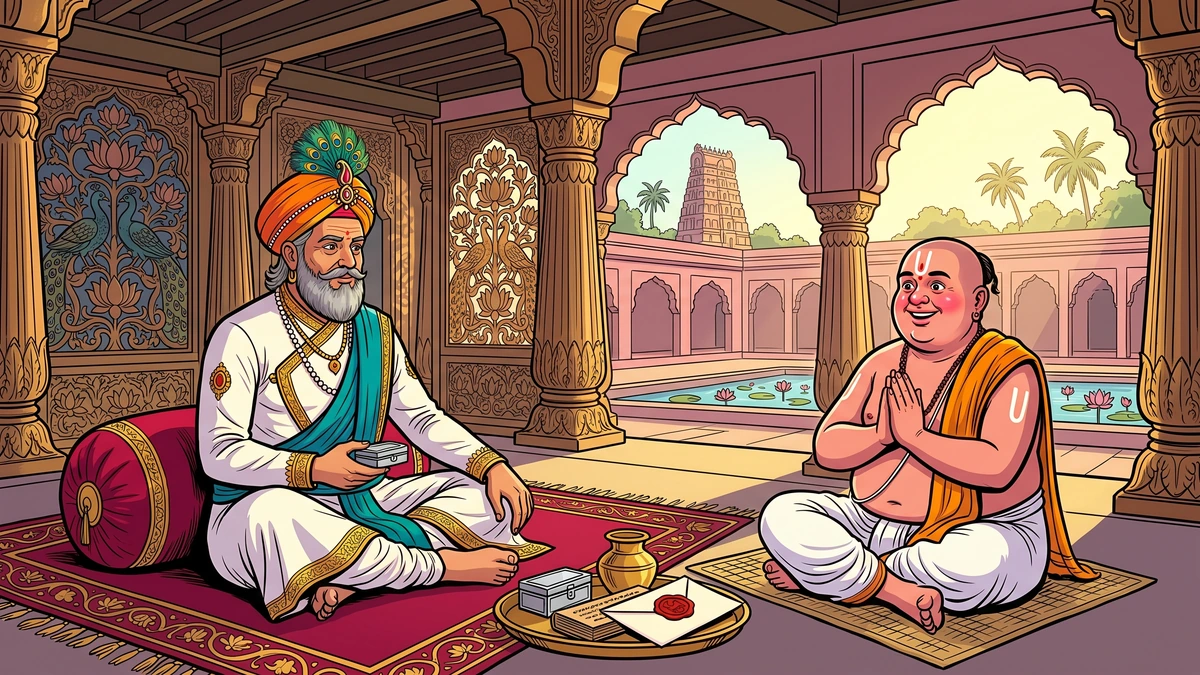
One ordinary midday, while King Chāmuṇḍa sat chewing betel-leaves on the marble verandah and the priest sat opposite him on a square of woven mat, the king laid down his silver betel-box and spoke kindly. “My most holy priest,” he said, “I am greatly pleased at your faithfulness in the discharge of your sacred duties. Ask of me now what you wish, and I shall grant your request.” The priest’s round face flushed; his small bright eyes lit up; his whole body seemed to puff itself a little larger inside the saffron uttarīya. He had been waiting many years for exactly this moment. “Great king,” he replied with a low bow, “I have always had a desire to become the amildār of a district and to exercise power over a number of people. If your Majesty should grant me this, I shall have attained my ambition.” The king blinked. An amildār — in the old Mysore administrative usage, a senior revenue-officer in charge of a whole district, the man who collected the king’s grain-tax, judged petty disputes, kept the peace among headmen, and signed the great red-sealed orders of state — was as far from a temple priest’s vocation as a battle-axe is from a sacred ladle. But the king had given his royal word; and there happened, just at that moment, to be a vacancy in the amildārship of Nañjangōḍ, the ancient pilgrim-town below Mysore where the Cauvery bends past a great Shiva temple. So the king, hiding his doubt behind a kindly smile, agreed.
Before he sealed the appointment, however, the wise old king did what every wise old king must do for an unwise new servant: he gave the priest three pieces of advice, in the rich figurative Kannada that the courts of the Deccan loved to deploy. He said, slowly and clearly:
(1) Mukha kappage irabēku. — “Your face must be black.”
(2) Ellaru kevianna kachchi mathanāḍabēku. — “When you speak of state affairs, you must do so biting the ear.”
(3) Ellara jūṭu kayyalli irabēku. — “The locks of every man must be in your hand.”
Now any man who had ever stood near a Mysore court would have understood at once. To “wear a black face” meant to keep a stern, unsmiling, dignified countenance — the gravity of office. To “speak biting the ear” meant to whisper close, in confidence, never airing affairs of state in public. To “hold all locks in one’s hand” meant to bind men firmly to one’s authority, to keep officials subservient. They were three excellent maxims, given in the old Kannada poetic compression that loaded each idiom with a generation of practical wisdom. The priest Guṇḍappa, however, who knew his Sanskrit liturgy backwards but had never once in his life heard a Kanarese proverb spoken outside his own Vedic study, listened with shining eyes and took every word with the literal precision of a temple ritual. The king saw the shining eyes, mistook the stupidity for understanding, and sent his priest off with the great red-sealed letter of appointment in his hand.
II · The Journey, the Bundle, and the Sacred Grass
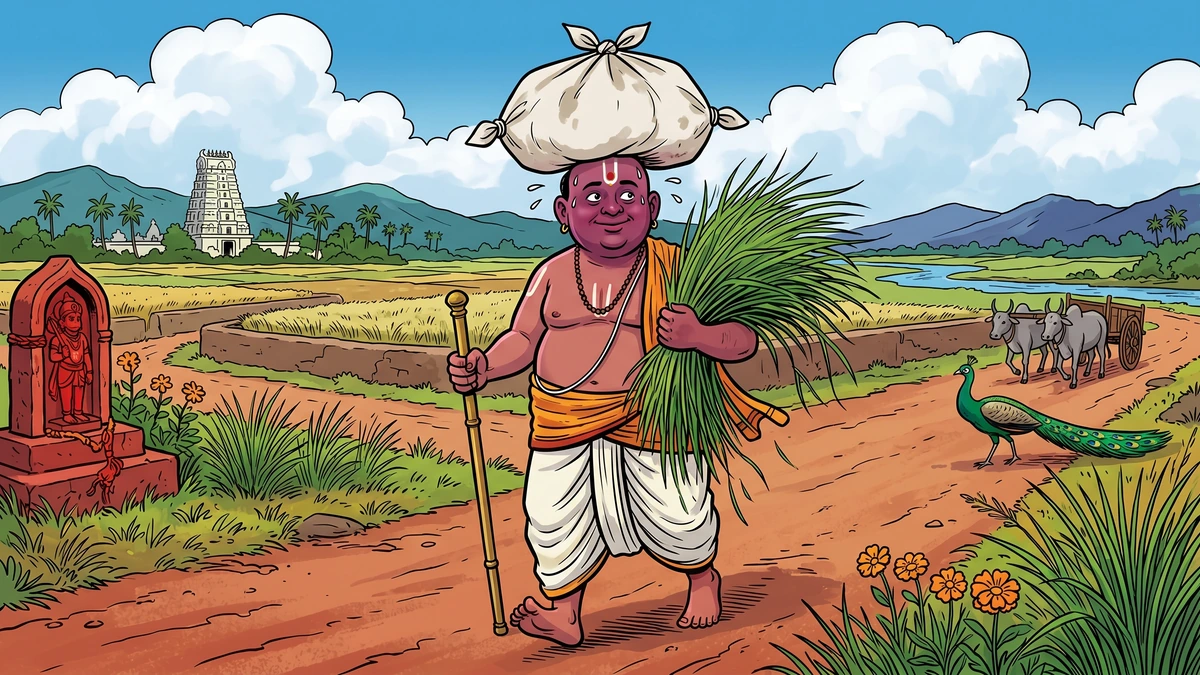
Guṇḍappa returned to his small agrahāra house and announced the news to his wife with an expansive sweep of one plump hand. “From tomorrow,” he declared, “I am the amildār of Nañjangōḍ.” His wife, a quiet woman, looked at him long enough to register the fact that her household was about to be very strange, then went to fold him a clean white bundle for the road. The next morning, before the temple bell had rung for the dawn māṃgala-ārati, the new amildār set out walking. He carried no horse, no escort, no umbrella of office. On his head he balanced a single bundle — six cubits by twelve, white cotton tied at four corners — containing his three spare panche, his copper panchapātra drinking-bowl, his small bag of dry rice, and his beloved book of Vedic chants. In one hand he gripped a brass walking-staff. And along the dusty Mysore road, every time he saw a tuft of fresh green kuśa grass — the sacred ritual grass which a Brahmin priest may use to purify a sacrificial fire — he stooped, plucked it, and tucked it into his other hand.
By the time he reached the gate of Nañjangōḍ about the twentieth ghaṭikā of the day, his fist was bursting with green ritual grass and his bundle was askew on his head, sweat-stained and tilted, and his face was flushed dark plum from the long walk under the Karṇāṭa-Dēśa sun. The town gate was crowded. The whole administrative establishment of Nañjangōḍ — the chief assistant in his crimson silk angarkha kurta and white safa pāgri turban with peacock crest, the senior karṇika clerks with palm-leaf account-books under their arms, the shanbhog village-accountant, the poligar military headman, four sword-and-shield sipahis in dark-blue tunics with yellow turbans, and a small brass band with curved nādaswaram shawms and twin tavil drums — had been waiting at the gate since dawn to receive the new amildār. Hours had passed; no palanquin had appeared; no horse-rider with red-sealed letter; nothing. They were beginning to grumble.
Then a road-worn priest with a tilted bundle on his head and a fistful of grass shuffled into view. The chief assistant, who had been pacing in his polished leather sandals, decided that this priest had perhaps come from the road behind and might at least bring news of the missing amildār‘s halting-place. He stepped forward, pressed his palms together politely, and asked, “Swāmī, have you any news of the new amildār‘s arrival?” The priest set down his bundle on the dust, untied a corner of it (carefully wrapping his hand in kuśa grass first, lest his clean white cloth be polluted by his unwashed fingers), drew out the great red-sealed letter, and held it up under the chief assistant’s nose. “I am the amildār,” said Guṇḍappa.
The crowd stared. The brass band, which had begun a half-hearted tuning of its nādaswaram, fell silent in mid-note. The chief assistant turned the letter over, saw the king’s red Mysore lion-seal, swallowed once, and bowed. There was nothing for it. The order had come from the throne. Hands were folded; turbans were straightened; the nādaswaram let out a long sweet wail of welcome; the tavil drums took up the bridal-procession beat of jaya-jaya-jaya; and the strangest amildār the town of Nañjangōḍ had ever seen was escorted through its painted gate with full ceremonial honours, his bundle now respectfully carried by a sipahi behind him, his fist of kuśa grass still clutched against his chest like a holy relic.
III · The Black Face and the Bitten Ear
The chief assistant brought the new amildār to his own house for the customary feast of welcome. The kitchen blazed; the cooks worked at speed; in less than a ghaṭikā a great green plantain leaf was unrolled before Guṇḍappa, heaped with hot saffron-gold rice, three kinds of vegetable palya, mango pickle, ghee-soaked holige sweet flat-bread, a bowl of majjige buttermilk, and a small pyramid of grated coconut chutney glistening green with curry-leaves. Now Guṇḍappa, who had never in his life paid for a meal with his own money, ate with the prodigious appetite of a man who has long enjoyed the profession of being fed by others. He ate three times as much as a stout man should. He finished the buttermilk; he asked for a second helping of holige; he made the cooks bring out a third dish of pickle. When at last he washed his hands and sat back belching gently into the warm afternoon, the chief assistant brought him a silver platter of betel-leaves with nutmeg, mace, areca-nut, and a small lump of pearl chūṇām lime.
“Where is the dakṣiṇā?” asked Guṇḍappa, chewing. The chief assistant froze. Among Brahmin priests, a dakṣiṇā — a small ceremonial fee — is what a host gives at the close of any sacred meal: usually two rupees, sometimes four, sometimes a little gold piece tied in silk. But for an amildār to ask for a dakṣiṇā at the close of his welcome-feast could mean only one thing in the language of the Mysore courts of that day: a bribe, a huge bribe, a graspingly demanded bribe. The chief assistant’s heart sank. He went to his iron-bound chest, counted out five hundred gold mohars with trembling fingers, tied them in a knotted silk bag, and placed the bag with a small bow on the betel-platter. Guṇḍappa, who had never in his life seen even five gold pieces in one place, opened the bag with shining eyes, counted every single coin out aloud onto the platter, returned them to the bag, tied them tightly into the corner of his white bundle, and then — cheerful as a child — swallowed the entire heap of nutmeg and mace at one gulp.
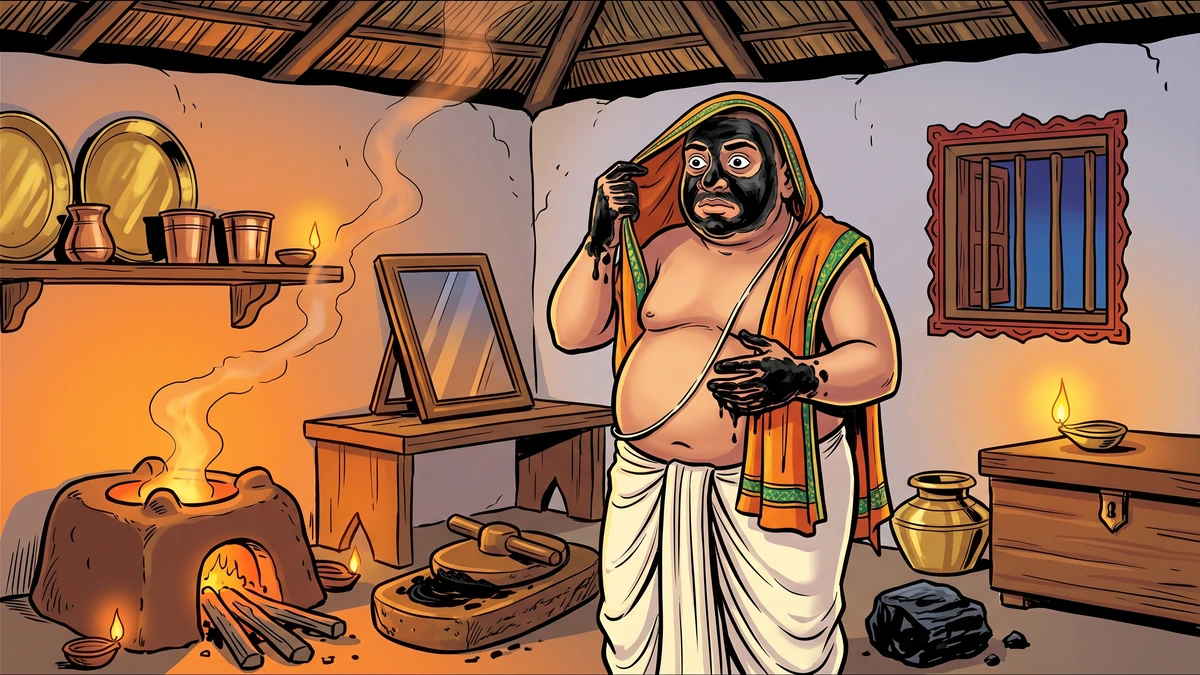
“I shall be at the office,” he announced grandly, “by the twenty-fifth ghaṭikā of the evening. See that all officers are in attendance.” The chief assistant, who had now begun to suspect that the new amildār was either an exceedingly subtle eccentric or an out-and-out idiot, hurried away to bathe, gulp a hasty meal of his own, and reach the amildār‘s office before his strange new superior. Inside the chief assistant’s house, alone now, Guṇḍappa remembered the king’s first piece of advice. “Mukha kappage irabēku — the face must be black.” Of course! He bustled into the kitchen, found a great lump of black charcoal in the corner near the chulha stove, ground it on a stone, mixed it with a little water into a thick black paste, and proceeded to smear the entire surface of his face — brow, cheeks, chin, the bridge of his fat nose — with the dripping black paste. When the work was done his face was the colour of the inside of a buffalo-horn ink-pot. Embarrassed at this strange visage, he pulled the loose corner of his saffron uttarīya up to half-cover his cheeks and walked, dignity intact, the short distance to the amildār‘s office.
The clerks in the office were waiting in their cleanest white kurtas, palm-leaf books of the day’s accounts laid neatly across the long teak desk, brass diyās burning at the four corners of the room. When the new amildār entered, the entire room rose, then froze. Through the saffron cloth that half-hid his face there glistened black charcoal-paste in three long dripping streaks. The amildār‘s great round eyes, white in the black mask, blinked solemnly at his subordinates. He took his seat on the carved teak chair of office; the clerks resumed their work, biting the inside of their cheeks to keep from laughing. From time to time the new amildār lifted a corner of his cloth and peered out at them with one charcoal-rimmed eye.
By the late evening certain pressing accounts and grain-tax receipts required the amildār‘s seal. The chief assistant gathered the documents in both hands and approached the great teak desk respectfully, stopping at a polite arm’s length. “Closer,” murmured Guṇḍappa. The chief assistant stepped a little closer. “Closer still,” murmured Guṇḍappa, his eyes shining now with the pleasure of remembering the king’s second piece of advice. “Bite the ear when speaking of state affairs.” The chief assistant, now within reach, bent down. Guṇḍappa rose halfway from his chair, leaned over the desk, fastened his fat lips upon the chief assistant’s right ear — and bit it. He bit it hard. Through clenched teeth, around the ear, in a muffled rumble, he asked, “Are all the people of Nañjangōḍ enjoying full prosperity?” The chief assistant, his ear in fierce agony and his blood beginning to run on his white kurta-collar, roared at the top of his lungs that yes, all the people were enjoying the greatest prosperity that any people had ever enjoyed since the dawn of the satya-yuga. Guṇḍappa nodded thoughtfully, jaws still locked. “Are the rains good? Are the granaries full? Are the bullocks fed? Are the temple-tanks deep?” Twenty more affairs of state were enquired of in exactly the same fashion, and twenty times the chief assistant roared out the answers, until at last, blubbering with pain, he tore his ear free from the amildār‘s grip, fled the office, and rushed out of Nañjangōḍ by the back gate, riding by night for Mysore to throw himself upon the king’s mercy.
IV · The Locks of Hair and the Royal Pardon
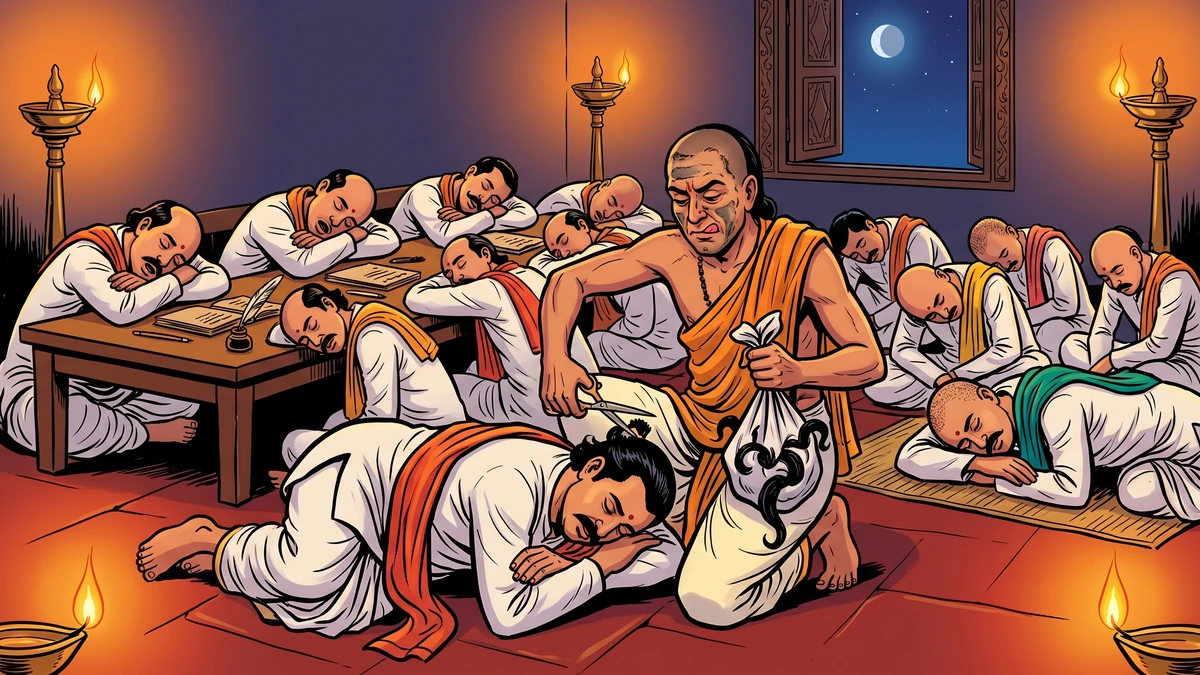
Two pieces of royal advice had now been duly carried out. There remained the third: “the locks of every man must be in your hand.” Guṇḍappa sat on his teak chair, his black-painted face still half-covered, and waited. The remaining clerks — uneasy, terrified, but unable to leave while their amildār kept his seat — sat with their heads bent and their eyes flicking nervously between the door and the strange black-faced figure on the dais. The lamps burned low. The night-watchman called the second watch. The clerks’ heads began to nod, and one by one, as the brass diyās guttered, they fell forward onto their forearms and slept. The third ghaṭikā of the night arrived; the fifth; the seventh; the tenth.
At last every officer in the room was deeply asleep. Guṇḍappa rose from his teak chair on tiptoe. From the inner pocket of his white bundle he drew out a small pair of brass scissors — the same scissors he had once used at the temple to clip flowers for the deity. Padding silently from sleeping clerk to sleeping clerk, he knelt at each man’s side, took up the long oiled black jūṭṭu — the hair-lock at the back of every Hindu officer’s head — and snipped it cleanly off at the root. One by one the locks fell into Guṇḍappa’s white cloth bundle. By midnight there were sixteen black oiled locks tied up in his white napkin. Guṇḍappa knotted the bundle, picked up his bag of five hundred gold mohars, walked out of the office under the gibbous moon, found a sleepy bullock-cart driver outside the town gate, and started for Mysore that very night to give his king the joyful news of how perfectly all three pieces of advice had been carried out.
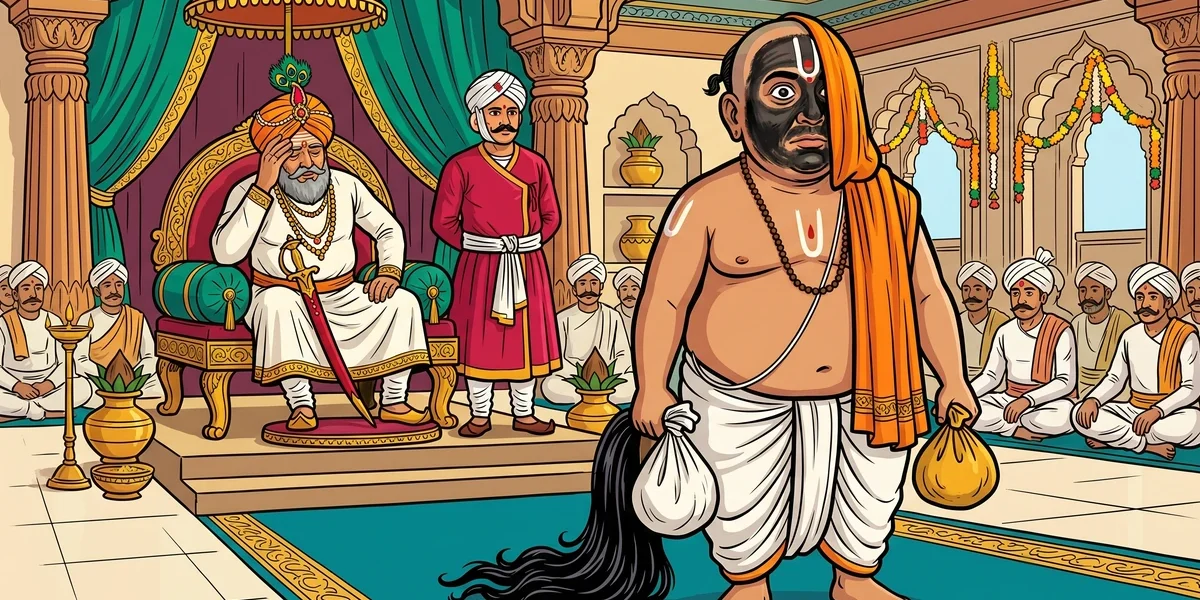
He arrived at the great audience-hall of King Chāmuṇḍa in the early dawn, only a nimiṣa after the chief assistant of Nañjangōḍ, who had ridden through the night and now stood weeping before the throne, his right ear swollen to the size of a small ripe mango and bandaged in a square of bloody white cotton. The king, in his white pearl-edged silk angarkha and saffron safa turban with peacock crest and ruby kalgi, listened to the chief assistant’s tale with growing horror. Just then, into the marble audience-hall — where the carved sandalwood pillars rose to a painted ceiling and ministers in white turbans waited along the walls — there stepped the new amildār: face still streaked with old, cracked, dried charcoal paste; saffron uttarīya dragging awry; one fat hand gripping a heavy bag of gold; the other hand clutching a knotted white bundle that bulged with sixteen severed Brahmin locks of hair.
“Most noble king!” cried Guṇḍappa proudly, stepping straight to the foot of the throne. “Behold — you ordered me to blacken my face for my new duty. See, I have not yet even removed the dye!” He pointed at his charcoal cheeks. “You ordered me next only to speak while biting an ear. Look, please, at my chief assistant’s ear which stands swollen here before you, and tell me whether I have not obeyed you to the letter!” He pointed at the bandaged chief assistant. “And as for the third order, that the locks of all my officers must be in my hand — why, here they are, in this bundle!” He upended the white napkin onto the polished floor of the audience-hall. Sixteen long oiled black jūṭṭu locks tumbled out across the marble in a soft heap, and the assembled ministers gave one collective gasp.
The king closed his eyes; he laid one royal hand upon his brow; for a long moment he did not speak. Never in his long reign had he seen such literal-minded folly clothed in such sincere pride. Such a man cared for nothing more deeply than the careful obedience of his master’s commands — and yet had so completely emptied those commands of their meaning that he had bitten a worthy gentleman half-deaf and shorn sixteen respectable Brahmin heads of the very lock that for orthodox Hindu officers symbolised their twice-born honour. The king begged the bandaged chief assistant’s pardon with bowed head. He sent him home with a healing salve and a purse of compensation. And from that day onwards King Chāmuṇḍa was very, very careful in the choice of his officers, never again raising any servant to a post of authority on the strength of nothing more than a bowing manner and a fluent recitation of sandhyā-vandanam.
Poor Guṇḍappa was relieved not only of the amildārship of Nañjangōḍ but also of his old position as household priest. He returned to his small agrahāra house with the five hundred gold mohars still tied in his bundle, and on these he and his quiet wife lived for several years — though without the constant streams of feast-rice and free holige from the palace kitchens, his round belly grew lean for the first time in his life, and his cheeks lost their plump shine. He never again held an office of authority. But every village child between Mysore and the Cauvery learned, soon enough, the proverb that came out of his short black-faced career: “Ājñeya akshara nōḍi, akshārtha nōḍi” — “Look not only at the letter of the order, look also at its meaning.”
The Moral · The Letter and the Spirit of Speech
Akshara-mātra-vādī puruṣa-tilaka.
“He who clings only to the letter is the dot upon the brow of folly.”
— Old Kannada proverb cited in the Mysore Karnataka Kaifiyat tradition; also reflected in Manusmṛti XII.105 and in the Hitopadeśa‘s warning “buddhir balena rakṣyatē” (“intellect is guarded by strength of judgement, not by mere words”).
The lesson of Guṇḍappa’s brief, ridiculous, painful career as amildār of Nañjangōḍ is one the old Kanarese tellers placed at the very heart of village wisdom: obedience without understanding is not virtue, but folly with shining shoes. The king’s three Kannada maxims — black face, bitten ear, locked hair — were the compressed wisdom of generations of Mysore administration: keep your gravity, hold your counsels close, bind your servants firmly. Spoken to a man of the world, they would have made an excellent young officer. Spoken to Guṇḍappa, who knew his Sanskrit chants but had never opened his mind to a Kanarese metaphor, they became weapons of his own undoing. He carried the form, lost the spirit, and shamed himself before the throne.
Behind this comic surface the tale also carries the older Indian doctrine of svadharma — “one’s own duty,” the calling for which one is born and trained. The Bhagavad-Gītā warns at III.35: “śreyān sva-dharmo viguṇaḥ para-dharmāt sv-anuṣṭhitāt” — “Better to do one’s own duty imperfectly than another’s duty well.” Guṇḍappa was a competent priest; placed in the office of an administrator, his very competence at one thing became an active disqualification from another. The Manusmṛti echoes the warning more sternly (II.94): “yad-yad-icchet manaḥ tat-tat icchet, na svadharma-kṣayam” — “Whatever the mind may desire, let no man choose at the cost of his own duty.” Pañcatantra V opens its book of Aparikṣita-Kāraka — “The Acts of Unconsidered Folly” — with exactly this teaching, dressed in story after story of foolish ambition and rash literalism: the barber who cut a noble lord’s nose because he had been told to “trim him short,” the monkey who pulled the wedge from the sawn log because it was “in the way,” the Brahmin who killed the loyal mongoose because he assumed it had bitten his child. Guṇḍappa is the brother of all these; the smiling, bowing fool who believes he is a sage.
For Indian administrative tradition the moral has an even sharper second blade. Both the Arthaśāstra of Kauṭilya (Book I, Vinayādhikārika) and the practical Mysore kayfiyat manuals warned every raja that amātya-parīkṣā — “the testing of ministers” — was the foundation of good government: a king who appointed officers on the strength of their devotional bearing, their family connections, or their flattery would sooner or later find his districts in revolt and his treasury empty. King Chāmuṇḍa’s own careless boon — “ask of me what you will” — is itself the deeper folly that makes Guṇḍappa’s misrule possible. The tale punishes the king as well as the priest, for one foolish granting can install a hundred foolish governors.
Why It Has Lasted
The Brāhmaṇ Priest who became an Amildār has crossed every century since Mrs. Kingscote’s risāldār first told it to her in the cold months of 1888 — and it has lasted, in the Kanarese countryside and beyond, because every generation of the Indian household recognises some Guṇḍappa in itself. The clerk who follows the rule-book without thinking; the cook who cuts the gourd into the size called for in the recipe long after the gourd has wilted; the schoolboy who copies the example sum so faithfully that he gets the answer wrong; the new officer who, given the proverb “hold your tongue,” sews his own lips together with thread — all of them are Guṇḍappa, all of them shine in the same charcoal black on the audience-hall floor. The tale lasts also because of its perfect three-step shape: the king’s three orders, the priest’s three obediences, the king’s one shame. It is a story you can hear once at five years old and tell again at fifty without losing a single thread of it. And it lasts, finally, because beneath its laughter it carries that gentlest of South Indian moral lessons: do not mistake the letter for the spirit, the bowing for the wisdom, or the ambition for the calling. Read the king’s words. Then, says Guṇḍappa from his small agrahāra verandah with his lean belly and his five hundred gold mohars, read what the king meant.
Canonical attribution · Tale XX of S. M. Natesa Sastri & Mrs. Howard Kingscote, Tales of the Sun (W. H. Allen, London & Calcutta, 1890); Project Gutenberg edition no. 37002. Sastri’s footnote: “A Kanarese tale related by a risāldār.” Compare Pañcatantra V (Aparikṣita-Kāraka); Hitopadeśa, prastāvika 6; Manusmṛti II.94 and XII.105; Bhagavad-Gītā III.35; ATU 1696 (literal-fool); Stith Thompson J2461, J2461.1.2, J1820, W154, N455.3, Q331; Grimm KHM 59; Pitrè Fiabe Siciliane 1875 (Giufà cycle).
You May Also Like
 Indian Folk Tales
Ages 3-5
Indian Folk Tales
Ages 3-5
How Raja Rasalu Played Chaupur With King Sarkap
How Raja Rasalu Played Chaupur With King Sarkap: Now, when evening came, Raja Rasâlu went forth to play chaupur with King Sarkap, and as he passed some
 Indian Folk Tales
Ages 3-5
Indian Folk Tales
Ages 3-5
The Fish Prince
The Fish Prince: Once there were a king and queen who had two sons. The older of the two was a very short and ugly man with only one eye, and that was in the
 Indian Folk Tales
Ages 9-12
Indian Folk Tales
Ages 9-12
Sura and Baya: The Shark and the Crocodile
Sura and Baya: The Shark and the Crocodile: In the waters where the great Brantas River of Java spreads into the sea, there existed a boundary that was