How Raja Rasalu Played Chaupur With King Sarkap
How Raja Rasalu Played Chaupur With King Sarkap: Now, when evening came, Raja Rasâlu went forth to play chaupur with King Sarkap, and as he passed some
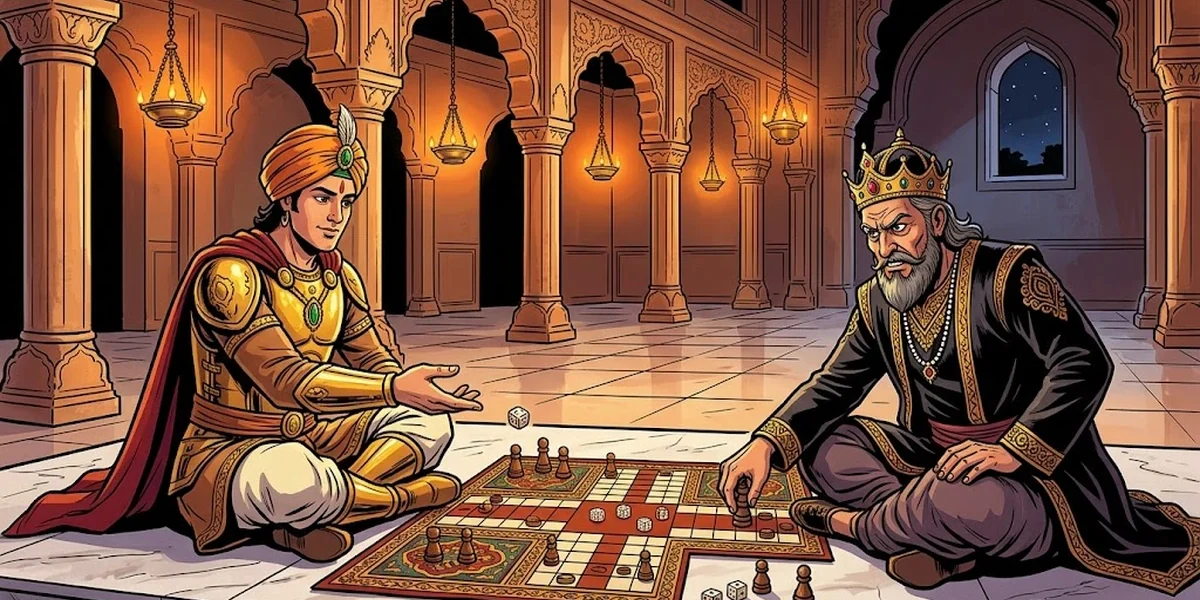
Of all the chapters in the long Punjabi epic of Raja Rasālū, none has been retold around evening fires more often than the night he sat down across a chaupur board from King Sarkap of Kot Bithaur and gambled, three games in a row, for the kingdom of the world and the head on his own neck. How Raja Rasalu Played Chaupur With King Sarkap is the climactic episode of the Sialkot cycle, the moment in which every gift the young prince has gathered on his journey — the bone dice from a graveyard, the kitten saved from a potter’s kiln, the loyal horse Bhaûnr Irāqī, the counsel of a corpse — converges into a single contest of nerve, intelligence and small generosities. The board is square, the stakes are absurd, and the outcome rewrites the political map of the Punjab.
Origin and Canonical Sources
The Rasālū cycle is a Punjabi oral epic that was carried for at least four centuries by the Mirāsī bards of the Sialkot region before it was committed to print. The first full English-language transcription is Flora Annie Steel‘s Tales of the Punjab Told by the People (Macmillan, London, 1894), prepared with annotations by R. C. Temple and illustrated by John Lockwood Kipling. Steel had lived in the Punjab from 1867, learned the language well enough to take dictation from village women, and arranged the Rasālū cycle into a continuous chapter she titled The Adventures of Rajah Rasalu. The chaupur match with King Sarkap is the seventh and most dramatic piece in that sequence, occupying pages 218–225 of the first edition.
Sir Richard Carnac Temple’s parallel three-volume The Legends of the Panjāb (Bombay and London, 1884–1900) preserves the Mirāsī bardic original in rhymed Punjabi couplets. Temple recorded the chaupur scene from at least three separate singers and noted the small variations between their performances; in his recension the magic dice and the rat Dhol Rājā are present in every version, but the kitten varies in colour, the women summoned to distract the prince vary in number from seven to seventy, and Sarkap’s daughter is named in some performances Kokilān and in others Sundarān. The story is therefore not a single fixed text but a living variant-cluster, and Steel’s English version is best understood as a careful synthesis of the most stable elements.
For folklorists the tale is classified within the international Aarne–Thompson–Uther system as ATU 851A (“The princess won by riddle”) crossed with the rare ATU 1641A (“The contest with the king”), and saturated with motif N4.5 (“Game of life and death played with magic dice”) and motif K91 (“Substituted dice”). The kitten-versus-rat sub-plot is independently catalogued as motif B431.2 (“Helpful cat”) and is a distinct contribution of Punjabi folk physics rather than an inheritance from pan-Indian Sanskrit literature. Stith Thompson, in his Motif-Index of Folk-Literature, traces the substituted-dice idea back as far as the Mahābhārata‘s Dyūtasabhā Parva, the loaded-dice match between Śakuni and Yudhiṣṭhira that ignites the great epic war — an ancestry that gives the Rasālū tale far deeper roots than its compact form suggests.
Beat One — The Potter’s Kiln and the Mother Cat
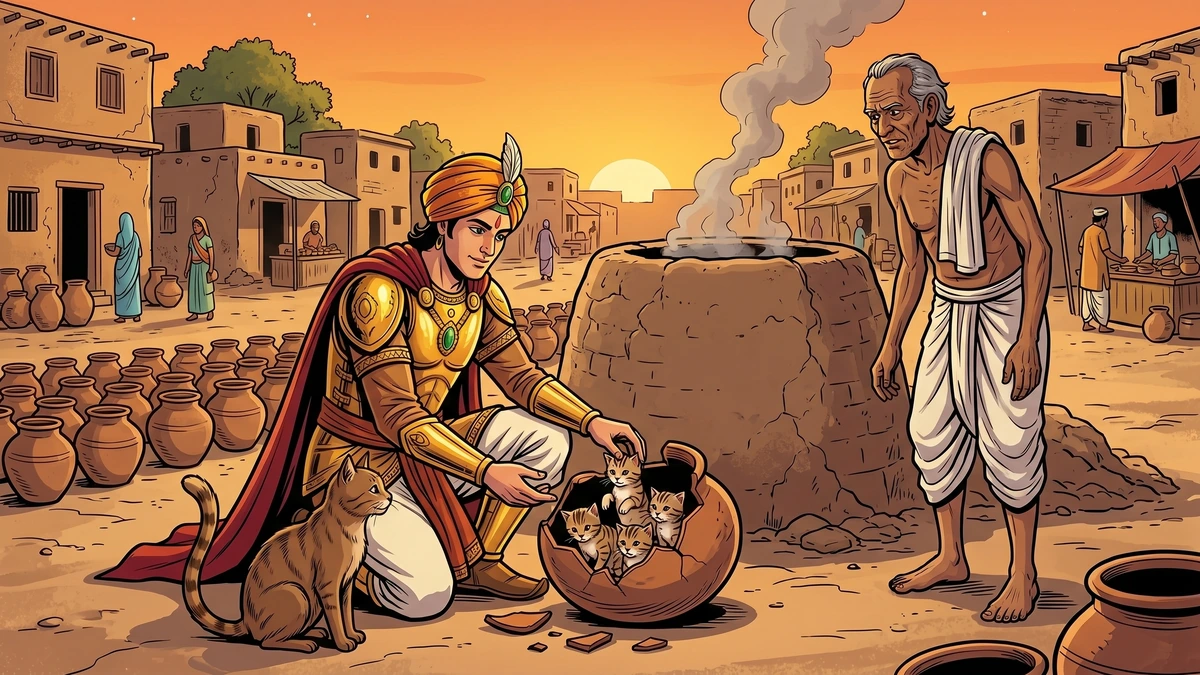
On the evening of the contest Rasālū rides through the lower town of Kot Bithaur on his way to the palace. Among the potters’ kilns at the edge of the bazaar he sees a cat pacing back and forth in obvious distress. He stops and asks her, in the Punjabi storytelling habit that takes the speech of animals quite for granted, what is the matter. She tells him that her kittens are sealed inside one of the unbaked pots that has just been fired, and unless someone breaks the kiln open the kittens will roast alive. The Mirāsī bards always linger over this moment, because everything that follows depends on what the prince does next. He could ride on; he is on his way to a duel with the most dangerous king in the Punjab, and the welfare of a litter of kittens is no concern of a man with three crowns to win. Instead he dismounts, finds the potter, and bargains to buy the entire kiln. The potter at first refuses, on the practical commercial grounds that he cannot fix a price until he sees how many pots have come out whole; eventually a sum is agreed, the prince purchases the kiln intact, breaks open the pots until he finds the kittens, and restores them to their mother. In gratitude she presses one kitten upon him, telling him to slip it into his pocket because it will help him in difficulty. He pockets the small warm bundle and rides on toward the palace.
This opening beat is structurally identical, in Indian narrative grammar, to the opening of the Jātaka stories in which the Buddha-to-be redeems a small creature on the way to a large act of statecraft, and the transmission is almost certainly intentional. The Rasālū bards were teaching the young men of Sialkot that a true prince stops for kittens. They were also seeding, with great economy, the device that will win the climactic game — but the device only works because the generosity that produced it is real.
Beat Two — The Stakes Are Fixed
At the palace Rasālū is received in the great pillared hall where Sarkap holds court. The chaupur cloth is laid out: a cross of four arms, a board of brilliant black and red squares, and a heap of carved wooden pieces in the centre. Before the first die is cast, the two kings declare their stakes aloud, in the formal manner of every chaupur match in Punjabi oral tradition. Sarkap, supremely confident of his enchanted dice, wagers in turn his kingdom, the wealth of the whole world, and finally his own head. Rasālū matches him with what little he carries: his shining armour, his horse, and his own head. The asymmetry is glaring. Sarkap is staking three sovereignties; Rasālū is staking the contents of his saddlebags and the bones inside his skin. Yet from the bards’ point of view this is the only honest way for a young hero to enter a rigged game. He cannot match wealth for wealth; he can only match courage for courage and trust the small magic in his pocket to balance the rest.
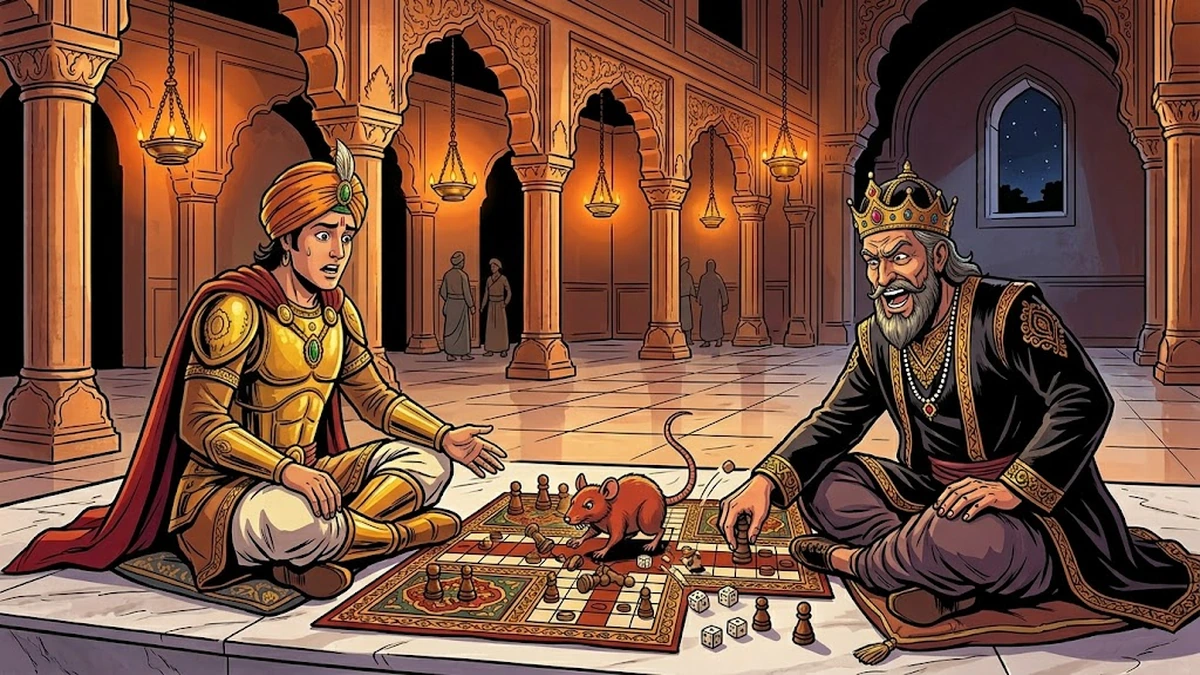
The first round opens. Rasālū, who has the first move, makes a young man’s mistake: in the eagerness of the moment he forgets the dead king’s warning and uses the dice that Sarkap has handed him. Sarkap then loosens from a hidden hatch his celebrated rat Dhol Rājā, who scampers across the painted board upsetting the pieces with such delicate cunning that the human players cannot detect the cheat. Rasālū loses the first game and pays his armour into Sarkap’s hand. The second game opens; Dhol Rājā runs again; the prince loses Bhaûnr Irāqī, his beloved horse. As the slaves come to lead the steed away the horse cries out to his master in rhymed verse — one of the most famous passages in the entire cycle — reminding him to put his hand in his pocket. The kitten, sensing the moment, begins to struggle. The cat’s gift and the corpse’s warning rise together in Rasālū’s mind, and he understands, at last, what he has been carrying.
Beat Three — The Kitten Faces the Rat
Before the third game Rasālū rises and addresses Sarkap with the calm of a man who has just remembered his own resources. He demands that his armour and horse be left in the hall as security, that they be returned to him only when Sarkap has won his head. He pulls from his pouch the small bone dice he carved in the graveyard. “We have played with your dice all this time,” he says; “now we will play with mine.” The kitten, of its own accord, leaps from his pocket and takes up a position at the small high window through which the rat Dhol Rājā has been entering and leaving the board. Sarkap, to break the prince’s concentration, orders the seventy fairest women of his harem to be brought into the hall and arrayed in their finest garments around the chaupur cloth, jewels and silks shimmering in the lamp-light. Rasālū does not so much as glance at them. He rolls his bone dice, and the third game begins.
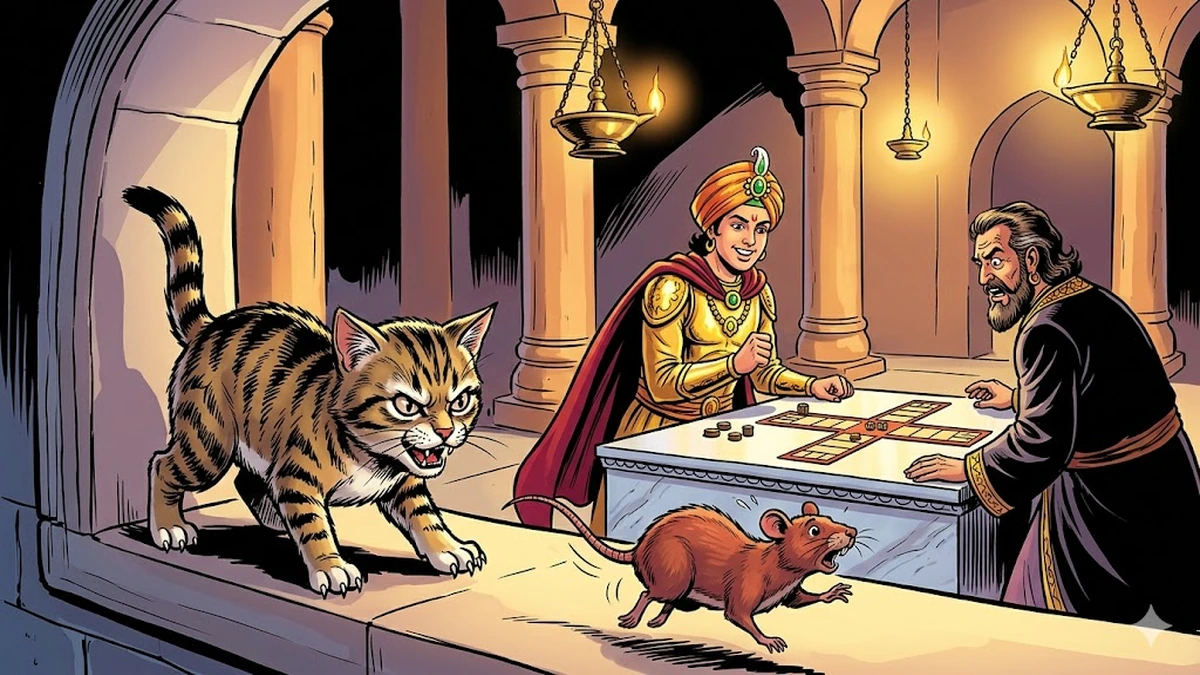
What happens next is the moment the bards always extend, building it slowly with repeated formulas. Sarkap, sensing that he is losing, claps for his rat. Dhol Rājā emerges from his hatch and starts toward the board — but at the window crouches the small striped kitten, eyes narrowed, claws ready. The rat freezes. He cannot reach the pieces without passing the cat, and a rat that passes a cat is no longer a rat but a meal. Without his rat to upset the geometry, Sarkap is reduced to playing the game on its own merits, and on its own merits he is no match for the prince. Rasālū wins the first round and reclaims his armour. The second round opens; again Sarkap calls for his rat; again the kitten freezes Dhol Rājā in the window-frame; and Rasālū wins back his horse. The kitten, pocketed by an act of small mercy outside a potter’s kiln, has done in two short rounds what no army of the Punjab had managed to do across decades of failed assaults: it has neutralised Sarkap’s invisible weapon and made his court vulnerable for the first time.
Beat Four — The Final Game and the Plea for Mercy
For the third and decisive game Sarkap brings his whole skill to bear, chanting over his pieces the rhymed prayer that Punjabi gamblers have used for centuries: “O moulded pieces, favour me to-day; for sooth this is a man with whom I play; no paltry risk — but life and death at stake; as Sarkap does, so do, for Sarkap’s sake.” Rasālū answers in the same metre but a higher key: “O moulded pieces, favour me to-day; for sooth it is a man with whom I play; no paltry risk — but life and death at stake; as Heaven does, so do, for Heaven’s sake.” The verse-duel itself is part of Punjabi gambling etiquette — a way of declaring the moral ground on which one stands before risking the body. Rasālū speaks for Heaven; Sarkap speaks only for himself. The bone dice fall, the pieces move on the cross-shaped cloth, and Sarkap loses, in succession, his kingdom, the wealth of the whole world, and his own head.
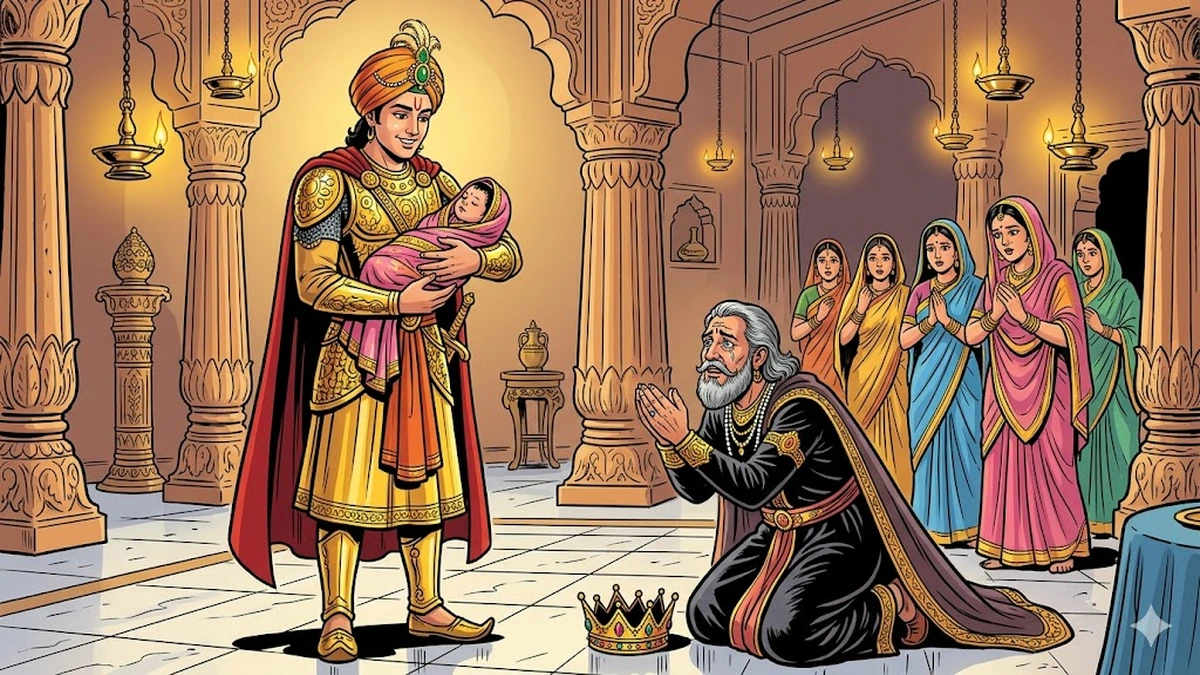
At this catastrophic moment a servant enters with news. A daughter has just been born to the king. Sarkap, broken by superstition and despair, orders the infant killed at once, declaring she has been born in an evil hour and has dragged her father’s fortunes down with her. Here Rasālū performs the act that lifts the entire episode out of the genre of the rigged-dice tale and into the higher genre of the founding legend. He rises in his shining armour and asks for the child as his future wife, and offers in return to spare the king’s life on the single condition that he never again play chaupur for another man’s head. Sarkap, weeping and amazed, agrees. The infant, who will grow up to be Princess Kokilān, is laid in the prince’s arms; the headless dice game becomes, in a single sentence, a wedding contract; and the Punjabi epic discovers that mercy can do what the sword cannot.
Moral — Generosity is the Hidden Game
“Billī di rakkhī jaan,
chauh kursiān vich hākīm banaûndī hai.”
— The kitten you spare today seats you on four thrones tomorrow.
(Punjabi proverb attached to the Rasālū cycle by R. C. Temple, Legends of the Panjāb I.49.)
The lesson of the episode is not, as a hasty reading might suggest, that cunning beats cunning, or that bone dice cancel enchanted dice. The lesson is older and stranger: that the small mercy you offer on the way to the great contest is the great contest, and that you have already won or lost the day’s match in the way you treated the kittens at the kiln long before you sat down across the chaupur board. Rasālū does not defeat Sarkap with the dice; he defeats him with the kitten, and the kitten is in his pocket only because, hours earlier, on a road where no one was watching, he chose to stop. The Mirāsī bards always knew this. They tell the kiln scene before the chaupur scene not because that is the chronological order but because that is the moral order — cause first, effect second, and the effect of mercy travels farther than the eye can see at the moment mercy is given.
Why The Story Has Lasted
This episode has been recited, sung, painted on shrine walls and carried in shadow-puppet performances across the Punjab and into Pakistani Sind for at least six hundred years, and probably a good deal longer than that. It has lasted because it solves, in a single coherent narrative, three problems that every culture has to solve: how to teach a young man that the rules of power are usually rigged; how to teach him that the response to a rigged game is neither cynicism nor brute force but a quiet repertoire of preparation, kindness and counter-magic; and how to teach him that the goal of victory, when victory comes, is reconciliation rather than revenge. The bone dice solve the first problem; the kitten solves the second; the marriage to the infant princess solves the third. A story that achieves all three of those tasks in nine hundred words of bardic verse is not a story that the storytelling tradition is willing to lose, and the Punjabi tradition has not lost it.
The episode has also lasted because of its structural beauty. Almost every element planted in the earlier chapters of the Rasālū cycle — the corpse’s warning, the bone dice, the talking horse, the kitten in the pocket, the prince’s habitual courtesy — comes to fruition in this one room. A listener who has heard the cycle from the beginning experiences the chaupur game as a dazzling consolidation, a moment in which everything pays off. That kind of formal economy is rare even in literary fiction; in oral folk tradition it is rarer still, because oral storytellers have no editing pencil and must build their architecture on the fly. The Rasālū bards built it anyway. That is part of why scholars from R. C. Temple in 1884 to A. K. Ramanujan a century later have treated the cycle as one of the high masterpieces of Indian oral literature.
Finally, the tale has lasted because the central image is unforgettable: a small striped kitten at a high window, holding the line against a magic rat, while two kings play for the kingdom of the world. That image has been illustrated by every Punjabi miniaturist from the eighteenth century onward and survives today on the painted walls of small shrines along the old Lahore-Sialkot road. When a story produces an image of that quality, the storytelling tradition will refuse to let it die.
Reflection & Discussion
- Rasālū loses the first two games of chaupur before he remembers his bone dice. What does that double loss teach about the nature of preparation? Is it ever wise to begin a contest before you have fully gathered yourself?
- Sarkap brings out seventy of his most beautiful court ladies to break the prince’s concentration. Rasālū does not look at them. What does that quiet refusal tell you about the kind of attention a great task requires?
- The kitten neutralises Dhol Rājā without ever having to fight him — her presence at the window is enough. What human conflicts have you seen resolved by mere presence rather than by combat?
- Rasālū spares Sarkap on the single condition that the king never again play for a man’s head. Why does the story make him spare an enemy who has just paved his courtyard with skulls? What does mercy accomplish here that punishment could not?
- The episode ends with the infant Princess Kokilān in Rasālū’s arms. Twenty years later, in a later chapter of the cycle, she will be the cause of his greatest sorrow. Knowing that, would you still have asked for the child? Why or why not?
Did You Know?
- Chaupur is the four-armed cross-shaped Indian dice game, played on a cloth board with cowrie-shells or wooden cubes for dice and small carved pieces for pawns. It is the direct ancestor of the modern Indian game pachisi and of the British and American game called Ludo, and it was already old enough in the time of the Mahābhārata (composed between roughly 400 BCE and 400 CE) to provide the template for the catastrophic dice match in the Dyūtasabhā Parva.
- King Sarkap of the Rasālū cycle is identified by some Punjabi chroniclers with the historical king Sārakapa of Kot Bithaur, a fortress whose ruins still stand near the modern town of Bhet in the Pothohar plateau of Pakistani Punjab. The local population still pointed out the site to Steel and Temple in the 1880s.
- The rhymed prayer Sarkap chants over his pieces (“O moulded pieces, favour me to-day”) is preserved by Temple in the original Punjabi as “Pakkī gottī, merī jitt hūnī chahīdī hai”, and was sung by Mirāsī bards in a slow, deliberate tempo that mimicked the casting of dice. Folklorists call this kind of formula a bardic boast, and it appears in the dice scenes of epic traditions as far apart as Ireland and Mongolia.
- The motif of the helpful cat against a magic rat is unusual in pan-Indian folklore, where the cat is more often a figure of suspicion. Its appearance in the Rasālū cycle is one of several details that suggest the story has absorbed elements from Buddhist Jātaka tales by way of the Buddhist communities of Gandhāra and Taxila, both within easy reach of Sialkot.
- Princess Kokilān, the infant Rasālū rescues at the end of this episode, will grow up to be the heroine of a separate tragic cycle — the Kokilān-da-Bagh stories — in which she is courted, after Rasālū’s long absence, by a younger king and dies of grief when he is killed in revenge. The chaupur game that founds the marriage is therefore also, in the long arc of the cycle, the origin of the eventual tragedy — an irony the Mirāsī bards never failed to mark with a slow, sad pause when they sang it.
The Chaupur Motif in Indian Story Memory
To grasp why the dice in this episode carry such weight, the listener has to know how seriously the Indian narrative imagination has always taken the casting of dice. In the Mahābhārata, the entire calamity of the dynastic war is set in motion by a single rigged dice match: the gambler Śakuni, on behalf of Duryodhana, plays against the eldest Pāndava Yudhiṣṭhira with loaded dice and wins the kingdom, the brothers, and finally Queen Draupadī herself. That episode — the Dyūtasabhā Parva — established for every later Indian storyteller the principle that an enchanted die is not merely a cheat at a game but a hinge on which kingdoms swing. When the Punjabi listener of the Rasālū cycle hears that Sarkap’s dice are bewitched and that Rasālū is rolling counter-dice carved from the bones of a wronged man, the listener’s mind reaches at once for Śakuni and feels the symmetry click into place. The Rasālū story is, in effect, the village answer to the great Sanskrit tragedy: where Yudhiṣṭhira lost a kingdom because his dice were not his own, Rasālū wins a kingdom because he had the wisdom to bring his own.
The image is reinforced by ritual. In many parts of north India, including the Punjab, dice are cast at certain festivals as a form of divination, and the dice used are described as “true” or “false” in language that has nothing to do with their geometric balance and everything to do with the moral state of the person who carved them. A cube made by an honest artisan, in this folk-physics, will tend to fall honestly; one made by a thief or by a king who has murdered his subjects will fall in the maker’s favour. Bone dice carved from the body of an unjustly-killed man, in this scheme, are the most “true” dice possible, because the bones themselves cry out for justice. Rasālū’s counter-magic, then, is not magic at all in the European sense — it is a kind of folk-justice physics, in which the universe itself is enlisted to balance a tilted game. That deeper logic is part of why the chaupur scene retains its grip on the Punjabi imagination today: the bone dice are not a trick, they are the world’s own immune response to a lie.
Reading the Story With Children
For modern parents and teachers, this is one of the most rewarding Indian folk tales to share with young listeners, because its surface is bright and its moral architecture is unusually layered. A child of seven or eight will be drawn at once to the talking cat at the potter’s kiln, the magic rat creeping across the dice cloth, and the small kitten standing guard at the window. A reader of eleven or twelve will start to notice the moral architecture — the way the kindness at the kiln returns as the kitten at the palace, the way Rasālū’s refusal to look at the seventy women is what gives him the eyes to see his enemy clearly, the way mercy at the moment of victory founds a marriage rather than merely sparing a life. By the time the same listener returns to the story as a young adult, the political dimension comes into focus: the realisation that powerful men often play with loaded dice, and that the wise newcomer prepares in advance, treats every small creature on the road as a potential ally, and refuses to be distracted by spectacle in the moments that matter.
One useful way to read the episode aloud is to pause at the moment Rasālū first sees the cat at the potter’s kiln and to ask the child: “What would you have done? Stopped, or ridden on?” The answers are almost always interesting, and they reveal a great deal about what the child has already absorbed about kindness and the proper response to the unimportant-seeming. After the story, a second pause — “Why do you think Rasālū asked for the baby princess instead of just sparing the king?” — opens the conversation about mercy, about the difference between winning and triumph, and about the strange long arcs by which a small kindness early in life produces a great responsibility later. These are conversations that books rarely supply on their own; folk tales, with their compact form and high moral stakes, supply them naturally and let the child do most of the thinking.
Frequently Asked Questions
**Q: Why is this story important?**
You May Also Like
 Indian Folk Tales
Ages 3-5
Indian Folk Tales
Ages 3-5
Mr. Bunny’s Carrot Soup
Mr. Bunny’s Carrot Soup: Once upon a time Mr. Bunny picked four carrots. I will make carrot soup, he thought. Rat asked, “May I have a carrot please?” Mr.
 Indian Folk Tales
All Ages
Indian Folk Tales
All Ages
The Charmed Ring
The Charmed Ring: In a remote village at the foot of the Himalayan mountains, there lived a poor but honest widow and her only son, Ramu. They owned nothing
 Indian Folk Tales
Ages 3-5
Indian Folk Tales
Ages 3-5
Princess Aubergine
Princess Aubergine: Once upon a time there lived a poor Brahman and his wife, so poor, that often they did not know whither to turn for a meal, and were