The Wonderful Ring
The Wonderful Ring: Once upon a time there lived a King who had two sons, and when he died he left them all his treasures; but the younger brother began to
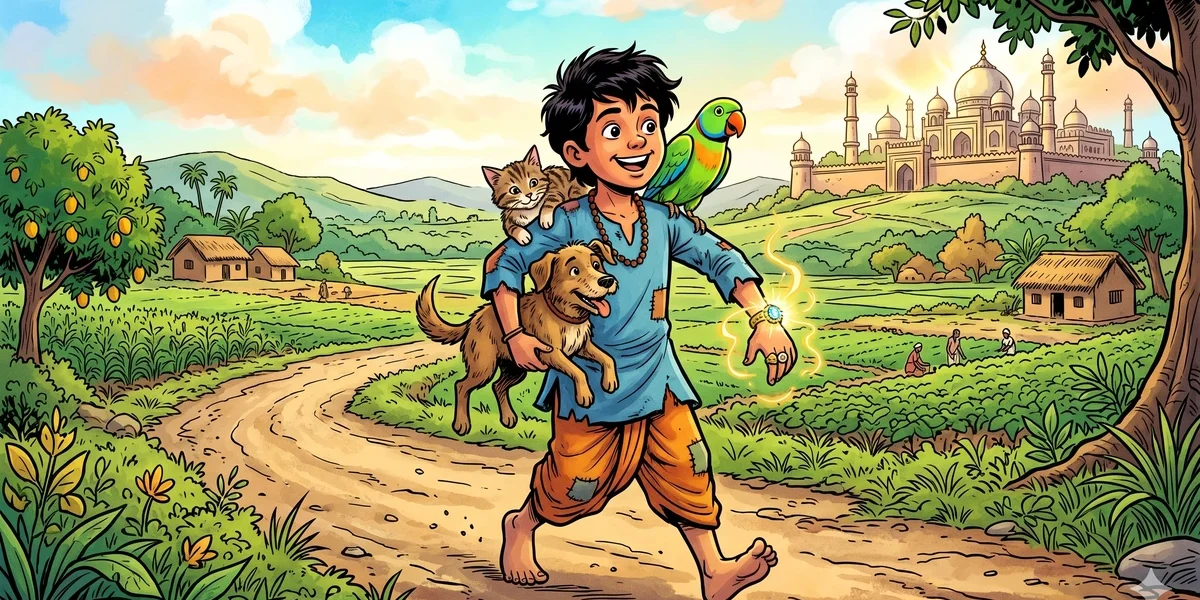
The Ring of Power: Mudrika Magic in Indian Narrative
Among the most portable and cross-culturally traveled of magical objects, the wish-granting ring appears in folk traditions from ancient Mesopotamia to Norse myth to the Arabian Nights — and in Indian folk narrative, where the mudrika (finger-ring) carries its own specific symbolic freight derived from three distinct cultural registers: gemological, royal, and tantric. A “wonderful ring” in the Indian folk context is not merely a convenient plot device but a concentrated node of power whose magical properties draw on all three registers simultaneously, making it one of the richest single objects in the folk tale repertoire.
In the royal context, the signet ring (ankusha-mudra or mudra-ring) was the sovereign’s seal of authority — the object whose impression in wax or clay gave any document the force of royal command. Kalidasa’s Abhijnana Shakuntalam turns entirely on the loss and recovery of a royal ring: Dushyanta’s ring is the material token of his recognition of Shakuntala, and without it the entire relationship collapses into unverifiable claim. The ring is identity externalized, memory made tangible, relationship preserved in metal. When a folk ring is wonderful, it is this sovereign function amplified to cosmic scale: a ring that compels not merely one king’s recognition but the universe’s compliance.
The Wish-Granting Ring and the Ethics of Desire in Indian Narrative
Indian folk tales featuring wish-granting objects — rings, lamps, vessels, or trees — invariably structure their narrative around the protagonist’s quality of desiring. The Panchatantra and Hitopadesha are explicit: the fool who receives a wish-granting boon and squanders it on trivial or selfish desires provides the comic cautionary tale; the wise person who desires what is genuinely needed (and who uses the boon for others rather than themselves) demonstrates the ethical intelligence that the magical object was, in some sense, testing for all along.
This structure encodes the Indian philosophical distinction between kama (desire in its raw, appetitive form) and viveka-kama (desire refined by discriminative wisdom). The wonderful ring does not merely grant wishes; it reveals the quality of the wishing. A ring given to someone who desires without wisdom produces disaster — the Midas-fable equivalent is attested across Indian traditions. A ring given to someone with viveka (discriminative intelligence) produces appropriate abundance, because the wishes such a person formulates are aligned with dharmic necessity rather than ego-satisfaction.
The Ring’s Journey: Loss, Recovery, and the Narrative of Identity
The wonderful ring’s narrative function typically involves at least one episode of loss followed by recovery — a structural rhythm that mirrors the Abhijnana Shakuntalam template and connects to the broader Indian narrative of viveka-khanda (the breaking of recognition). The ring is lost — through carelessness, theft, or magic — and the protagonist’s journey to recover it constitutes the tale’s middle movement. This loss-and-recovery structure is not merely plot mechanics but carries a philosophical resonance: the ring represents the protagonist’s true identity or capacity, temporarily alienated.
In the tantric tradition, rings have specific sadhana significance: certain rings, worn during practice, function as mudra-bandha (seal-constraints) that help contain and direct the energy of practice. The wonderful ring of folk narrative borrows this energetic logic: it is an object that seals, contains, and directs power — the protagonist who controls it controls the direction of flow between the human and divine domains. Its loss is a breaking of that seal; its recovery restores the protagonist’s capacity to direct power rather than be scattered by it.
Cross-Cultural Ring Lore: Aladdin, Solomon, and the Mudrika
The wonderful ring’s cross-cultural resonance is extraordinary. The ring of Solomon (Khātam Sulaymān) in Islamic tradition commands djinn and gives Solomon sovereignty over all creation; the ring of Aladdin (in some versions supplementing the lamp) provides direct access to a second djinn; Norse mythology’s Andvaranaut generates gold endlessly. The Indian mudrika of folk tale operates in this same matrix, yet its specific powers are inflected by Indian cosmology: the ring may command Nagas, Yaksha treasure-keepers, or the spirits of the five elements — each of these being specifically Indian supernatural categories.
What distinguishes the Indian version from its Abrahamic and Norse cousins is the ethical conditionality already noted: the wonderful ring’s powers are not guaranteed by mere possession but conditional on the quality of the possessor’s character and intention. This conditionality is not universal in world ring-lore — Solomon’s ring commands regardless of his virtue — but is characteristically Indian, reflecting the belief that magical power and ethical development must advance together, or the power corrupts rather than liberates.
“The ring granted every wish he spoke aloud — so he learned to wish carefully, the way one learns to speak to a fire: with respect, precision, and a clear sense of what one truly needs.”
Why This Story Lasted
The Wonderful Ring endures because the fantasy of effortless wish-fulfilment is universal, and the tale’s wisdom — that this fantasy reveals character rather than bypassing it — is precisely what the fantasy requires to be safe to entertain. The ring does not eliminate the problem of desire; it makes desire’s quality visible. Every person who has wished for something impossible has, in wishing, revealed something about themselves. The wonderful ring simply makes that revelation part of the plot, turning the fantasy of unlimited power into a mirror for the quality of the one holding it. This is what keeps the ring story fresh across generations: the magic changes, but the human who encounters it always brings themselves.
Frequently Asked Questions
What is the mudrika and why is it significant in Indian tradition?
The mudrika (finger-ring) carries significance across three Indian registers: gemological (stones’ planetary powers), royal (the signet ring as sovereign identity and authority, as in Kalidasa’s Abhijnana Shakuntalam), and tantric (rings as mudra-bandha seals containing and directing practice energy). A wonderful ring in folk narrative concentrates all three registers, making it one of the richest single objects in the Indian narrative repertoire.
How does Kalidasa’s Abhijnana Shakuntalam relate to ring stories?
Kalidasa’s play turns entirely on the loss and recovery of Dushyanta’s signet ring — the material token of his recognition of Shakuntala. Without it, the entire relationship collapses into unverifiable claim. The ring is identity externalized, memory made tangible. The wonderful ring of folk narrative amplifies this function to cosmic scale: not just one king’s recognition but the universe’s compliance.
What is the difference between kama and viveka-kama in this tale’s ethics?
Kama is desire in its raw, appetitive form; viveka-kama is desire refined by discriminative wisdom. The wonderful ring reveals the quality of wishing: someone desiring without viveka produces disaster (the Midas analogue); someone with discriminative intelligence wishes for what is genuinely needed and dharmically appropriate, producing beneficial outcomes. The ring tests the wisher as much as it serves them.
How does the Indian wonderful ring differ from Solomon’s ring or Aladdin’s ring?
The key distinction is ethical conditionality: the Indian ring’s powers are conditional on the quality of the possessor’s character and intention, not guaranteed by mere possession. Solomon’s ring commands regardless of virtue; the wonderful Indian mudrika requires viveka (discriminative intelligence) to function beneficially. This conditionality reflects the Indian belief that magical power and ethical development must advance together.
What does the ring’s loss and recovery represent structurally?
The loss-and-recovery rhythm mirrors the Abhijnana Shakuntalam template and embodies viveka-khanda — the breaking of recognition. The ring represents the protagonist’s true identity or capacity, temporarily alienated. Its loss is a breaking of the tantric mudra-seal; its recovery restores the protagonist’s ability to direct power rather than be scattered by it — transforming the middle movement of the tale into a journey back to the self.
Frequently Asked Questions
**Q: Why is this story important?**
You May Also Like
 Aesop's Fables
Ages 9-12
Aesop's Fables
Ages 9-12
The Talkative Tortoise
The dual-rooted Indian fable of Kambugrīva — "Conch-Necked," the tortoise of Phullotpala pond — and his two wild-goose friends Saṅkaṭa and Vikaṭa, who try to lift him out of a drought by carrying him on a stick. The story comes to us through two ancient traditions at once: the Buddhist Pali Canon as Kacchapa Jātaka No. 215, and the Hindu Panchatantra as Book I, Mitrabheda. It is not, as is often claimed, a tale of Aesop. T.W. Rhys Davids' 1880 translation is preserved in full alongside the Sanskrit retelling, with Sanskrit names restored, the dual-tradition origin explained, and the story's two-thousand-year journey through Pahlavi, Arabic, Persian, Hebrew, Latin, and finally La Fontaine's French traced.
 Aesop's Fables
Ages 3-5
Aesop's Fables
Ages 3-5
The Story Of The King Who Would Be Stronger Than Fate
The Story Of The King Who Would Be Stronger Than Fate: Once upon a time, far away in the east country, there lived a king who loved hunting so much that, when
 Aesop's Fables
Ages 9-12
Aesop's Fables
Ages 9-12
The Wolf in Sheep’s Clothing
The Wolf in Sheep's Clothing: In the rolling hills of ancient Macedonia, where olive groves stretched across sun-baked valleys and shepherds tended their