The City Of Paithan A Story Of Love And Duty In The Mughal Era
The City Of Paithan A Story Of Love And Duty In The Mughal Era: Close to the city of Paithan, in a small village called Sauviragram, which lay along the banks
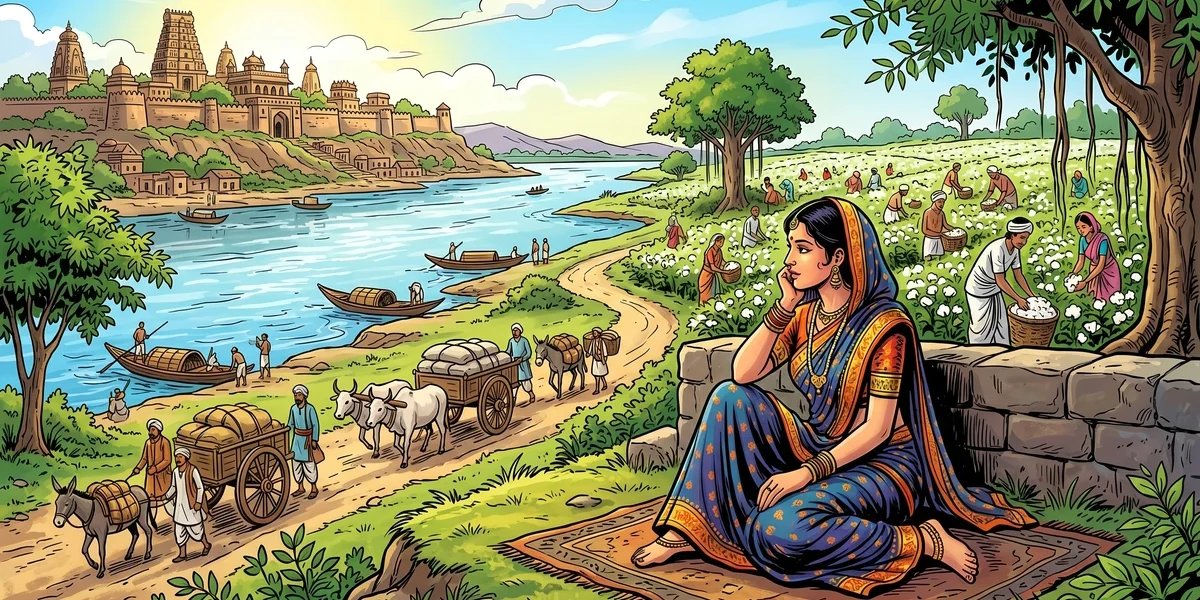
Paithan — ancient Pratishtana, city of tirthas, confluence of the sacred Godavari and the long memory of the Deccan — is not merely a setting in this folk romance. It is the first cause: the city’s very sanctity draws the stranger, and in drawing him, sets the love story in motion. Part One of this tale belongs to the threshold, to arrival, to the moment a traveller crosses into holy ground and finds his fate waiting.
I. Pratishtana: City at the Crossing of Waters and Time
The ancient city the folk tale calls Paithan has been a place of pilgrimage for over two millennia. Known in the Puranas as Pratishtana and to Ptolemy’s geographers as Plithana, it sat at the confluence of the Godavari — the Dakshin Ganga, the Ganges of the South — and the smaller Banaganga. Confluence points (sangam) are among the holiest geographies in the Indian sacred imagination: water meets water as the earthly meets the divine, and the tirtha — literally “ford” or “crossing” — becomes a liminal space where ordinary rules of identity and fate may be renegotiated.
The folk romance tradition understood this geography intuitively. A young man who arrives at a tirtha-city is already in the space of transformation. He has crossed a threshold; he is no longer entirely who he was. The Mughal-era setting of this story adds a second crossing: the political and cultural frontier between the old Deccan sultanate world and the expanding Mughal order. Paithan in the story stands at two thresholds simultaneously — sacred and historical — and the love that ignites there partakes of both.
Scholars of the nagarakhyana tradition — the genre of city-love stories — note that Indian romantic narrative frequently encodes the beloved and the city as doubles. The city is beautiful, ancient, wealthy, and spiritually potent; the beloved reflects all these qualities. To fall in love in Paithan is to fall in love with Paithan. The folk narrator exploits this doubling with precision: Part One establishes the city’s character before it introduces the heroine’s.
II. The Arriving Stranger: Structure of the Opening Movement
Indian folk romance follows a recognisable grammar of arrival. The hero — often young, often of good family but reduced circumstances, often on a journey with a stated purpose — enters a new city and there undergoes the darshana (first sight) that reconfigures his life. The stated purpose of his journey is almost always fulfilled in an unexpected way: he came for commerce and found love, or came for pilgrimage and found duty. The Paithan story follows this grammar precisely.
What the folk tradition captures, which its more literary cousins in Sanskrit kavya sometimes smooth over, is the hero’s vulnerability at the moment of arrival. He is away from home, his social identity is temporarily suspended, and the city — with its unfamiliar sounds, its festivals, its hierarchy of beauty — is both overwhelming and inviting. This suspension of normal social identity is what makes the first sight possible: he sees the heroine not through the grid of caste endogamy and arranged alliance but as a human being in a luminous city, and she is luminous too.
The Mughal period frame adds a particular poignancy to the arriving stranger motif. In an era of political reorganisation — when Deccan sultanates were being absorbed, when revenue arrangements were shifting, when old temple-town economies were adjusting to new imperial structures — the traveller might genuinely be unsure what order he was entering. Paithan’s response, in the folk tale, is to remain itself: ancient, sacred, capable of producing a love story that transcends its political moment.
III. Love at the Tirtha: Darshana and Its Consequences
The darshana motif — the transformative first sight — has roots deep in both devotional and romantic Sanskrit literature. In the bhakti tradition, to see the deity is to be changed; the devotee goes to the temple not merely to worship but to be seen in return, to enter into visual relationship with the divine. The folk romance transfers this reciprocal gaze from deity and devotee to beloved and lover, with careful preservation of its transformative charge.
When the hero first sees the heroine in the Paithan tale, the scene is typically set against a backdrop of the city’s sacred life — a festival, a ghat, a procession. This is not coincidental. The tirtha setting sanctifies the encounter: what happens at the crossing of sacred waters partakes of the crossing’s transformative power. The hero’s darshana of the heroine is simultaneously a religious experience and an erotic one, and the folk tradition, less squeamish than its courtly counterparts, does not separate these registers.
This conflation of the sacred and the erotic at the tirtha is a feature of the broader srngara-bhakti complex that scholars of Deccan folk literature have identified in stories from the Godavari basin. Love at the river ghat, love during a festival, love occasioned by pilgrimage — all these situate kama within a sacred frame that both legitimises and intensifies it. The folk narrator’s genius is to make the city itself the guarantor of the love’s authenticity.
“The river knows the pilgrim before the city does; but it is the city that keeps him.”
— Folk saying from the Godavari basin tradition
Why This Story Lasted
Part One of the Paithan story survived in folk memory because it answered a recurring human need: the need to understand how a city can change a person. The sacred geography of Pratishtana gave the tale’s listeners a real, verifiable place whose reputation for transformation preceded the story. You could go to Paithan and stand at the Godavari ghat and feel the truth of the narrative. The city was not metaphor; it was evidence. And evidence that a place can remake you — that crossing into sacred ground can reorganise your fate — is among the most consoling of folk wisdoms.
The Mughal-era setting added a layer of historical poignancy that resonated across the centuries of Marathi oral tradition. The city’s persistence through political upheaval became itself a kind of argument: if Paithan could remain Pratishtana through Mughal conquest, perhaps the love born in its shadow could persist through whatever storms the lovers faced. The city as survivor underwrote the story’s hope.
What is the historical significance of Paithan in Indian culture?
Paithan, known in antiquity as Pratishtana, is one of the oldest continuously inhabited cities in the Deccan. Mentioned in the Puranas and identified by Ptolemy, it was the capital of the Satavahana empire and a major tirtha (pilgrimage site) on the Godavari river. Its sacred status and commercial importance made it a focal point of Deccan cultural life for two millennia, and it appears frequently in Marathi folk literature as a city of transformative power.
What is the role of the tirtha in Indian folk romance?
In Indian folk romance, the tirtha (sacred ford or pilgrimage site) functions as a liminal space where ordinary social rules are temporarily suspended and transformative encounters become possible. Love kindled at a tirtha is implicitly sanctified by the sacred geography, and the beloved encountered there partakes of the city’s spiritual luminosity. This tradition draws on the bhakti concept of darshana — transformative first sight — and transfers its theological charge to the romantic encounter.
How does the Mughal-era setting affect the story’s meaning?
The Mughal period setting creates a double threshold: Paithan stands at both a sacred crossing (the Godavari tirtha) and a historical one (the absorption of Deccan sultanates into the Mughal empire). The city’s persistence as a sacred centre through political reorganisation becomes an argument for the love story’s durability. The arriving stranger’s uncertainty about the new political order mirrors his uncertainty about his own fate, making his encounter with the city — and the heroine — feel genuinely consequential.
What is the nagarakhyana tradition in Indian literature?
The nagarakhyana (city-narrative) is a sub-genre of Indian romantic literature in which the city itself functions as a major character, shaping the lover’s experience and the story’s outcome. In these narratives, the beloved and the city often reflect each other’s qualities — beauty, antiquity, spiritual depth — so that falling in love with the heroine and falling in love with the city become indistinguishable experiences. The Paithan folk romance is a vernacular example of this tradition.
How does Part One of this story differ from Part Two?
Part One focuses on arrival and the darshana moment — the city as transformer, the stranger as subject of transformation, and the love kindled in sacred space. Its narrative energy is centripetal, drawing the hero into the city’s orbit. Part Two pivots to the conflict between that love and the demands of duty (dharma), introducing the antagonistic forces that test whether love born at a tirtha can survive the pressures of honour, obligation, and political circumstance. Together the two parts form a complete love-duty cycle characteristic of Deccan folk romance.
Frequently Asked Questions
**Q: Why is this story important?**
You May Also Like
 Aesop's Fables
Ages 3-5
Aesop's Fables
Ages 3-5
The Close Alliance A Tale Of Woe
A farmer’s bullocks lead him into a crocodile-infested river—a parable of how bad companions drag the virtuous toward ruin.
 Aesop's Fables
Ages 3-5
Aesop's Fables
Ages 3-5
An Island and Art, Why? – Stories In Art
An Island and Art, Why? – Stories In Art: Bhavna sat restlessly on the wooden bench in her classroom, feet hanging in mid-air; she was shorter than most of her
 Aesop's Fables
Ages 6-8
Aesop's Fables
Ages 6-8
Lamb Wolf
Read 'Aesops Fables Lamb Wolf' — a classic Aesop's Fables story about nature and animals. In this classic Aesop’s fable, a wolf and a lamb take center s...