How Raja Rasalu Became A Jogi
How Raja Rasalu Became A Jogi: Then, after a time, Rasâlu went to Hodinagari. And when he reached the house of the beautiful far-famed Queen Sundrân, he saw an
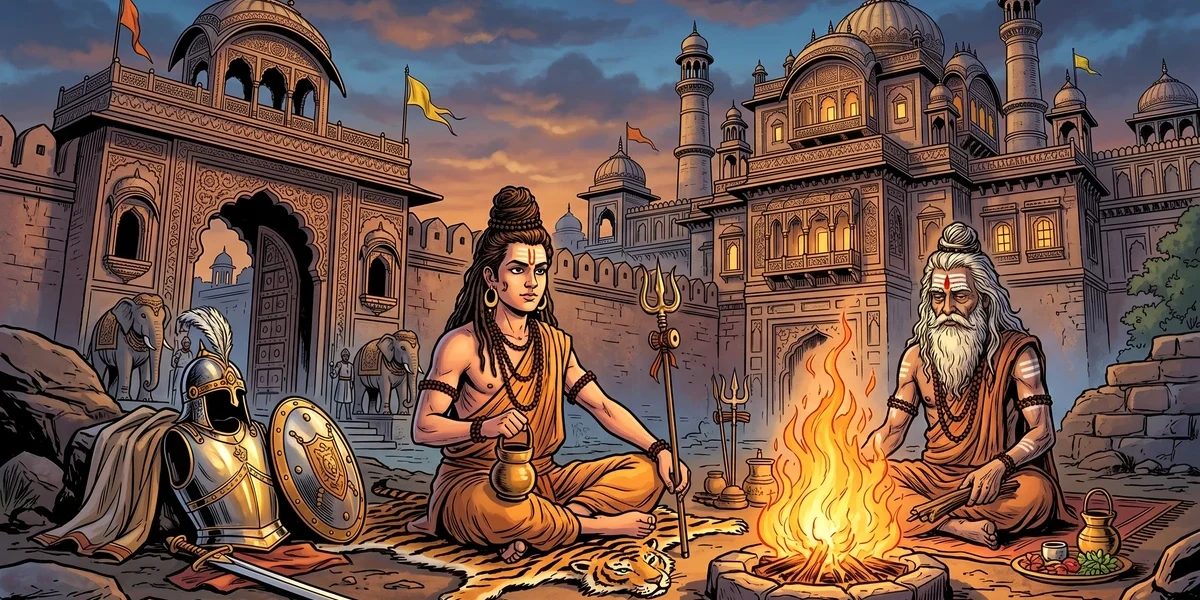
How Raja Rasalu Became a Jogi: The King Who Renounced the World and Found a Deeper Kingdom
Raja Rasalu is one of the great heroes of the Punjab folk tradition — a warrior-prince whose legend spans dozens of tales, from contests with ogres and demons to philosophical encounters with sages and saints. He is the archetypal kshatriya hero who becomes something more: a man who moves from the active life of conquest to the contemplative life of the jogi (yogi, wandering ascetic), not because he was defeated but because he understood something that victory cannot teach. The story of how Raja Rasalu became a jogi is among the most philosophically significant episodes in the cycle: it is the moment the warrior discovers that the deepest conquest is the conquest of the self.
The governing concept is vairagya—dispassion, the turning-away from the world that comes not from despair but from a superseding understanding of what is worth desiring. Rasalu does not become a jogi because the world failed him (though the world’s impermanence is part of what he sees); he becomes a jogi because he has seen enough of the world’s nature to understand what the jogi sees that the raja cannot. The renunciation is not loss but graduation: having mastered the king’s domain, he enters the domain that the king’s domain cannot encompass.
“He had won every battle, filled every storehouse, and ruled every territory he had set his eye on. Then one morning he understood that none of this was the thing he had been looking for.”
Beat I — The Hero at the Height of His Power
The transformation to jogi is only meaningful against the background of Rasalu’s achievement: he is not a failed king renouncing in defeat, but a successful one renouncing from the summit. The Punjab folk tradition is careful about this — it establishes that Rasalu has genuinely mastered the warrior’s domain before the transformation, because the philosophical point requires that the mastered domain be found insufficient rather than merely difficult. Anyone can renounce what they cannot have; the jogi tradition honours the renunciation of what has been fully possessed and found ultimately unsatisfying.
Beat II — The Encounter That Changes Him
In various versions of the tale, the transformation is triggered by a specific encounter: with a jogi or sadhu whose stillness and freedom contrast with Rasalu’s restless achievement; with the death of someone he loved and could not protect despite all his power; with a moment of insight in which the transience of everything he has built becomes suddenly, overwhelmingly apparent. The trigger is specific to the version, but its function is consistent: something cuts through the normal orientation of the warrior-king and allows him to see the world from the jogi’s perspective — not as territory to be conquered but as a passing show of impermanence, beautiful and insubstantial.
Beat III — The Renunciation and Its Meaning
When Rasalu takes up the jogi’s staff and robe, he does not lose his identity — he transforms it. The folk tradition is psychologically precise about this: a warrior who renounces is not a weakened warrior but a warrior whose courage has found a different object. The jogi’s path requires the same qualities as the warrior’s — endurance, focus, discipline, the willingness to go into dangerous territory — but directed inward rather than outward. The renunciation is not the abandonment of the warrior’s virtues but their redirection toward the conquest that the warrior’s domain cannot access: the conquest of the restless, desiring, achieving self.
Hero: Raja Rasalu — one of the great heroes of Punjabi folk narrative, associated with Sialkot (now Pakistan)
Themes: Vairagya (dispassion, turning from the world), the warrior who becomes a jogi, the insufficiency of external conquest, the inner kingdom
Related cycles: The Rasalu tales span dozens of episodes; this renunciation episode is among the most philosophically significant
Beat IV — The Deeper Kingdom
The tale implies rather than states the nature of the jogi’s kingdom: it is the kingdom of the self that has been emptied of its grasping, the inner domain that becomes available when the restless pursuit of external territory stops. This is not an easy kingdom to describe — the folk tradition gestures at it through the jogi’s freedom of movement, the respect with which even powerful kings receive wandering ascetics, the sense that the jogi carries something that all the raja’s armies cannot take and all his treasuries cannot purchase. Rasalu, having been a raja of the external world, enters the domain of the jogi as a ruler entering a realm whose size makes his former kingdom look small by comparison.
Why This Story Lasted
The story of how Raja Rasalu became a jogi has lasted because it encodes one of the deepest movements in human experience: the discovery that what one has been pursuing — achievement, power, recognition, conquest — is not actually the thing one was looking for, and the willingness to pursue the right thing even when it requires giving up everything the wrong pursuit produced. This is not a story for the young; it is a story for those who have achieved enough to understand that achievement itself is not the answer. In the Punjab tradition, Rasalu’s jogi transformation is not a sad ending but a triumphant one — the warrior who became wise enough to seek a different kind of victory.
Frequently Asked Questions
Who is Raja Rasalu?
Raja Rasalu is a legendary Punjabi folk hero, son of Raja Salbahan of Sialkot (in what is now Pakistani Punjab). His legend spans dozens of tales collected in the oral tradition and in texts like Temple’s Legends of the Punjab (1884–1903). He is associated with extraordinary martial prowess, contests with supernatural beings, romantic adventures, and philosophical encounters. He is one of the most beloved figures in Punjabi folk narrative.
What is a jogi?
A jogi (from Sanskrit yogi) is a wandering ascetic in the North Indian and Punjabi tradition — a person who has renounced worldly life and pursues spiritual liberation through discipline, meditation, and freedom from attachment. Jogis were respected figures in traditional Punjabi society, associated with wisdom, supernatural powers, and freedom from the constraints of caste and worldly obligation.
What is vairagya?
Vairagya (Sanskrit) is the quality of dispassion or detachment from worldly things — not the detachment of someone who cannot have what they want, but the detachment of someone who has understood that the things they wanted will not ultimately satisfy. It is described in the Indian philosophical tradition as a prerequisite for genuine spiritual practice. Rasalu’s transformation illustrates vairagya as it can arise for a king who has had everything.
Is this episode in the Rasalu cycle singular or common?
The theme of the warrior-hero who renounces to become an ascetic is widespread in Indian tradition — the most famous instance is Arjuna’s crisis at the beginning of the Bhagavad Gita, and the Jain tradition traces its founding to kings who renounced. Rasalu’s transformation is a Punjabi folk version of this pan-Indian archetype, giving it local colour and embedding it in the hero cycle that would be most familiar to a Punjabi audience.
What happens to Rasalu after he becomes a jogi?
In various versions of the cycle, the jogi-Rasalu continues to have adventures, but they are of a different character: philosophical encounters with other sages, interventions on behalf of the oppressed, and demonstrations of spiritual power rather than martial conquest. The folk tradition imagines the jogi as still heroic, still active, but operating on a different plane — the same virtues expressed in a different register.
Frequently Asked Questions
**Q: Why is this story important?**
You May Also Like
 Aesop's Fables
Ages 3-5
Aesop's Fables
Ages 3-5
The King and The Drum – An Indian Folktale
The King and The Drum – An Indian Folktale: Long ago there lived a king somewhere in the central part of India. He was very proud of his looks. He spent hours
 Aesop's Fables
Ages 3-5
Aesop's Fables
Ages 3-5
The Journey – A Short Story About Love and Longing
The Journey – A Short Story About Love and Longing: It was an evening of pluvial delicacy. The monsoon had set in. In the month of Sravan the sky was overcast
 Aesop's Fables
Ages 3-5
Aesop's Fables
Ages 3-5
The Gardeners Cunning Wife
The Gardeners Cunning Wife: In a certain village there lived with his wife a poor gardener who cultivated greens in a small patch in the backyard of his house.