Story Camp – A Creative Journey For Budding Wordsmiths
Discover how the Story Camp of 2017 transformed children into active storytellers and writers through the power of narrative.
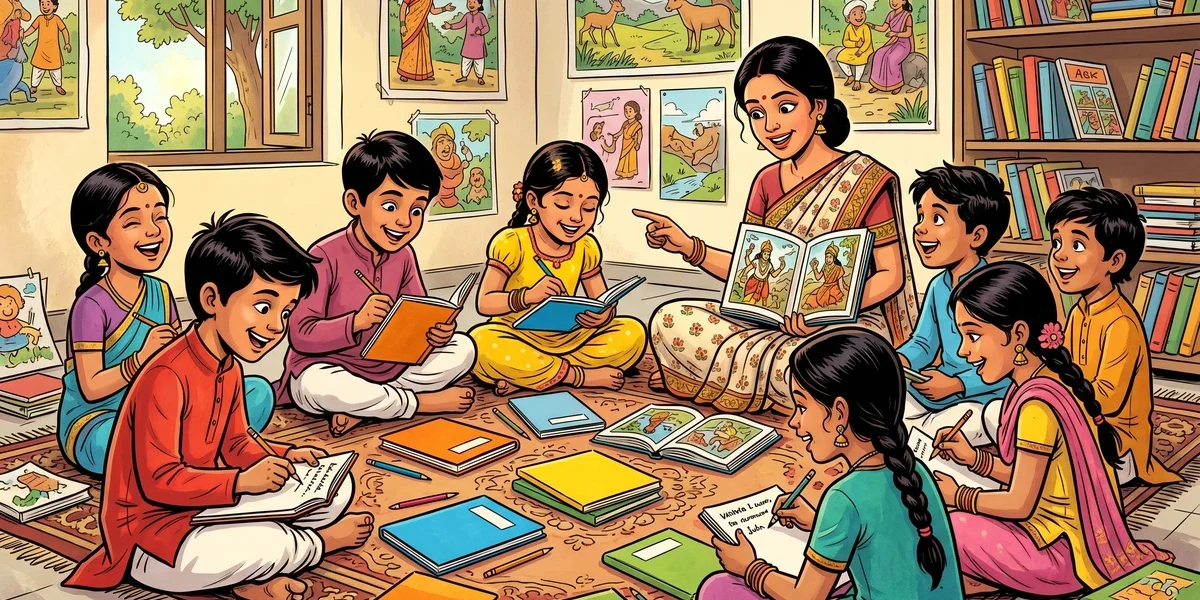
Story Camp: Kathā-Shilpa and the Ancient Art of Learning to Tell
The Wordsmith’s Apprenticeship: An Ancient Institution
The idea that storytelling is a craft — something that can be learned through sustained practice, structured mentorship, and community feedback — is as old as storytelling itself. Long before the modern writing workshop or creative writing program, every major storytelling tradition maintained deliberate institutions for the transmission and development of narrative craft.
In ancient India, the tradition of kathā (story, narrative) was embedded in the gurukula system — the residential apprenticeship in which students lived with and served a guru, learning through prolonged exposure, imitation, guided practice, and graduated responsibility. The great storytelling compilations of the tradition — the Panchatantra, the Kathāsaritsāgara (The Ocean of the Streams of Story), the Hitopadesha — were themselves explicitly pedagogical: stories embedded within stories, the outer frame being a teaching context (a king asking a sage to educate his sons, a teacher instructing students) that licensed the stories within as instruments of practical wisdom.
In Celtic bardic tradition, the training of the filid (poet-seers) lasted twelve years and included the memorisation of hundreds of stories in strict sequence, the mastery of poetic metres, and the study of history, law, and genealogy. The fully trained ollam (master poet) was expected to know 350 stories exactly — their plots, their details, their proper occasions. This was not rote recitation but the acquisition of a deep structural competence: knowing the stories in their bones allowed the bardic practitioner to improvise, adapt, and create new stories within the tradition’s formal constraints.
In the Arabic tradition, the institution of the storyteller (hakawati) in the coffeehouses of Cairo, Damascus, and Baghdad transmitted narrative craft through years of listening, apprenticeship, and gradually expanded performance — first the simple stories, then the longer ones, then the frame narratives of the Thousand and One Nights in their full elaboration. The hakawati learned to read audiences, to pace, to build suspense, to know when to speed and when to linger. These were teachable skills, and they were taught.
What Story Camp Teaches: The Craft Elements of Narrative
The modern story camp or writing workshop for young people participates in this ancient tradition of deliberate narrative apprenticeship, even when it does not know its own lineage. What the young wordsmith learns at story camp — in whatever form that camp takes — is a set of craft elements that have been understood and transmitted, in various vocabularies, across all these traditions.
The first is the story’s essential architecture: beginning, middle, and end in their deep structural sense. The beginning establishes a character in a world; the middle introduces the trouble that disrupts that world; the end resolves the trouble, transforming either the character, the world, or both. This three-part structure — called by Russian formalists fabula and sjuzhet, by the Sanskrit tradition bija (seed), bindu (point), and phala (fruit) — is not a convention but a biological fact about how human minds process experience. Stories that follow this structure are remembered; those that violate it are felt, even by very young listeners, to be unsatisfying.
The second element is character: the felt sense that the person at the centre of the story has desires, fears, and a consistent way of being in the world that makes their choices feel inevitable and surprising at the same time. Character is what transforms plot into story: without it, events simply happen; with it, events happen to someone, and we care. The bardic traditions, the gurukula, and the modern workshop all teach character through the same exercise: describe what this person wants, what they fear, and what they are willing to do — and the story will follow.
The third element is detail — the specific, concrete, sensory particular that makes the story inhabitable rather than merely reportable. “The monkey sat in a tree” is reportable; “the monkey sat in the high fork of the rose-apple tree, its tail curled around a branch, its eyes on the silver river below” is inhabitable. The great storytelling traditions have always known that the path to the universal runs through the specific: the detail that is precisely right opens into resonance that the general statement never can.
“Every story you read is teaching you how to write. Every story you write is teaching you how to read. The two are the same practice, and both require the same thing: patient attention to how the thing is made.”
The Community of Practice: Why Storytelling Cannot Be Learned Alone
One of the most important things any story camp or writing workshop provides — and one of the things that distinguishes deliberate apprenticeship from solitary practice — is community. The young wordsmith writing alone in a room has access only to their own sense of how the story is landing; the young wordsmith reading their work aloud to listeners, or receiving responses to a draft, has access to the audience’s actual experience of the story. These are entirely different kinds of information, and the second is indispensable.
The ancient storytelling traditions understood this. The hakawati performing in the coffeehouse got immediate feedback from the audience — laughter, silence, the restlessness that signals a story is losing its grip, the held breath that signals it has found the right moment. The bardic apprentice performed before the community of the filid and received critique from the master. The gurukula student told stories in the assembly of the ashram and learned from the response of the other students and the guru’s commentary. In each case, the community of practice provided the feedback loop that solitary practice cannot generate.
The modern writing workshop, at its best, provides the same thing: a structured community of readers who give the writer access to their own experience of the work. This is often uncomfortable — the story one thought was clear is not understood; the character one thought was sympathetic is found annoying; the climax one thought was earned feels rushed. This discomfort is the core learning. The gap between the story in the writer’s head and the story the reader receives is the precise location of the craft work that needs to be done.
The Courage of the Unfinished Draft: What Young Wordsmiths Most Need
Of all the things a story camp offers its young wordsmiths, the most important may be the most invisible: permission to be unfinished. The young writer’s greatest enemy is not lack of talent but premature judgment — the internal critic that compares the first draft to the finished works they have read and finds it wanting, and concludes from this comparison that they are not writers.
Every experienced writer knows that the first draft is always unfinished; that the gap between the first draft and the final work is where most of the writing actually happens; and that the feeling of inadequacy in the face of a first draft is not a sign of incapacity but a sign of taste — the taste that will eventually enable the writer to revise toward the vision they carry. The Indian concept of abhyasa (sustained practice, patient repetition) captures what is needed: not a sudden breakthrough to competence but the steady accumulation of practice over time, each story a little clearer than the last, each draft a little closer to the intention.
Story camp, at its best, creates the conditions for abhyasa in narrative: a protected time and space in which the young wordsmith can write without the pressure of immediate judgment, share without the fear of permanent evaluation, and receive feedback that distinguishes the work from the worker. The story is not yet good; the writer is not yet finished; both can improve, and neither has failed. This is the culture of the healthy apprenticeship, and it is what produces writers — not the sudden recognition of genius, but the patient cultivation of craft in community.
Why This Story Lasted
Stories about learning the craft of storytelling have an unusual reflexive quality: they are stories about stories, and in telling us about the making of narrative, they are themselves demonstrating what they describe. The story of the young wordsmith discovering their voice, finding their community of practice, learning to tolerate the gap between intention and execution — this is a story every writer recognises, at every stage of their development. It persists because the experience it describes is genuinely universal among those who try to learn the craft of telling, and because the encouragement it offers — that craft is learnable, that community helps, that patience is the key — is always needed and never quite sufficiently believed.
Frequently Asked Questions
What is the gurukula tradition of learning and how does it relate to storytelling?
The gurukula (Sanskrit: guru = teacher, kula = family/household) was the traditional Indian system of residential education in which students lived with a teacher for years or decades, learning through sustained immersion rather than formal coursework. In the context of storytelling and narrative arts, gurukula transmission meant prolonged exposure to a master storyteller’s repertoire, gradual entrusting of performance responsibility, and the internalization of craft through lived example rather than explicit instruction. The Kathāsaritsāgara, Panchatantra, and other great narrative compilations were explicitly associated with this pedagogical tradition — stories taught through stories, wisdom embedded in entertainment.
What did Celtic bards learn in their apprenticeship?
The Irish and Welsh bardic traditions involved extended formal apprenticeships lasting up to twelve years. Students (filid) were expected to memorise a progressively expanding repertoire of stories — starting with simpler narratives and working toward the most complex and prestigious. They also studied history, law, genealogy, poetic metres, and ritual protocol. The fully trained ollam (master poet) was expected to know at least 350 stories in exact detail and to command the full range of bardic functions: praise poetry, satirical poetry, commemorative narrative, and genealogical record-keeping. The tradition recognised that the development of narrative mastery required years of systematic, graduated practice in a structured community context.
What are the basic craft elements that all storytelling traditions share?
Despite their vast differences in cultural context and formal convention, storytelling traditions across the world share recognition of a core set of craft elements: narrative structure (beginning, complication, resolution), character (a being with consistent desires, fears, and ways of responding), specificity (concrete sensory detail that makes the story inhabitable), voice (the particular quality of the telling that distinguishes this story from all others), and pacing (the management of speed and density across the story’s arc). Different traditions emphasise these elements differently, but all recognise them as learnable components of the craft — things that can be studied, practiced, and improved.
What is “abhyasa” in Indian philosophy and how does it apply to creative practice?
Abhyasa (अभ्यास) is a Sanskrit term meaning sustained practice, patient repetition, or continuous effort over time. In Patanjali’s Yoga Sutras (1:13), abhyasa is defined as “the effort to attain steadiness” — the disciplined, repeated application of attention and effort to a practice over a long period, without premature expectation of results. Applied to creative practice, abhyasa describes the kind of patient, consistent engagement with the craft of writing or storytelling that produces genuine development: not a sudden breakthrough but a steady deepening through accumulated practice. The tradition consistently holds that abhyasa, combined with vairagya (non-attachment to results), is the fundamental condition for mastery in any skill.
How can parents support a child who wants to develop as a writer or storyteller?
Research and practitioner experience in creative development consistently identify several supportive practices: providing time and protected space for writing without immediate evaluation; being a genuinely interested listener and reader rather than a critic; asking questions about the story (what happens next? why does the character do that?) rather than evaluating its quality; connecting the child with communities of peer writers (writing groups, story camps, school literary magazines); exposing them to a wide range of stories across genres and traditions; and modelling the acceptance of imperfection by sharing one’s own creative attempts. The most powerful thing a parent can communicate is that the effort of making stories is valuable independent of the quality of any particular result.
Frequently Asked Questions
**Q: Why is this story important?**
You May Also Like
 Aesop's Fables
Ages 6-8
Aesop's Fables
Ages 6-8
The Rats Wedding
A charming Punjabi folk tale about a little rat who swaps his way from a piece of root to a noble bride — and a famous lesson about honesty in trade.
 Aesop's Fables
Ages 6-8
Aesop's Fables
Ages 6-8
Lamb Wolf
Read 'Aesops Fables Lamb Wolf' — a classic Aesop's Fables story about nature and animals. In this classic Aesop’s fable, a wolf and a lamb take center s...
 Aesop's Fables
Ages 3-5
Aesop's Fables
Ages 3-5
How Raja Rasalu Became A Jogi
How Raja Rasalu Became A Jogi: Then, after a time, Rasâlu went to Hodinagari. And when he reached the house of the beautiful far-famed Queen Sundrân, he saw an