The Story Of The King Who Would See Paradise
The Story Of The King Who Would See Paradise: Once upon a time there was king who, one day out hunting, came upon a fakeer in a lonely place in the mountains.
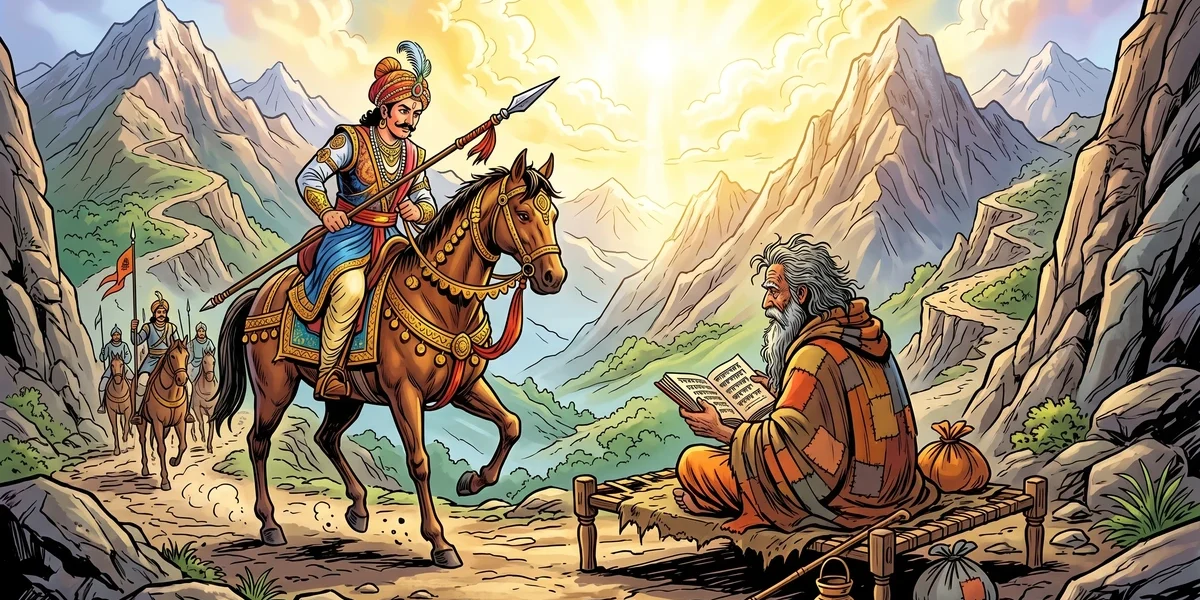
The King’s Impossible Desire: Seeing Paradise While Living
Among the most audacious desires a monarch could entertain in Indian folk narrative is the wish to behold svarga — paradise, the celestial realm — while still dwelling in mortal flesh. This tale belongs to a distinctive sub-genre of Indian story: the divya-darshana narrative, in which a human being seeks direct vision of a sacred realm ordinarily inaccessible to the living. The king’s desire is not irreverent; it is, in the Indian theological frame, actually the most natural of all yearnings. If the soul’s deepest identity is divine (aham Brahmasmi — “I am Brahman”), then the wish to see the divine realm is not vanity but recognition — the homesickness of a soul temporarily exiled in flesh.
Yet the tale also knows that this desire, however metaphysically legitimate, is structurally problematic for a mortal king. Paradise is the domain of the gods, of purified souls, of beings whose karma-account has reached the credit necessary for that altitude. A king — however righteous — is embedded in the world of action and consequence. His very power is a web of attachment that binds him to the lower realms. The tale thus sets up an irresolvable tension: the most human of spiritual longings expressed by the most worldly of human archetypes.
Svarga-Loka in Indian Cosmography: What Paradise Actually Is
Indian cosmography describes a layered universe of fourteen worlds — seven above and seven below the human plane — with svarga-loka occupying the celestial register above the human but below the highest brahmaloka. In the Puranas, svarga is Indra’s realm: populated by Apsaras (celestial dancers), Gandharvas (divine musicians), and the devas (gods), characterized by abundance, beauty, and freedom from the suffering that defines mortal life. Crucially, svarga is not eternal: Puranic cosmology teaches that beings dwell there until their accumulated merit (punya) is exhausted, then return to lower births. It is heaven as a temporary reward, not as final liberation.
This Puranic nuance gives the tale a philosophical sophistication unavailable to audiences unfamiliar with it: when the king desires svarga, he is not desiring moksha (liberation) but a particularly beautiful transit lounge. The sage or teacher who ultimately redirects him toward the kingdom within — the interior paradise of realized self — offers him something genuinely superior: not a temporary reward-realm but the recognition of what was never separate from him. This redirection is the tale’s philosophical pivot.
The Sage’s Redirect: Paradise as Inner Realization
The tale’s resolution — in most variants — involves a wise figure (sage, ascetic, or divine messenger) who demonstrates to the king that the paradise he seeks is not a location to be reached by journey but a state to be recognized by transformation. This teaching maps directly onto the Upanishadic concept of the antaryamin — the inner ruler, the divine presence dwelling within the heart of every being. The Chandogya Upanishad’s famous declaration, “Tat tvam asi” (That thou art), is the philosophical ground on which the sage builds: the king already IS the divine he seeks to see; the quest is not spatial but perceptual.
This philosophical move — collapsing the distance between seeker and sought — is the characteristic gesture of Indian non-dual philosophy (advaita). It does not dismiss the king’s desire as foolish but reveals it as profoundly correct in direction yet mistaken in orientation: he is looking outward (toward a realm) for what can only be found inward (as a recognition). The tale thus performs a classic Vedantic teaching through narrative drama, making the abstract concept of self-realization emotionally accessible through a king’s concrete and relatable longing.
Royal Pilgrimage and Its Limits: When Power Cannot Purchase the Sacred
One of the tale’s implicit arguments concerns the limits of royal instrumentality. The king’s habitual mode of operation is command-and-achieve: he wants something, he mobilizes resources, the thing is accomplished. This works for armies, palaces, and grain stores. It does not work for paradise. The tale specifically stages the king’s attempts to reach svarga through royal means — expeditions, sacrifices, payments to priests — and demonstrates their systematic failure. This failure is not a critique of kingship but of the category error involved in applying political instrumentality to spiritual attainment.
The Sanskrit concept of adhikara (qualification or eligibility) is operative here: certain realms and realizations require specific spiritual preparation, not material investment. The king’s wealth is precisely irrelevant to his quest — a democratic lesson embedded in an aristocratic tale. The poorest village ascetic who has achieved inner stillness is closer to paradise than the richest king who has not. The tale democratizes the sacred without undermining the social order — it does not say kings are inferior, but that their power does not extend to the one domain that matters most.
“He searched for paradise in every direction the compass offered — and found it, at last, in the only direction he had not yet looked: inward.”
Why This Story Lasted
The Story of the King Who Would See Paradise endures because the king’s desire is everyone’s desire, regardless of rank. The longing for a state of perfect beauty, abundance, and freedom from suffering is universal; only the particulars of the quest differ by century and culture. The tale’s genius is its redirection: it does not dismiss paradise as illusion, nor locate it at an impossible cosmic distance, but reveals it as the innermost nature of the seeker. This teaching — that what we most deeply seek is what we most fundamentally are — is perhaps the most subversive and liberating message any folk tale can carry. Every generation rediscovers it as if for the first time, because each must make the inward turn for themselves.
Frequently Asked Questions
What is svarga-loka in Indian cosmography?
Svarga-loka is Indra’s celestial realm in Puranic cosmography — populated by Apsaras, Gandharvas, and devas, characterized by beauty and abundance. Crucially, it is not eternal: beings dwell there until their accumulated merit (punya) is exhausted, then return to lower births. It is heaven as temporary reward, not final liberation (moksha).
How does the sage redirect the king toward inner paradise?
The sage teaches that paradise is not a location to be reached by journey but a state recognized through transformation — the Upanishadic antaryamin (inner ruler). Drawing on “Tat tvam asi” (That thou art), the sage reveals that the king already IS the divine he seeks: the quest is not spatial but perceptual, a turn from outward searching to inward recognition.
Why can royal power not purchase paradise in this tale?
The Sanskrit concept of adhikara (spiritual eligibility) is operative: certain realizations require inner preparation, not material investment. The tale stages the king’s use of armies, sacrifices, and priestly payments — and their systematic failure — to demonstrate the category error of applying political instrumentality to spiritual attainment. A poor ascetic with inner stillness is closer to paradise than the wealthiest king without it.
What Vedantic philosophy underlies this folk tale?
The tale embodies advaita (non-dual) Vedanta — specifically the Chandogya Upanishad’s “Tat tvam asi” (That thou art). The sage collapses the distance between seeker and sought, revealing that the divine realm is not external but identical with the seeker’s innermost nature. The king’s outward quest is thus correct in desire (toward the divine) but mistaken in orientation (outward rather than inward).
Is svarga the same as moksha in Indian tradition?
No — svarga and moksha are fundamentally different. Svarga is a temporary reward-realm where accumulated merit (punya) is enjoyed before rebirth. Moksha is permanent liberation from the cycle of birth and death. The sage’s redirect in the tale offers something superior to svarga: not a temporary paradise but recognition of the self’s identity with Brahman — which is the essence of moksha.
Frequently Asked Questions
**Q: Why is this story important?**
You May Also Like
 Aesop's Fables
Ages 9-12
Aesop's Fables
Ages 9-12
Echo and Narcissus – A Roman Mythological Tale
Echo and Narcissus – A Roman Mythological Tale: Echo was a beautiful nymph. She was very fond of the woods and hills and loved to play there. But she had one
 Aesop's Fables
Ages 9-12
Aesop's Fables
Ages 9-12
The Lord Of Death
The Lord Of Death: Once upon a time there was a road, and every one who travelled along it died. Some folk said they were killed by a snake, others said by a
 Aesop's Fables
Ages 3-5
Aesop's Fables
Ages 3-5
The Wooden Boy’s Lessons in Honesty
Geppetto’s latest blog entry: Some weeks ago, I visited a good friend and saw that he had a bit of plastic, which he wasn’t using. So I asked him for it, he