The Oak and the Reed
The Oak and the Reed: Along the banks of a slow, meandering river, there grew two very different plants in close proximity to one another. One was a mighty oak

This is one of the most quietly philosophical of all the fables in the Aesopic corpus — a small clear teaching-story, set on the bank of a Greek river, in which a great proud oak tree and a slender humble reed have a brief disagreement about the meaning of strength, and a wild storm passes through the riverbank that afternoon to settle the disagreement once and for all. The fable belongs to Aesop, the Greek storyteller of the sixth century BCE, in whose corpus it is catalogued as Perry 70 under the Greek title Drys kai Kalamos — “The Oak and the Reed.”
The principal Greek source-form survives in the Augustana recension of the prose Aesopica (1st-2nd c. CE). It was retold in Greek choliambic verse by Babrius as Fable 36 in the second century CE. It came down through the medieval Romulus collections and Walter of England’s verse-Aesop into modern English through William Caxton’s first printed Aesop in 1484, then Roger L’Estrange (1692), Samuel Croxall (1722), Thomas Bewick (1818), and Joseph Jacobs (1894). Jean de La Fontaine retold it as Book I Fable 22 of his celebrated French Fables (1668) — Le Chêne et le Roseau, often considered one of his finest fables. ATU type 298C. The teaching of the bending reed is also a central image of Tao Te Ching chapter 76, attributed to Laozi (sixth century BCE) — written, remarkably, in roughly the same century as Aesop, on the other side of the world.
This is the story.
The Boast of the Oak

It happened, the old tellers said, on the bank of a small clear river that ran through a green Greek valley in central Greece, on a bright still summer afternoon. On the high firm ground above the river bank, there grew a magnificent oak tree — a great old oak with a trunk as thick as the bodies of three grown Greek men set together, with rough grey bark furrowed deep by a hundred and forty winters, with a wide crown of dark glossy green oak leaves that cast a great pool of cool shade for half a stadium around. The oak was, in his own opinion, the king of the riverbank. The oak was, in his own opinion, perhaps the king of all of central Greece.
And on the soft muddy lower ground at the very edge of the slow blue river, there grew a single slender reed — a small green hollow reed of perhaps a man’s own height, bending easily this way and that with every passing breath of wind off the surface of the water, swaying with the dragonflies, dipping with the kingfishers, never still for more than a passing breath at a time.
The great oak, looking down from his high firm ground at the small bending reed by the river’s edge, said one bright afternoon, in the slow heavy way of great oaks: “Reed — small cousin — how I pity you. The smallest sparrow that lands on the smallest twig of you bends you like a young child. The smallest breath of wind off the river makes you tremble like a frightened deer. Look at me, by contrast: my roots go down through the earth a hundred and twenty feet. My trunk is the thickness of three men. My crown is the kingdom of the eagles. The strongest gale that ever blew off the Aegean Sea in two centuries has not so much as rustled a single leaf in my crown. That — small cousin — is what strength looks like. That is what root and trunk and grip mean. I am sorry for you. I am genuinely sorry for you.”
The slender reed, swaying in the small afternoon breeze off the slow blue river, did not say very much in reply. The reed was a small humble creature, used to bending. The reed said only — quietly, in the slow patient way of small humble creatures — “Yes, cousin. You are very strong. I am very small. I have no quarrel with you.”
The Wind Begins

And the bright still summer afternoon, the old tellers said, did not stay still very long. The great oak’s pride had hardly finished settling back into the still summer air when there came — first as a small whisper from the far north over the green hills — and then as a slow rising murmur through the leaves of the cypress trees on the upper slopes — and then, all at once, as a great wild grey storm-wind off the wild north Aegean Sea — one of the great mountain gales of the kind that sailors and farmers of central Greece have known and feared for thirty centuries.
The wind came down upon the green river valley with a great roaring grey wall. The slow blue river, which had been mirror-still a moment before, was suddenly whipped into a thousand small white angry waves. The dragonflies were blown clean out of the sky and into the long grass of the bank. The kingfishers fled, low and fast, into the shelter of the willows on the far side. The bright still summer afternoon, in a single long minute, became a great wild grey afternoon of war.
And the great oak — the king of the riverbank, the proud cousin, the boaster of root and trunk and crown — set his rough grey bark, locked his hundred-and-twenty-foot roots into the deep dry firm ground above the river, and prepared, with the slow heavy certainty of a great proud oak, to do what he had always done with every storm of the last hundred and forty winters: to stand.
The slender reed by the river’s edge — the small humble creature who had been pitied a moment before — set his soft green hollow stem, kept his small flexible roots in the soft muddy bank, and prepared, with the slow patient certainty of a small humble reed, to do what he had always done with every storm of his short young life: to bend.
The Oak Stands and Falls
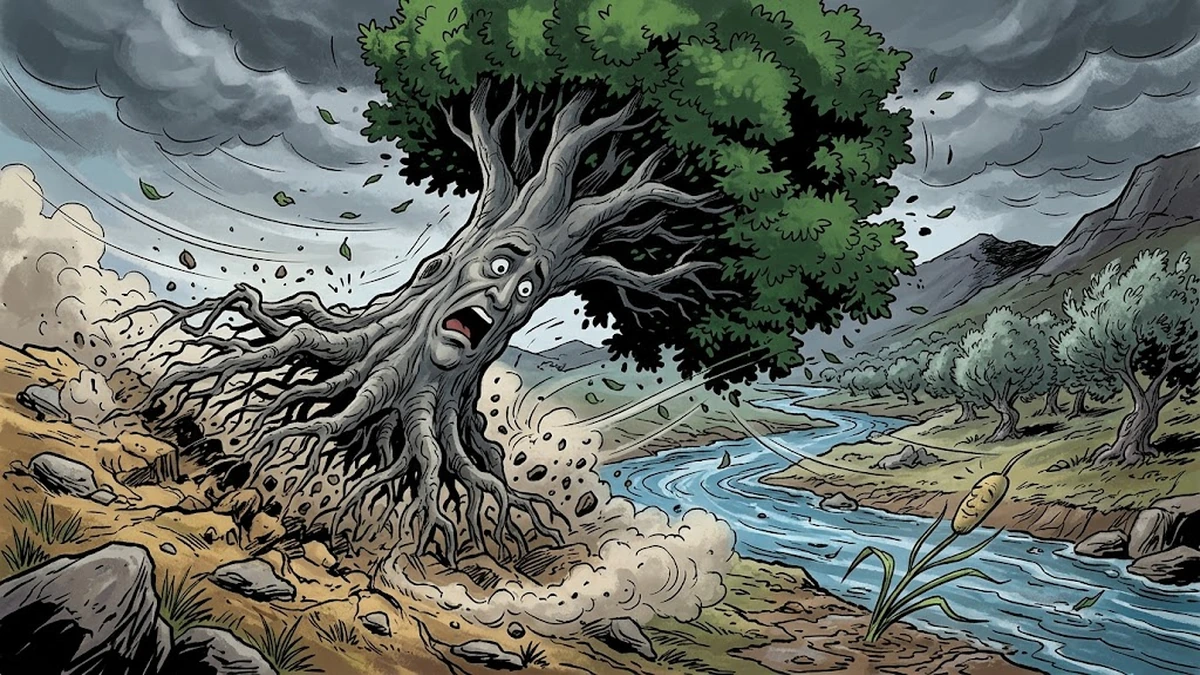
The great wild grey storm-wind, the old tellers said, hit the riverbank like the wind that had wrecked the Phoenician fleet at the battle of Salamis. It hit the great oak in his proud high crown with the full force of every cold north Aegean gale that had ever blown. The oak, locking his hundred-and-twenty-foot roots, set his great grey trunk against the wind, and stood.
The wind blew harder. The oak stood.
The wind blew harder still. The oak — the great proud king of the riverbank — held himself rigid, and stood.
The wind blew with the full wild force of every great storm that had ever come down off the cold north Aegean Sea since the days when the gods themselves were young — and this time the great oak’s hundred-and-twenty-foot roots, locked deep into the dry firm ground above the river, suddenly tore — with a great wrenching grey root-deep CRACK that shook the entire valley — clean out of the earth.
The great oak, the king of the riverbank, the boaster of root and trunk and crown, fell — slowly and majestically and uselessly — across the green grass of the upper bank, his crown crashing down into the water of the river, his great grey trunk lying broken across the soft muddy edge, his hundred-and-twenty-foot roots, snapped and ragged, exposed to the wild grey afternoon sky.
The slender reed — the small humble creature, the cousin who had been pitied a moment before — bent. He bent low. He bent flat to the river’s surface. He bent until the tip of his green head touched the muddy water at his roots. The wind howled over him. The storm screamed past him. And the slender reed — flexible, humble, soft, hollow, small — bent and survived.
After the Storm

The wild grey storm passed off the green river valley, the old tellers said, in perhaps a quarter of an hour. The cold north wind, having taken its great oak, retreated back over the green hills toward the north Aegean Sea. The bright sun came out again. The dragonflies returned to the river. The kingfishers crept back to the willows. The slow blue river settled, a few minutes later, back into its mirror-still afternoon.
And the slender reed — the small humble cousin, the survivor — slowly straightened himself up, in the bright returning afternoon sunlight, on the soft muddy bank by the slow blue river, looked down at the great proud broken oak lying on his side with his roots in the air, and did not — the old tellers said — say very much. The reed was a small humble creature. The reed was used to bending. The reed had no quarrel with the oak, even now.
The reed said only — quietly, in the slow patient way of small humble survivors, with the small clear sad voice of a creature who has just watched a great proud cousin meet the consequence of his own great proud certainty — “I am sorry, cousin. The wind that uprooted you was the wind I bent under. We are not, in the end, so different. We met the same storm. We answered the storm in different ways. The cost of my answer was a moment of bending. The cost of yours was your life.”
And the great proud broken oak, the old tellers said, lying on his side with his roots in the air on the wild grey afternoon riverbank, did not — could not, ever again — say anything in reply.
The Moral
The Greek prose Aesopica preserves the moral in this form:
“Ho mythos deloi hoti tois kairois eikein tou antiteinein kreitton.”
“The fable shows that yielding to the moment is better than resisting it.”
And La Fontaine, in his celebrated French verse Fable I.22 (1668) — often called the finest of all his fables — preserves the same teaching in two of his most memorable lines: “Je plie, et ne romps pas” — “I bend, and I do not break.” The pithy modern English form, descending through Croxall and Jacobs:
“The reed bent, and so survived. The oak stood, and so was broken.”
Or simply: “Better to bend than break.” The Sanskrit teachers in India taught the same teaching in the language of the Bhagavad Gita: vinayena yujyate — “by humility one is fitted.” And the Tao Te Ching of Laozi, written in roughly the same century as Aesop on the other side of the world, says it more clearly than any other ancient teacher: “The hard and stiff will be broken. The soft and supple will prevail.” (Chapter 76.)
Why This Story Has Lasted
It has lasted for two and a half thousand years because every adult who has ever, in his life, tried to stand rigid against a great storm of life — a sudden loss, a great change, a sweeping reform, a wild new wind — and watched the rigid stand cost him more than he could afford to pay — already knows, in his bones, the great wrenching grey root-deep crack of the oak’s roots tearing out of the dry firm ground, and the slow patient bend of the small humble reed at the river’s edge. The fable is not really about trees. The fable is about postures. The fable is about responses. The fable is about every human being who has ever, in all of history, faced a great storm of change and had to choose between rigid pride and humble flexibility.
Two and a half thousand years after Aesop, the small clear voice of the slender reed at the river’s edge is still telling us, in our own age of fast change and wild new winds, the same old quiet lesson: bend. Bend low. Bend humbly. Bend with the wind. The storm will pass. The mirror river will return. The bright sun will come out again. And the small humble bender will still be standing on the muddy bank when the great proud stander has been laid out flat across the grass with his roots in the air.
You May Also Like
 Aesop's Fables
All Ages
Aesop's Fables
All Ages
The Lamb and the Wolf
The Lamb and the Wolf: In a bustling town in ancient India, A young lamb encountered a hungry wolf at a stream. This tale, beloved across generations, carries
 Aesop's Fables
Ages 9-12
Aesop's Fables
Ages 9-12
Echo and Narcissus – A Roman Mythological Tale
Echo and Narcissus – A Roman Mythological Tale: Echo was a beautiful nymph. She was very fond of the woods and hills and loved to play there. But she had one
 Aesop's Fables
Ages 3-5
Aesop's Fables
Ages 3-5
The Fate of the Turtle
A Panchatantra tale where a talkative turtle breaks his promise to stay silent and pays with his life.