The Children of Odin: How Sif Lost Her Hair
The Children of Odin: How Sif Lost Her Hair: In Asgard, the great realm of the gods where immortal beings dwelt in golden halls and the boundaries of How Sif

Among the Norse myths, few are as quietly consequential as the tale of how Sif lost her golden hair. It begins as a petty act of vandalism and ends with the gods of Asgard holding in their hands the very treasures that would define them: Odin’s spear, Frey’s ship and boar, Odin’s self-multiplying ring, and above all Mjolnir, the hammer of Thor. The story is preserved in the Prose Edda, the great handbook of Norse poetry compiled in Iceland around 1220 by the chieftain and historian Snorri Sturluson. It appears specifically in Skáldskaparmál (“The Language of Poetry”), the section in which Snorri explains the mythic origins of the kennings that poets used. The retelling most readers know in English comes from Padraic Colum’s The Children of Odin (Macmillan, 1920), which gathered the Eddic material into a continuous narrative for younger readers. Folklorists classify the central episode under motif D1711 (magician) and the broader smith-and-wager pattern under H501/N2-class wager motifs; it is not a wonder-tale of the Aarne–Thompson–Uther catalogue but a creation myth of objects, an aetiology explaining where the divine regalia came from.
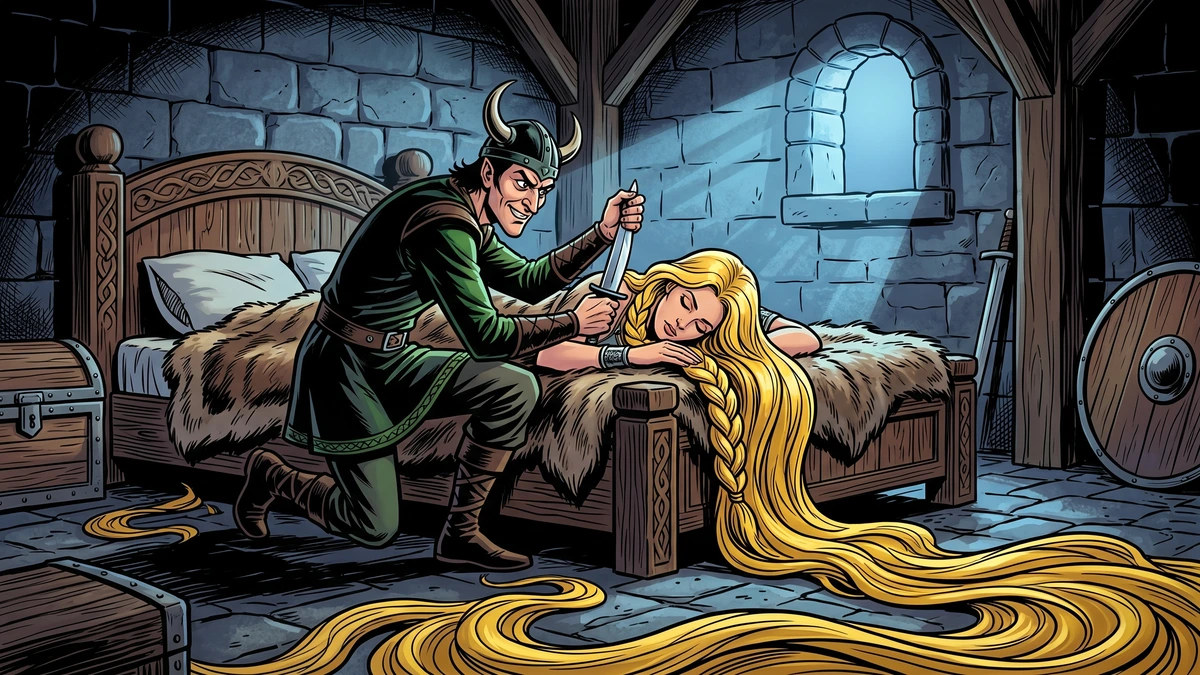
A Sleeping Goddess and a Trickster’s Knife
The story opens in Asgard, the high realm of the Aesir, where Thor the thunder-god lived with his wife Sif. Sif was a goddess associated with the earth and its harvests, and her defining feature was her hair: long, heavy, and golden, falling to her feet like ripened grain catching the light. In the symbolic grammar of Norse myth this hair was no mere ornament. Gold hair on a harvest-goddess stood for the wheat of summer, for fertility and abundance, for the gold of the fields that fed gods and mortals alike. To touch it was to touch the prosperity of the world.
Loki, the trickster, lived among the Aesir as a perpetual irritant. He was clever past all measure and restless past all patience, and he delighted in mischief for its own sake. Snorri’s text is blunt about his motive: he did it til lævísi, “out of love of mischief,” with no grievance to excuse him. One night, while Sif lay sleeping, Loki crept into the chamber she shared with Thor, drew a sharp knife, and cut away every strand of her golden hair, leaving her cropped and bare. Then he slipped out into the dark, pleased with the cruelty of his own joke.
When Sif woke and saw what had been done, she wept — not from vanity but from a kind of grief, for the hair had been part of who she was, and now it was gone. The shame of it kept her hidden away. And when Thor learned the truth, the thunder-god’s rage was immediate and total.
The Bargain Struck in Fear
Thor caught Loki and seized him, and Snorri tells us plainly what he intended: he would break every bone in the trickster’s body. There would be no trial and no mercy. Loki, who valued his own skin above all things, did the only thing he ever reliably did well — he talked. He swore an oath. He would go down to Svartalfheim, the world of the dark elves and dwarf-smiths beneath the earth, and he would not return until he had brought back hair of pure gold for Sif: hair that would not merely sit on her head like a wig but would grow from her scalp like living hair, rooting itself and lengthening as natural hair does.

It is worth pausing on what Thor demanded, because it shows the moral logic of the Norse world. Thor did not ask for Loki’s death. He asked for the harm to be undone — and more, for it to be undone so completely that the world would be no poorer for Loki’s malice. Restitution, not revenge, was the price of peace. Loki, hearing this, agreed at once, because agreeing cost him nothing and refusing would cost him his bones.
So Loki went down into the dark. He came to the hall of the dwarfs called the Sons of Ivaldi, master-smiths whose forge-fire never cooled. He told them what he needed, and these craftsmen — perhaps for the pleasure of the challenge, perhaps for the fame of it — set to work. They spun gold finer than any thread had ever been spun, drawing it out until it was soft as real hair and bright as the sun, and they worked into it the enchantment that would let it take root and grow. But the Sons of Ivaldi were generous, or ambitious, and while their forge was hot they made two more gifts besides: Skidbladnir, a ship that could carry all the gods yet fold up small enough to fit in a pouch, and Gungnir, a spear so perfectly balanced that it would never miss its mark. The hair was for Sif; the ship and the spear were for the gods, and they would become the possessions of Frey and Odin.
The Wager of a Head
Loki had what he came for. A wiser creature would have gone home. But Loki could never leave a room without complicating it, and as he stood among the dwarfs admiring the treasures, he began to boast. He declared that no other smith in all the dark world could match the Sons of Ivaldi. There happened to be a dwarf nearby named Brokkr, whose brother Sindri (also called Eitri) was a smith of legend, and Brokkr took the bait. He said his brother could make three treasures the equal of these. Loki, never able to resist raising a stake, wagered his own head on it.

Sindri set to work, and now Loki understood the danger he had talked himself into, for if he lost he would lose his head. So he turned himself into a fly to sabotage the forging. Three times Sindri laid material on the fire and told Brokkr to work the bellows without stopping, whatever happened. First Sindri made the golden boar Gullinbursti, whose bristles glowed in the dark; the fly bit Brokkr’s hand, but he did not falter. Then Sindri made the ring Draupnir, from which eight golden rings of equal weight would drip every ninth night; the fly bit Brokkr’s neck, harder, but still he held the bellows. Last, Sindri laid iron on the fire to make a hammer, and the fly bit Brokkr’s eyelid so savagely that blood ran down and blinded him. For one instant Brokkr lifted his hand to wipe his eye — and in that instant the bellows sagged. The hammer came out perfect in every way but one: its handle was a little too short.
The two parties carried their six treasures up to Asgard, and the gods sat in judgement: Odin, Thor, and Frey. Loki gave Odin the spear Gungnir, gave Frey the ship Skidbladnir, and gave Thor the golden hair, which Sif set upon her head, where it took root and grew and was lovelier than before. Then Brokkr gave Odin the ring Draupnir, gave Frey the boar Gullinbursti, and gave Thor the hammer — which was named Mjolnir. The gods judged the hammer the greatest treasure of them all, because it was the one defence of Asgard against the frost-giants, and they declared that Brokkr had won the wager.
The Head, the Neck, and the Stitched Lips
Brokkr came to collect what he had won: Loki’s head. Loki, true to form, tried first to buy his way out, and when that failed he produced a piece of lawyer’s cunning. He agreed that Brokkr owned his head — but pointed out that the wager had said nothing whatever about his neck, and Brokkr could not take the head without cutting the neck, which was not his to cut. The gods, however reluctantly, found that the argument held.

Brokkr was cheated of his prize but not of all satisfaction. If he could not have Loki’s head, he would at least silence the mouth that had caused all the trouble. He took an awl and a thong and sewed Loki’s lips shut — and in some tellings the holes for the stitches were bored with the awl named Vartari. Loki tore the thong free soon enough, but the image endures: the trickster, for once, made speechless by the consequences of his own talk. So the tale ends where it must, with the gods richer by six treasures and Loki poorer by a measure of his pride.
The Six Treasures and What They Meant
The story is, at heart, a catalogue of objects, and each of the six is worth knowing in its own right because each became central to a god’s identity. The golden hair of Sif is the smallest of the gifts and the cause of all the rest; its enchantment — that it grew like living hair — restored not only Sif’s beauty but the symbolic order of the harvest, the gold of the wheat returned to the earth-goddess. Skidbladnir, the ship given to Frey, the god of fair weather and plenty, always found a fair wind the moment its sail was raised, could hold all the gods and their war-gear, and yet could be folded like a cloth and carried in a pouch — a marvel of craft that joined the impossible to the practical. Gungnir, the spear given to Odin, never missed and never stopped until it had struck; in later myth it is the spear Odin casts over the heads of an army to dedicate the slain to himself, and the spear on which he wounds himself in his quest for the runes.
Of Sindri’s three, the ring Draupnir (“the dripper”) given to Odin embodied increase itself: every ninth night, eight rings of equal weight dropped from it, an inexhaustible source of gold and so of gift-giving, the social glue of the Norse world. The boar Gullinbursti (“golden-bristled”) given to Frey could run through air and water faster than any horse, and its glowing bristles lit the darkest night — a fitting mount for a fertility god, since the boar was an animal of abundance. And Mjolnir, the hammer given to Thor, was judged the finest of all not because it was the most beautiful but because it was the most necessary: it was the weapon that kept the frost-giants from overrunning Asgard, and it could be thrown and would always return to the hand. Its one flaw, the short handle, is the tale’s quiet masterstroke — the most important object in Norse myth carries forever the mark of Loki’s interference, a reminder that even the gods’ defences were shaped by mischief.
How We Know This Story
The tale survives because of one remarkable book and one remarkable man. Snorri Sturluson (1179–1241) was an Icelandic chieftain, lawspeaker, and historian, and around 1220 he composed the Prose Edda as a manual for poets — a guide to the old mythology that the intricate verse of the skalds depended upon. By Snorri’s day Iceland had been Christian for two centuries, and the danger he saw was that the myths would be forgotten and the poetry rendered unreadable. So he wrote them down, and in the section called Skáldskaparmál he set the story of Sif’s hair, the dwarfs, and the six treasures as the explanation behind a cluster of poetic kennings. Without Snorri, this story would almost certainly be lost; it appears in no surviving poem of the older Poetic Edda.
From the medieval Icelandic manuscript the tale travelled into the modern world through translation and retelling. The English version most readers meet is Padraic Colum’s The Children of Odin: The Book of Northern Myths (1920), illustrated by Willy Pogány, which wove the scattered Eddic episodes into a single flowing narrative for young readers and gave this story its familiar shape and chapter title. Scholarly translations such as Arthur Gilchrist Brodeur’s Prose Edda (1916) preserve Snorri’s terser original. Comparative folklorists note that the story belongs to a wide family of “skilful smith” and “rash wager” tales found across Europe, but its particular combination — a harvest-goddess shorn, a trickster’s forced restitution, and a forge-contest that arms the gods — is distinctively Norse, and distinctively the work of a culture that prized craftsmanship, the binding force of oaths, and the hard idea that a debt must be paid in full.
The Moral: Malice Repaired Becomes the World’s Wealth
The tale of Sif’s hair carries a moral that is unusually generous for a mythology so preoccupied with doom. The lesson is not simply that mischief has consequences, though it does. It is that a wrong, when its author is forced to truly repair it, can end by enriching the very world it damaged. Loki cut one head of hair; the demand for restitution sent him into the dark, and the world came back up into the light holding the spear, the ship, the ring, the boar, the new gold hair, and the hammer that would guard Asgard itself. Snorri sets the wrong down at the very start of his account in stark Old Norse:
“Loki Laufeyjarson hafði þat gert til lævísi at klippa hár allt af Sif.”
“Loki, son of Laufey, had done this out of love of mischief: to cut all the hair from Sif.”
The sentence is almost casual, and that is the point — the harm is small and motiveless, the kind of careless cruelty anyone might do and shrug away. What follows is the hard part: being made to set it right. Thor’s refusal to accept a mere apology, his insistence that the loss be undone completely, is the engine of every good thing in the story. The moral the Norse storyteller leaves us is double-edged: do not trust the clever tongue that wounds for sport, but also do not let a wrongdoer off with words. Make them mend what they broke, all the way, and sometimes the mending will leave the world better than it was.
Why the Tale Has Lasted
This myth has survived eight centuries since Snorri wrote it down, and far longer in oral form before that, because it does so much work in so small a space. It is, first, an origin story for the most famous objects in Norse myth — most of all Mjolnir, the hammer that modern audiences know from a thousand retellings. Every time Thor’s hammer appears in art, opera, comics, or film, it carries, knowingly or not, the short handle that Loki the fly gave it. The tale is also a near-perfect character study of Loki: motiveless in his cruelty, brilliant in his escapes, and finally undone not by force but by the simple act of being unable to stop talking. And it is a story about craft — about the dignity of the smith, the patience of Brokkr at the bellows, and the truth that the greatest things are made by those who do not flinch when it hurts. Children remember the fly and the stitched lips; adults recognise the deeper pattern, that accountability, fully enforced, is a kind of creation. That blend of mischief, justice, and wonder is why the children of Odin still tell how Sif lost her hair.
You May Also Like
 Norse Folk Tales
Ages 9-12
Norse Folk Tales
Ages 9-12
The Giant Who Had No Heart In His Body
The Giant Who Had No Heart In His Body: Once on a time there was a _King_ who had _seven sons_, and he loved them so much that he could never bear to be
 Norse Folk Tales
Ages 9-12
Norse Folk Tales
Ages 9-12
Tyr and the Binding of Fenrir
Tyr and the Binding of Fenrir: In the time before Ragnarok, when the gods still believed they could prevent the end times through cunning and sacrifice, there
 Norse Folk Tales
Ages 9-12
Norse Folk Tales
Ages 9-12
The Three Princesses In The Blue Mountain
The Three Princesses In The Blue Mountain: There were once upon a time a _King_ and _Queen_ who had no children, and they took it so much to heart that they