The Three Princesses In The Blue Mountain
The Three Princesses In The Blue Mountain: There were once upon a time a _King_ and _Queen_ who had no children, and they took it so much to heart that they
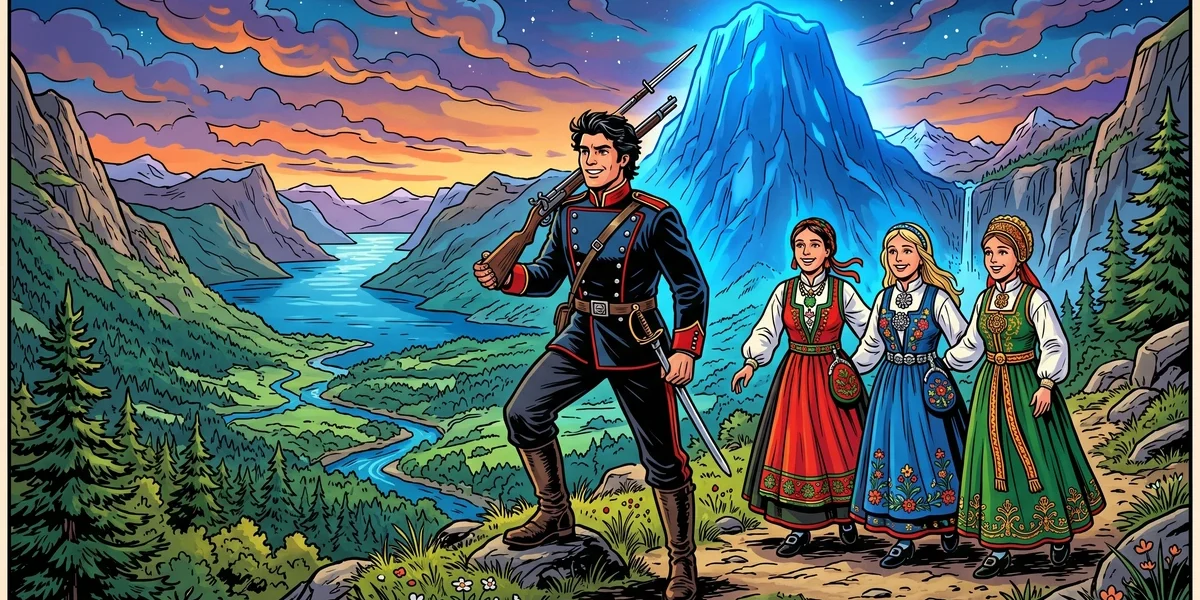
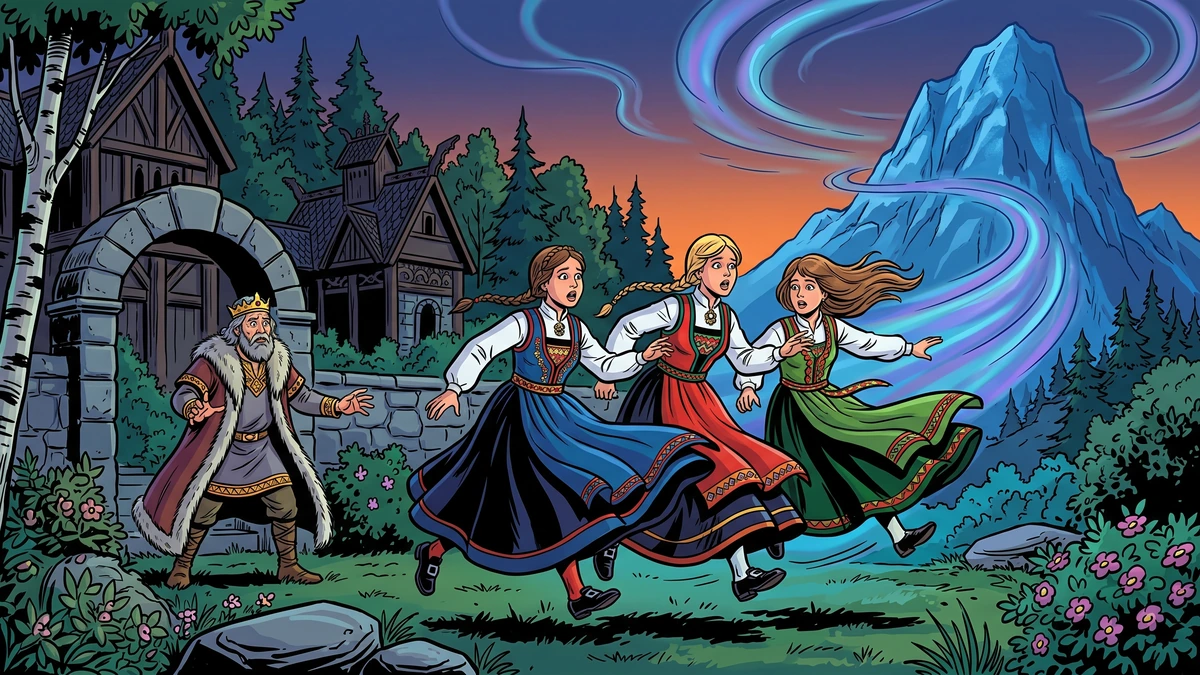
There was once a king whose three daughters were the brightness of his whole kingdom — until the day they walked out into the palace garden and did not come back. No gate had opened, no horse had been heard; the princesses had simply vanished, as if the green earth had drawn breath and swallowed them. The king offered his kingdom and a daughter’s hand to whoever could bring them home. Many tried. The man who at last succeeded was not a prince but a plain soldier, and the place he had to go was down — deep down, into the hollow heart of the Blue Mountain.
“The Three Princesses in the Blue Mountain” is one of the great Norwegian wonder-tales: a long, dark, satisfying adventure of stolen royalty, a descent into the underworld, many-headed trolls, a treacherous betrayal, and a giant bird that carries the hero back to the light. Where “The Three Billy-Goats Gruff” is a miniature, this is the full symphony. This retelling places the tale in its proper setting — a story collected from Norwegian storytellers in the nineteenth century, and a near-perfect example of one of the oldest tale-types known to folklore.
A Norwegian Wonder-Tale: Origins and Attribution
The story is Norwegian, and it comes down to us through Peter Christen Asbjornsen (1812–1885) and Jorgen Moe (1813–1882), the collectors whose Norske Folkeeventyr (“Norwegian Folktales”) did for Norway what the Brothers Grimm did for Germany. Asbjornsen and Moe began publishing in the early 1840s and continued to gather and issue tales for decades; the longer, more elaborate wonder-tales like this one were taken down from skilled adult storytellers who could hold a winter room spellbound for the better part of an hour. Asbjornsen and Moe’s decision to record the tales in plain, vigorous Norwegian speech rather than polished literary Danish was itself an act of nation-building, and it helped shape the written language of modern Norway.
Folklorists place the story squarely in Aarne–Thompson–Uther tale type ATU 301, “The Three Stolen Princesses.” It is one of the most widespread tale-types in the world, recorded across Europe, the Middle East, and Asia, and it is closely related to the ancient “Bear’s Son” cycle of stories — the family of tales that folklorists have long connected, however distantly, to the underground monster-fight at the heart of the Old English epic Beowulf. The Brothers Grimm collected their own German version, “Dat Erdmanneken” (“The Gnome,” KHM 91), and the same architecture — the descent, the rescue, the betrayal, the return — turns up under a hundred different names. The Norwegian telling is admired for its clean, steady shape and its vivid underworld of copper, silver, and gold.
The Vanished Princesses and the Soldier’s Quest
When the three princesses disappear, the kingdom grieves and the king despairs, and into that despair walks an ordinary discharged soldier with nothing to lose. In the Norwegian wonder-tale the hero is very often a soldier or the youngest of three plain brothers: a man without rank, without wealth, and without the protection that rank and wealth bring. His only capital is his courage and his decency, and the tale is built to prove that, in the end, those are the things that count.
The soldier sets out, and somewhere in the forest he and his companions come upon a lonely hut where they shelter and take turns: while two go out to hunt, one stays behind to cook. On the cooking days a strange and threatening little being — a troll or an underground dwarf — comes to torment whoever is alone, and the soldier’s companions are beaten and shamed and say nothing of it. When the soldier’s turn comes, he stands his ground, masters the creature, and forces from it the secret the whole quest has been missing: the three princesses are alive, and they are held inside the Blue Mountain, each one guarded by a troll. The hero now knows where to go. What he does not yet know is that the real danger of this story is not the trolls.
Down into the Blue Mountain
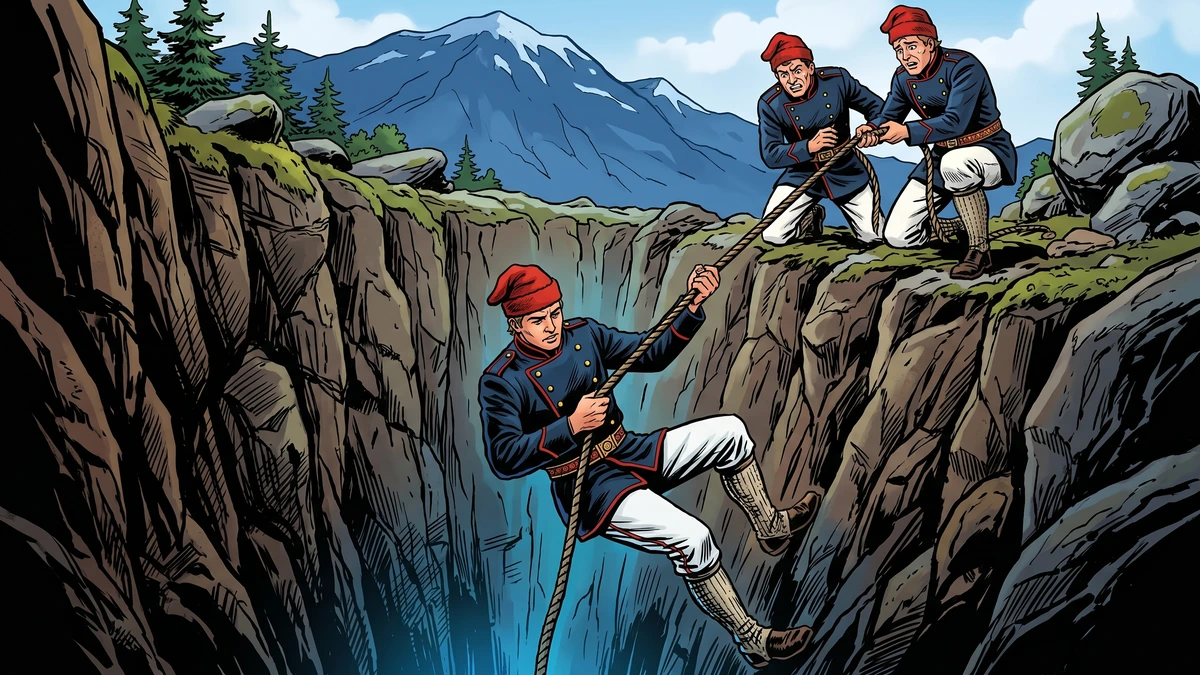
At the Blue Mountain the companions find a deep shaft — a well, a pit, an opening that drops into blackness with no bottom that anyone can see. Someone must be lowered on a long rope into the dark. The two companions look down into that hole and their courage fails them; they will not go. The soldier will. He has himself tied to the rope and asks to be let down, and with that single decision the tale draws its sharpest line. The men who stay at the top of the shaft are safe, and they will betray him. The man who goes down into the dark is in mortal danger, and he is the hero.
The descent into the Blue Mountain is the tale’s mythic centre. To go underground in a wonder-tale is to cross out of the ordinary world entirely — to enter the country of the dead, of trolls, of buried treasure and buried truth. The hero is lowered hand over hand into a place from which the rope is his only way home, and the rope is held by men he has every reason, and no way, to trust.
The Many-Headed Trolls and the Three Halls
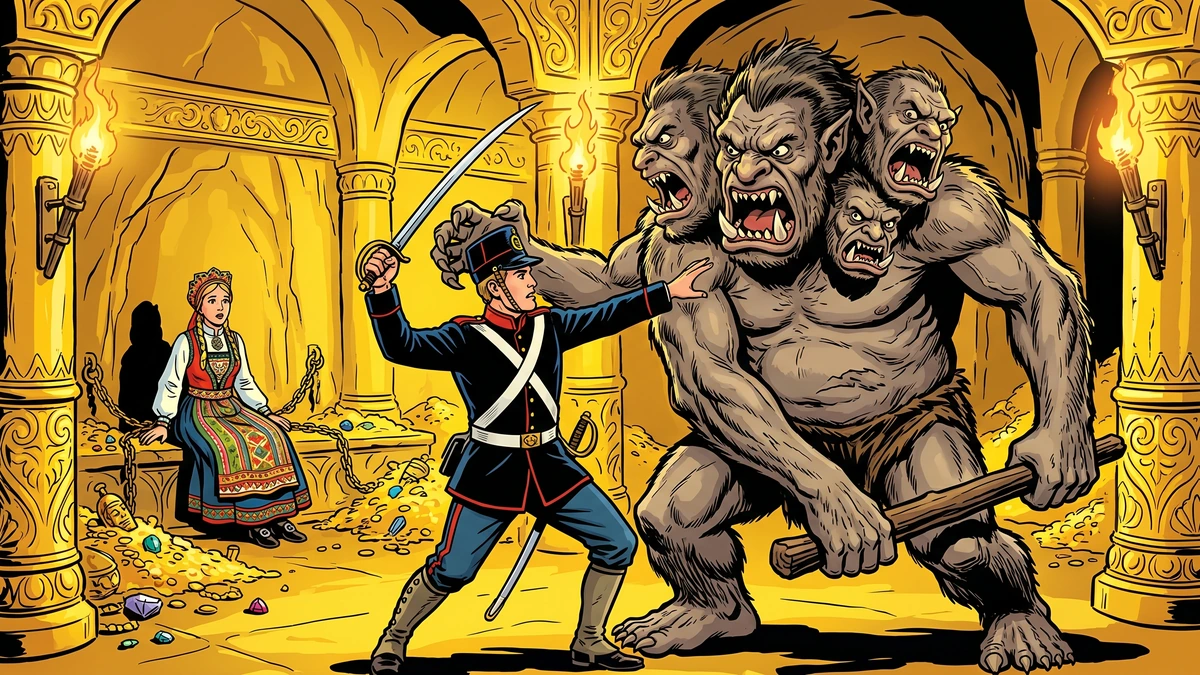
Inside the mountain the soldier finds not a cave but a hidden kingdom. He passes through hall after gleaming hall — one of copper, one of silver, one of gold — and in each hall sits one of the lost princesses, captive and watched over by a troll. The trolls of the Blue Mountain are the grandest of their grotesque kind: monsters with three heads, with six heads, with nine, each one larger and more terrible than the last. The hero meets them in order, smallest first, and each fight is harder than the one before.
This rising pattern — three, six, nine; copper, silver, gold — is the deep grammar of the wonder-tale, the same escalating rhythm that runs through “The Three Billy-Goats Gruff” on a tiny scale and through this story on a vast one. The hero does not win by magic and he does not win by luck; he wins by meeting each monster squarely and refusing to stop. One by one the many-headed trolls fall, and one by one the princesses are freed from the copper, the silver, and the golden hall. The eldest two are sent up the rope first. Last of all stands the youngest princess — the one the soldier has rescued from the deepest, golden room, and the one whose fate is now bound to his.
Betrayal, the Great Bird, and the Return
Here the tale turns, and it turns on human treachery rather than monstrous strength. With the princesses safely raised, the companions at the top of the shaft see their chance. They will haul up the prize and leave the man who won it in the pit; they will march the princesses home, claim the rescue as their own, and take the rewards and the royal marriages for themselves. The rope goes slack. The hero is sealed alive inside the Blue Mountain, betrayed not by a nine-headed troll but by the ordinary cowardice and greed of men he called comrades.
But a wonder-tale will not let its hero die underground. Wandering the troll-kingdom, he comes upon a way out: a giant bird — in many tellings a great eagle — that can carry him up through the dark to the surface of the world. The bird will only fly if it is fed, and the climb is long; in the harshest versions the hero, when his provisions run out, cuts flesh from his own body to keep the great wings beating. It is the price of return, and he pays it. He rises at last into daylight, scarred and changed, and makes his way back to the king’s hall, where the false companions are being feasted as heroes and the wedding of the youngest princess is being prepared.
He comes in disguised and lowly, a stranger no one looks at twice. But the youngest princess has kept a token — a ring, a proof agreed between them in the golden hall — and by that token the truth comes out. The treacherous companions are unmasked before the whole court and punished; the soldier is revealed as the man who went down into the Blue Mountain and brought three princesses back into the sun. He marries the youngest, and the kingdom that the cowards tried to steal is given, rightfully, to the man who earned it in the dark.
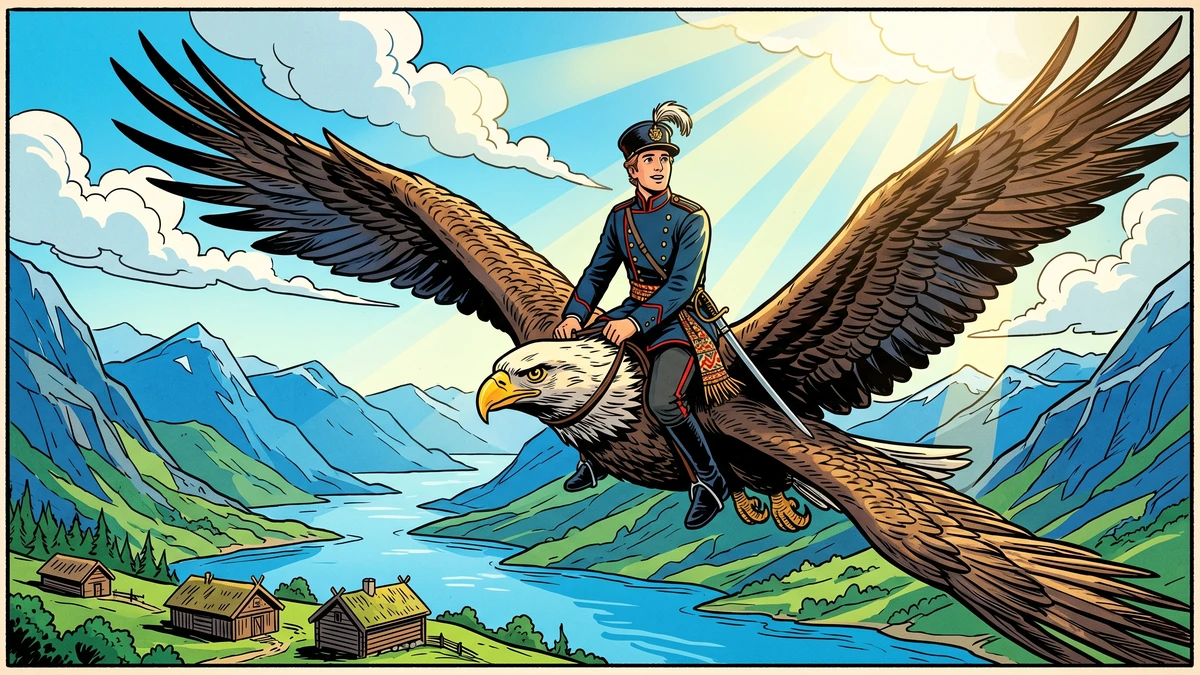
The Moral: Courage Rewarded, Treachery Exposed
“The Three Princesses in the Blue Mountain” is, at heart, a story about who deserves a reward and why. The companions want the prize without the danger; they will stand at the top of the shaft and let another man take the risk, and then they will lie. The soldier accepts the danger and does the work, and is betrayed for it. For a long, dark stretch of the story it looks as though the cowards have won — they are home, feasted, and about to marry princesses — and the tale lets that injustice stand just long enough to make a child ache.
Then it sets the account right. The token in the princess’s keeping is the hinge: the truth has been preserved, and once it is spoken aloud it cannot be unspoken. An old Norwegian proverb names the tale’s faith exactly:
“AErlighet varer lengst.”
“Honesty lasts longest.”
The lie of the false companions is loud and quick and, for a while, convincing — but it cannot last. The hero’s honest courage is quiet and costly and slow to be recognised, and it is the thing still standing at the end. The tale teaches a hard, true lesson that children feel before they can phrase it: that doing the dangerous, decent thing may not be rewarded at once, and may even be punished first, but that truth has a longer life than any lie told over it.
Tale Type ATU 301 and Its Worldwide Cousins
The architecture of this story — a hero descends into an underworld, defeats monsters, rescues captives, is betrayed by those who haul him up, and returns to expose the betrayal — is tale type ATU 301, “The Three Stolen Princesses,” and it is genuinely ancient. Folklorists have traced its bones across Europe and far into Asia, and they have long noted its kinship with the “Bear’s Son” tale cycle and, through that cycle, with the underground and underwater monster-fights of Beowulf. The Grimms’ “Dat Erdmanneken” tells the same story in Low German; Russian, Celtic, and Mediterranean versions abound.
What the Norwegian telling adds is its particular furniture and its particular chill: the cold vertical shaft into the Blue Mountain, the three coloured halls, the many-headed trolls counted out in threes, the giant bird and the terrible price of the flight home. These are not decoration. The descent and return give the tale the shape of every initiation story ever told — the young person who must go down into darkness and danger and come back transformed before the community will accept them as an adult. The treacherous companions give it its moral spine. Together they explain why a story this old has never needed to be retired.
Why the Tale Has Lasted
“The Three Princesses in the Blue Mountain” has lasted because it satisfies on two levels at once. As pure adventure it is hard to beat: a bottomless shaft, a hidden kingdom of copper and silver and gold, monsters that grow in horror, a betrayal that leaves the hero buried alive, and a flight to freedom on the back of a giant bird. A listener simply wants to know what happens next. But underneath the adventure the tale is doing quieter, lasting work. It tells a child that the world is not always fair in the short run — that liars sometimes sit at the feast while the deserving are left in the dark — and then it promises, with the whole weight of its happy ending, that the truth does not stay buried, that honesty lasts longest, and that the person who goes down into the danger and does the real work is the person the story, in the end, belongs to. Few tales reward a young listener so generously, and that is why, generations after two Norwegian friends wrote it down, the soldier is still climbing out of the Blue Mountain into the light.
You May Also Like
 Norse Folk Tales
Ages 9-12
Norse Folk Tales
Ages 9-12
The Husband Who Was To Mind The House
The Husband Who Was To Mind The House: Once on a time there was a man, so surly and cross, he never thought his _Wife_ did anything right in the house. Empathy
 Norse Folk Tales
Ages 3-5
Norse Folk Tales
Ages 3-5
The Three Billy-Goats Gruff
Norwegian *De tre bukkene Bruse* — three goats, one bridge, one greedy troll — ages 3–5 / 6–8. Asbjørnsen & Moe.
 Norse Folk Tales
Ages 9-12
Norse Folk Tales
Ages 9-12
Odin’s Quest for Wisdom
Odin's Quest for Wisdom: From the moment of his birth, Odin All-Father burned with a need that nothing could satisfy. While other gods delighted in feasts and