1003+ Stories from Ancient India — Free to Read! Explore all stories →

The Apples of Idun

The Apples of Idun: In Asgard, the home of the gods, there existed a treasure more valuable than all the gold in the nine worlds - the golden apples of Idun.

The Apples of Idun - Indian Folk Tales
Ad Space (header)
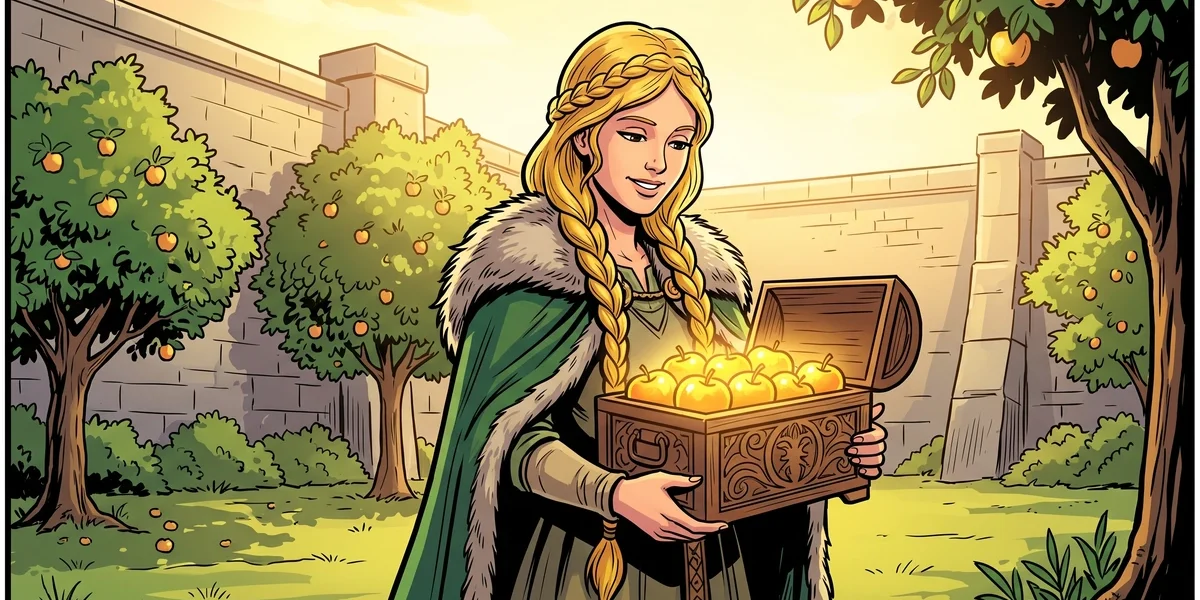
The Apples of Idun Norse myth ACK illustration cover - the goddess Idunn holding a carved casket of glowing golden apples in a sunlit walled Asgard orchard

In Asgard there was a treasure that no smith could forge and no hoard could replace: the golden apples of Idun. They were not wealth in the ordinary sense, for they bought nothing and were traded for nothing. Their worth lay in a single, frightening fact — without them, even the gods grew old. The Apples of Idun is the Norse myth that admits the unspoken anxiety beneath every story of the Æsir: that immortality itself was borrowed, renewed each morning, and could be lost in an afternoon to a single act of carelessness.

It is a tale of a foolish bargain struck under duress, of a trickster who breaks the world and is then forced to mend it, and of a goddess so quiet in the surviving texts that she barely speaks — yet upon whom the survival of every other god depends.

How the Tale Survives: Sources and Attribution

The fullest account of the Apples of Idun comes from the Prose Edda, composed in Iceland around 1220 by the chieftain, lawspeaker and poet Snorri Sturluson (1179–1241). The narrative belongs to Skáldskaparmál (“The Language of Poetry”), the section of the Prose Edda that explains the kennings — the compressed poetic riddles — that a trained skald was expected to command. Snorri introduces Idun there with a working definition for poets: she is to be called the wife of Bragi and the keeper of the apples, and the apples themselves are named the remedy by which the Æsir hold off old age.

Snorri did not invent the story. He was retelling, in clear thirteenth-century prose, a far older skaldic poem: Haustlöng (“Autumn-long”), attributed to the Norwegian skald Þjóðólfr ór Hvini, who is generally dated to the late ninth or early tenth century. Haustlöng is an ekphrastic poem — a description of mythological scenes said to be painted on a decorated shield — and Snorri quotes its dense, kenning-thick stanzas directly in Skáldskaparmál, which is the only reason the poem survives at all. Scholars have long noted a revealing detail: Haustlöng describes the abduction of Idun by the giant but does not clearly mention the apples. This has led many to argue that the apples, as the specific object of the theft, may be an element Snorri emphasised or that developed in the tradition after Þjóðólfr’s day.

Idun is also attested in the Poetic Edda, the anthology of mythological and heroic verse preserved chiefly in the Icelandic manuscript Codex Regius (GKS 2365 4to, written c.1270). She appears in Lokasenna (“Loki’s Quarrel”), where Loki insults her among the assembled gods, and she is named in Hrafnagaldr Óðins. The Prose Edda text itself is reconstructed by editors from several medieval manuscripts — among them the Codex Upsaliensis (DG 11, c.1300–25), the Codex Regius of the Prose Edda (GKS 2367 4to), the Codex Wormianus (AM 242 fol.) and the Codex Trajectinus. The name Iðunn is usually understood to mean something like “the ever-young” or “the rejuvenating one,” a meaning that is itself the seed of the whole myth.

Odin Loki and Honir camp around a fire in a dark oak wood while the giant Thjazi in eagle form watches from the branches above

Beat One: Three Gods, an Ox, and an Eagle’s Bargain

The trouble does not begin with Idun at all. It begins with a journey. Odin, the trickster Loki, and the silent god Hœnir set out together across a wild and empty country, far from Asgard and far from any settled hall. The land gave them nothing to eat. At last they came upon a herd of oxen in a valley, killed one, and built a cooking fire in an oak wood.

But the meat would not cook. Again and again they raked the embers and opened the earth-oven, and again and again the ox lay raw. Then a voice spoke from the oak above them. An enormous eagle sat in the branches, and it claimed the meat would not cook because the eagle itself was holding back the fire’s heat by its own craft. If the three travellers would grant the eagle its fill of the ox, it would release the fire.

They agreed. The eagle dropped down and seized for itself both haunches and both shoulders — nearly the whole animal. Loki, furious at being cheated of his supper, snatched up a great pole and struck the bird across the body with all his strength. The blow landed — and there it stuck. One end of the pole was fixed fast to the eagle, and Loki’s hands were fixed fast to the other end. The eagle beat its wings and rose, and Loki was dragged with it, his arms wrenched, his feet scraping over stone and thicket until he thought they would tear from his body. He shouted for mercy and begged to be set free.

The eagle — who was no bird, but the giant Thjazi wearing an eagle’s feather-shape — named its price. It would not release Loki for anything less than an oath: Loki must bring Idun out of Asgard, and her apples with her. Half-throttled and desperate, Loki swore the oath. The eagle let him go, and he limped back to his companions and said nothing of what he had promised.

Loki leads the goddess Idunn out through the gates of Asgard toward a dark forest while she carries her casket of golden apples

Beat Two: The Apples in the Wood

An oath sworn to a giant is still an oath, and Loki had bound himself. At the appointed time he went to Idun in her quiet garden inside the walls of Asgard. He did not threaten her. The trickster’s weapon was never force; it was a story shaped to fit exactly the trust of the listener.

Loki told Idun that while wandering in a wood beyond Asgard he had found apples — apples that seemed to him just as fair as her own, perhaps the very twins of them. Surely, he said, she would want to see such a marvel and compare them against the apples in her keeping. Would she bring her own apples along, so the two kinds could be set side by side?

Idun — trusting, and perhaps proud of the apples that were her sole and sacred charge — went with him. She carried her apples in their casket out through the gates and into the trees. There the eagle was waiting. Thjazi swept down in his feather-shape, caught up Idun and her apples together, and bore them north through the air to his cold stronghold of Thrymheim in the mountains of Giantland. The walls of Asgard had not been breached. The gate had simply been opened from the inside, by kindness turned against itself.

Beat Three: A Greying Asgard

The loss did not announce itself with thunder. It announced itself in the faces of the gods. Without a daily apple, the Æsir began to age, and they aged quickly. Hair that had been bright went grey and then white. Skin loosened and creased. Hands that had been sure grew slow and trembling. The shining company of Asgard became, within a short season, a council of stooped and frightened elders.

Alarmed, the gods met in assembly to ask the one question that mattered: when had Idun last been seen, and with whom? Memory, even failing memory, returned the same answer. She had last been seen walking out through the gates of Asgard in the company of Loki.

Loki was seized and dragged before the assembly. Under threat of death — for the gods, even aged and weakened, were many, and their anger was the anger of the desperate — Loki confessed the whole bargain: the eagle, the pole, the oath, the lie told in the garden. The gods gave him no choice and no comfort. He had carried Idun out; he would carry her back, or he would die. It is the turning point the trickster myths return to again and again: the one who unmakes the order of the world is the only one with the cunning to restore it, and is compelled to do so.

The gods of Asgard aged into stooped white-haired elders gathered in anxious council in a golden pillared hall

Beat Four: The Falcon, the Nut, and the Burning Eagle

To reach Thrymheim and return alive, Loki needed wings of his own. He went to the goddess Freyja and borrowed her falcon-shape — a feather-cloak that let its wearer fly as a bird. Wearing it, he flew north out of Asgard, over the mountains, into Giantland, and came at last to the hall of Thjazi.

Fortune, for once, favoured the gods. Thjazi had rowed out to sea to fish, and Idun was alone in the hall. Loki worked quickly. He transformed Idun into the shape of a nut — small enough to be carried in a single claw — gripped her tight, and launched himself back into the sky toward Asgard.

Thjazi came home, found his hall empty, and understood at once. He pulled on his own eagle-shape and flew after the falcon, and an eagle is a faster and stronger flier than a falcon burdened with a nut. The gap between them began to close.

From the walls of Asgard the watching gods saw the falcon racing in with the eagle gaining behind it. They acted fast. They gathered great heaps of wood-shavings and kindling and piled them along the wall. The instant Loki crossed above the wall and dropped, exhausted, inside it, they set the shavings ablaze. The eagle, flying too fast and too low to turn, plunged straight into the wall of fire. Thjazi’s feathers caught. He fell, burning, just inside the gates of Asgard, and there the gods killed him. Idun was restored to her own shape, the apples were returned to her keeping, and the Æsir ate, and were young again.

Loki as a falcon carries Idunn home as the giant eagle Thjazi plunges burning into the wall of fire on the rampart of Asgard

The Moral: What Cannot Be Stolen

The Apples of Idun is, on its surface, a rescue adventure. Underneath, it is a meditation on the fragility of anything that must be renewed to be kept. The gods are not eternal in the way we might assume. Their youth is a daily gift, dependent on one goddess, one orchard, one casket carried safely behind one wall. Strip away the apples and the divine becomes mortal within weeks. The myth’s quiet terror is that perfection is maintenance — and maintenance can be interrupted.

It is also a story about how trust is breached. Thjazi never storms Asgard. He does not need to. He needs only Loki’s broken word and Idun’s open heart. The defences that fail are not walls but judgement. And the apples that Loki promises Idun in the wood — the fake apples, “just as fair” as the real ones — are the perfect emblem of the lie: a counterfeit of the genuine, attractive precisely because it imitates what the victim already values.

The Norse imagination, however, never believed that youth or treasure was the highest good. The Hávamál, the great poem of Norse wisdom in the Poetic Edda, sets against the perishable apple a thing no giant can carry off:

Deyr fé,
deyja frændr,
deyr sjálfr it sama;
ek veit einn,
at aldri deyr:
dómr um dauðan hvern.

“Cattle die, kinsmen die, the self must also die; but one thing I know that never dies — the reputation of each dead person.” — Hávamál, stanza 77

Read beside the Idun myth, the stanza becomes a corrective. The apples buy more life; they do not buy a good name. Loki’s reputation as the breaker of Asgard’s peace is fixed by this tale forever — that is the judgement that “never dies” — and no orchard can restore it.

Why the Tale Has Lasted

The Apples of Idun has outlived the religion that produced it because its central image is endlessly portable. Golden fruit that confers agelessness is one of the most widespread motifs in world story: the apples of the Hesperides guarded for Hera in Greek myth, the peaches of immortality in the Chinese tradition, the fruit of life in countless folk and fairy tales. The Norse version is distinctive because it refuses to treat immortality as a settled possession. Here the wonder-fruit is not hidden at the world’s edge; it is in the household, in daily use, and therefore daily at risk.

For modern readers the story has a second life as a near-perfect parable of the confidence trick and the social-engineering attack. The fortress is sound; the lock is sound; the breach comes through a trusted insider who is told a flattering, plausible story and invited to step outside the wall “just to compare.” Idun’s abduction would be recognised instantly by anyone who has studied how scams actually work.

It also rewards attention to its quiet figure. Idun speaks almost not at all in the sources, yet she is the load-bearing pillar of the divine world — a reminder, very old and still sharp, that the person whose steady work keeps a community alive is often the one least celebrated in the telling, and the first to be targeted when that community is attacked. The myth that began as instruction for skalds memorising kennings has become, a thousand years on, a story about youth, trust, and the cost of a single open gate.

Frequently Asked Questions

What are the Apples of Idun in Norse mythology?

The Apples of Idun are golden apples kept by the goddess Idun in Asgard. According to Snorri Sturluson’s Prose Edda, the gods of the Aesir ate them to ward off old age; the apples are described as their remedy against ageing. They are not wealth to be traded but the daily source of the gods’ youth and vitality, which is why their loss threatens the survival of the entire divine world.

Who is the goddess Idun?

Idun (Old Norse Idunn, often glossed as ‘the ever-young’ or ‘the rejuvenating one’) is the Norse goddess who guards the apples of youth. The Prose Edda names her as the wife of the poet-god Bragi and the keeper of the apples. Though she speaks very little in the surviving texts, she is one of the most structurally important figures in Norse myth, because the agelessness of all the other gods depends on her care.

What is the original source of the Apples of Idun myth?

The fullest narrative survives in the Skaldskaparmal section of the Prose Edda, written by Snorri Sturluson in Iceland around 1220. Snorri was retelling an older skaldic poem, Haustlong, attributed to the Norwegian skald Thjodolfr or Hvini (late 9th or early 10th century), which he quotes directly. Idun is also named in the Poetic Edda, notably in Lokasenna, preserved in the Codex Regius manuscript (GKS 2365 4to, c.1270).

How did Loki rescue Idun from the giant Thjazi?

After being forced to confess that he had lured Idun out of Asgard, Loki borrowed the goddess Freyja’s falcon feather-cloak and flew to Thjazi’s mountain hall of Thrymheim. Finding Idun alone, he transformed her into a nut, gripped her in his claws, and flew home. Thjazi pursued in eagle form, but the gods of Asgard lit a great fire of wood-shavings on the wall; the eagle flew into the flames, fell burning, and was killed.

What is the moral of the Apples of Idun?

The myth warns that anything which must be renewed to be kept is fragile, and that defences fail through misplaced trust rather than force. Thjazi never breaches Asgard’s walls; he succeeds because Loki breaks his word and Idun is deceived by a flattering, plausible story. The Norse Havamal sets against this perishable youth a thing no giant can steal: a person’s reputation, the one thing said to outlive death.

Ad Space (in-content)
Ad Space (after-content)

Get a New Story Every Week!

Join thousands of parents and teachers who receive our hand-picked folk tales every Friday. Stories with morals your kids will love.

Free forever. No spam. Unsubscribe anytime.