Soria Moria Castle
Soria Moria Castle: Once on a time there was a poor couple who had a son whose name was _Halvor_. Ever since he was a little boy he would turn his hand to
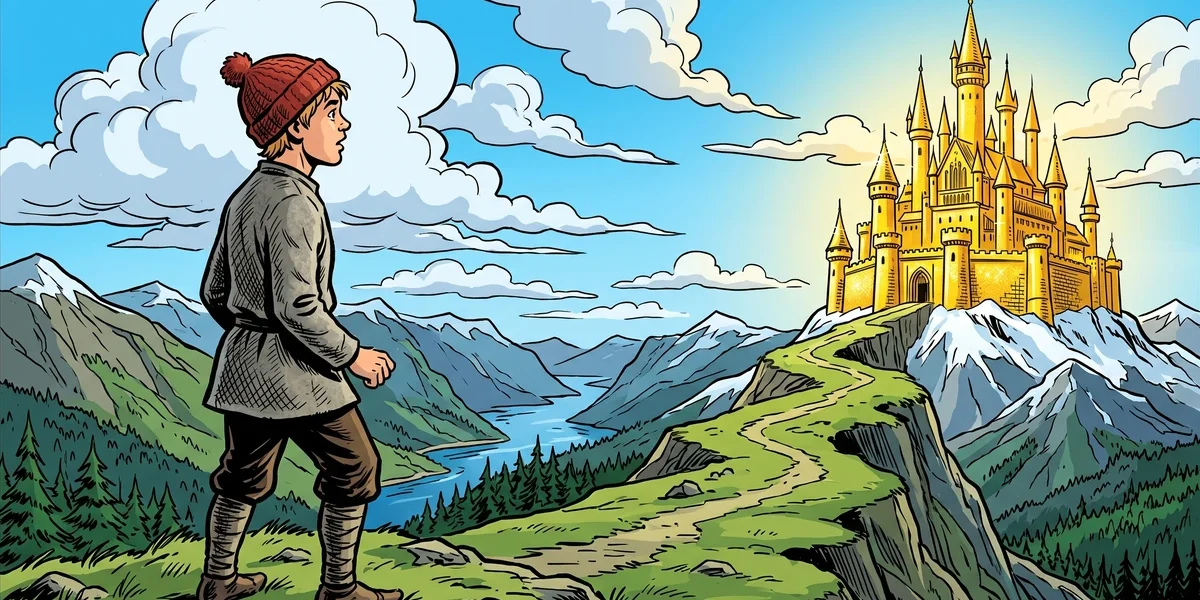
Few names in Norwegian storytelling shimmer quite like Soria Moria. The castle of that name has never been mapped, yet for almost two centuries it has stood at the far edge of the Nordic imagination — a palace of gold seen glittering across an impossible distance, the destination every wanderer longs to reach. The tale that carries the name, Soria Moria slott, was gathered from oral tradition by Peter Christen Asbjørnsen and Jørgen Engebretsen Moe and printed in their landmark collection Norske Folkeeventyr (Norwegian Folktales), in the second instalment issued in 1843. It belongs to one of the most widespread of all wonder-tale patterns, classified by folklorists as Aarne–Thompson–Uther type 400, The Man on a Quest for His Lost Wife. What makes the Norwegian version unforgettable is not the bones of the plot but the name at its heart, and the strange, idle boy who chases it.
A Tale Carried Out of the Cinders
When Asbjørnsen and Moe began collecting in the 1830s, Norway had only recently emerged from four centuries of Danish rule and was hungry for a literature that sounded like itself. The two friends — Asbjørnsen a zoologist with a folklorist’s ear, Moe a poet and later a bishop — travelled the valleys writing down what farmers, herders and grandmothers told them. Their genius was a prose style that kept the rhythm of the spoken voice rather than smoothing it into bookish Danish, and Soria Moria slott is a fine example: brisk, wry, and unafraid of a hero who begins as a do-nothing. The collection was later given its enduring visual identity by the illustrators Erik Werenskiold and Theodor Kittelsen; Kittelsen’s haunting 1881 painting of the gold castle glimpsed over a far ridge of mountains became, for Norwegians, the single image that fixed the tale forever in the national memory.
The story reached the English-speaking world through George Webbe Dasent, whose Popular Tales from the Norse (1859) translated Asbjørnsen and Moe with such verve that it shaped how Victorian readers imagined Scandinavia. It is Dasent’s Soria Moria Castle that English readers have loved ever since — the version that keeps the homely opening and lets a boy who will turn his hand to nothing become the unlikeliest of heroes.
The publication history is worth pausing over, because it explains why the tale feels at once so polished and so spoken. Norske Folkeeventyr did not appear all at once. Asbjørnsen and Moe issued it in instalments — a first slim booklet in 1841, further parts through 1843 and 1844, and an expanded second edition in 1852 — revising and re-listening as they went. Soria Moria slott entered the canon in the second-collection material of 1843. The collectors faced a real artistic problem: written Norwegian of the 1840s was essentially Danish, a language no farmer actually spoke, yet a pure dialect transcription would have been unreadable across the country. Their solution — a supple middle register that kept folk syntax, proverb and idiom while staying broadly legible — is now regarded as a turning point in the history of the modern Norwegian language, and it is one reason the brothers Grimm themselves praised the collection. The tale of Halvor, then, is not merely an old story preserved; it is an old story that helped a nation learn to write the way it spoke.
The Boy Who Sat in the Ashes
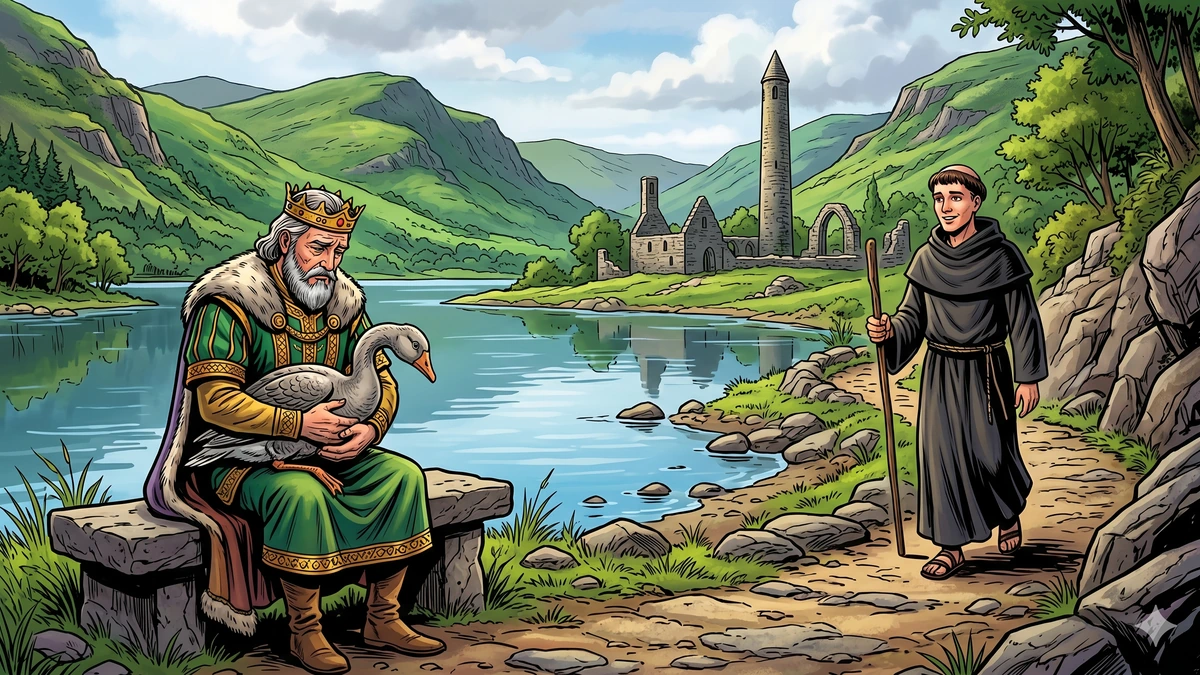
Halvor is the kind of hero the Norwegian tales loved best: the Askelad, the ash-lad, the youngest and least promising, who would rather poke at the embers of the hearth than learn a trade. His parents place him with one master after another, but he runs home from each, and folk shake their heads over him. The tale wastes no sentiment on his idleness — it simply waits, the way folktales do, for the moment when the overlooked child steps into his story.
That moment comes when a skipper anchors nearby and asks whether Halvor would care to go to sea and see strange lands. Halvor agrees at once, and for the first time in his life he is quick about something. The voyage ends, as voyages in folktales must, in a great storm; the ship is broken, and Halvor is cast ashore alone on a coast he does not know. There is no map here and no rescue. The boy who never wanted to leave the cinders is now further from home than he has ever imagined, and the only road open to him leads inland, toward whatever the strange country holds.
The figure of the cinder-boy — the Askelad or Ash-Lad — is one of the great recurring heroes of Norwegian tradition, and audiences would have recognised Halvor instantly as a member of that family. The Ash-Lad is always the underestimated one: too young, too lazy, too foolish-seeming for the world to expect anything of him. Folklorists have long read him as a democratic hero, an expression of a rural culture that distrusted inherited rank and liked to imagine that worth might lie unnoticed in the humblest seat by the fire. What the Ash-Lad has, beneath the soot, is a readiness that the proud and the clever lack — a willingness to say yes to the stranger’s offer, to share his food, to listen to a warning rather than scoff at it. Halvor’s whole adventure turns on those small courtesies, and the tale is quietly insistent that they, not brute strength, are what mark him out.
Three Castles and the Multi-Headed Trolls
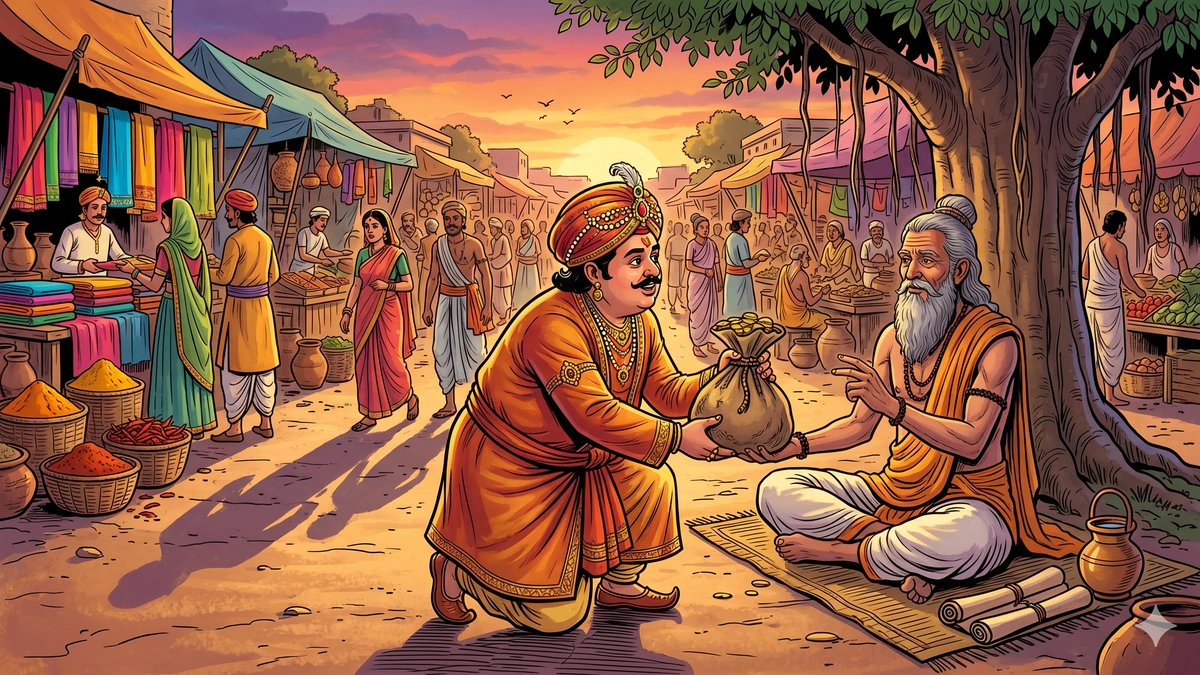
Walking through the unknown land, Halvor comes upon a great castle, and in it a princess who warns him to flee — for the place belongs to a troll, and no ordinary man could stand against it. Instead of running, Halvor asks for something to eat, and the princess, seeing he means to stay, points him to a flask of enchantment. Whoever drinks from it gains the strength to wield the troll’s own monstrous sword. Halvor drinks, takes up the great blade, and when the three-headed troll comes roaring home he cuts it down.
The freed princess tells him her two sisters are held in the same way, each by a troll more terrible than the last. Halvor goes on. At the second castle he faces a six-headed troll; at the third, a nine-headed one. Each time he drinks deeper from the flask of strength, each time he lifts a heavier sword, and each time a captive princess is set free. The three sisters, royal daughters stolen long ago, are restored to the daylight, and the idle ash-boy — who could not be trusted to mind a single trade — has become the rescuer of a kingdom. He and the youngest, gentlest princess come to love one another, and in the gold-bright castle they call Soria Moria they are wed.
The troll of Norwegian folklore is a creature quite unlike the giants of other traditions. Trolls are old, slow, hoarding things, bound to mountain and forest, often turned to stone by sunrise; their many heads — three, six, nine, climbing in folktale arithmetic — are a measure of how ancient and how dangerous they are. They do not merely threaten the hero; they hold things. In tale after tale the troll has stolen a princess, a treasure, the sun itself, and locked it away inside the mountain where time does not move. To kill a troll, in this storytelling logic, is to release what has been frozen out of the living world. That is exactly what Halvor does: each fallen troll restores a daughter to the daylight. The flask of strength is the tale’s neat device for making this possible — a borrowed, conditional power, never Halvor’s own, which marks him as a hero who succeeds through what is given to him by those he is kind to, rather than through any might he was born with.
The Homesick Heart and the Broken Word
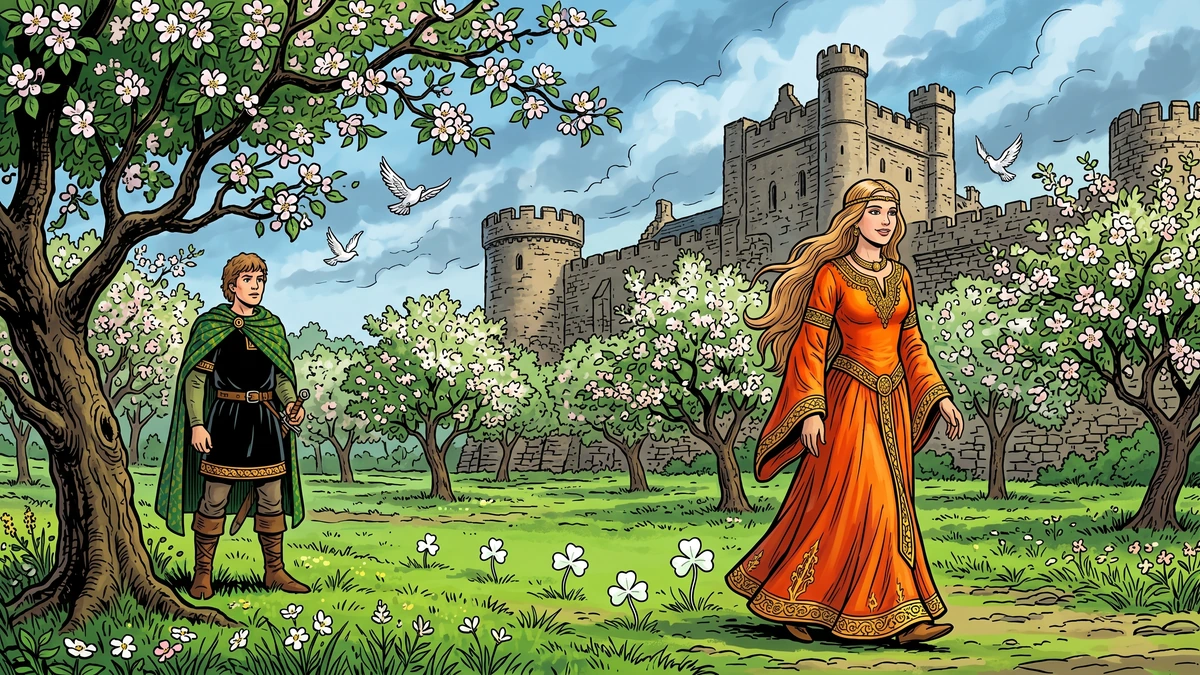
Here the tale turns from triumph to longing, and that turn is its true subject. For all his happiness, Halvor begins to ache for the poor cottage of his parents — the very hearth he once could not be persuaded to leave. His princess understands; she gives him a wishing ring and lets him go, but she lays a careful condition on the gift. He may wish himself home, but he must name only her, and never speak a wish that would carry him back without her at his side.
Halvor reaches the old cottage and his parents marvel at the fine lord their cinder-boy has become. But on a Sunday, dressing for church, he forgets himself and says aloud that he wishes his princess could see him now — and in the same breath the ring sweeps him away, back toward Soria Moria, but alone, and then the way is lost to him entirely. A spoken wish, carelessly made, has undone everything the flask of strength once won. The castle that was his home is now exactly what its name has always meant to everyone else: a place glimpsed and longed for, and impossibly far.
The House of the Winds
No sword can win back Soria Moria; Halvor must ask the way. He wanders until he comes to the house where the Winds live with their old father. One by one the brothers are questioned — the East Wind, the South Wind, the North Wind — and not one of them has ever blown so far as the gold castle. Only the West Wind, returning late and breathless, has been there: he has come, in fact, straight from the princess’s wedding, for she is about to be married against her will to another. The West Wind gathers Halvor up and carries him over land and sea, setting him down at Soria Moria on the very day of the feast.
Disguised and unknown, Halvor sends the princess a token — her own ring, which she recognises — and when the truth is spoken the false wedding collapses and the true one is restored. The ash-lad and his princess are joined again, this time for good, and the castle that was so nearly lost forever becomes, at last, a home that will not slip away.
It is worth noticing how completely the second half of the tale inverts the first. In the troll-castles Halvor wins by force, drinking from the flask and swinging a giant’s sword; on the road to the Winds he wins by helplessness, by admitting he does not know the way and humbly asking those wiser than himself. The folktale is unusually clear-eyed about this. Strength took him to Soria Moria; only humility could take him back. A boy who once would not stir from the hearth has had to learn both halves of heroism — the daring that begins a journey and the patience that completes it.
The Riddle of the Name
Part of the tale’s lasting spell is that nobody can say with certainty what “Soria Moria” means. The words sound foreign to Norwegian ears — faintly southern, faintly oriental — and that strangeness is precisely the point: the castle is meant to lie outside the known world. Folklorists have offered several guesses. Some connect the name to far-off places that would have sounded impossibly exotic to a Norwegian valley audience — Soria recalling the Spanish town of Soria, Moria echoing the biblical Mount Moriah or the Moorish lands of romance. Others argue the syllables are simply euphonious nonsense, a chime of vowels invented to evoke distance and gold rather than any real geography. Either way, the effect is the same. The name does not point to a place; it points to a feeling. Where a lesser tale would name a kingdom, this one offers a sound that means elsewhere — and audiences have been free, ever since, to fill that elsewhere with whatever they themselves most long for.
The Meaning of a Distant Castle
The moral of Soria Moria slott is gentler and stranger than the simple lesson of a giant-killing tale. It is a story about longing: about the worth hidden inside the boy everyone wrote off, and about how easily happiness, once held, can be spoken away by a careless word. Halvor’s flask of strength wins him a castle, but only patience, humility and the long walk to the house of the Winds can win it back. The tale insists that the second journey — the one taken not in pride but in need — is the one that truly earns the prize.
Lykken står den kjekke bi.
— Norwegian proverb: “Fortune stands by the bold one.”
Yet boldness alone is not the whole of it. The proverb fits the ash-boy who finally rises and acts — but the tale quietly adds that the bold must also keep faith with what they love, or fortune slips through their fingers like a name half-remembered.
Why the Tale Has Lasted
More than almost any other Norwegian folktale, Soria Moria slott outgrew its own pages. The name became a byword in the Norwegian language for the unreachable place of perfect happiness — the dream on the horizon. Henrik Ibsen wove it into Peer Gynt, where Peer dreams of a “Soria-Moria Castle” shining beyond his reach; the image recurs in Norwegian poetry, politics and song down to the present day. Kittelsen’s painting of the far gold towers is reproduced endlessly, and the phrase still surfaces wherever Norwegians speak of a goal that glitters just out of reach.
For all that cultural weight, the tale endures because its shape is universal. ATU type 400 is told across Europe and Asia — the hero who wins a supernatural bride or wins his way to a hidden realm, loses what he has won through a broken taboo, and must journey to the world’s end to win it back. The pattern is among the oldest in recorded storytelling: its ancestor is the Greco-Roman tale of Cupid and Psyche, set down by Apuleius in the second century, in which a forbidden act severs the lovers and a series of impossible labours reunites them. Its near cousin within the same Norwegian collection is East of the Sun and West of the Moon, where again a broken condition sends the heroine on a quest past the houses of the Winds. The repeated motif of the Winds as guides — the four brothers, only one of whom has flown far enough — is itself a small piece of folk cosmology, a way of saying that the goal lies beyond all ordinary travel and can be reached only by asking the powers of the air.
What every version of the type shares is a single, uncomfortable truth: that the things we love most are the things we are most in danger of losing through our own carelessness, and that getting them back asks more of us than getting them ever did. Halvor begins in the ashes and ends in a castle of gold — but the heart of his story is the long road in between, and the patience it finally taught a boy who once would not move from the hearth. Soria Moria endures not because it is a tale of trolls slain, but because it gave a whole language a word for the bright, distant thing every person is, in some quiet way, always walking toward.
You May Also Like
 Norse Folk Tales
Ages 9-12
Norse Folk Tales
Ages 9-12
East Of The Sun And West Of The Moon
East Of The Sun And West Of The Moon: Once on a time there was a poor husbandman who had so many children that he hadn’t much of either food or clothing to
 Norse Folk Tales
Ages 6-8
Norse Folk Tales
Ages 6-8
The Giant Who Had No Heart In His Body
Norwegian Ash-Lad tale — Boots, three grateful animals, and a giant’s heart hidden in an egg — ages 6–8+. Asbjørnsen & Moe / ATU 302.
 Norse Folk Tales
Ages 9-12
Norse Folk Tales
Ages 9-12
Odin’s Quest for Wisdom
Odin's Quest for Wisdom: From the moment of his birth, Odin All-Father burned with a need that nothing could satisfy. While other gods delighted in feasts and