The Widow’s Son
The Widow's Son: Once on a time there was a poor, poor _Widow_, who had an only _Son_. She dragged on with the boy till he had been confirmed, and then she
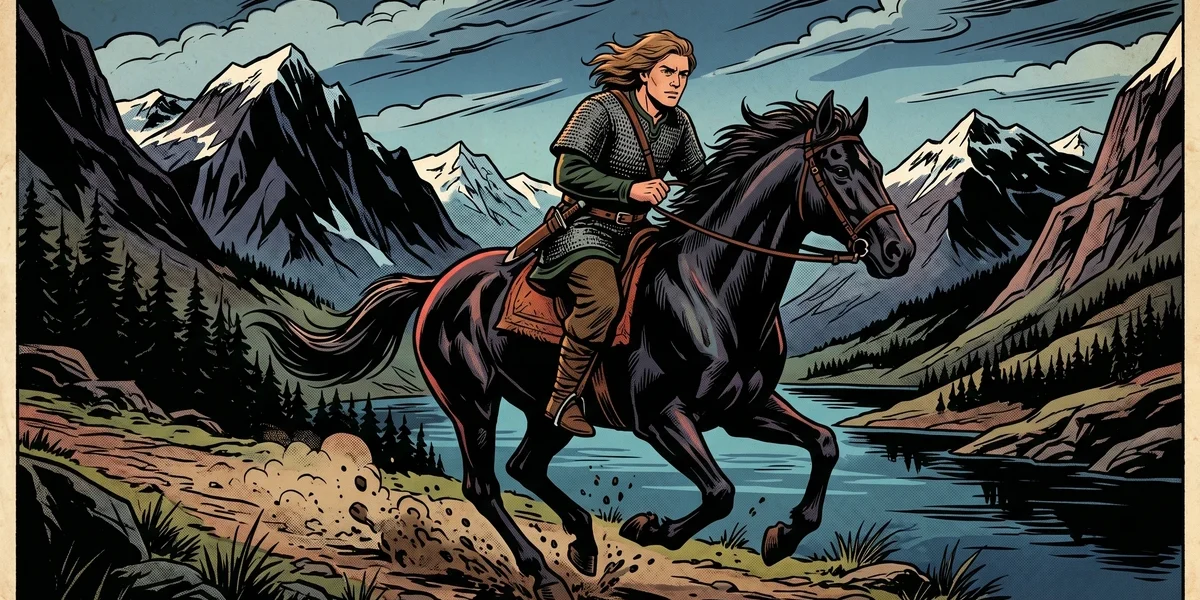
Among the wonder-tales that Peter Christen Asbjørnsen and Jørgen Moe carried home from the cottages of nineteenth-century Norway, The Widow’s Son is one of the grandest and the most generous. It begins in the barest of circumstances — a poor widow who can no longer feed her only child — and ends with that same boy a crowned king, master of a magic horse, husband of a princess, and friend even to the foreign king he once defeated. Between those two points lies a story of forbidden doors, a cauldron of gold, a flight across a conjured wilderness, and a single act of kindness in a dark stable that quietly decides everything.
A Tale from the Norske Folkeeventyr
The story was collected in Norwegian as Enkesønnen by Peter Christen Asbjørnsen (1812–1885) and Jørgen Moe (1813–1882), the naturalist and the poet-bishop whose lifelong friendship produced Norske Folkeeventyr — the collection that did for Norway what the Brothers Grimm had done a generation earlier for the German lands. First issued in slim instalments from 1841 and steadily enlarged through the augmented editions of the 1840s and 1850s, the Norske Folkeeventyr was gathered not from libraries but from the living voice: from cottagers, ferrymen, charcoal-burners and farm servants whom the two friends sought out in the valleys and along the fjords, taking down their words and rendering them in a fresh, plain Norwegian prose that helped a young nation, long governed in Danish, hear its own tongue speak.
English readers met the tale through Sir George Webbe Dasent, the Scottish scholar of Old Norse whose Popular Tales from the Norse (1859) first carried Asbjørnsen and Moe’s stories across the North Sea; it is Dasent’s vigorous, idiomatic translation that gave the tale its enduring English title, The Widow’s Son. The original Norwegian editions were later illustrated by Erik Werenskiold and Theodor Kittelsen, whose granite-shouldered trolls and luminous northern light fixed the visual imagination of these tales for more than a century.
Folklorists classify the story as international tale type ATU 314, “Goldener” (older catalogues called it “The Youth Transformed to a Horse”), in the Aarne–Thompson–Uther index. The type is recognised by a distinctive chain of motifs: a youth enters the service of a supernatural master, breaks a prohibition and is marked with gold; he escapes on a talking horse, hindering the pursuit by casting objects that swell into obstacles — the celebrated motif D672, “the Obstacle Flight”; he then hides his shining nature beneath a disguise and works as a humble gardener at a king’s court, before three days of secret heroism reveal him at last. The Widow’s Son follows this scheme closely, while keeping the unmistakable colour of the Norwegian fjord-country: the troll for an ogre, the snow-bright princess, the rusty arms hanging in a cold chamber, and the great black horse who is more than a horse.
The Widow’s Farewell and the Four Forbidden Rooms
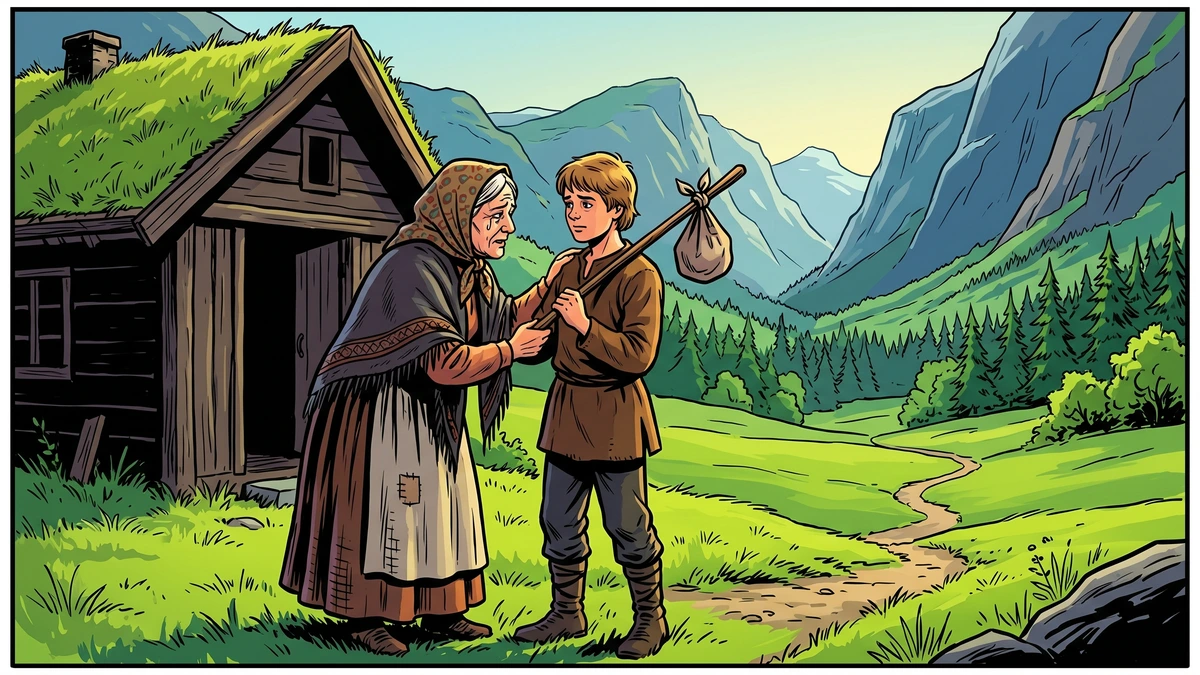
The tale opens on want. A poor widow has raised her only son as far as she is able; once the boy is confirmed, she tells him plainly that she can feed him no longer, and he must go out into the world and earn his own bread. There is no cruelty in this — only the hard arithmetic of poverty, the same arithmetic that sends so many Norse heroes walking down the road with nothing. It is worth pausing on that opening, because the whole moral weight of the story is loaded into it: the widow’s love is measured not by what she can give, but by what she is willing to let go.
A day or two along the road the lad is met by a strange man who offers him an easy place — good meat, good drink, and almost nothing to do. The bargain seems too soft to be safe, and it is. The master’s house holds four locked rooms, and each time he goes away on a journey he forbids the lad, on pain of death, to enter them. Curiosity wins, as curiosity must in such tales; and what the boy finds is strangely small — a bramble-bush rod, a stone and a pitcher of water, a bubbling copper cauldron with no fire beneath it. He dips a finger into the cauldron and draws it out gilded; no scrubbing will rub the gold away. The forbidden-chamber motif is one of the oldest in European storytelling, and here it does double duty: it brands the hero with the gold that names his tale type, and it reveals his master for what he truly is.
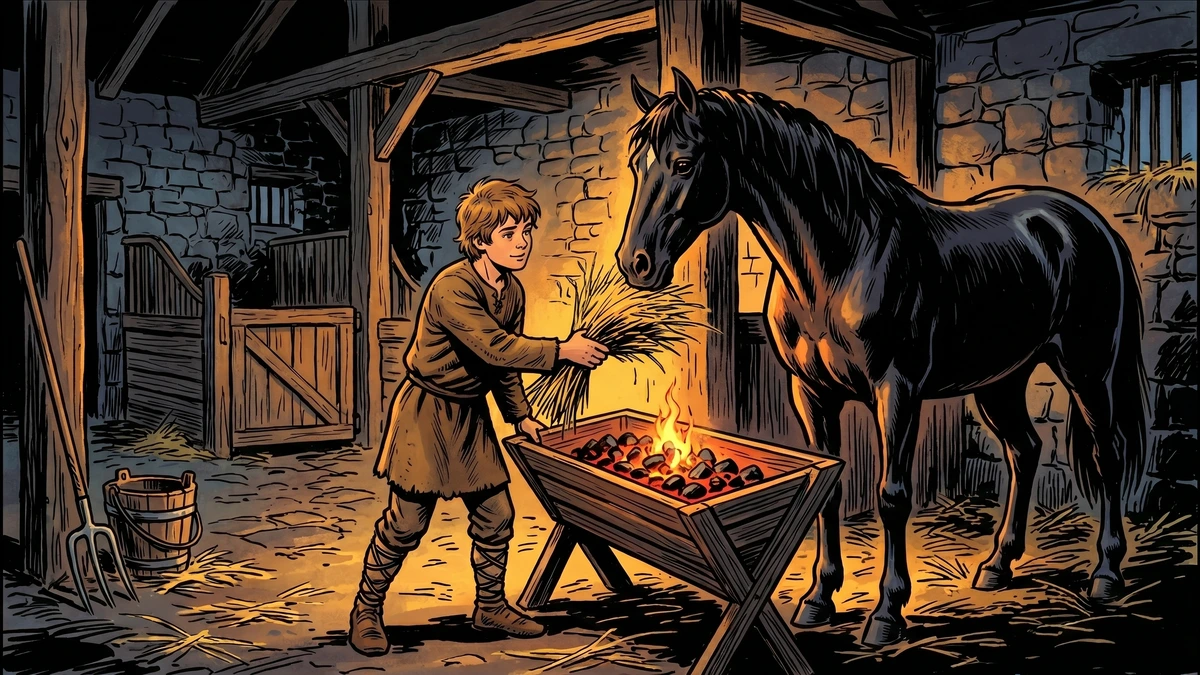
For in the fourth room stands a great black horse, with a manger of red-hot coals set cruelly at its head and a truss of sweet hay placed out of reach at its tail. The lad does the simplest, kindest thing: he turns them round, and gives the starving animal the hay. It is the quiet hinge of the entire story. The horse speaks — “Since you are so good at heart as to let me have some food, I’ll set you free” — and warns him that the master is no man at all, but a Troll who will kill him the moment he returns. Everything the lad later wins flows from this one unbidden mercy, shown to a creature that could do nothing for him in return. He had not bargained for a reward; that is precisely why he earns one.
The Rusty Arms, the Cauldron, and the Flight
The horse’s instructions reverse every instinct a poor boy might have. From the rooms above he must choose not the bright, splendid coat of mail, sword and saddle, but the most rusted and worn of all — for in this story the shabby thing is the true thing, and glitter is a trap. Then he must climb into the very cauldron that gilded his finger and bathe in it. He fears he will come out a fright; instead he emerges handsome, “red and white as milk and blood,” and far stronger than before. The gold that marked him as a trespasser becomes, once he submits to it fully, the making of him. The tale quietly insists that the same trial can disfigure or transform, depending on the courage with which one enters it.
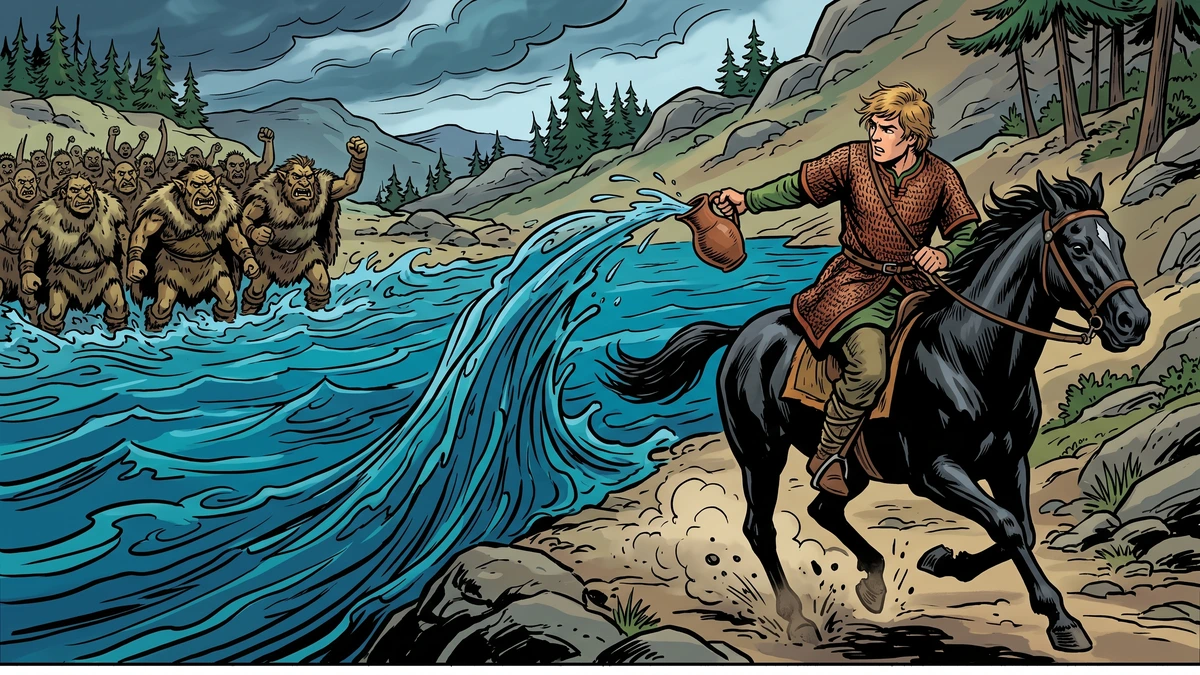
Armed, mounted and carrying the four humble objects from the forbidden rooms, the lad rides off — and the Troll gives chase with all his pack. Here the story breaks into its most thrilling movement, the Obstacle Flight. At the horse’s word the lad throws the bramble-rod behind him, and a dense thicket springs up; he throws the stone, and a black mountain of rock rears between them and their pursuers; he throws the pitcher of water, and a deep lake spreads across the land. Each time the Troll and his crew must turn home for tools to hew, to mine, to drink their way through — and at the last the trolls lie down at the lake’s edge and swill until they burst. The episode is pure narrative delight, but it is also a careful lesson: the boy escapes not by his own strength but by trusting his helper exactly, and by using the small, overlooked things he was once forbidden to touch.
The Fir-Moss Wig and the Gardener’s Boy
Safe at last in a green wood near a king’s palace, the horse asks the lad to do something stranger than fight a troll: to hide. He must strip off his shining arms, hang them with the saddle inside a hollow lime-tree, pull on his old ragged clothes, and cover his head with a wig of fir-moss that makes him “ugly, and pale, and miserable to look at.” Then he is to go to the palace and beg for the lowest possible work. Whenever he needs the horse, he has only to come to the wood and shake the bridle.
This deliberate self-concealment is the moral centre of the second half of the tale. The lad, now beautiful and strong, chooses to be thought a half-witted fright. Turned away from the kitchen and the stable because he will not remove his wig, he ends as a gardener’s boy, sleeping on turf beneath the steps of the summer-house because no servant will share a room with him. Yet the disguise cannot quite hold. One morning, washing at sunrise with the wig laid aside, he is seen from her window by the Princess, who has never beheld anyone so handsome. She arranges for him to sleep within her chamber door; twice he clutches the moss wig fast, and at last her maid whisks it away to reveal the lad “so lovely, and white and red” as the Princess had seen him in the morning sun. When the King learns of it his fury is immediate: the lad is flung into the prison tower, and the Princess shut up in her room. Humility has protected the hero so far — but it cannot, by itself, win him a kingdom. For that he must be seen.
Three Days of Battle and the Horse’s Last Gift
War comes, as it so often does, to force the truth into the open. A rival king invades, and the lad begs the gaoler to carry his request to the King: a coat of mail, a sword, and leave to fight. The court treats it as a joke, fitting him with a worn-out suit and a broken-down hack that goes on three legs and drags the fourth. He rides out, sticks fast in a bog, and is laughed at by every soldier who passes — and then, the moment they are gone, he runs to the lime-tree, throws on his rusty mail, shakes the bridle, and rides into the battle a shining stranger who turns the enemy to flight. Three days running he plays the same double part: the mocked fool stuck in the mire, and the unknown champion who saves the King’s army and at last cuts down the enemy king himself.
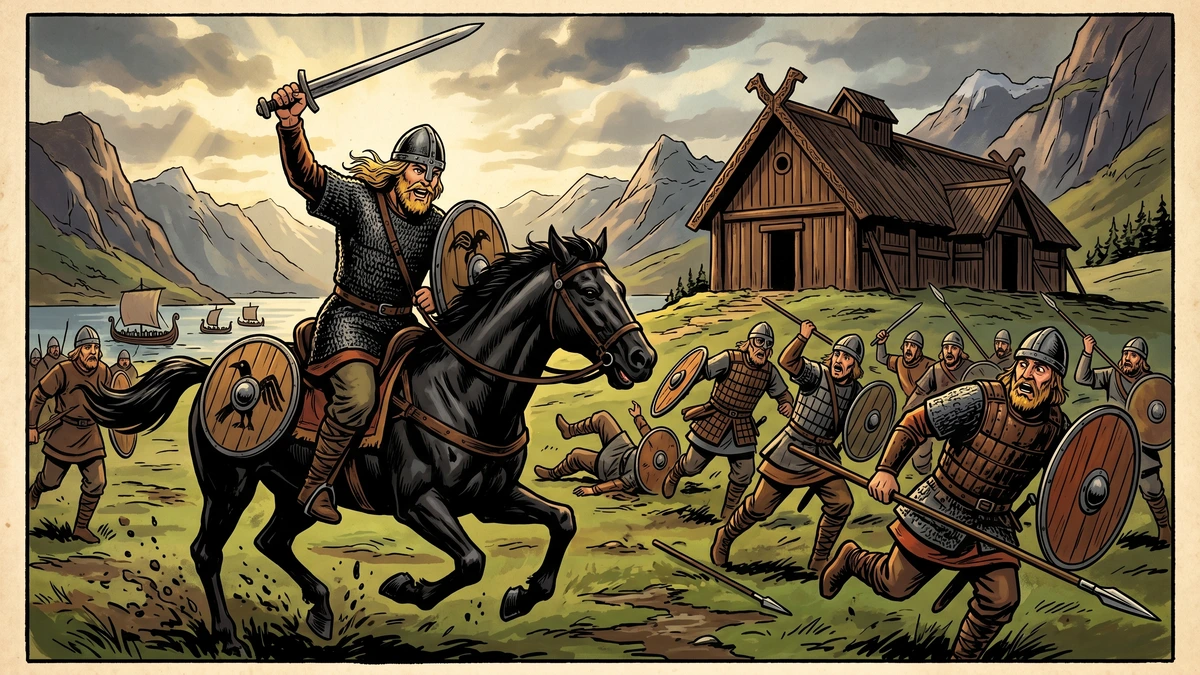
Recognition turns, beautifully, on a small thing — the King’s own pocket-handkerchief, thrown to the wounded stranger to bind his leg, and found there when the fighting is done. The lad is brought to the palace in honour; the Princess cries from her window, “Here comes my own true love”; and with the pot of healing ointment he tends not only his own hurt but every wounded man in the host. He weds the Princess and is given half the kingdom. Yet the tale withholds its deepest note for the end. On the wedding day the black horse stands in its stall with drooping ears, refusing its corn, and asks the new young King to strike off its head. He refuses, horrified — he would sooner give the horse rest and plenty for life. But the horse insists, and the King, weeping, turns away his face as the blow falls. Where the horse stood there now rises a prince: a king of the slain enemy’s own land, whom that king had thrown into a troll’s shape and sold into bondage. The mercy shown in the dark stable is repaid in full — one act of kindness has freed two prisoners, and the two kings part as friends who never afterward make war.
The Troll, the Black Horse, and the Norse Imagination
Two figures give The Widow’s Son its distinctly Norwegian flavour, and both reward a closer look. The first is the Troll. In Norse folklore the troll is far more various than the lumbering brute of modern cartoon: he may be a mountain giant, a shape-shifter, a hoarder of treasure, or — as here — a sly householder who passes for an ordinary man until his cruelty betrays him. The genius of the tale’s opening is its restraint. Asbjørnsen and Moe never announce the master as a monster; they let the lad, and the reader, deduce it from a manger of coals and a horse begging to be fed. The troll’s evil is exposed not by a roar but by a small domestic cruelty, which is somehow more chilling — and which makes the boy’s answering kindness all the more pointed.
The second figure is the black horse, and he belongs to one of the most beloved patterns in world folklore: the grateful, speaking animal helper who is in truth an enchanted human being. The Norse imagination was steeped in transformation — the old Eddic myths are full of gods and giants who change their shapes — and the folktales inherited that fluency. The horse’s request to be beheaded, so distressing on a first reading, is the necessary key to his freedom: the enchantment can be broken only by an act that looks like destruction and is in fact deliverance. That the hero must perform it weeping, against his own wish, is the tale’s way of testing him one last time — will he keep faith with his friend even when faith demands something terrible? He does, and the horse’s long bondage ends in the same instant. It is a motif the Brothers Grimm knew well, and its persistence across cultures speaks to a deep intuition that trust, fully given, can undo even the cruellest spell.
The Moral of the Story
At its heart The Widow’s Son is a story about the long return on small kindness and quiet faithfulness. The widow gives up her only child rather than see him starve; the boy feeds a horse that nothing compelled him to feed; the horse, in turn, spends its own enchanted life to make him a king and to free a fellow captive. Nothing in the tale is wasted, and nothing kind is ever truly lost — it only travels a long way round before it comes home. The Norse storytellers framed this with their plain country wisdom:
“Som du sår, skal du høste.”
— Norwegian proverb: “As you sow, so shall you reap.”
The tale also teaches a subtler lesson about glitter and worth. Twice the hero is told to refuse the bright thing and take the rusty one, and twice the shabby choice proves to be the true and powerful one; the dazzling Troll’s house, by contrast, is a comfortable trap. Greatness, the story suggests, often arrives disguised as something poor — a worn coat of mail, a fir-moss wig, a gardener’s boy asleep on the turf — and is recognised only by those patient and clear-eyed enough to look past the surface.
Why the Tale Has Lasted
For more than a century and a half The Widow’s Son has held its place in the Norwegian canon, and it is easy to see why. It has the satisfying architecture of the very oldest stories — the rule of three and four, the forbidden door, the helpful animal, the flight pursued, the hidden hero unmasked — and yet it never feels mechanical, because each motif is bound to a feeling: the widow’s grief, the boy’s pity, the horse’s weary longing for release. As a tale of type ATU 314, it belongs to a family that stretches across half the world, from Norway to the Himalaya, which is itself a quiet marvel: a poor Norwegian boy and his black horse are cousins to heroes told of in Persian, Arab and Siberian firesides.
It endures, too, because its values are ones every generation has wanted to pass to its children. It honours the love that sacrifices, the kindness offered without hope of reward, the humility that can bear to be laughed at, and the courage that finally steps forward when it is truly needed. And it ends not in conquest but in reconciliation — two kings who were once enemies becoming neighbours and friends. In an age fond of louder, harder stories, the gentle insistence of The Widow’s Son — that a single mercy in a cold stable can outlast trolls, war and enchantment — is exactly what keeps readers, young and old, coming back to the firelit world of Asbjørnsen and Moe.
You May Also Like
 Norse Folk Tales
Ages 9-12
Norse Folk Tales
Ages 9-12
The Three Princesses Of Whiteland
The Three Princesses Of Whiteland: Once on a time there was a fisherman who lived close by a palace, and fished for the _King’s_ table. One day when he was out
 Norse Folk Tales
Ages 3-5
Norse Folk Tales
Ages 3-5
The Three Billy-Goats Gruff
Norwegian *De tre bukkene Bruse* — three goats, one bridge, one greedy troll — ages 3–5 / 6–8. Asbjørnsen & Moe.
 Norse Folk Tales
Ages 9-12
Norse Folk Tales
Ages 9-12
East Of The Sun And West Of The Moon
East Of The Sun And West Of The Moon: Once on a time there was a poor husbandman who had so many children that he hadn’t much of either food or clothing to